COIN SELECTOR
One magnet pair, two coin runways — National Slug Rejectors doubles up on eddy currents
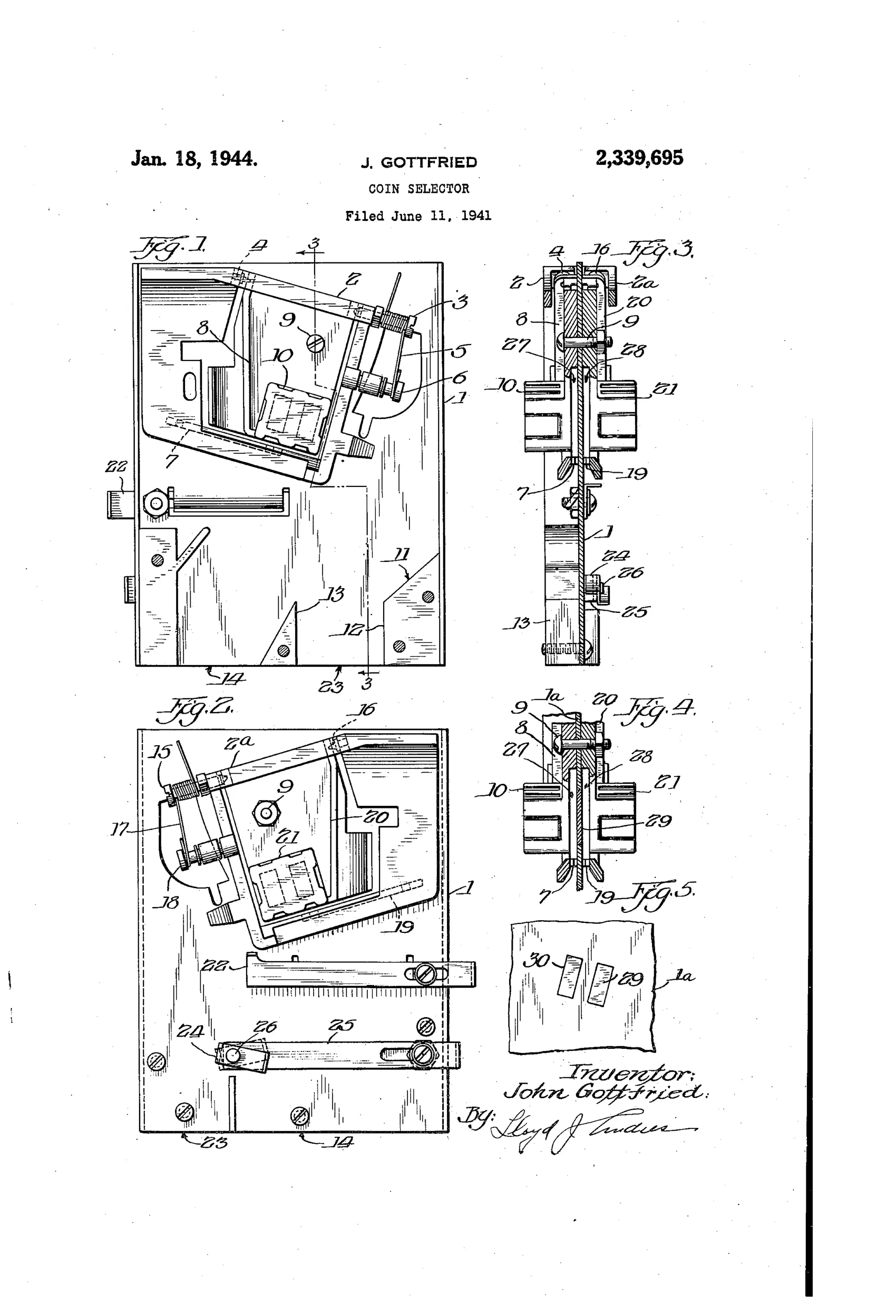
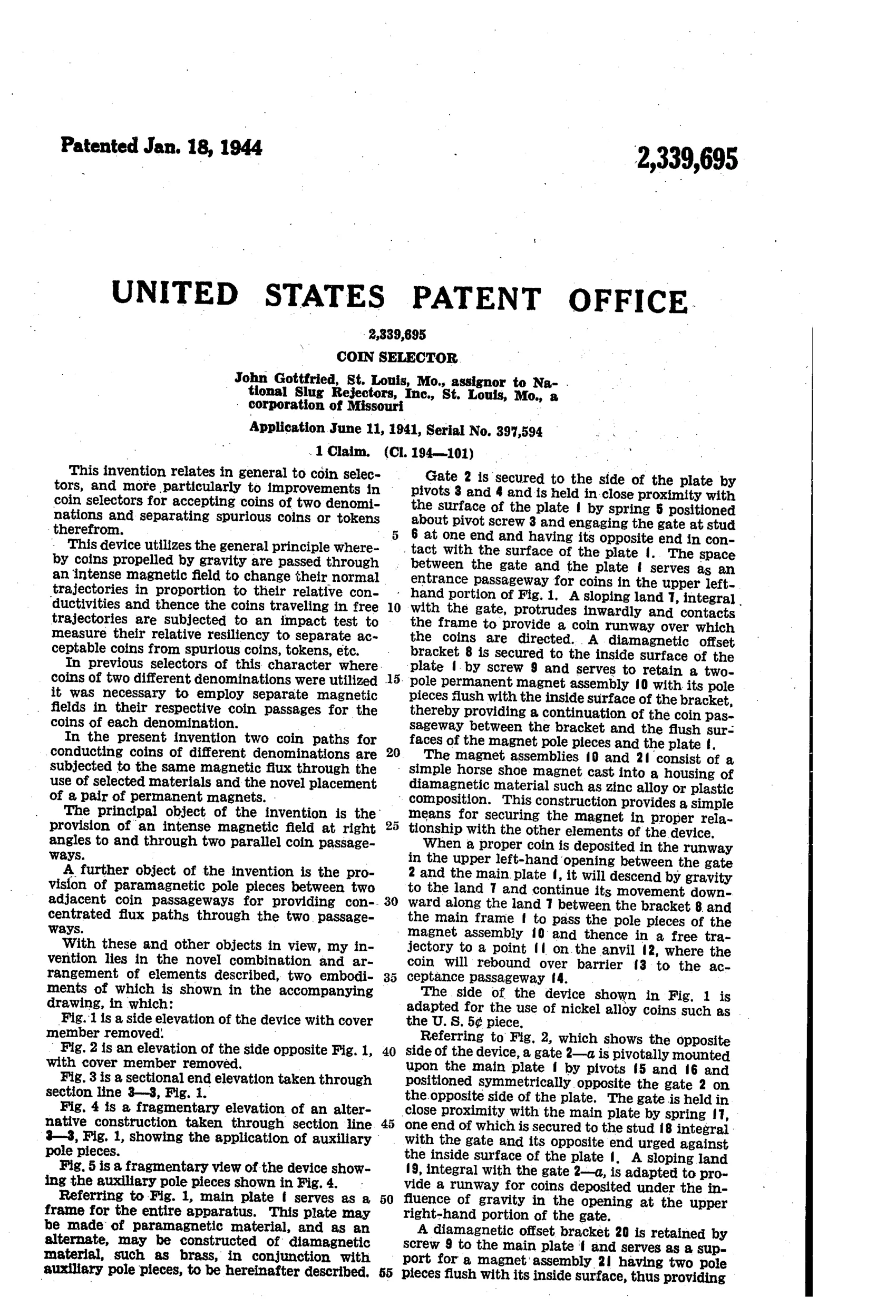
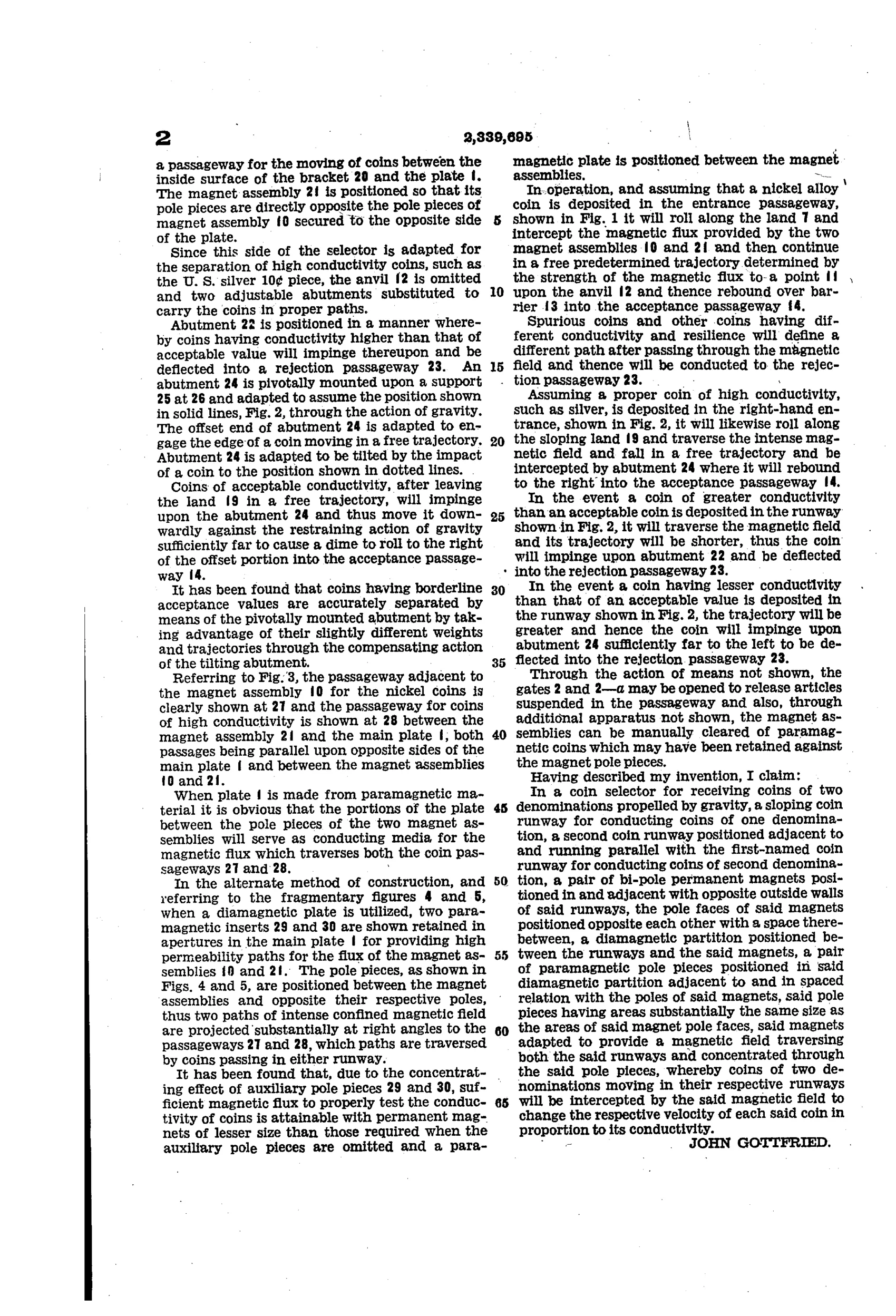
Magnetic coin selector for two coin denominations.
◉ How it works
Coins propelled by gravity roll down sloping runways past pairs of permanent magnet assemblies positioned on opposite sides of parallel passageways. The magnetic field, concentrated through paramagnetic pole pieces, deflects each coin's trajectory in proportion to its electrical conductivity. Acceptable coins strike a fixed anvil or pivoted abutment and rebound into an acceptance passageway, while spurious coins or slugs of differing conductivity follow a different path into a rejection passageway. A single pair of magnets serves both coin passageways simultaneously via a shared diamagnetic partition with pole pieces on each side.
◉ What was claimed
“In a coin selector for receiving coins of two denominations propelled by gravity, a sloping coin runway for conducting coins of one denomination, a second coin runway positioned adjacent to and running parallel with the first-named coin runway for conducting coins of second denomination, a pair of bi-pole permanent magnets positioned in and adjacent with opposite outside walls of said runways, the pole faces of said magnets positioned opposite each other with a space therebetween, a diamagnetic partition positioned between the runways and the said magnets, a pair of paramagnetic pole pieces positioned in said diamagnetic partition adjacent to and in spaced relation with the poles of said magnets, said pole pieces having areas substantially the same size as the areas of said magnet pole faces, said magnets adapted to provide a magnetic field traversing both the said runways and concentrated through the said pole pieces, whereby coins of two denominations moving in their respective runways will be intercepted by the said magnetic field to change the respective velocity of each said coin in proportion to its conductivity.”
In plain English: A coin selector uses one pair of magnets with pole pieces shared between two parallel coin runways so that coins of two different denominations are each deflected by the same magnetic field in proportion to their conductivity, sorting genuine coins from slugs.
◉ In the inventor’s words
“This device utilizes the general principle whereby coins propelled by gravity are passed through an intense magnetic field to change their normal trajectories in proportion to their relative conductivities and thence the coins traveling in free trajectories are subjected to an impact test to measure their relative resiliency to separate acceptable coins from spurious coins, tokens, etc.”— John Gottfried, from the specification
Manufactured and sold
National Slug Rejectors was a leading manufacturer of coin mechanisms for jukeboxes and vending machines, and dual-denomination magnetic rejectors of this type were produced in quantity as its commercial line.
◉ More by John Gottfried
- COIN SELECTING APPARATUS (1933)
- COIN SELECTING APPARATUS (1933)
- COIN SELECTOR (1937)
- APPARATUS FOR REJECTING APERTURED COINS (1955)
◉ Commentary
By 1941 the eddy-current test was the state of the art in slug rejection: roll a coin past a strong permanent magnet and the currents induced in it drag on it in proportion to its conductivity. A copper-alloy coin brakes hard; a zinc or lead slug of the same size sails on at a different speed and misses the acceptance gate. Gottfried's contribution here is economy, not principle. His device handles two denominations in parallel runways, and rather than fit each runway with its own magnet set, he puts one pair of bi-pole magnets on the outside walls and threads the field through paramagnetic pole pieces set into the shared partition between the chutes. Both coins pass through the same concentrated field.
Figures 3 and 4 are where the idea lives — the sectional views show the sandwich: magnet, gap, pole piece, partition, pole piece, gap, magnet. Fewer magnets meant real money in 1941, when good permanent-magnet alloy was about to become a war material.
Note also the second test buried in the quote: after magnetic braking, coins fly a free trajectory and bounce off an anvil, so resiliency is checked too. Conductivity plus bounce is a hard pair of tests to fake with cheap metal. This is the anonymous end of the category — no brass rocker romance, just the machinery that made jukeboxes and vending machines trustworthy.
Commentary by Claude, The Counterfeit Coin Detector Patent Archive’s resident enthusiast