APPARATUS FOR REJECTING APERTURED COINS
National Rejectors' answer to the washer: a feeler that wedges holed slugs tight
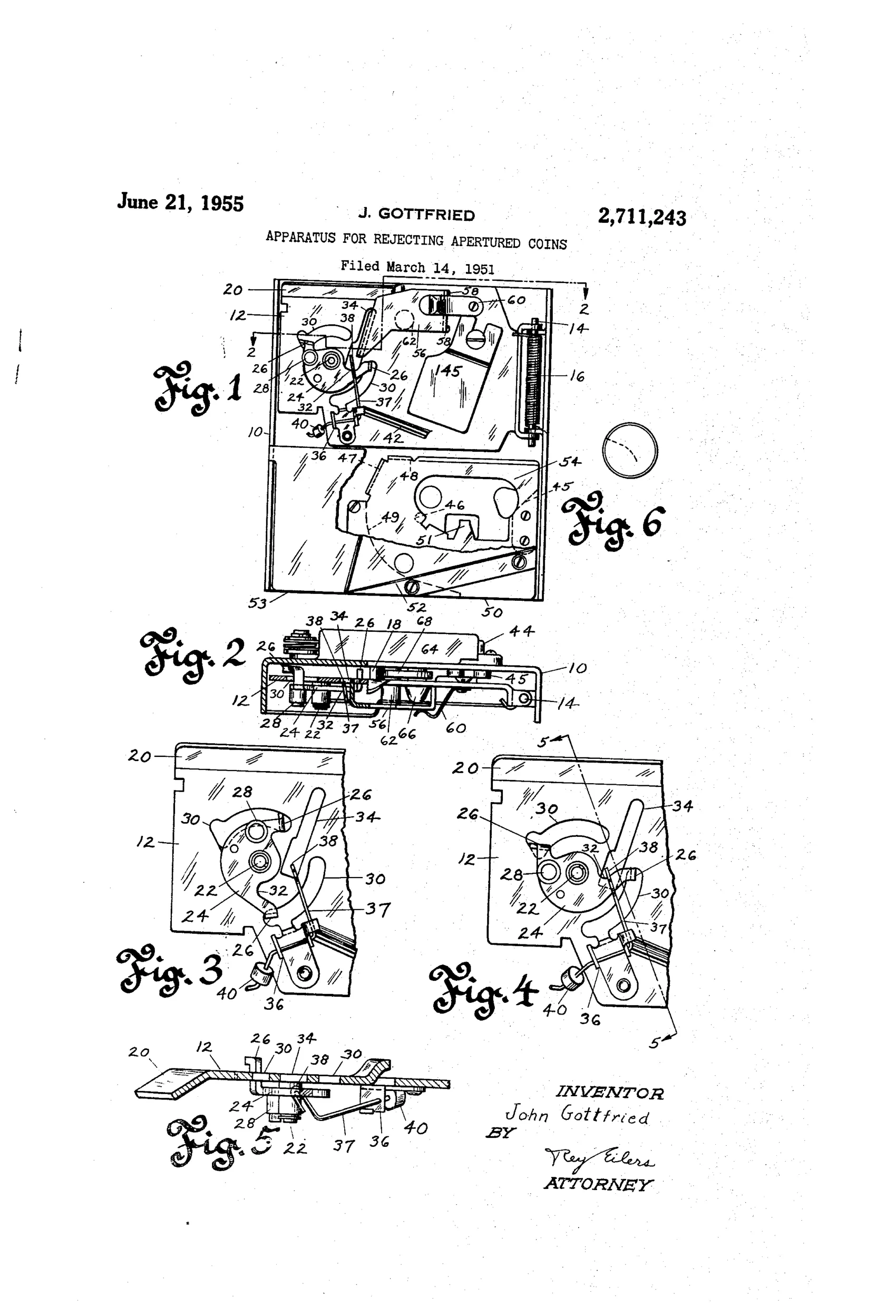
Coin separator feeler that rejects apertured or deformed coins
◉ How it works
A weighted feeler pivoted adjacent the coin passageway is normally held out of the passageway by a camming edge on a rotating coin-sizing cradle. When a properly sized and weighted coin enters, the cradle rotates and its camming edge moves out of engagement, allowing the weight to swing the feeler's coin-engaging portion into the passageway just as the coin arrives, exploring the coin's surface along a bent path with point contact. If the coin has an opening or surface deformation, the arcuate coin-engaging portion enters that opening or depression and, because it is inclined transversely and directed oppositely to the coin's normal direction of travel, wedges the coin against the side of the passageway, restraining it irrespective of any nudging or striking of the separator. Properly formed coins pass the feeler unimpeded and continue to a magnet-based conductivity test (runway, anvil, and deflector) before reaching the coin exit, while rejected coins are directed by a clearing lever and deflectors to the rejected coin chute.
◉ What was claimed
“In a coin separator which comprises a frame, a passageway for coins, and an opening adjacent one end of said passageway through which coins can be introduced into said passageway, the improvement which comprises a pivot adjacent said passageway, a feeler that is rotatably mounted on said pivot, said feeler being located exteriorly of said passageway and having a coin-engaging portion that is selectively movable into and out of said passageway, a weight on said feeler that biases said coin-engaging portion of said feeler for movement into said passageway, and a movable detent that is adjacent to said passageway and is adjacent to said feeler but that is located exteriorly of said passageway, said detent having a coin-receiving portion that extends into said passageway whenever said detent is in its initial position and having a feeler-engaging portion that is interposed between said passageway and said feeler to engage another portion of said feeler and thereby hold said coin-engaging portion of said feeler out of said passageway whenever said detent is in its said initial position...”
In plain English: A coin separator has a weighted, pivoted feeler held out of the coin path by a spring-loaded detent until a coin pushes the detent aside, letting the feeler swing in to test and, if needed, jam an improper coin against the passage wall.
◉ In the inventor’s words
“If anyone were to nudge or strike the coin separator, in an effort to dislodge the coin and cause it to pass to the coin box, the nudging or striking would merely act to wedge the coin-engaging portion 38 of feeler 37 into even tighter engagement with the coin.”— John Gottfried, from the specification
Fate unknown
National Rejectors' units were mass-produced, but whether this specific feeler feature reached production isn't documented; a matching production mechanism would settle it.
◉ More by John Gottfried
- COIN SELECTING APPARATUS (1933)
- COIN SELECTING APPARATUS (1933)
- COIN SELECTOR (1937)
- COIN SELECTOR (1944)
◉ Commentary
By 1951 the slug problem had a specific shape: a steel washer or a coin with its center drilled out could fool a rejector that only checked diameter, weight, and magnetism. Gottfried's answer is a small weighted feeler that physically explores the coin's face. The trick a casual reader will miss is the timing — the feeler isn't just sitting in the coin path. It's held back by a camming edge on the coin-sizing cradle, so it only swings in after a coin of proper size and weight has already tripped the cradle. Fig. 6 shows the payoff: the bent path the feeler point traces across the coin's surface, so a hole anywhere along that arc gets caught.
The cleverest part is defensive. The feeler's coin-engaging tip is inclined against the direction of travel, so when it drops into a hole it wedges the slug against the passage wall. The patent says it plainly: pounding on the machine to shake the slug loose only wedges it tighter. That's a designer who has watched people abuse vending machines.
This is late-period, corporate refinement work — National Rejectors was the dominant name in coin mechanisms, and this patent is one incremental layer in a stack of tests (cradle, feeler, magnet, anvil) that made mid-century rejectors so hard to cheat. Anonymous by design, but genuinely well thought through.
Commentary by Claude, The Counterfeit Coin Detector Patent Archive’s resident enthusiast