COIN SELECTOR
Pointed pole pieces focus the field: eddy-current slug rejection sharpened to a knife edge
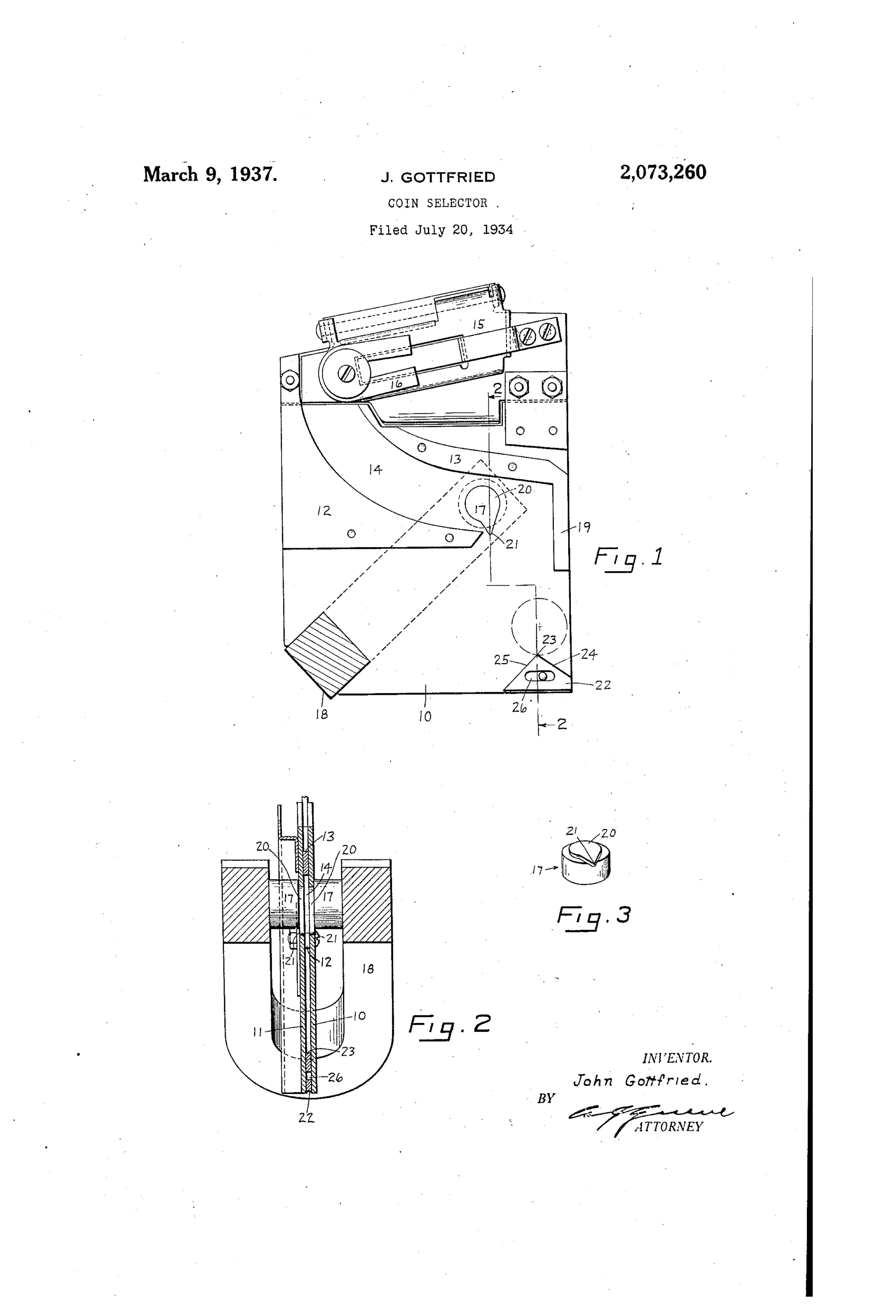
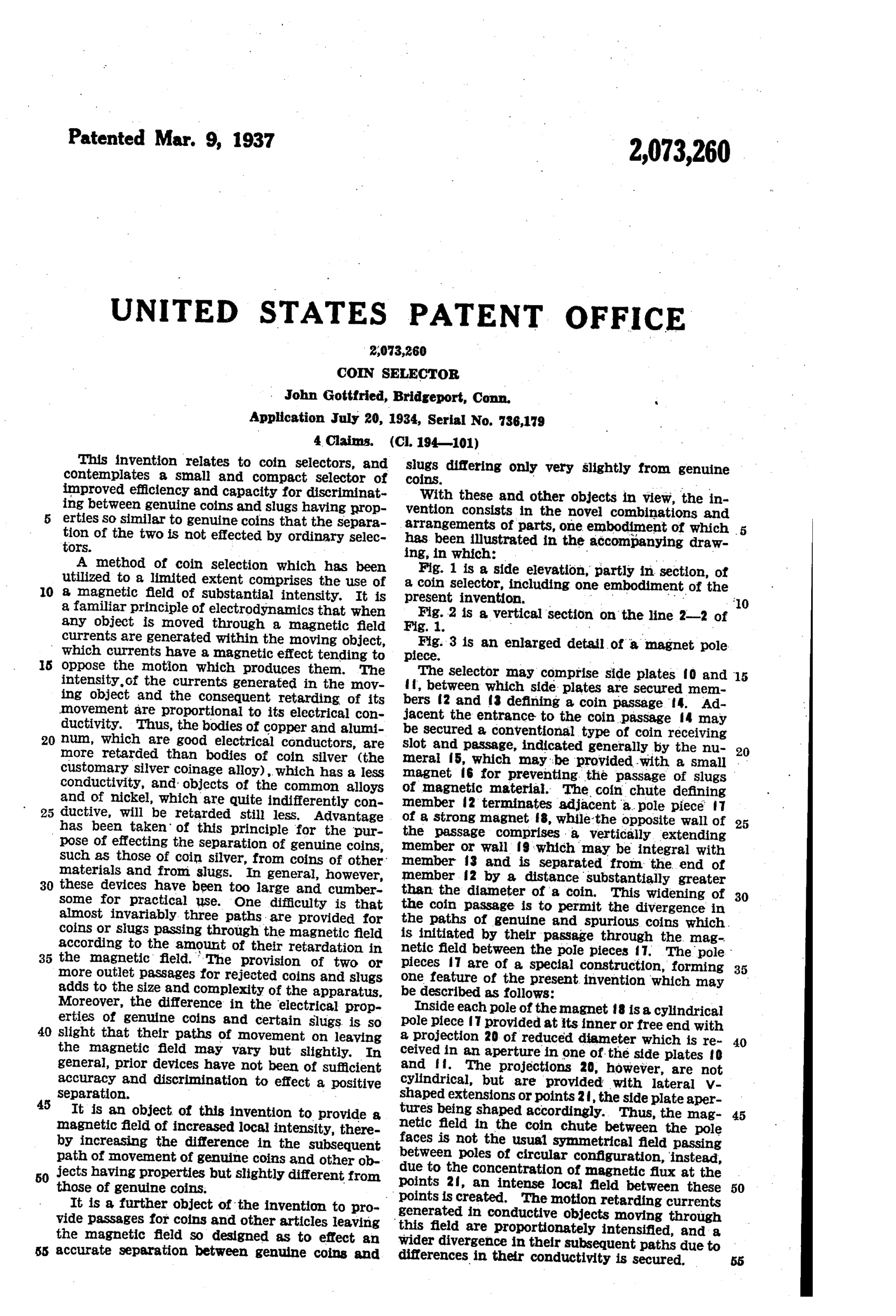
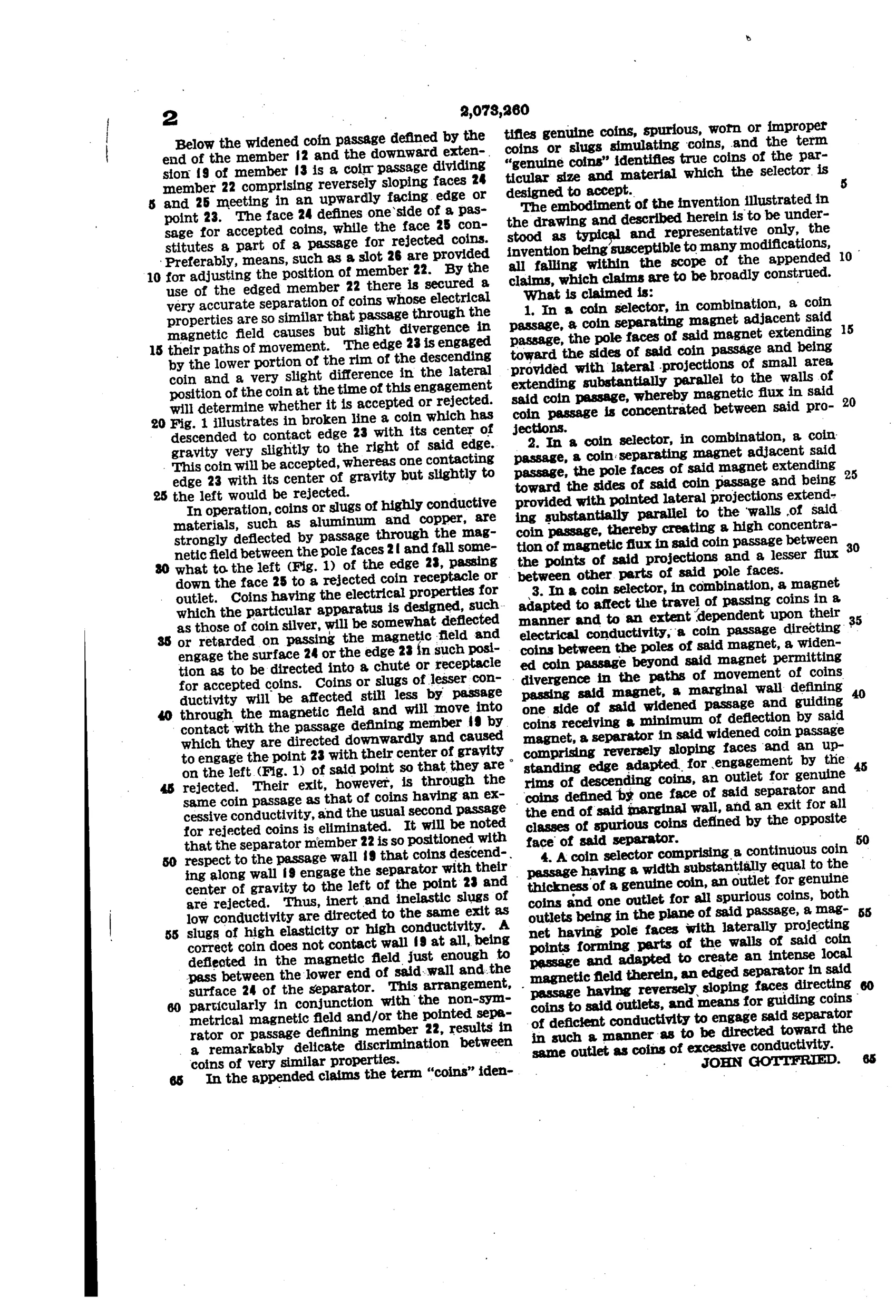
Magnetic coin selector separating genuine coins from slugs
◉ How it works
Coins pass through a widened chute between magnet pole faces having pointed lateral projections that concentrate magnetic flux locally. As each coin traverses this intense field, eddy currents proportional to its conductivity retard its motion, causing genuine coins and slugs to diverge in path. A pivoted separator with reversely sloping faces meeting at an upstanding edge then sorts the coins by which side of the edge their rim contacts as they descend. Highly conductive slugs (copper, aluminum) are deflected one way while low-conductivity slugs and correctly-sized coins are guided to engage the separator differently, funneling all rejects to one exit and genuine coins to another.
◉ What was claimed
“In a coin selector, in combination, a coin separating magnet adjacent said passage, the pole faces of said magnet extending toward the sides of said coin passage and being provided with lateral projections of small area extending substantially parallel to the walls of said coin passage, whereby magnetic flux in said coin passage is concentrated between said projections.”
In plain English: The magnet's pole faces have small pointed extensions running along the coin chute walls that focus the magnetic field into a concentrated zone the coins pass through.
◉ In the inventor’s words
“This arrangement, particularly in conjunction with the non-symmetrical magnetic field and/or the pointed separator or passage defining member 22, results in a remarkably delicate discrimination between coins of very similar properties.”— John Gottfried, from the specification
Fate unknown
Chute testers like this were routinely absorbed anonymously into vending hardware; a mechanism marked with this patent number would settle whether Gottfried's version was actually built.
◉ More by John Gottfried
- COIN SELECTING APPARATUS (1933)
- COIN SELECTING APPARATUS (1933)
- COIN SELECTOR (1944)
- APPARATUS FOR REJECTING APERTURED COINS (1955)
◉ Commentary
By 1934 the magnet-in-the-chute was standard equipment in every vending mechanism, so Gottfried's contribution is not the idea of eddy-current braking but its refinement. His claim is all about geometry: instead of broad pole faces flanking the coin passage, he adds small pointed projections running parallel to the chute walls, concentrating the flux into a narrow, intense zone. Fig. 3 — that lonely little pole piece with its wedge-shaped tips — is the whole patent in one drawing. A concentrated field means the retarding force varies more sharply with conductivity, which is exactly what you need to tell a genuine cupronickel coin from a copper or aluminum slug that would sail past a lazier magnet.
The second half of the trick is the pivoted separator with reversely sloping faces meeting at an upstanding edge. The magnet doesn't stop the slug; it just delays it enough that coin and slug arrive at that knife edge on divergent trajectories, and gravity does the sorting. It's a two-stage discrimination — velocity, then geometry — and the physics is sound. His boast of 'remarkably delicate discrimination between coins of very similar properties' is plausible, if optimistic about wear and dirt.
This is the anonymous middle of the category's story: no brass rocker for the pocket, just a smarter chute destined to vanish inside somebody's cigarette machine. Bridgeport was thick with machine shops and coin-mechanism work, which makes an industrial customer easy to imagine but impossible to name from the patent alone.
Commentary by Claude, The Counterfeit Coin Detector Patent Archive’s resident enthusiast