EJECTOR FOR COIN-DETECTORS FOR MONEY-CONTROLLED MACHINES.
The magnet doesn't just reject steel slugs — it sweeps its own house clean
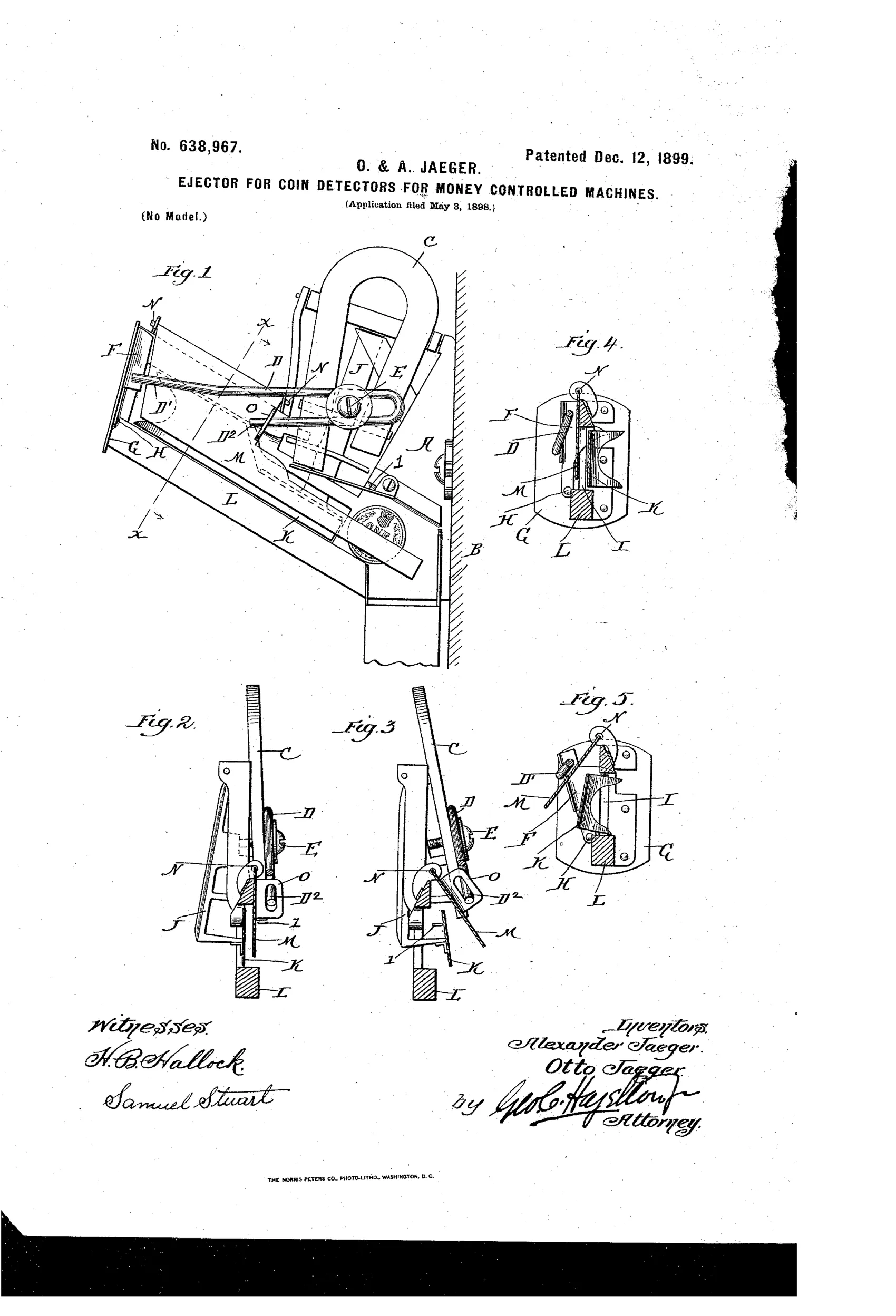
Coin-detector ejector mechanism for vending machines
◉ How it works
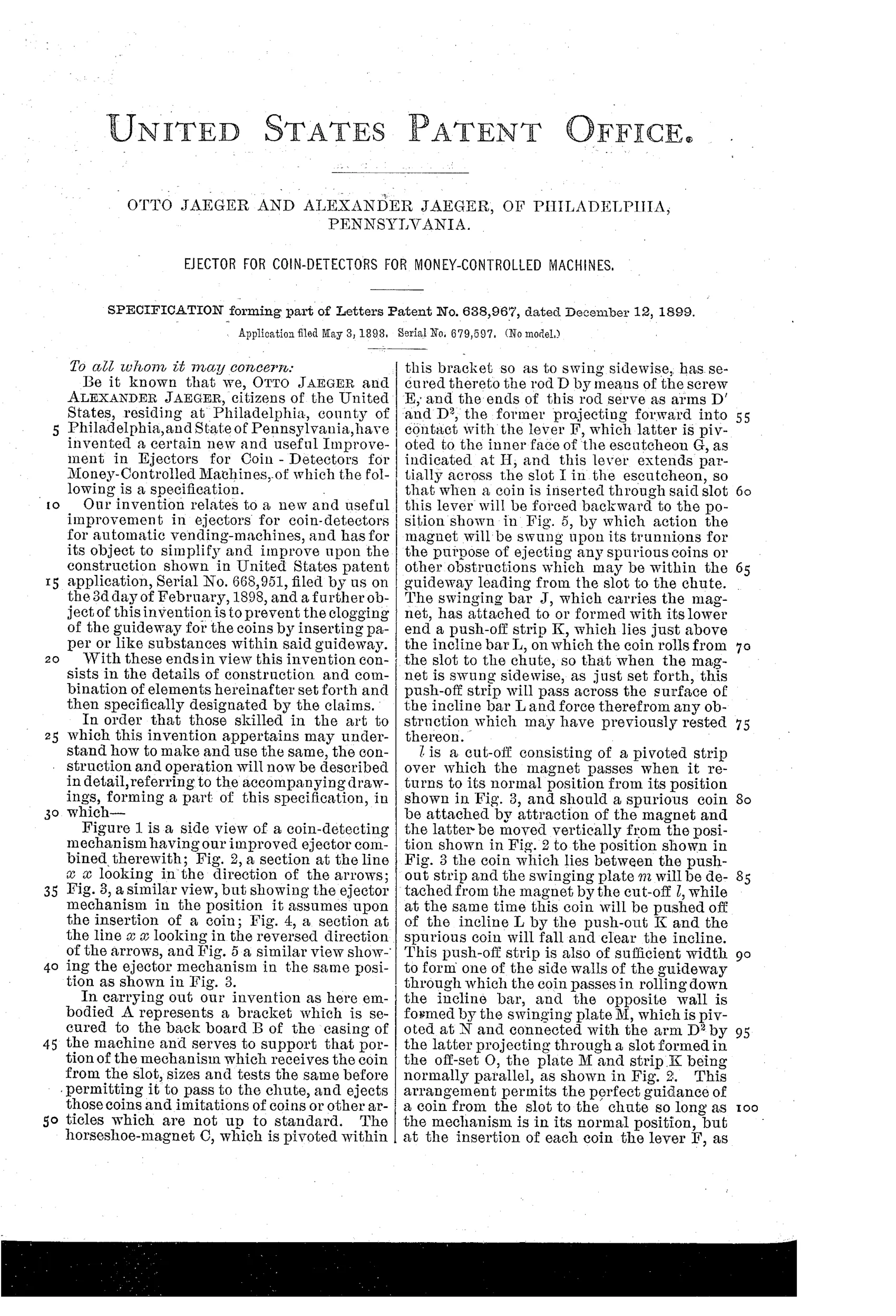
A horseshoe magnet is pivoted within a bracket secured to the machine's back board so it can swing sidewise. A bent rod attached to the magnet has two unequal arms; one presses against a lever that projects into the coin slot, so inserting a coin forces the lever backward and swings the magnet sidewise. The magnet carries a push-off strip that, as the magnet swings, sweeps across an incline bar to eject any spurious coin or obstruction resting there. A pivoted cut-off strip detaches any coin that becomes magnetically attracted during the return swing, ensuring it clears the incline rather than jamming the guideway.
◉ What was claimed
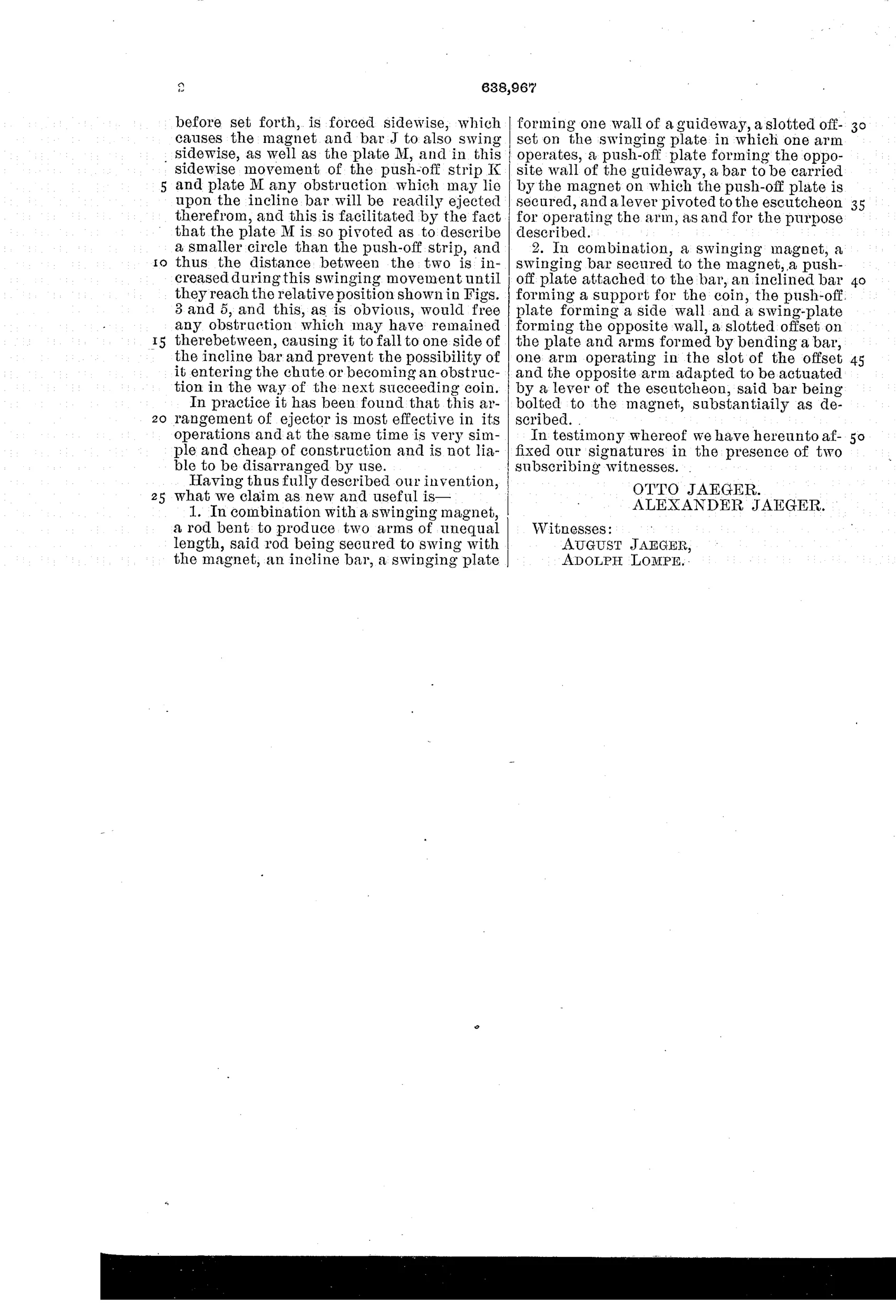
“In combination with a swinging magnet, a rod bent to produce two arms of unequal length, said rod being secured to swing with the magnet, an incline bar, a swinging plate forming one wall of a guideway, a slotted offset on the swinging plate in which one arm operates, a push-off plate forming the opposite wall of the guideway, a bar to be carried by the magnet on which the push-off plate is secured, and a lever pivoted to the escutcheon for operating the arm, as and for the purpose described.”
In plain English: The device combines a swinging magnet with a bent rod having two unequal arms, an inclined guide bar, a swinging plate and push-off plate forming the two walls of the coin guideway, and a lever on the coin slot that operates one arm to swing the magnet and clear obstructions.
◉ In the inventor’s words
“a further object of this invention is to prevent the clogging of the guideway for the coins by inserting paper or like substances within said guideway.”— Otto Jaeger and Alexander Jaeger, from the specification
Fate unknown
Like most chute-tester patents this would have been buried inside a machine; a surviving mechanism or licensing record naming the Jaegers would settle it.
◉ Patented the same day
- COIN-GUARD OR CONTROLLING DEVICE FOR COIN-OPERATED MACHINES. — Robert Fred. Tochtermann
◉ Commentary
By 1898 the pivoted horseshoe magnet was already the standard weapon against steel slugs in coin-operated machines. The Jaeger brothers of Philadelphia aren't claiming that; they're solving the problem the magnet created. A magnet that catches a slug now holds a slug — and a held slug, or a wad of paper stuffed down the slot by a mischief-maker, jams the guideway and puts the machine out of service until someone comes with a key.
Their answer is to make every legitimate coin do janitorial work. The lever projecting into the slot means inserting a coin forces the whole magnet assembly to swing sidewise, and the push-off strip carried on the magnet sweeps across the incline bar, shoving off whatever was parked there. The nicest detail is the pivoted cut-off strip that peels away any slug still clinging magnetically during the return swing, so it falls clear instead of riding back into the coin path. Figures 2 through 5 show the two positions from both directions — worth a look to see how little travel the sweep actually needs.
The explicit worry about 'inserting paper or like substances' tells you this came from real service experience, not the drafting table. It's a refinement patent in a crowded field, but a thoughtful one: self-clearing chutes became a genuine requirement as unattended machines multiplied. Whether this particular linkage was the one that stuck is another matter — these mechanisms vanished anonymously into vending cabinetry.
Commentary by Claude, The Counterfeit Coin Detector Patent Archive’s resident enthusiast