APPARATUS FOR SEPARATING GENUINE FROM SPURIOUS COINS
A coin held to a hot pin: testing nickels by thermoelectric voltage
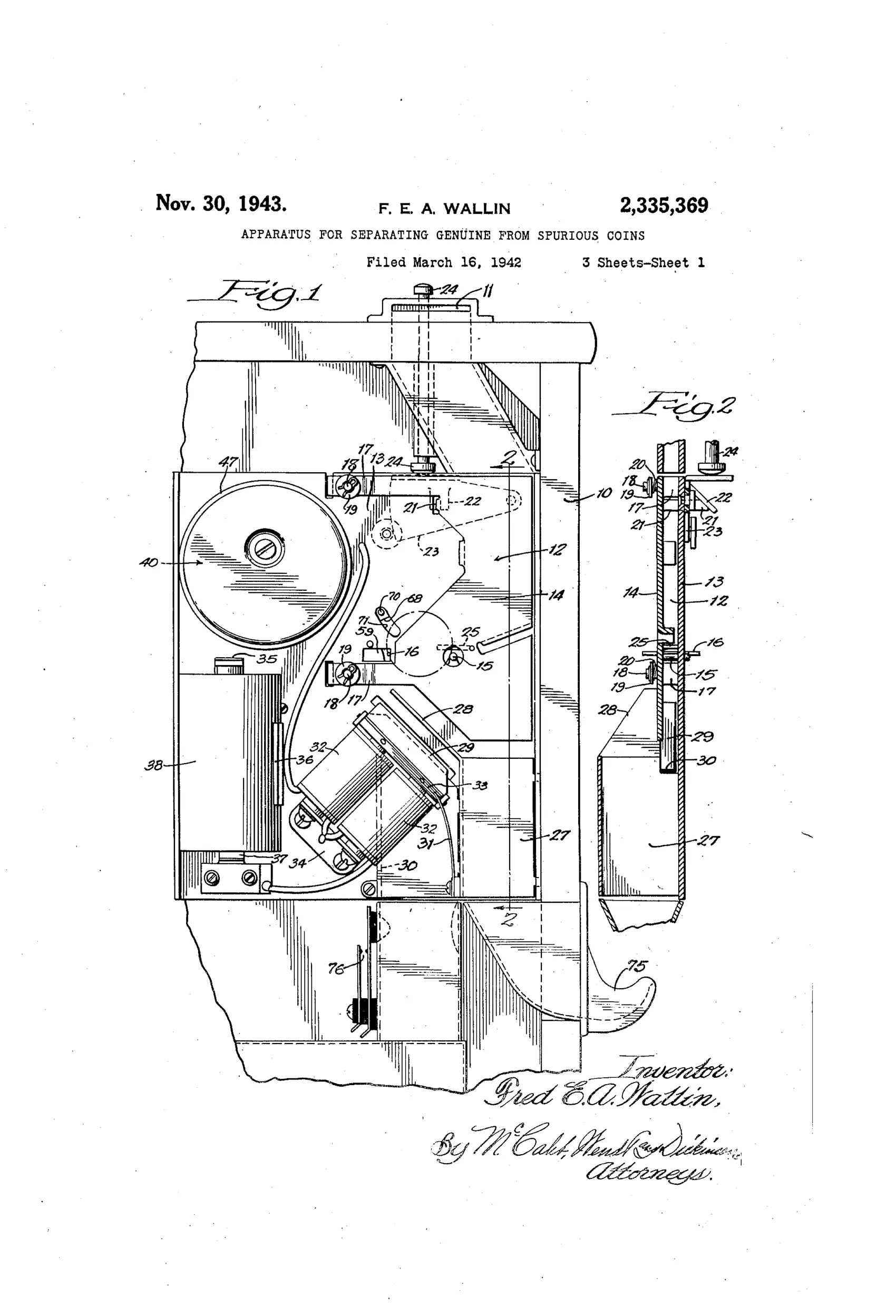
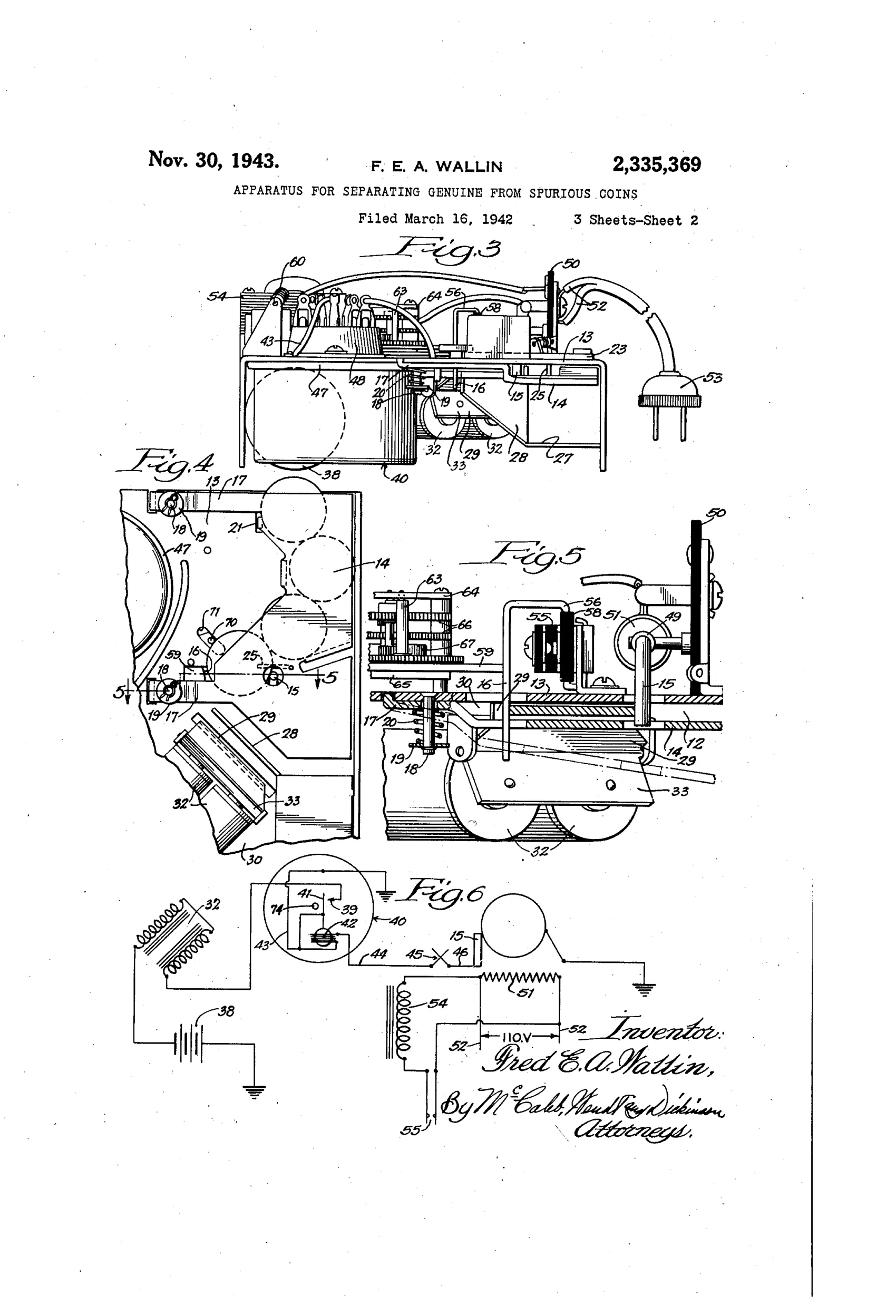
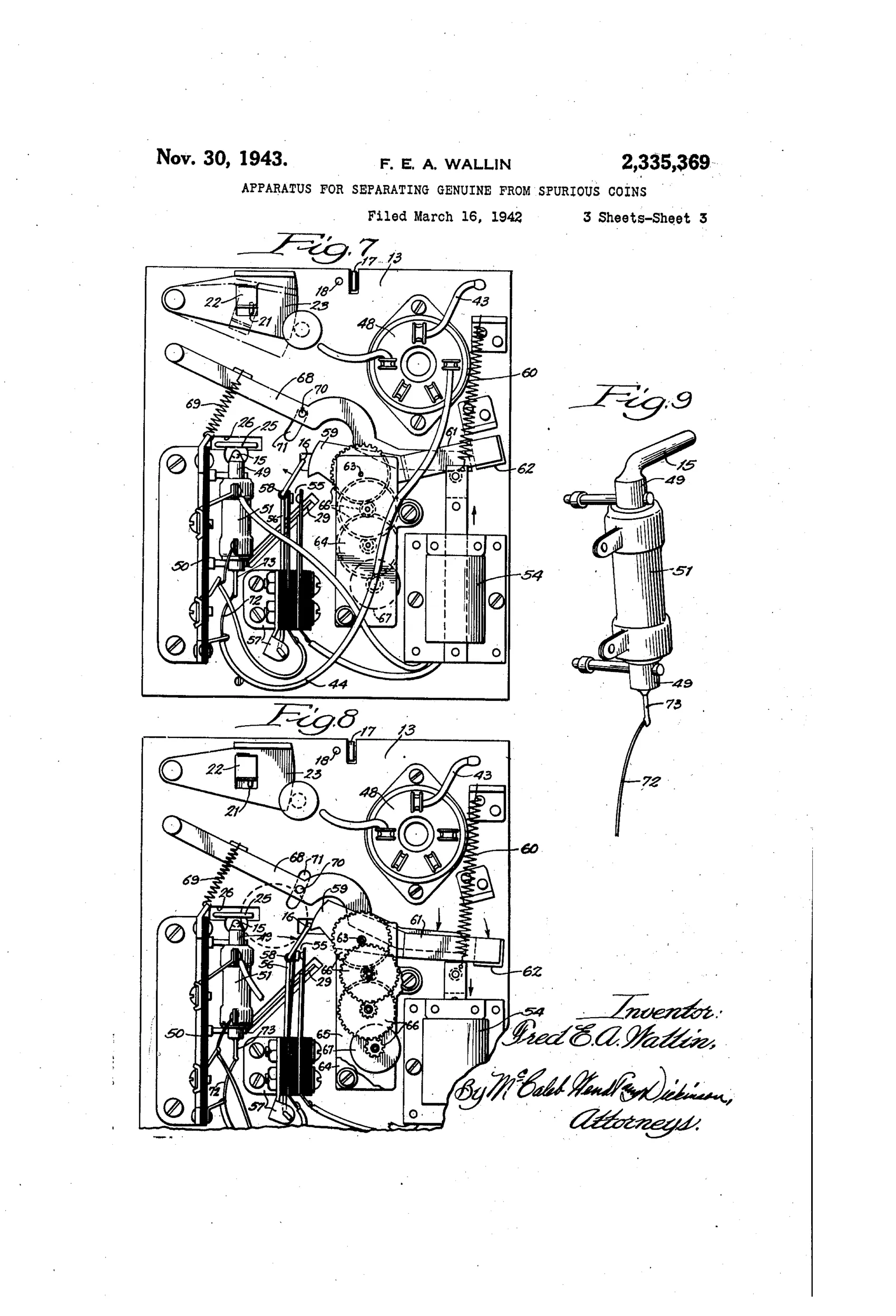
Thermoelectric coin-testing gate for vending machines
◉ How it works
A heated silver contact pin engages an inserted coin, forming a thermocouple whose voltage is compared against a reference thermocouple through a sensitive relay. A solenoid-driven pin presses the coin firmly against the heated contact for a timed interval set by a clockwork flywheel delay. If the coin's thermoelectric voltage exceeds and opposes the reference voltage (as genuine nickel does), the relay energizes a magnet that opens a gate, letting the coin drop into the accepted-coin chute. If the voltage is insufficient or reversed, as with slugs or foreign coins, the gate stays closed and the coin is diverted to the reject/return chute.
◉ What was claimed
“1. In an apparatus for separating genuine from spurious coins, comprising a heated contact arranged to engage a coin and constitute therewith a thermocouple and means controlled by said thermocouple for determining the disposition of the coin, in combination, means for holding a coin in a testing position in engagement with said heated contact, automatic means for actuating said holding means to effect release of the coin from said position, and time delay means associated with and exclusively controlling the operation of said automatic means whereby the coin is maintained in testing position for a definite interval of time.”
In plain English: The machine holds a coin against a heated contact to test it as part of a thermocouple, and a timer keeps it there for a set period before releasing it, so its authenticity can be determined by the resulting voltage.
◉ In the inventor’s words
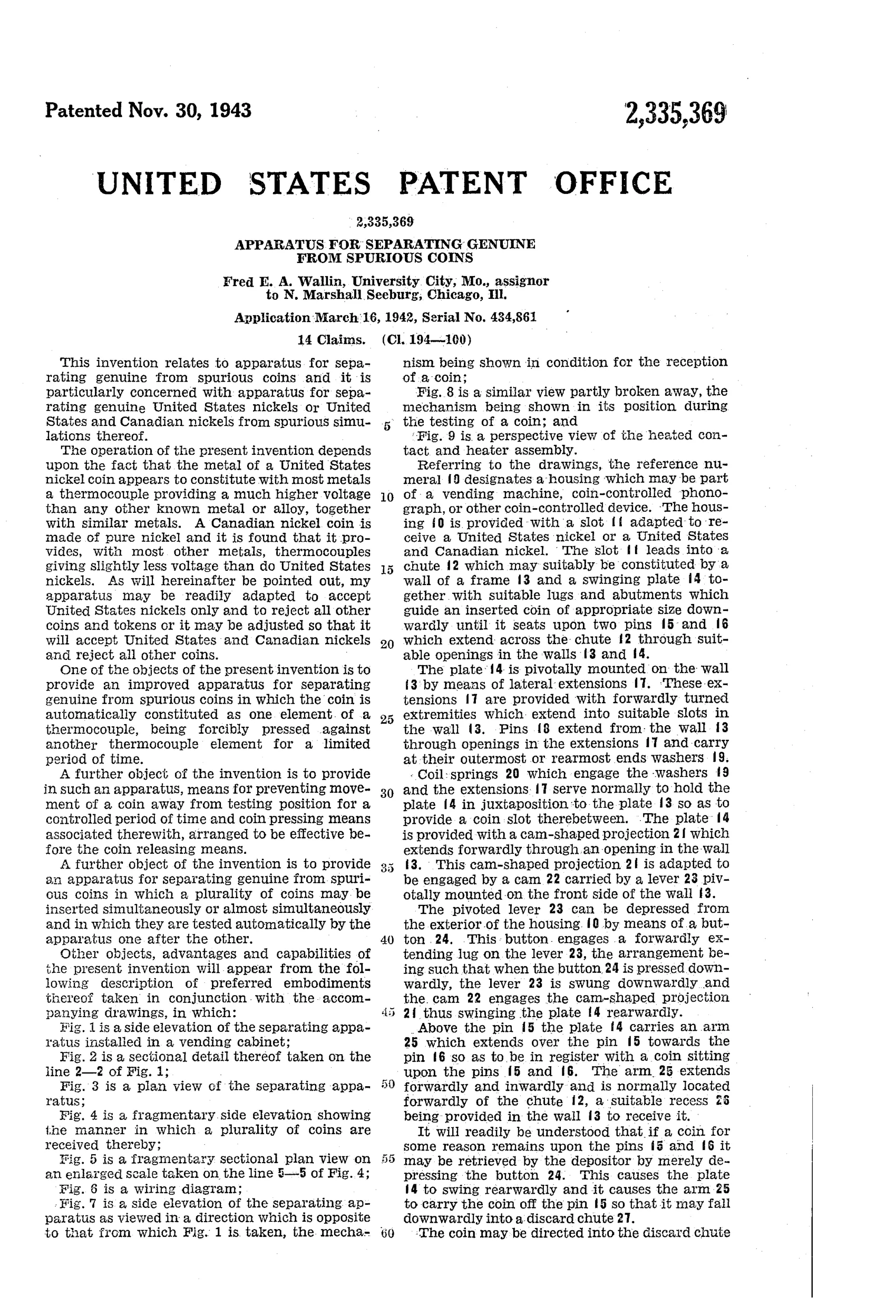
“The operation of the present invention depends upon the fact that the metal of a United States nickel coin appears to constitute with most metals a thermocouple providing a much higher voltage than any other known metal or alloy, together with similar metals.”— Fred E. A. Wallin, from the specification
Fate unknown
Seeburg had the manufacturing capacity, but no thermocouple-based acceptor is documented in their production line; a surviving mechanism or service manual referencing the heated contact would settle it.
◉ More by Fred E. A. Wallin
- APPARATUS FOR SEPARATING GENUINE AND SPURIOUS COINS (1938)
- APPARATUS FOR SEPARATING GENUINE FROM SPURIOUS COINS (1943)
- APPARATUS FOR SEPARATING GENUINE FROM SPURIOUS COINS (1943)
◉ Commentary
By 1942 the slug-rejector art had tried nearly everything — magnets, rocking gauges, weight gates, eddy-current bounce tests. Wallin's entry, assigned to Seeburg of jukebox fame, reaches for something genuinely different: the coin itself becomes half of a thermocouple. A heated silver pin presses against the inserted nickel, and the tiny voltage generated at that hot junction is weighed against a reference thermocouple through a sensitive relay. The physics is sound and rather elegant — the copper-nickel alloy of a U.S. five-cent piece sits far from silver on the thermoelectric scale, so a genuine nickel produces a distinctive signal that cheap zinc or steel slugs cannot fake. It is essentially testing the coin's metallurgy, not its shape or weight.
The mechanical fuss in the drawing tells you where the trouble lies. Thermocouple voltages are millivolts at best, and they need a firm, clean contact held for a real interval to stabilize — hence the solenoid-driven clamping pin and the clockwork flywheel delay that holds the coin in place for a timed dwell. That dwell is the patent's actual claim, and also its commercial weakness: a vending machine that pauses to cook each coin is slower than a chute that judges by bounce and magnetism in a fraction of a second.
It is a wartime refinement chasing counterfeit-proof certainty, and a scientific dead end for exactly the reason it is clever — the test is too slow and too delicate for the trade it served.
Commentary by Claude, The Counterfeit Coin Detector Patent Archive’s resident enthusiast