APPARATUS FOR SEPARATING GENUINE FROM SPURIOUS COINS
Seeburg patent tests nickels by turning coin and contact into a thermocouple
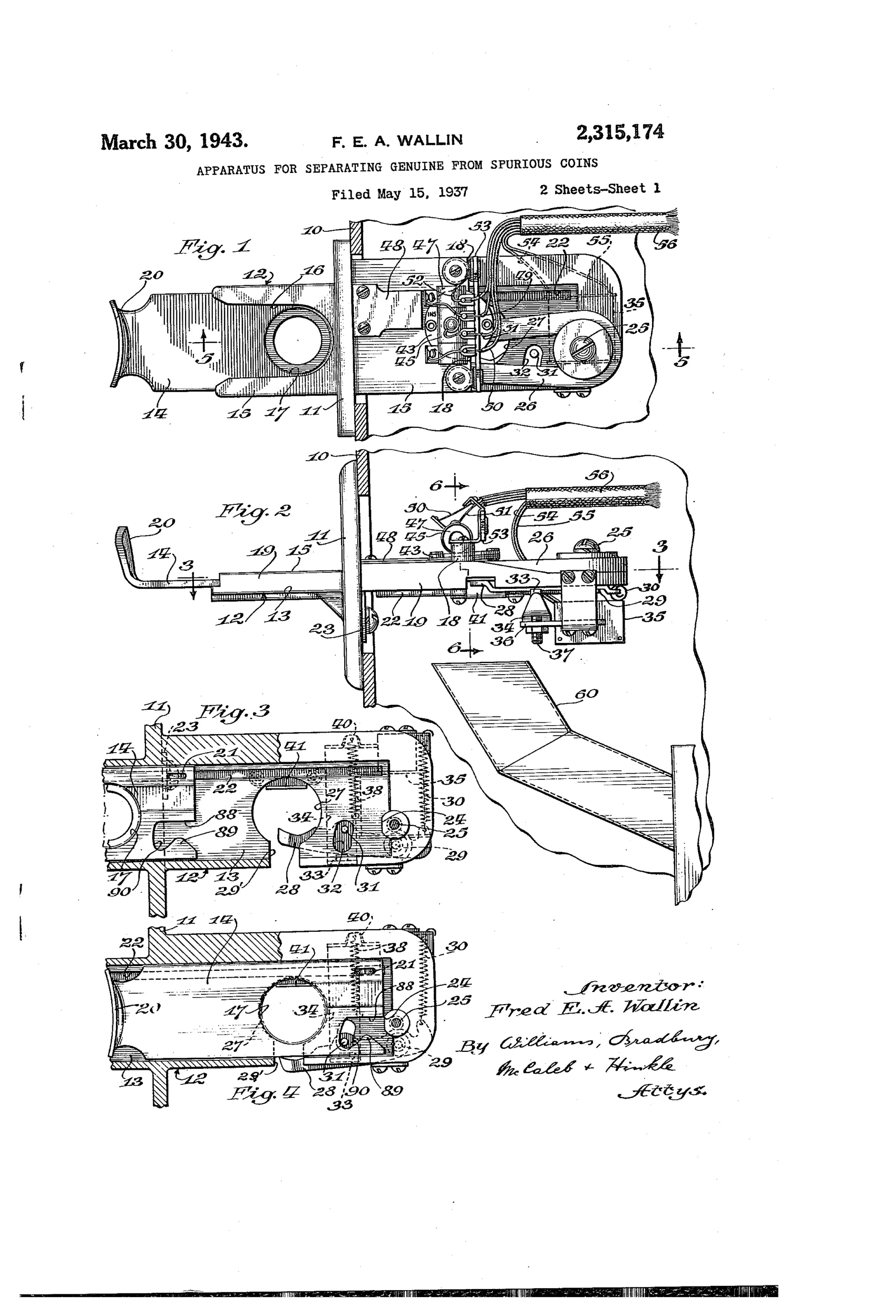
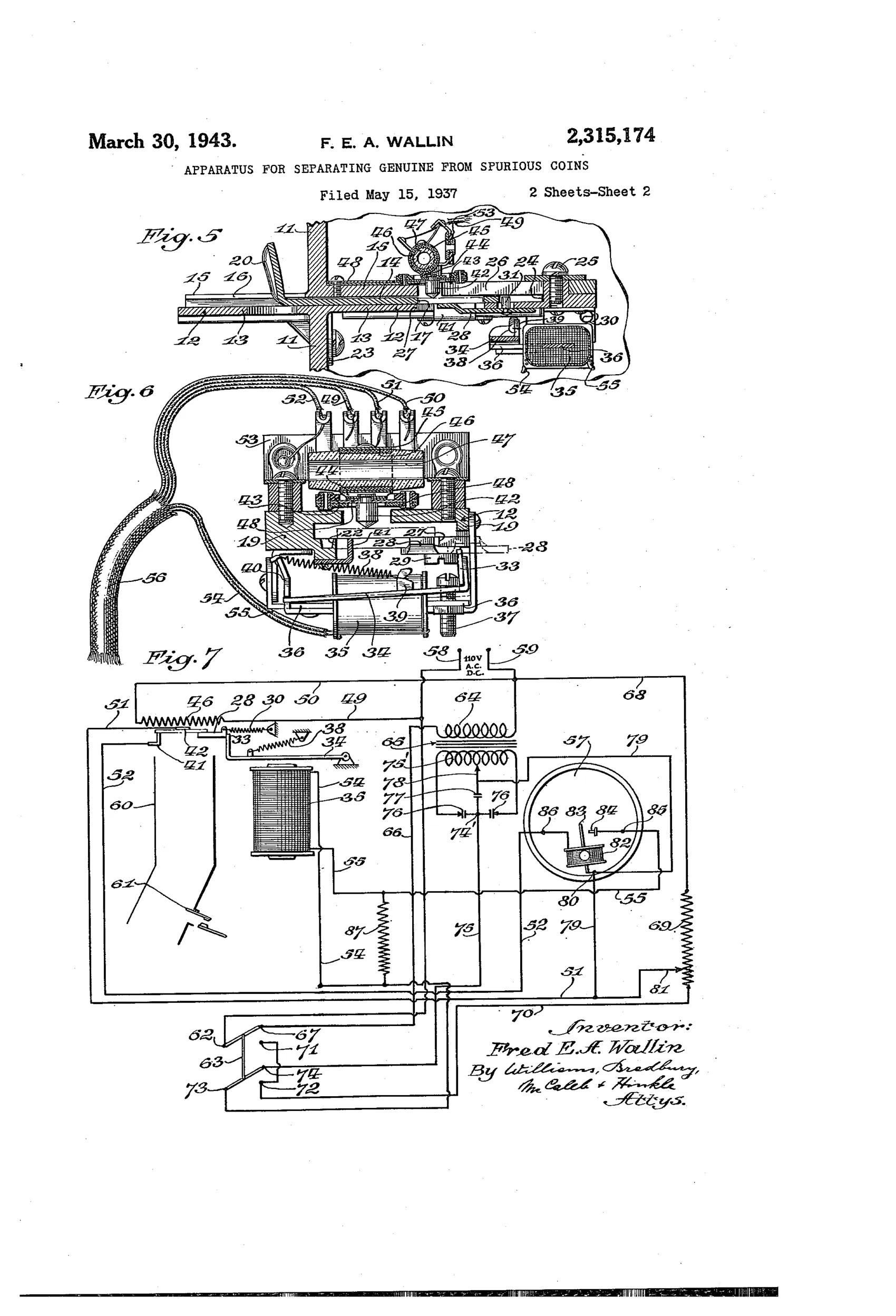
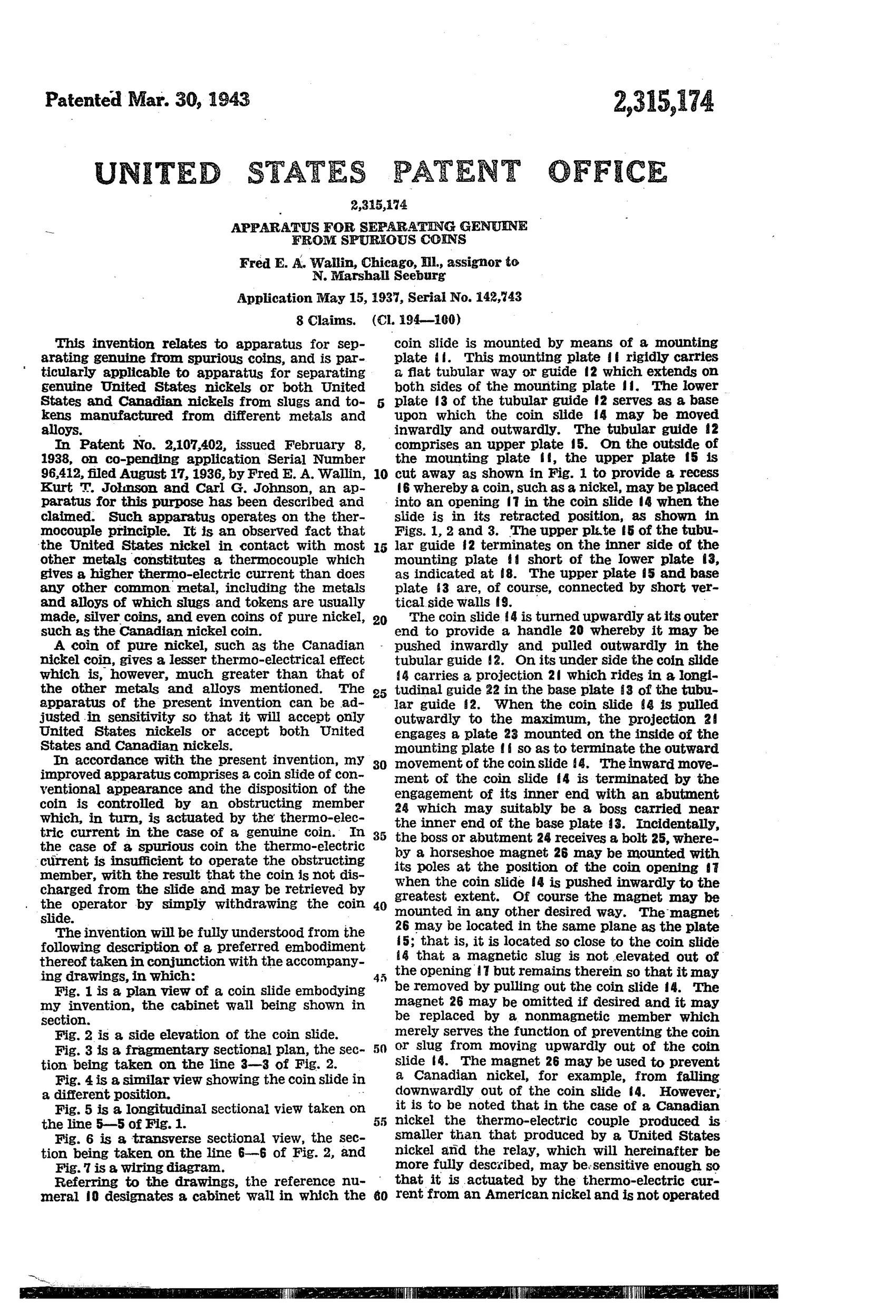
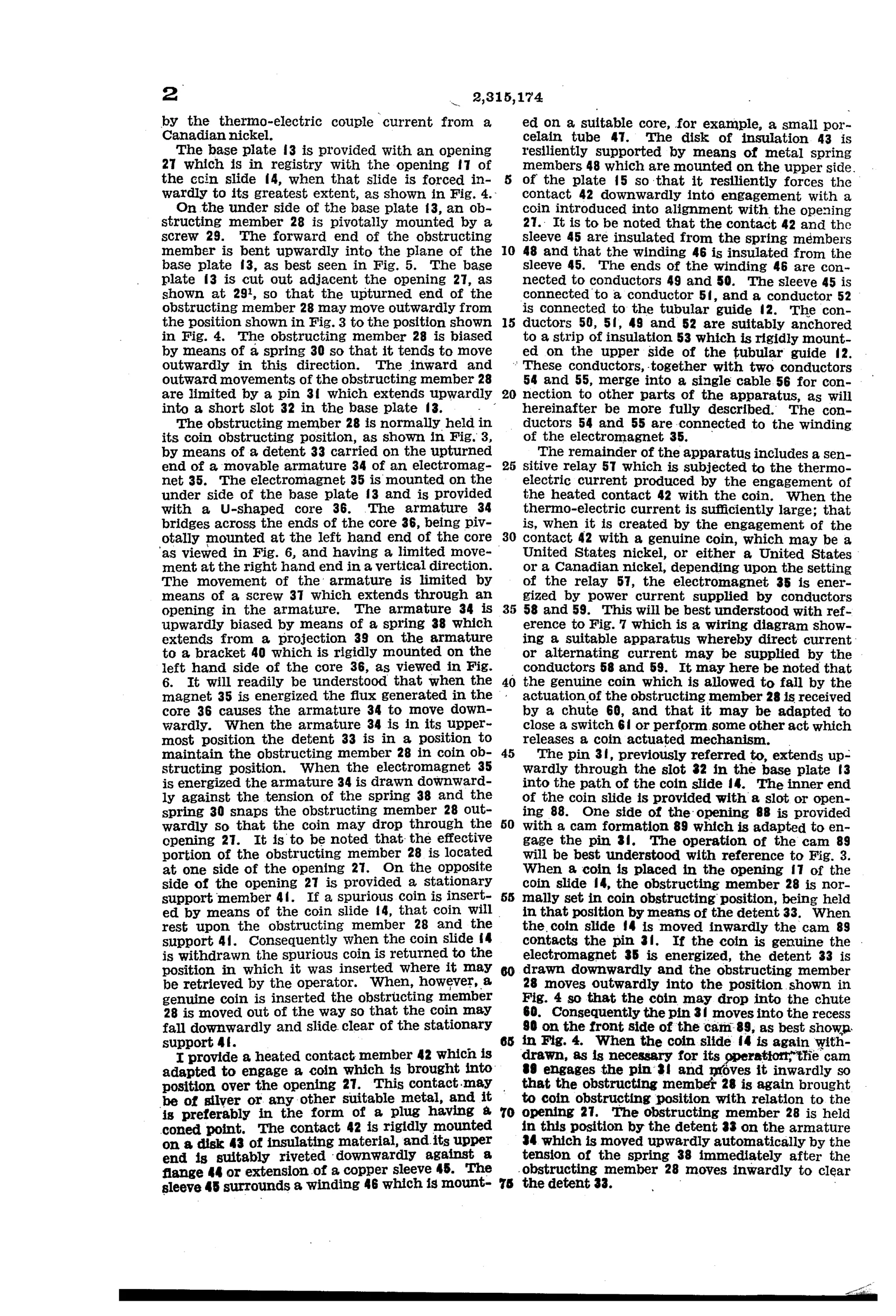
Thermoelectric coin slug rejector mechanism
◉ How it works
A coin slide carries a coin into engagement with a heated metal contact of a dissimilar metal, forming a thermocouple junction. The thermo-electric current generated depends on the coin's metal composition, with genuine nickels producing substantially more current than slugs or tokens of other alloys. This current operates a sensitive relay whose contacts, when closed, energize an electromagnet that pulls down an armature and detent, releasing a spring-biased obstructing member so the genuine coin drops through the discharge opening into a chute. If the current is insufficient (spurious coin), the obstructing member remains in place and the coin is retained on the slide for retrieval by withdrawing the slide. The device includes a potentiometer and rectifier circuit allowing adjustment of sensitivity and operation from either AC or DC power lines, plus a horseshoe magnet near the coin opening to prevent magnetic slugs from falling out of the slide prematurely.
◉ What was claimed
“1. Apparatus for separating genuine from spurious coins comprising a cabinet, a coin slide having a coin receiving pocket whereby a coin may be slid from a coin receiving position outside the cabinet to a coin discharging position inside the cabinet, an obstructing member normally located below the pocket in coin discharging position to prevent discharge of a coin from the slide, a contact of a metal dissimilar to that of the genuine coin adapted to engage the coin in said pocket in its coin discharge position, means for heating the contact, means completing a circuit through said contact and coin, and means controlled by the current in said circuit for controlling the movement of the obstructing member to coin releasing position, said slide being adapted to return the coin to the exterior of the cabinet when the obstructing member is not moved to coin releasing position.”
In plain English: A coin slide brings a coin against a heated dissimilar-metal contact to generate a thermoelectric current; if that current is strong enough (indicating a genuine coin), it triggers release of a blocking member so the coin drops through, otherwise the slide simply returns the rejected coin to the outside.
◉ In the inventor’s words
“It is an observed fact that the United States nickel in contact with most other metals constitutes a thermocouple which gives a higher thermo-electric current than does any other common metal, including the metals and alloys of which slugs and tokens are usually made, silver coins, and even coins of pure nickel, such as the Canadian nickel coin.”— Fred E. A. Wallin, from the specification
Fate unknown
Seeburg jukeboxes certainly used slug rejectors, but no thermocouple-type unit is documented in production; a surviving Seeburg coin mechanism with a heater circuit would settle it.
◉ More by Fred E. A. Wallin
- APPARATUS FOR SEPARATING GENUINE AND SPURIOUS COINS (1938)
- APPARATUS FOR SEPARATING GENUINE FROM SPURIOUS COINS (1943)
- APPARATUS FOR SEPARATING GENUINE FROM SPURIOUS COINS (1943)
◉ Commentary
Most slug rejectors of the 1930s tested a coin's size, weight, or magnetic response — properties a determined slug-maker could copy. Wallin's idea is stranger and, in principle, sharper: press the coin against a heated contact of dissimilar metal and read the thermoelectric voltage generated at the junction. His observation is the heart of the patent — the U.S. copper-nickel alloy makes an unusually hot thermocouple against most other metals, beating slugs, tokens, silver, and even the pure-nickel Canadian coin. That last point matters commercially: this is a test that discriminates by alloy chemistry, not by anything a machinist can file to shape.
The drawings show the whole system built around a familiar coin slide: the coin rides in a pocket to a discharge position, sits over a spring-loaded obstructing member, and only drops when the microvolt-level thermocurrent trips a sensitive relay and electromagnet detent. The wiring diagram (Fig. 7) reveals the practical burden — heater, potentiometer, rectifier, relay — a lot of powered apparatus where a rocking gauge cost pennies. Note also the horseshoe magnet by the coin opening, a belt-and-suspenders touch to hold steel slugs in the slide.
The assignment to N. Marshall Seeburg places this in the jukebox world, where the nickel was the whole business model and slug losses were real money. It's a genuinely original detection principle in a category dominated by mechanical gates — likely too fussy for wide adoption, but honest engineering.
Commentary by Claude, The Counterfeit Coin Detector Patent Archive’s resident enthusiast