APPARATUS FOR SEPARATING GENUINE AND SPURIOUS COINS
Seeburg tests nickels by turning the coin itself into a thermocouple
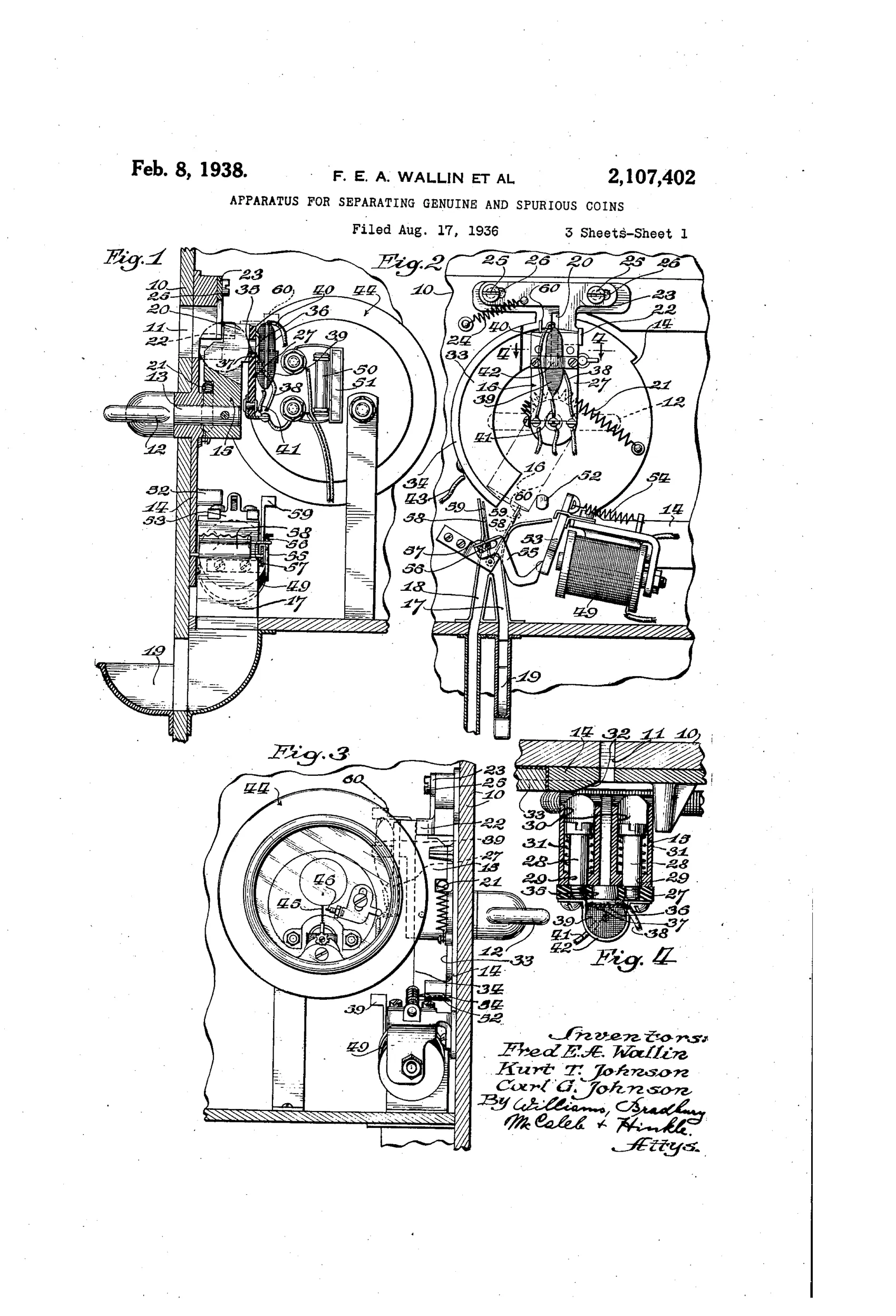
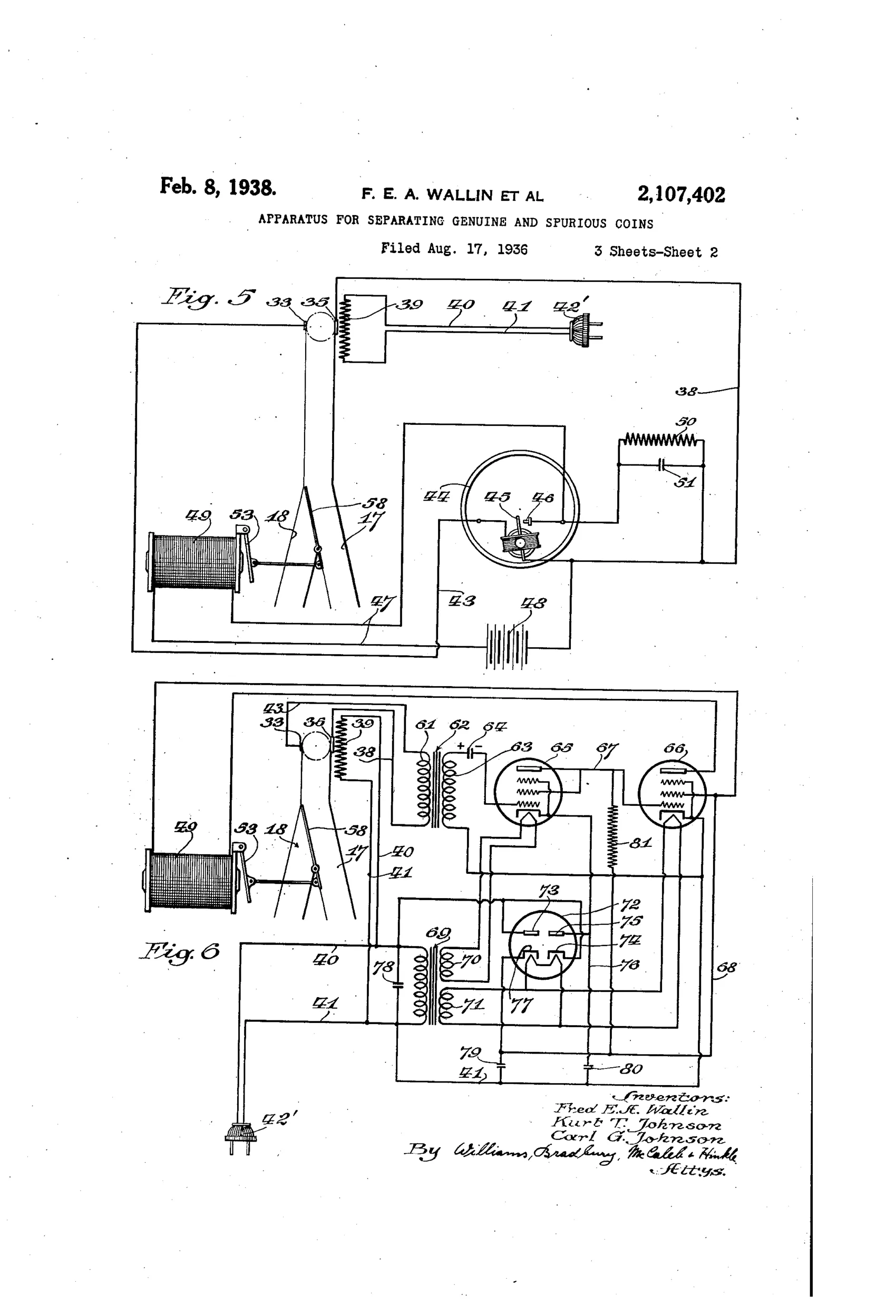
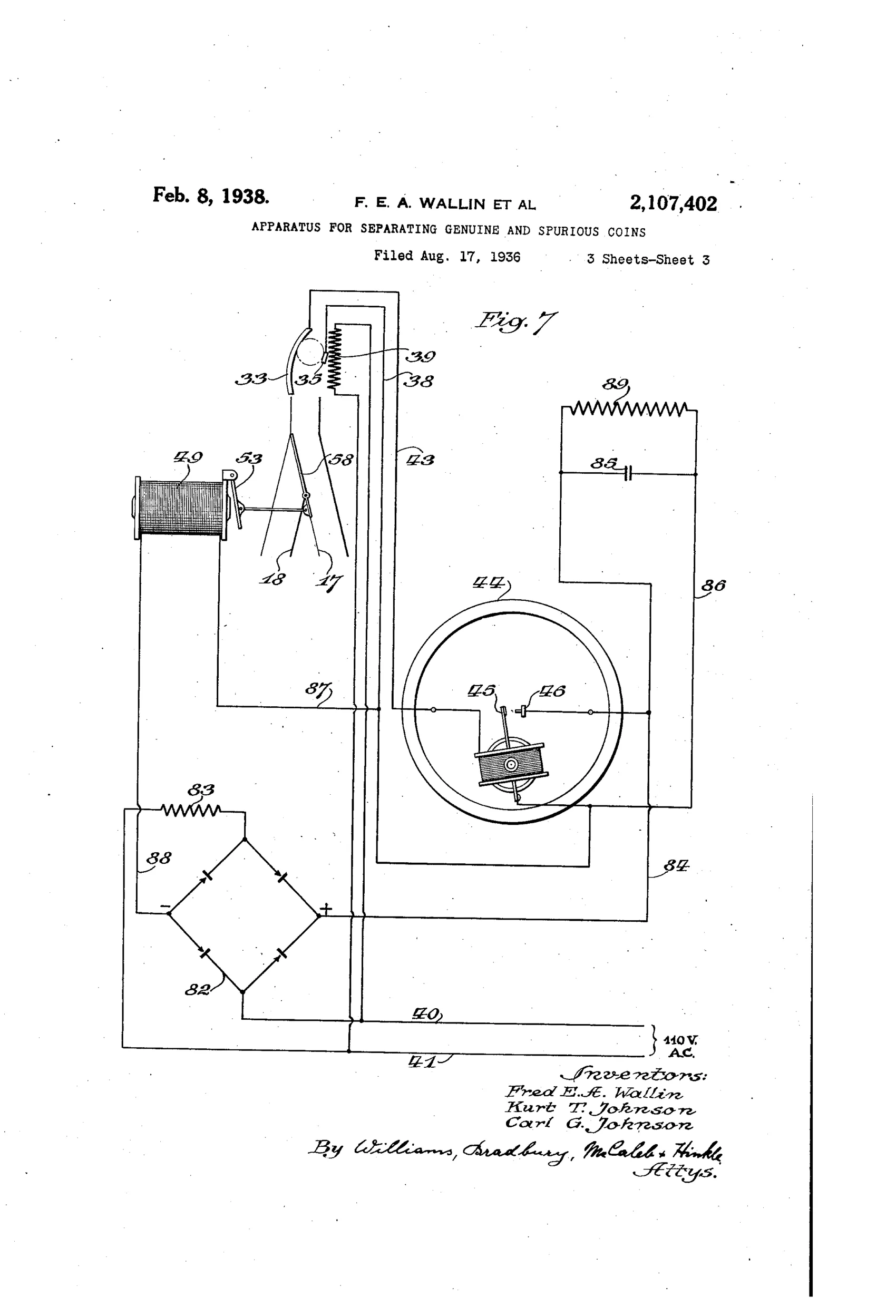
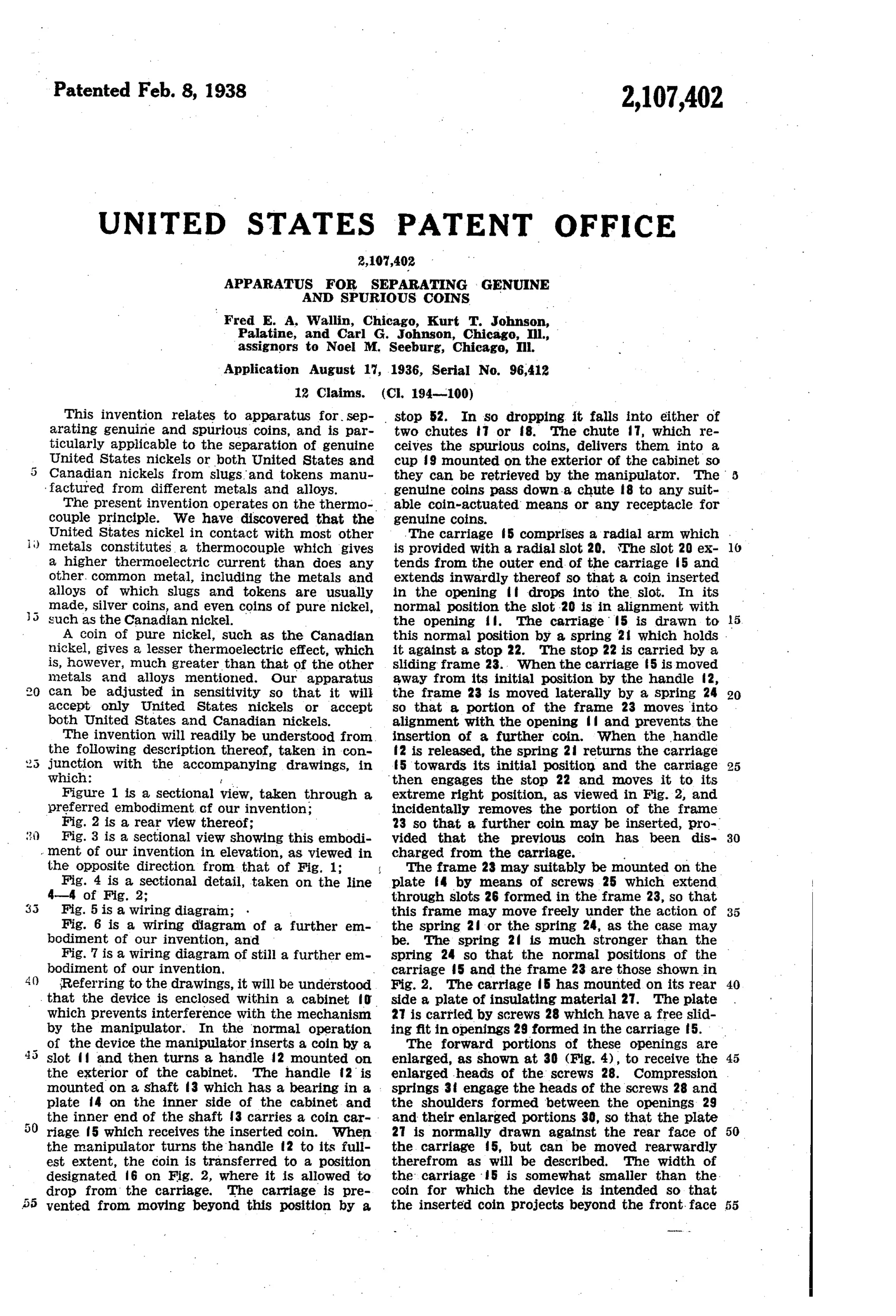
Thermoelectric coin-testing apparatus for slot machines
◉ How it works
A coin dropped into a rotating carriage is pressed against a heated silver stud, forming a thermocouple whose current strength varies with the coin's metal composition. This tiny current is fed to a sensitive relay (or, in alternate embodiments, a vacuum-tube amplifier) whose contacts close only when the current exceeds a threshold characteristic of genuine nickel. When the relay or amplifier closes, an electromagnet is energized and pulls an armature that swings a gate, diverting the coin into the genuine-coin chute; otherwise the coin falls by default into the spurious-coin chute and cup. The device can be tuned, by adjusting the relay contact spacing, to accept only U.S. nickels or both U.S. and Canadian nickels while rejecting slugs, tokens, and other alloys.
◉ What was claimed
“1. Apparatus for separating genuine and spurious coins comprising a cabinet, a carriage in the interior of the cabinet for receiving an inserted coin, a handle on the exterior of the cabinet for moving said carriage into coin discharge position, a contact on said carriage adapted to be engaged by said coin, means for heating said contact, means for receiving a coin discharged from said carriage, means completing a circuit through a coin in the carriage and said contact, a gate controlling the disposition of the discharged coin, two separate means for receiving discharged coins and electromagnetic means controlled by said circuit for actuating said gate.”
In plain English: A cabinet holds a hand-turned carriage that presses an inserted coin against a heated contact, completing a circuit whose current controls an electromagnet-driven gate that sorts the coin into one of two separate chutes depending on whether it is genuine or spurious.
◉ In the inventor’s words
“We have discovered that the United States nickel in contact with most other metals constitutes a thermocouple which gives a higher thermoelectric current than does any other common metal, including the metals and alloys of which slugs and tokens are usually made, silver coins, and even coins of pure nickel, such as the Canadian nickel.”— Fred E. A. Wallin, from the specification
Fate unknown
Seeburg certainly built coin mechanisms, but no documented production unit using this thermoelectric test is known to me; a surviving marked mechanism or Seeburg service literature would settle it.
◉ More by Fred E. A. Wallin
- APPARATUS FOR SEPARATING GENUINE FROM SPURIOUS COINS (1943)
- APPARATUS FOR SEPARATING GENUINE FROM SPURIOUS COINS (1943)
- APPARATUS FOR SEPARATING GENUINE FROM SPURIOUS COINS (1943)
◉ Commentary
Most 1930s slug rejectors interrogate a coin's size, weight, or magnetism. Wallin and the Johnsons went after something deeper: the coin's actual alloy. Press a coin against a heated silver stud and the junction becomes a thermocouple; the tiny voltage it generates depends on what the coin is made of. Their key discovery — quoted proudly in the patent — is that the U.S. copper-nickel five-cent piece produces a higher thermoelectric current against most metals than nearly any other common coinage alloy, including pure-nickel Canadian coins. That gives a single electrical number that a slug simply cannot fake by being the right diameter and weight.
The engineering around that number is where the drawing rewards attention. A hand-cranked carriage presses the coin against the heated contact; a sensitive relay (or, in the alternate circuits of Figs. 6 and 7, a vacuum-tube amplifier) decides whether the microvolt-level current clears a threshold, and an electromagnet swings a gate to the genuine chute. The default path, sensibly, is rejection — fail-safe by gravity. Adjustable relay contacts even let the operator choose whether to admit Canadian nickels.
The assignment to Noel M. Seeburg puts this squarely in the Chicago coin-op establishment, where slug fraud against jukeboxes was a real payroll problem. Whether a heated-stud thermocouple could survive dirty coins, cold rooms, and drift in the field is the honest question; the industry ultimately settled on simpler magnetic and gauging rejectors. A fascinating road not much taken.
Commentary by Claude, The Counterfeit Coin Detector Patent Archive’s resident enthusiast