APPARATUS FOR SEPARATING GENUINE FROM SPURIOUS COINS
Seeburg's jukebox nickel test: the coin itself becomes half a thermocouple
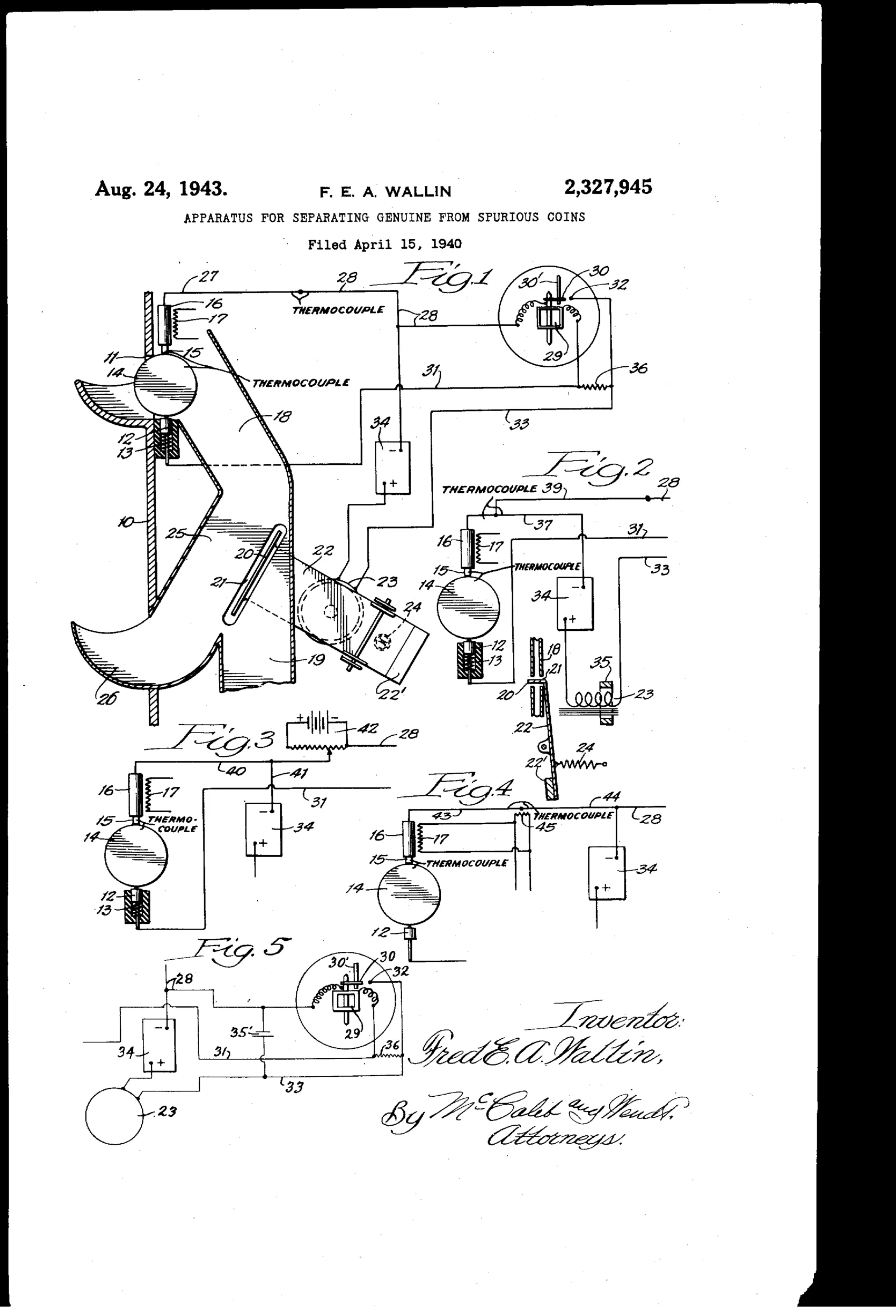
Thermocouple-based electric coin authenticator device
◉ How it works
A coin passing through a slot is pressed by a spring-loaded contact into engagement with a heated contact, forming a thermocouple whose voltage depends on the coin's metal composition. This thermoelectric voltage energizes a sensitive relay coil which, when sufficiently strong, closes contacts to energize an electromagnet that withdraws a gate from the coin chute, allowing the coin to pass to the accepted-coin path. An opposed voltage supplied by a battery or potentiometer through a dissimilar-metal conductor cancels out the voltage from most other metals, so only coins with the target thermoelectric signature (such as US nickels) produce enough net current to trip the relay. Spurious coins or slugs fail to overcome the opposed voltage, the gate remains extended, and the coin is diverted into a return chute and cup.
◉ What was claimed
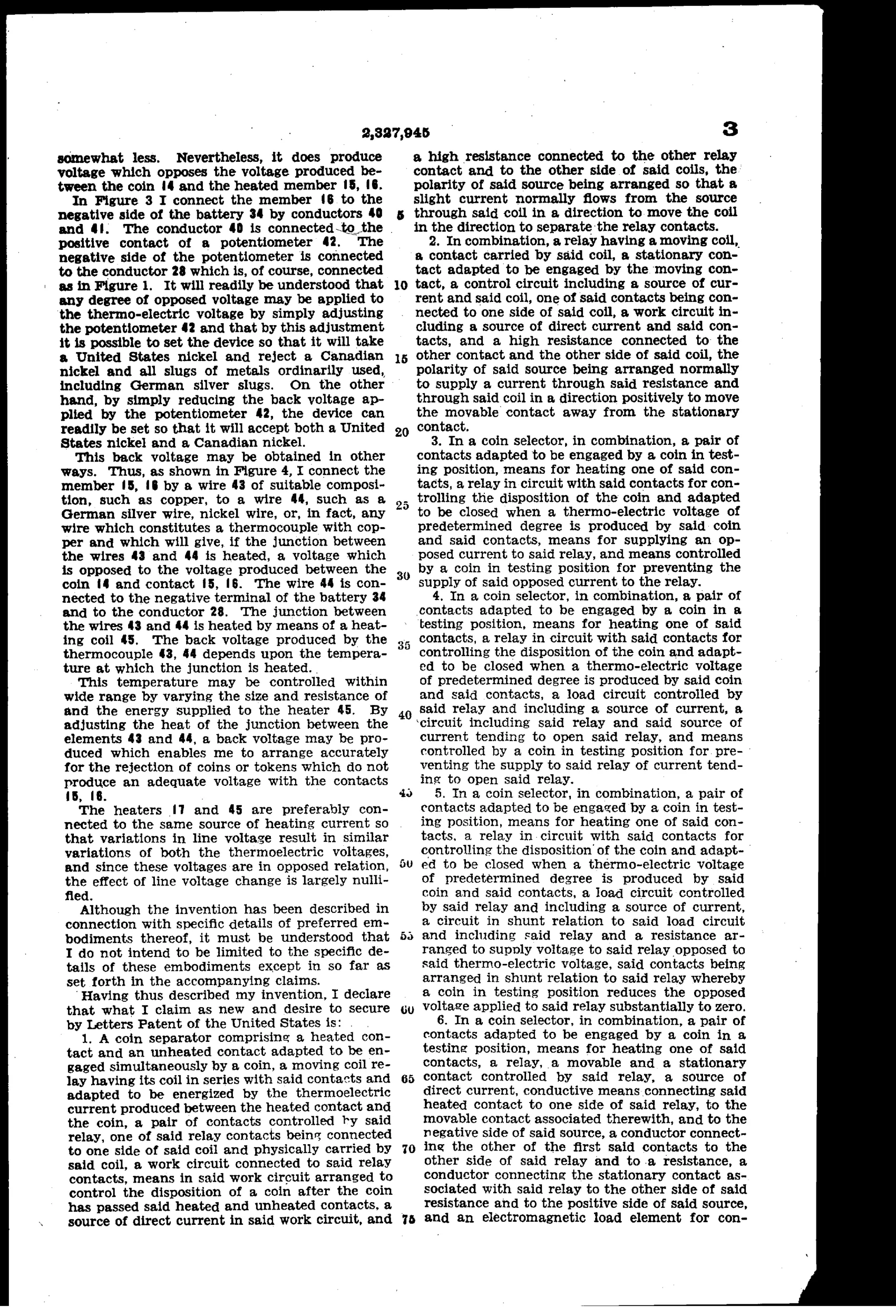
“A coin separator comprising a heated contact and an unheated contact adapted to be engaged simultaneously by a coin, a moving coil relay having its coil in series with said contacts and adapted to be energized by the thermoelectric current produced between the heated contact and the coin, a pair of contacts controlled by said relay, one of said relay contacts being connected to one side of said coil and physically carried by said coil, a work circuit connected to said relay contacts, means in said work circuit arranged to control the disposition of a coin after the coin has passed said heated and unheated contacts, a source of direct current in said work circuit, and a high resistance connected to the other relay contact and to the other side of said coils, the polarity of said source being arranged so that a slight current normally flows from the source through said coil in a direction to move the coil in the direction to separate the relay contacts.”
In plain English: The device uses a heated and unheated contact to generate a thermoelectric voltage from an inserted coin, which drives a relay coil; a resistor-biased current normally holds the relay contacts open unless the coin's voltage is strong enough to close them and trigger the coin-sorting mechanism.
◉ In the inventor’s words
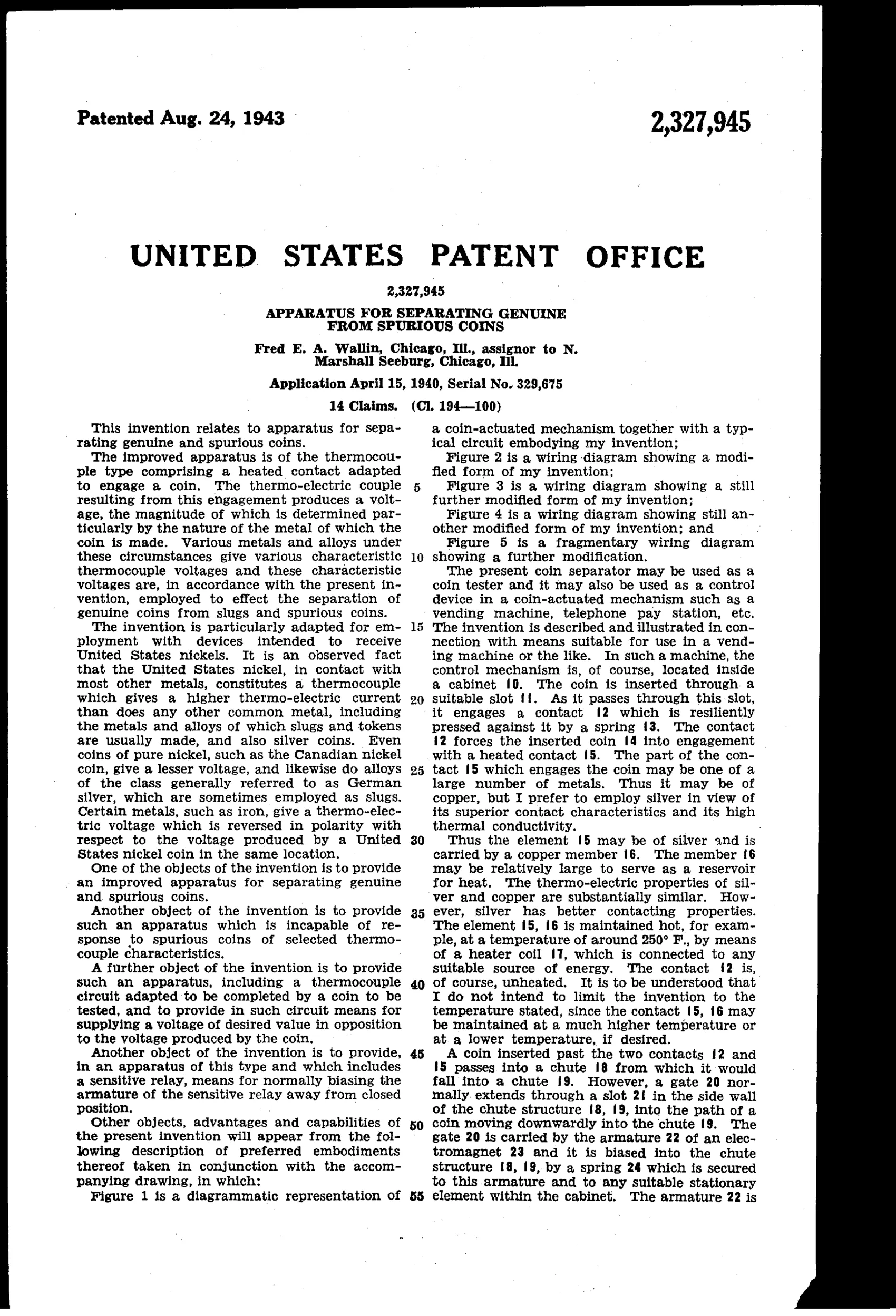
“It is an observed fact that the United States nickel, in contact with most other metals, constitutes a thermocouple which gives a higher thermo-electric current than does any other common metal, including the metals and alloys of which slugs and tokens are usually made, and also silver coins.”— Fred E. A. Wallin, from the specification
Fate unknown
The Seeburg assignment proves serious commercial interest, but no Seeburg rejector is documented as using the thermocouple test; a teardown of period Seeburg coin mechanisms would settle it.
◉ More by Fred E. A. Wallin
- APPARATUS FOR SEPARATING GENUINE AND SPURIOUS COINS (1938)
- APPARATUS FOR SEPARATING GENUINE FROM SPURIOUS COINS (1943)
- APPARATUS FOR SEPARATING GENUINE FROM SPURIOUS COINS (1943)
◉ Commentary
By 1940 the slug problem had gone electric, and this is one of the stranger and more elegant answers. Wallin — assigned to Seeburg of Chicago, the jukebox house, which tells you exactly what nickel-hungry machine this was meant to protect — proposes reading a coin's metal directly. A spring presses the coin against a heated contact; coin plus contact form a thermocouple, and the millivolts generated depend on the alloy. His claimed observation is the whole trick: the copper-nickel US five-cent piece produces a stronger thermoelectric current against most metals than common slug alloys do, and stronger than silver too.
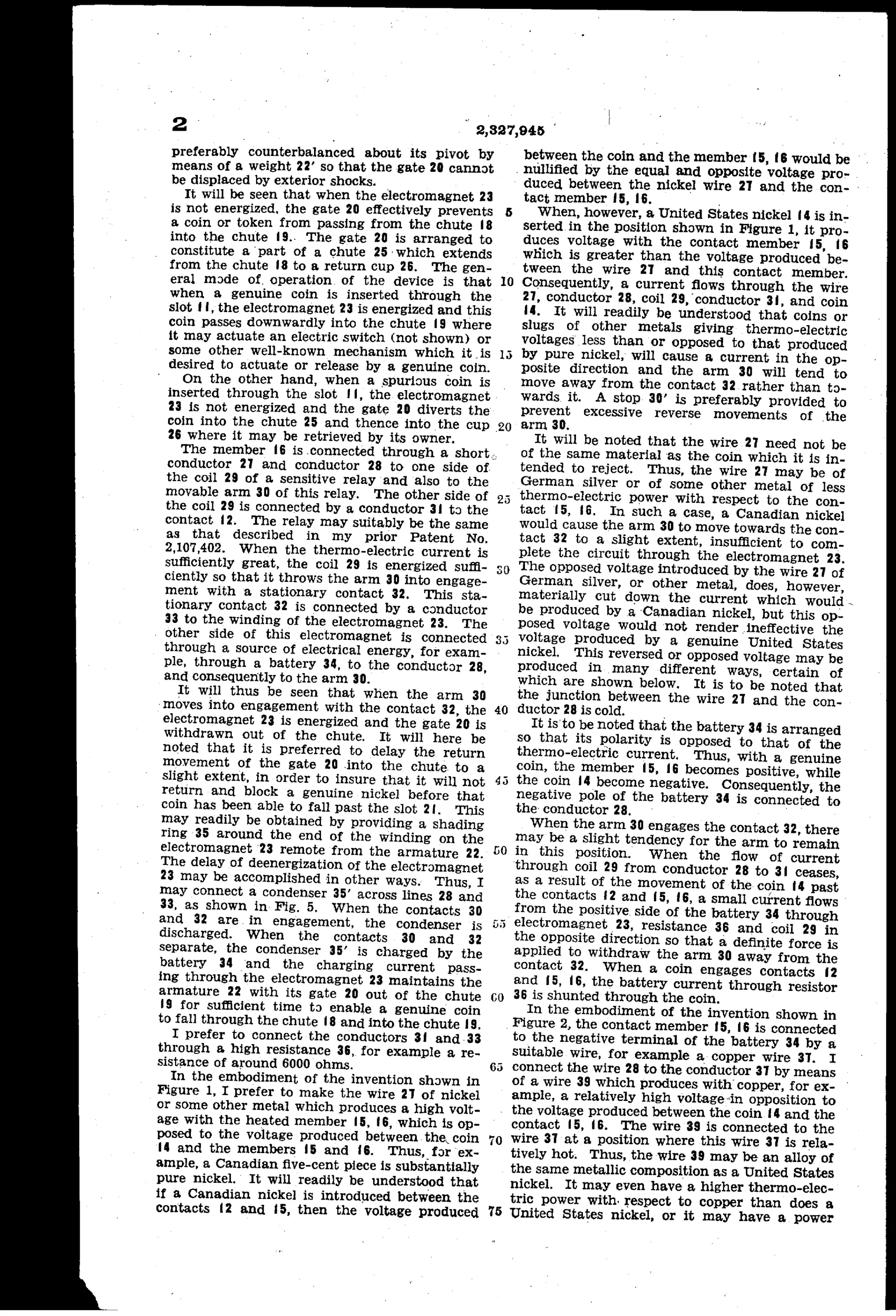
The circuit refinement is what a casual reader misses in the wiring diagrams. A battery pushes a small opposing current through the moving-coil relay, biasing it open. Only a coin whose thermoelectric output overcomes that deliberate handicap can close the contacts and pull the gate electromagnet. That biasing turns a crude threshold into a tunable one — Figs. 2 through 5 are all variations on how to null out the lesser voltages.
Would it work? In principle, yes; thermoelectric sorting of alloys is real metallurgy. In a coin chute it faces ugly realities: dirty coins make bad contacts, the heated element wastes power and drifts, and a moving-coil relay reading millivolts is delicate. The industry settled instead on magnets, ball-and-cradle gauges, and eddy-current tests. This one reads like a clever laboratory idea that lost to cheaper physics.
Commentary by Claude, The Counterfeit Coin Detector Patent Archive’s resident enthusiast