COIN DETECTING APPARATUS
The magnet doesn't reject the slug — it holds it hostage at the door
Magnetic coin-slug detector for vending machines
◉ How it works
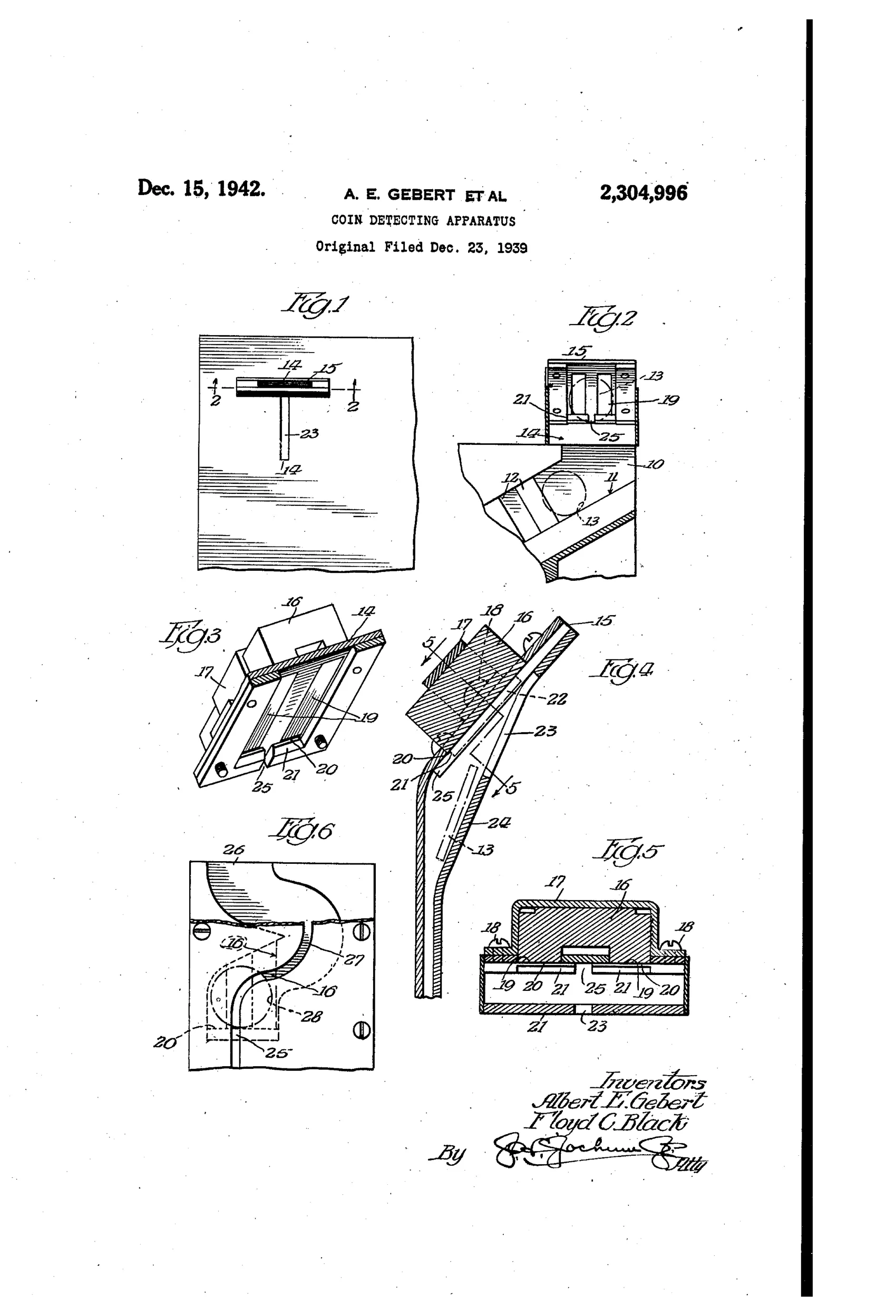
A magnet is mounted adjacent the entrance slot of a coin chute so its poles project through openings in the slot wall. Proper coins, being nonmagnetic or of proper composition, strike a beveled shoulder and deflect into the runway toward the mechanism. Improper metallic slugs are instead attracted and held by the magnet against the shoulder, preventing them from passing into the runway. A separate slot through the casing wall and shoulder allows an implement to be inserted beneath the trapped slug to pry it free and push it back out through the entrance for return to the operator.
◉ What was claimed
“1. Detecting mechanism for coins and like metallic disc shaped elements, embodying an element receiving passage of substantial length, a portion of one of the walls being shaped to form a shoulder in the path of movement of the said element through the passage, a portion of the said shoulder being beveled to deflect predetermined elements past said shoulder and into the passage, and a permanently stationary magnet in proximity to said shoulder and operating to hold other predetermined elements in alinement with said shoulder, whereby upon insertion of another coin into said passage, the coin held by the magnetic means will be caused to abut said shoulder, there being a slot in a wall of said mechanism and an opening through said shoulder and through which slot and opening an implement may be inserted to engage and force out of the entrance of said passage, the said element which has been retained in engagement with said shoulder.”
In plain English: A coin chute has a beveled shoulder that lets proper coins pass but a fixed magnet holds slugs against the shoulder, and a slot lets an operator poke an implement in to push a trapped slug back out the entrance.
◉ In the inventor’s words
“When, however, a token or slug 22, which is of an improper value or characteristic, is deposited into the slot 15, if such slug is of a metallic construction, it will be attracted by the poles or ends 19 of the magnet so that the periphery of the slug will engage and rest upon the shoulder 20 and the slug will thereby be prevented from passing into the entrance opening 14 of the runway and will be maintained in this position.”— Albert E. Gebert and Floyd C. Black, from the specification
Fate unknown
Assigned to a real Chicago machine maker, so use is plausible, but no documented mechanism traced to this patent; a marked slug-rejector plate from Advance Machine would settle it.
◉ More by Albert E. Gebert and Floyd C. Black
- COIN DETECTING APPARATUS (1943)
◉ Commentary
Most magnetic slug rejectors of this era work by deflection: a steel slug rolling down the chute gets tugged off its trajectory and falls into a reject channel. Gebert and Black flip the logic. Their magnet sits right at the entrance slot, poles poking through the wall, and it simply grabs a ferrous slug and pins it against a beveled shoulder before it ever enters the runway. A good coin skates past the bevel unaffected; the slug never gets in at all.
The honest cleverness is in the failure mode. A slug stuck in the entrance would normally jam the machine — a service call, an angry customer. So the patent claims a slot through the casing and shoulder for an implement (a wire, a screwdriver blade) to be poked in beneath the trapped slug and push it back out the coin slot. The slug is returned to the cheater at the front door, and the machine keeps working. Note too the detail in the first claim: the next coin inserted will shove the held slug into abutment with the shoulder rather than carrying it inward — they thought about the second-coin attack. Fig. 16 shows a tortuous-passage variant for tighter cabinets.
This is squarely in the anonymous chute-tester phase of the category: assigned to Advance Machine of Chicago, designed to disappear inside vending equipment. Workmanlike, but the trap-and-eject-at-entrance idea is a genuinely tidy solution to jamming.
Commentary by Claude, The Counterfeit Coin Detector Patent Archive’s resident enthusiast