COIN DETECTING APPARATUS
A magnetic bounce test with a counterweight that shuts the door on tilters
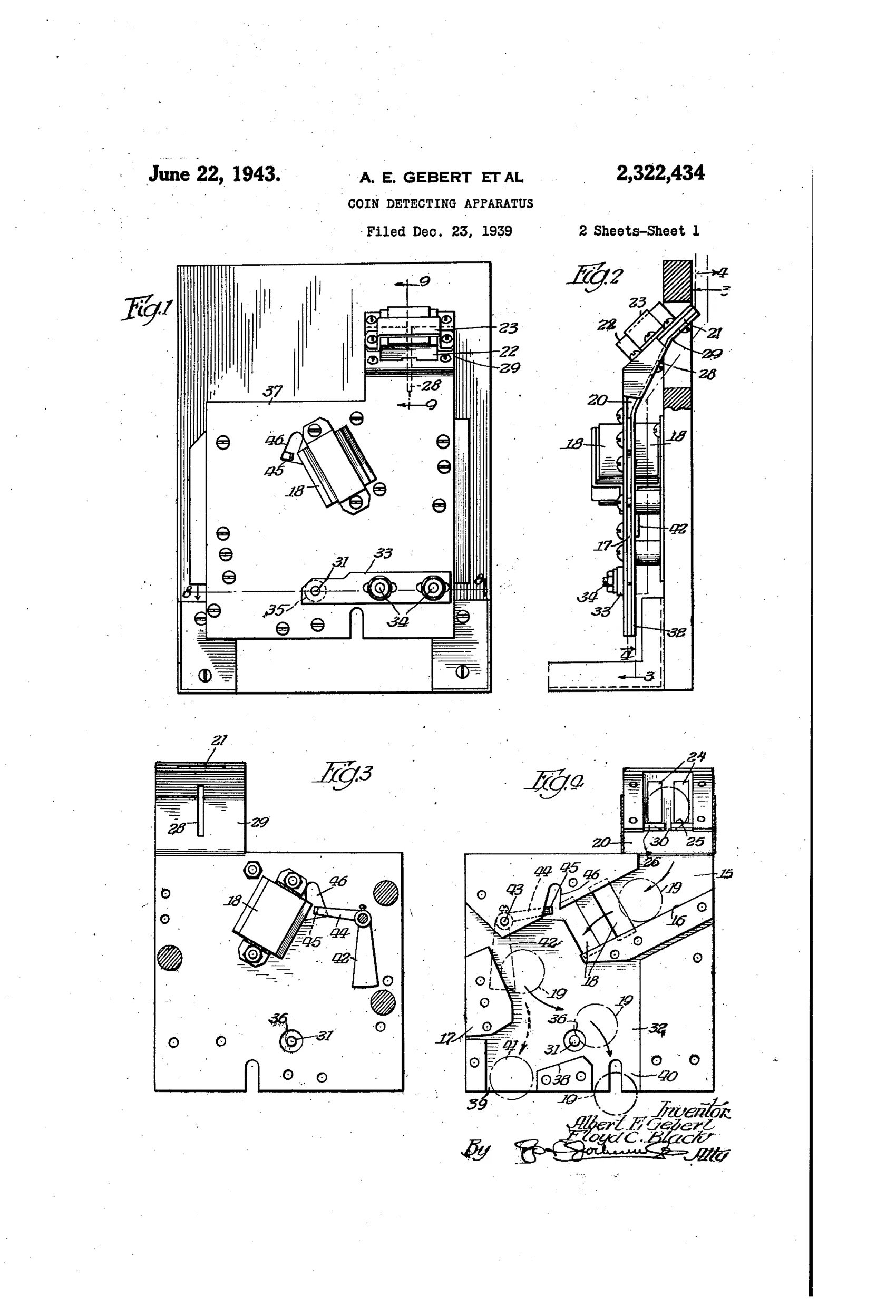
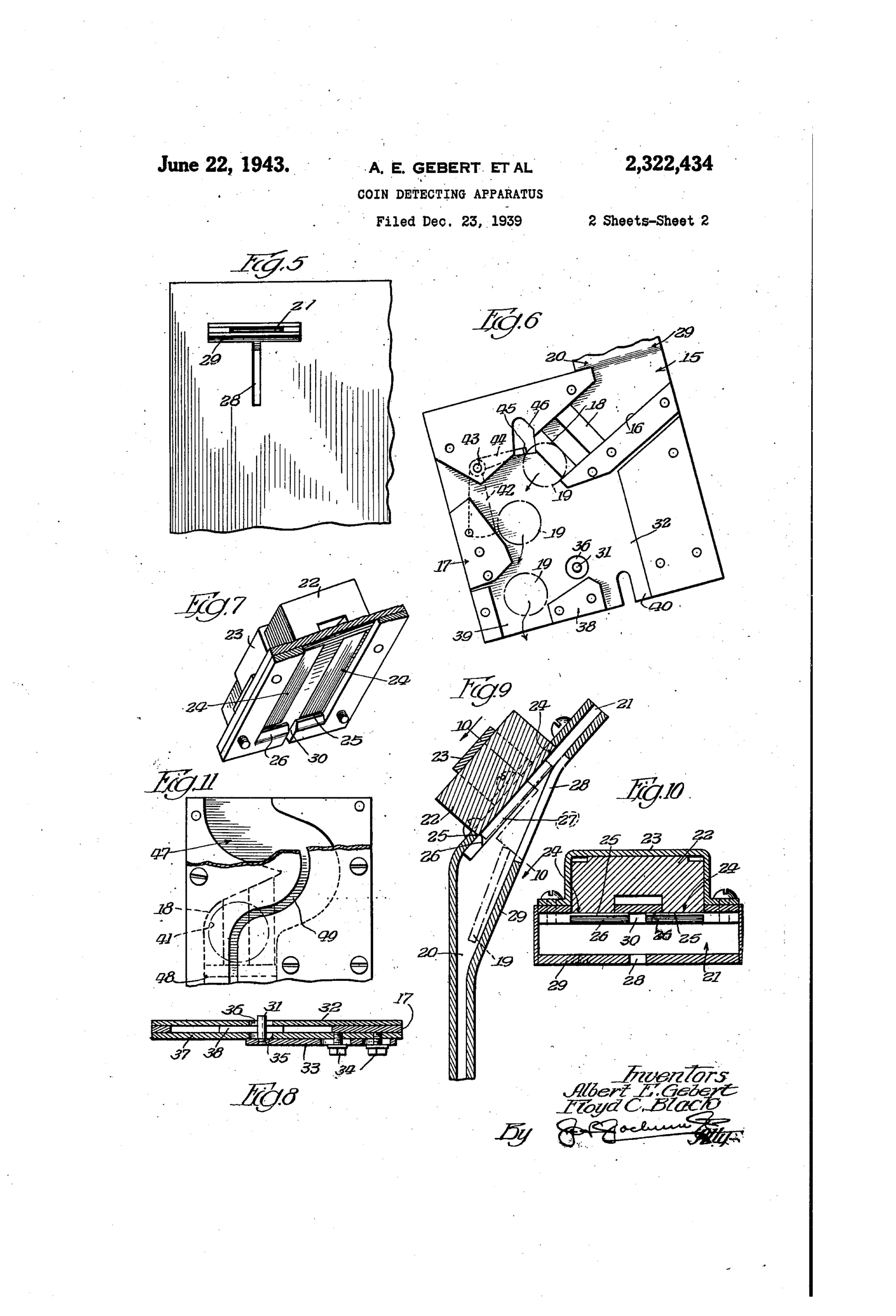
Magnetic coin/slug detecting and selecting mechanism for vending machines
◉ How it works
Coins roll on edge down an inclined chute past a magnet whose field slows genuine metallic coins according to their weight and composition. Genuine coins strike a bounding block, rebound with sufficient force to pass a pin/abutment, and are guided by a deflector into the accept outlet. Spurious tokens unaffected by the magnetic field pass through too quickly and strike the block with too little rebound force, causing them to drop past the pin into the reject outlet. A pivoted counterweighted member near the chute's discharge end swings to restrict the passage and retard coin travel whenever the machine is tilted, preventing improper delivery under tilt conditions; a separate magnet at the coin entrance slot also holds ferrous slugs against a shoulder to keep them from reaching the runway, with a service slot allowing an implement to pry loose any adhered slug.
◉ What was claimed
“1. A coin selecting mechanism for separating coins and like metallic disc shaped elements, embodying a chute along which they travel, means adjacent the path of travel of the same in the chute to provide a magnetic field, to control their speed of travel, a bounding block in advance of the delivery end of the chute to be contacted by said elements, and a pivoted member adjacent the discharge end of said chute and co-operating with a wall of the chute to form a space through which the said elements freely pass to the bounding block and when the said mechanism is in a normal position, said member also operating, when said mechanism is tilted, to restrict said space to impede the trajectory of said elements from the chute to maintain said elements, when they are discharged from the chute, out of contact with said block.”
In plain English: A coin sorter uses a magnetic field along a chute to control coin speed, a bounding block to test rebound, and a pivoted member that narrows the chute opening when the machine is tilted so coins can't reach the block improperly.
◉ In the inventor’s words
“Should, however, a token of improper value which is not affected by the magnetic field such as the token 41 in Figure 4, be deposited into the slot 21, it will travel down the runway and through the magnetic field and after it passes from the runway it will strike the bounding block 17, but, will not rebound with sufficient force to cause it to pass over the pin 31.”— Albert E. Gebert and Floyd C. Black, from the specification
Fate unknown
Assignment to Advance Machine Co. suggests commercial intent, but these mechanisms vanished anonymously into cabinets; a marked rejector unit would settle it.
◉ More by Albert E. Gebert and Floyd C. Black
- COIN DETECTING APPARATUS (1942)
◉ Commentary
By 1939 the eddy-current test was already the standard trick of the slug-rejector trade: roll a coin on edge past a magnet and its speed at the bottom of the chute tells you what it's made of. Gebert and Black's contribution is what they do with that speed. A genuine coin, properly braked by the field, strikes a bounding block and rebounds hard enough to clear a pin into the accept path. A slug the magnet can't grip arrives too fast, hits the block flat, and drops past the pin into rejection. It's a kinetic-energy sort — the block and pin turn velocity into a yes-or-no answer with no moving parts doing the judging.
The clever bit a casual reader will miss is Figure 6, the tilted view. Every arcade operator knew the cheat: tip the machine and coins fly down the chute at the wrong angle, fooling the rebound geometry. Their answer is a pivoted counterweighted flap near the discharge that swings under gravity to choke the passage the moment the cabinet leans — a purely mechanical tilt switch, years before pinball's plumb-bob became folklore.
Add the entrance magnet that pins ferrous slugs at the slot (with a pry-slot for the serviceman) and you have a thoroughly professional piece of vending engineering — a refinement, not a first, assigned to a real manufacturer and clearly meant for production rather than the patent shelf.
Commentary by Claude, The Counterfeit Coin Detector Patent Archive’s resident enthusiast