ART OF TESTING COINS OR OTHER TOKENS FOR GENUINENESS
Two-stage eddy-current sorting in 1931 — the ancestor of every modern coin validator
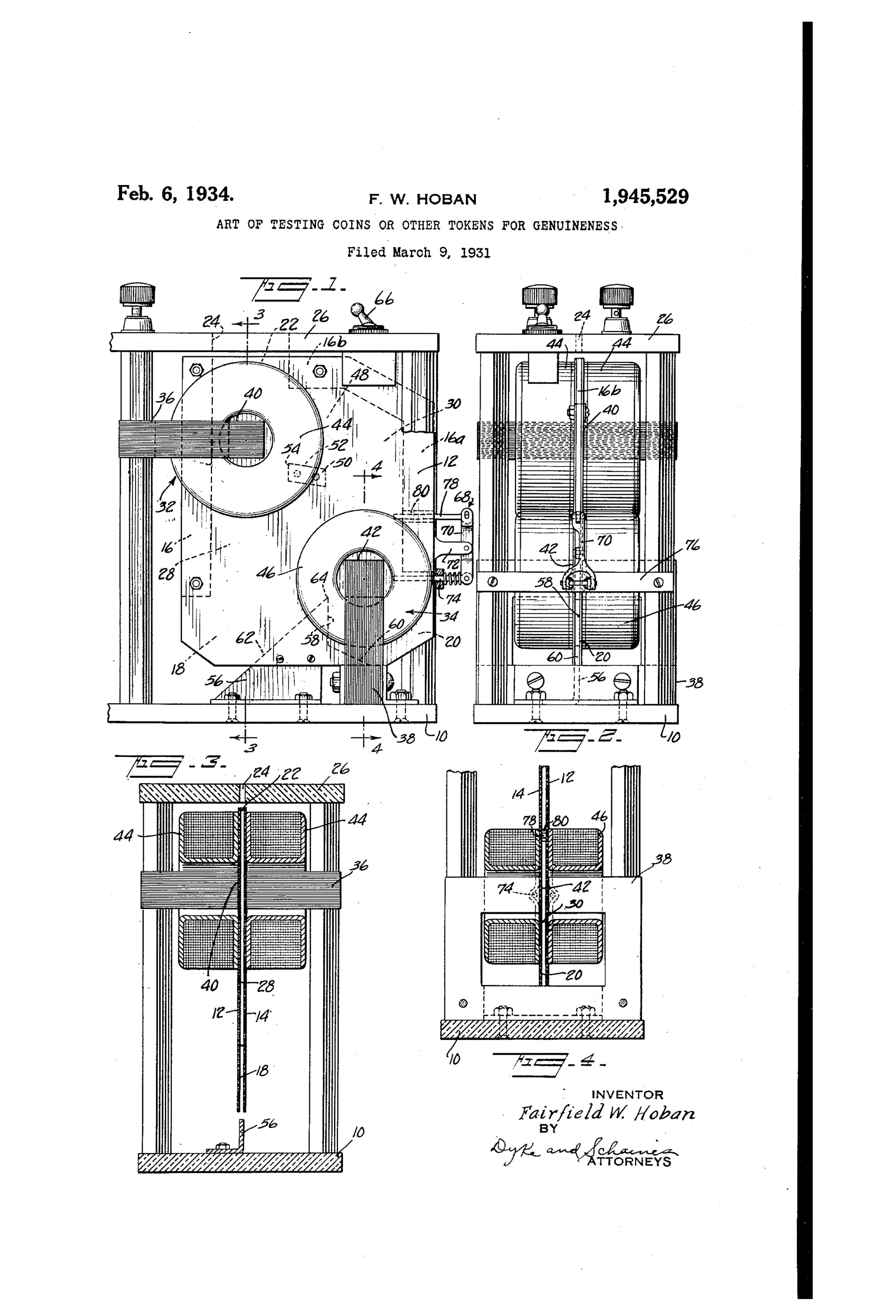
Electromagnetic coin-slug detector using eddy currents
◉ How it works
A coin dropped through an insulated vertical chute passes between laminated silicon-iron cores wound with coils that create fluctuating magnetic fields at two offset gaps. The upper field is strong enough to deflect the genuine silver coin and highly conductive slugs (copper, aluminum) sideways into a second passage while letting low-conductivity slugs (lead, tin, zinc, brass) fall straight through and out a reject outlet. The second, weaker field then lets the genuine coin pass through to acceptance while deflecting the remaining copper/aluminum slugs laterally over an inclined apex to the same reject outlet. A spring-armature rocker arm with a stop pin also blocks the acceptance outlet when the lower coil circuit is de-energized, forcing any coin to be rejected unless power is on.
◉ What was claimed
“1. The herein described method of distinguishing between genuine and spurious coins, tokens or like devices which consists in subjecting a device to a fluctuating electromagnetic field made to deflect the genuine device and devices more responsive to eddy current effect than the genuine over one path and to pass the others over another path to be eliminated, and subjecting the device deflected by the first field to a second fluctuating electromagnetic field made to pass the genuine device for acceptance and to deflect the others into the first path below the first field to be likewise eliminated.”
In plain English: The method tests a coin by first using a magnetic field to deflect the genuine coin and highly conductive slugs into one path (letting inert slugs pass elsewhere), then applying a second field to that deflected path which lets the genuine coin through for acceptance while sending the remaining bad slugs back to be rejected.
◉ In the inventor’s words
“Devices dropping or moving through the chute possess kinetic energy which is a function of the mass and velocity ( tfrac{1}{2}M V^2), the mechanical force thus developed tending to overcome, or overcoming, the opposing electrical force due to eddy current effect.”— Fairfield W. Hoban, from the specification
Fate unknown
Assigned to a specialties corporation, suggesting commercial intent, but no marked example or vending-trade record is documented; a surviving mechanism would settle it.
◉ Patented the same day
- ART OF TESTING COINS OR OTHER TOKENS FOR GENUINENESS — Theodore M. Edison
◉ More by Fairfield W. Hoban
- ART OF TESTING COINS OR OTHER TOKENS FOR GENUINENESS (1932)
- ART OF TESTING COINS OR OTHER TOKENS FOR GENUINENESS (1934)
◉ Commentary
Hoban's insight is that conductivity is a signature. Drop a coin between energized laminated cores and eddy currents induced in the coin push back against its fall — how hard depends on what the coin is made of. Lead, tin, zinc, and brass barely respond; silver and copper respond strongly. One field can't sort three classes of metal, so Hoban stacks two: the first, stronger gap deflects silver coins and high-conductivity slugs sideways while the dull slugs drop straight to rejection; a second, weaker gap then passes the genuine silver coin but shoves the remaining copper and aluminum impostors over an inclined apex back into the reject path. It's a binary search done with magnetism, and the logic is genuinely elegant.
The drawings reward a close look. The cores are laminated silicon iron — Fig. 3 shows the stacked plates clearly — because Hoban needs a fluctuating field, not a static magnet, and he even writes out the kinetic-energy balance (½MV²) that the deflection has to overcome. Note also the rocker arm and stop pin near the acceptance outlet: with power off, everything is rejected. A fail-safe, decades before that word was fashionable.
By 1931 the class was thick with magnets that merely snagged steel slugs. This is something else — a conductivity discriminator, the working principle of every electronic coin mechanism since. Whether Fairfield Specialties ever built it, the idea won.
Commentary by Claude, The Counterfeit Coin Detector Patent Archive’s resident enthusiast