ART OF TESTING COINS OR OTHER TOKENS FOR GENUINENESS
Edison's son teaches coins to sort themselves with two tuned eddy-current fields
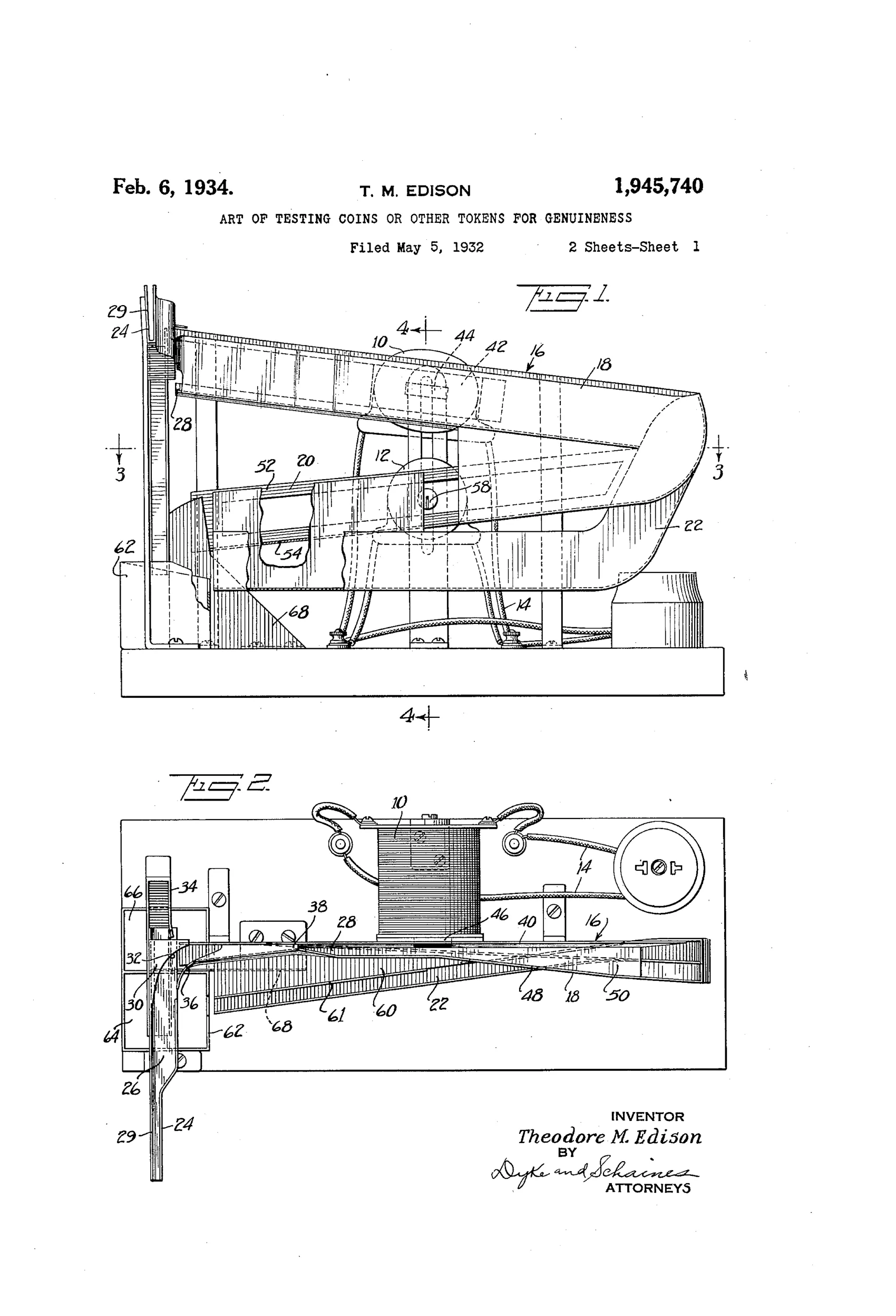
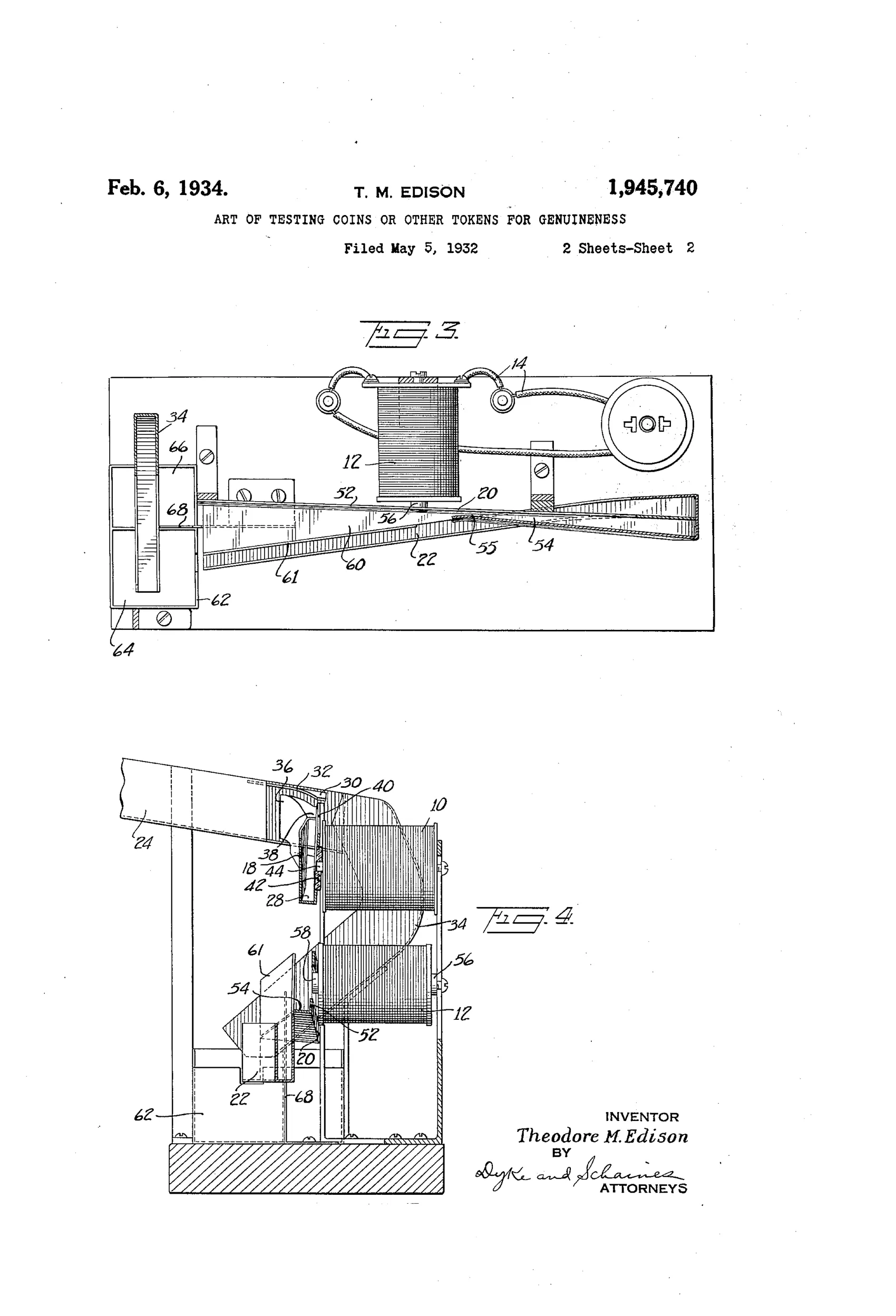
Electromagnetic coin sorter detecting counterfeit coins by eddy currents
◉ How it works
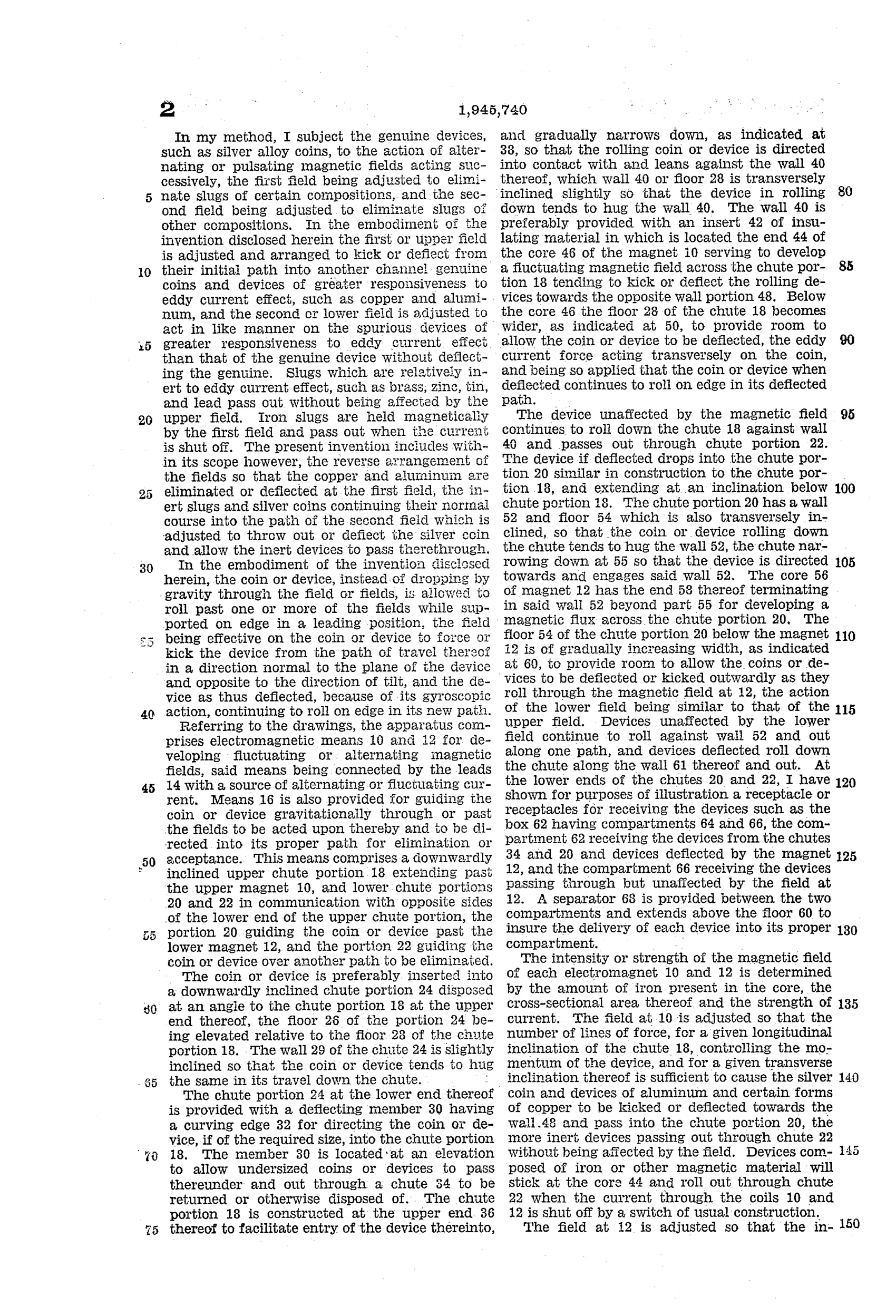
A coin or token rolls on edge down an inclined chute past two electromagnets energized with alternating or pulsating current. Each magnet's fluctuating field induces eddy currents in the moving coin, and the reaction between field and eddy current kicks or deflects the coin sideways off its path if it is too responsive to eddy current effect. The first field is tuned to deflect genuine coins and highly conductive slugs (like copper or aluminum) into one channel while passing others; the second field is tuned oppositely to catch remaining spurious devices, so that after the two successive fields only genuine silver-alloy coins remain on the accepted path while inert slugs (lead, tin, zinc) pass through unaffected and magnetic slugs (iron, nickel) stick to the core until the current is shut off.
◉ What was claimed
“1. The hereindescribed method of distinguishing between genuine and spurious coins, tokens or like devices which consists in subjecting a device to the successive action of fluctuating magnetic fields, the eddy current effect of one field being such as to eliminate certain of the various spurious devices which may be presented for test and the eddy current effect of the other field being such as to eliminate other of the various spurious devices which may be presented for test.”
In plain English: The method passes a coin through two different pulsating magnetic fields in sequence, each tuned to knock out a different class of counterfeit slug by its eddy-current response, so that only genuine coins pass both tests.
◉ In the inventor’s words
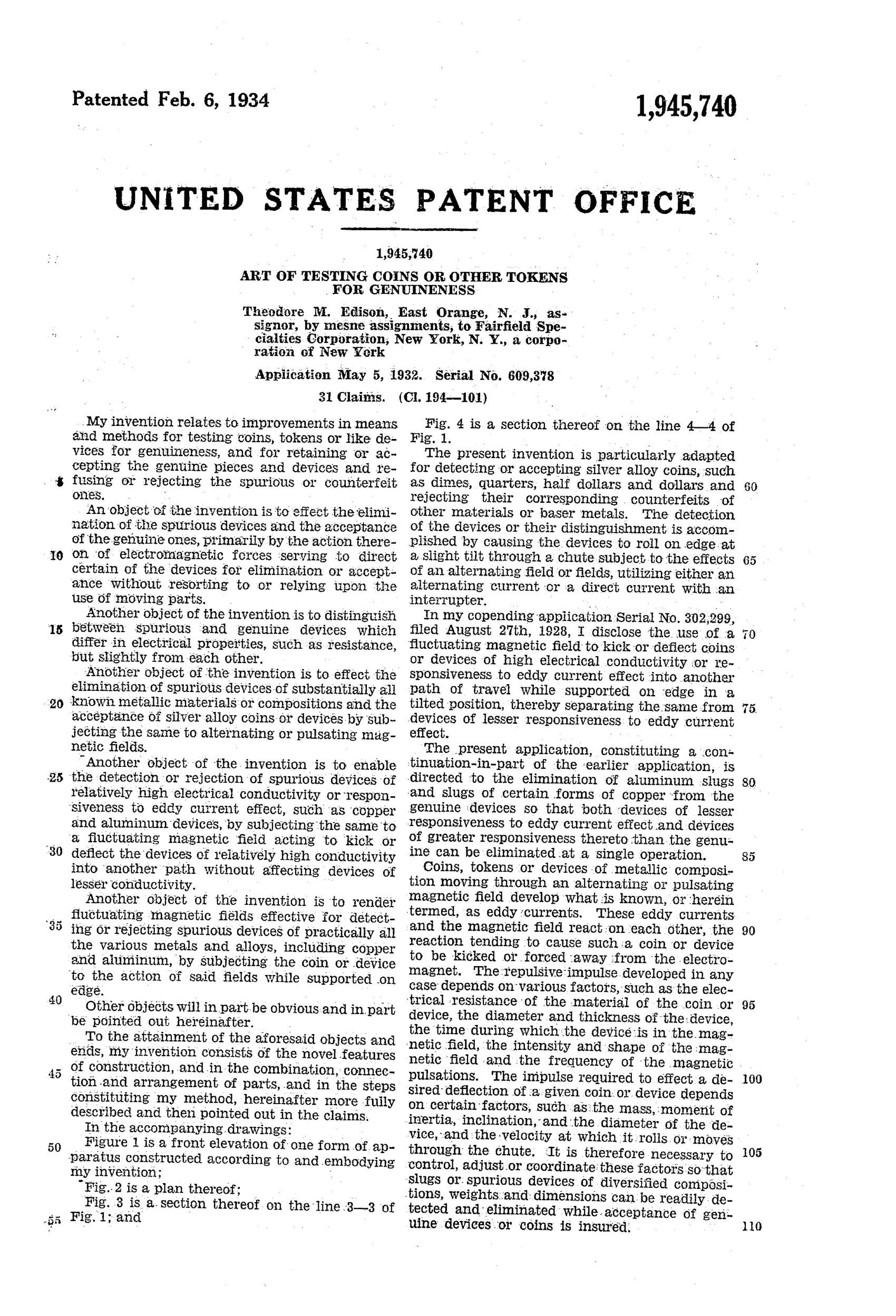
“The impulse required to effect a desired deflection of a given coin or device depends on certain factors, such as the mass, moment of inertia, inclination, and the diameter of the device, and the velocity at which it rolls or moves through the chute.”— Theodore M. Edison, from the specification
Fate unknown
Eddy-current rejection became standard in later coin mechanisms, but I know of no documented device built to this specific design; Fairfield Specialties production records or a surviving unit would settle it.
◉ Patented the same day
- ART OF TESTING COINS OR OTHER TOKENS FOR GENUINENESS — Fairfield W. Hoban
◉ Commentary
The inventor here is Theodore M. Edison — Thomas Edison's youngest son and an MIT-trained physicist — and the patent reads like it. Where the previous forty years of slug rejectors used brute physical tests (a magnet grabs steel, a gauge measures diameter, a weighted gate checks mass), this one interrogates the coin's electrical conductivity without touching it. A coin rolling down the chute passes two electromagnets driven by alternating current; the fluctuating field induces eddy currents in the coin, and the reaction force literally kicks it sideways. How hard the kick is depends on the alloy.
The genuinely clever part is the two-stage logic. One field alone can't separate silver from everything else, because copper and aluminum slugs are also good conductors. So Edison stacks two fields tuned oppositely: the first deflects the high-conductivity group one way, the second sifts out the remaining pretenders, and only silver-alloy coins survive both. Dead metals like lead and zinc roll through unmoved; magnetic slugs simply stick to the core. It's a truth table built out of physics.
As a category milestone, this is the pivot point. The rocking balances of Allender's era tested what a coin weighed; this tests what a coin is made of, in motion, automatically. Every modern electronic coin validator that senses a coin inductively is a descendant of this idea, whether or not it descends from this patent.
Commentary by Claude, The Counterfeit Coin Detector Patent Archive’s resident enthusiast