IMPROVEMENT IN DETECTERS OF COUNTERFEIT COIN
A whole counterfeit detector made from one bent strip of metal
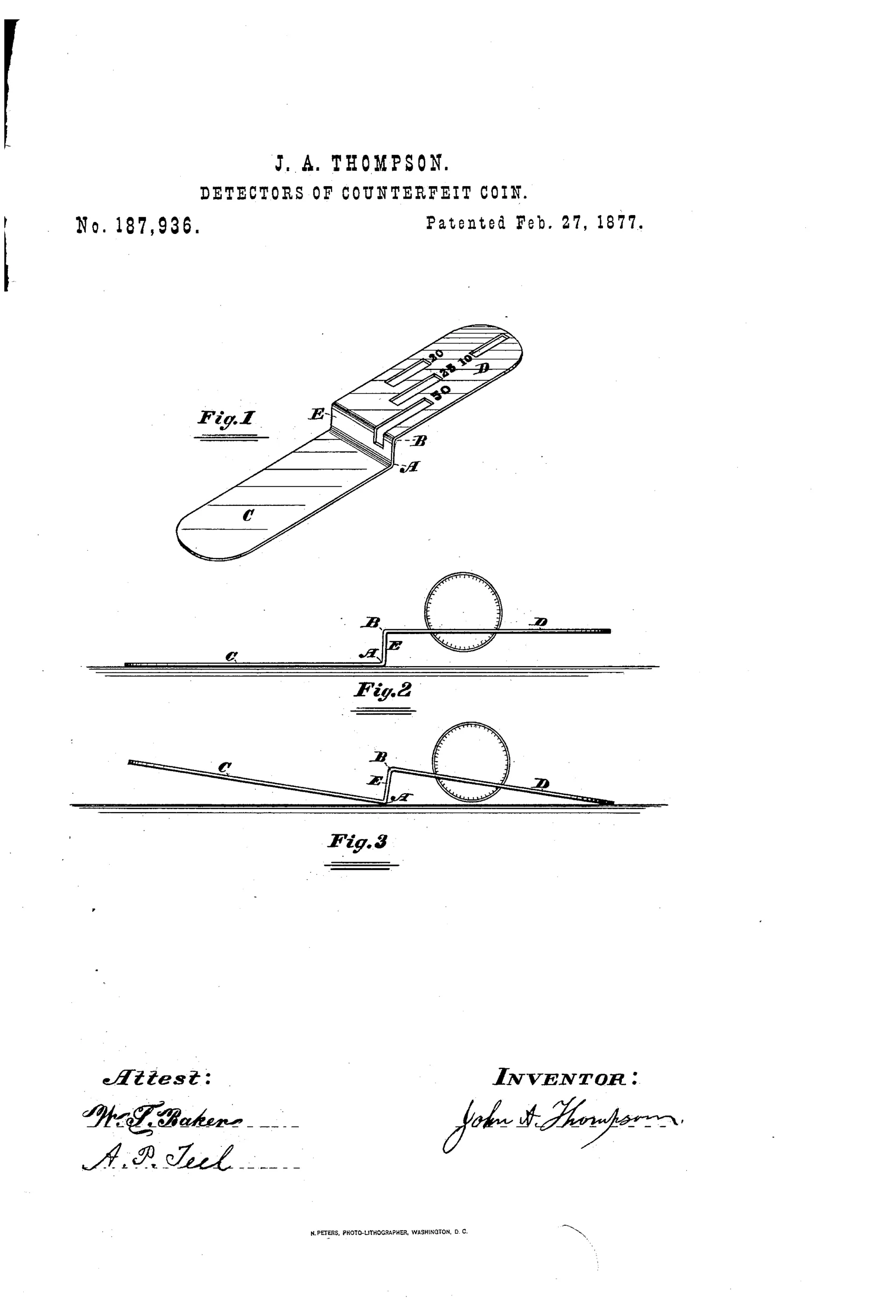
A pocket coin-weighing gauge for detecting counterfeits.
◉ How it works
The device is a flat metal plate shaped like a paper-knife with a right-angular bend near the middle forming a fulcrum. One side of the bend is a plain lever arm that rests on a table; the other side contains slots graduated for different coin denominations. When a genuine coin is placed in its matching slot, its correct weight barely tips the plate on the fulcrum until the slotted end settles flat; a lighter or oversized counterfeit coin fails to balance the plate properly, revealing itself by not tipping or by not fitting the slot.
◉ What was claimed
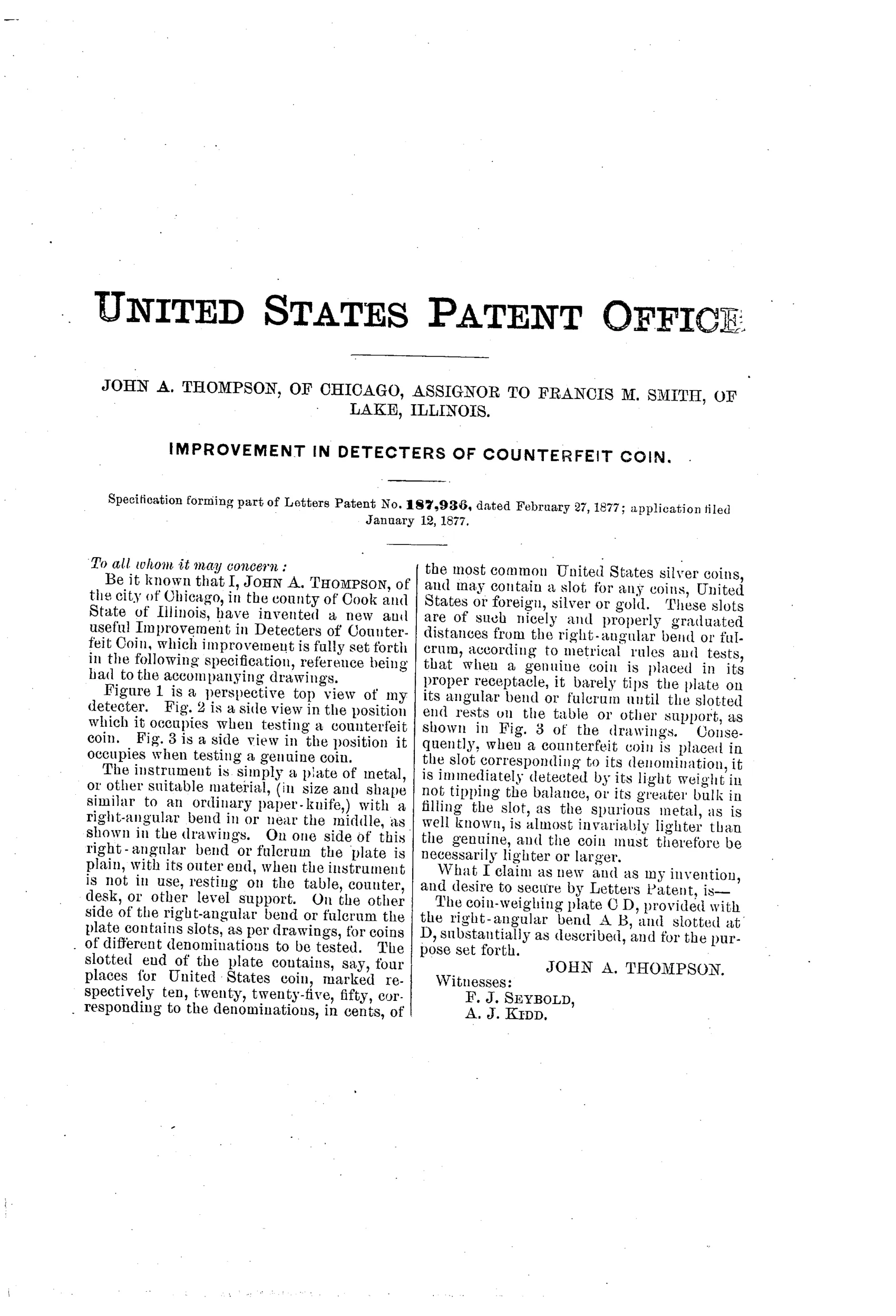
“The coin-weighing plate C D, provided with the right-angular bend A B, and slotted at D, substantially as described, and for the purpose set forth.”
In plain English: The invention claims a coin-weighing plate with a right-angle bend acting as a fulcrum and slots for coins, used to test coins by balance and fit.
◉ In the inventor’s words
“Consequently, when a counterfeit coin is placed in the slot corresponding to its denomination, it is immediately detected by its light weight in not tipping the balance, or its greater bulk in filling the slot, as the spurious metal, as is well known, is almost invariably lighter than the genuine, and the coin must therefore be necessarily lighter or larger.”— John A. Thompson, from the specification
Fate unknown
No marked example of this Chicago design is documented in the detector literature; a surviving stamped specimen would settle it.
◉ Patented the same day
- IMPROVEMENT IN DEVICES FOR DETECTING COUNTERFEIT COIN. — Thomas J. Towsey
◉ Commentary
By 1877 the classic Allender-style rocker had been on counters for two decades: a brass beam, a pivot, calibrated counterweights, sizing apertures. Thompson's insight is that you can throw away almost all of that hardware. Take a flat strip shaped like a paper-knife, put one right-angle jog in it, and the bend itself becomes the fulcrum. One arm rests on the table as the counterpoise; the other carries slots graduated for the dime, twenty-cent piece, quarter, and half dollar. No knife edge, no separate weight, no assembly — the plate is the whole machine.
Figs. 2 and 3 show the trick better than the text does. A genuine coin dropped in its slot has just enough weight to tip the slotted end down flat; a light casting leaves the arm cocked up, as in Fig. 2. And the slot does double duty: a counterfeit padded out with base metal to make weight ends up too thick or too broad to enter at all. Weight and dimension tested in one motion — the same two-pronged logic as Allender, at a fraction of the cost.
The weakness is the flip side of the elegance. A one-piece stamped balance is only as accurate as its bend, and there is no adjustment anywhere. Coins wear light in circulation; this plate can't be recalibrated. It is a clever cheapening of a proven idea, arriving just as the era of pocket coin detectors was winding down.
Commentary by Claude, The Counterfeit Coin Detector Patent Archive’s resident enthusiast