IMPROVEMENT IN COUNTERFEIT-COIN DETECTERS
Allender's rocker reduced to one piece of bent sheet metal
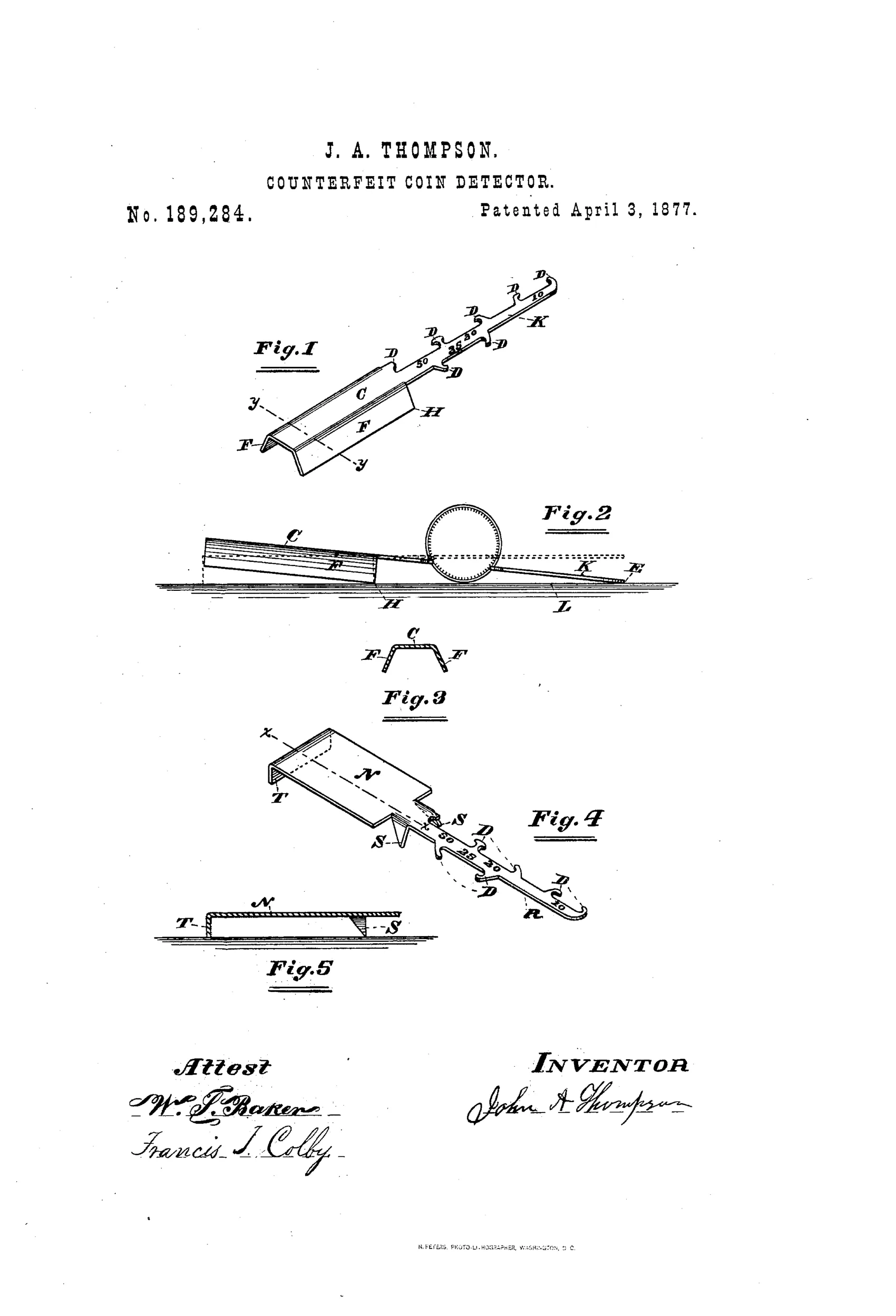
A balance-beam device for spotting counterfeit coins
◉ How it works
A flat plate or bar, C K, is bent at its ends into flanges F set at seventy to eighty degrees, which act as the pivot support for the whole instrument. The plate rests balanced upon these flanges so it can rock or tip about the point H. The projecting end K of the plate carries pairs of ears or lugs D, each pair sized and spaced to clasp a coin of a specific denomination, with the receptacle for a given denomination marked on the bar K. A genuine coin, being heavier than a counterfeit of the same size, tips the bar K down until point E rests on the supporting table L; a lighter counterfeit coin fails to tip the beam and the instrument remains resting flat on the flanges F.
◉ What was claimed
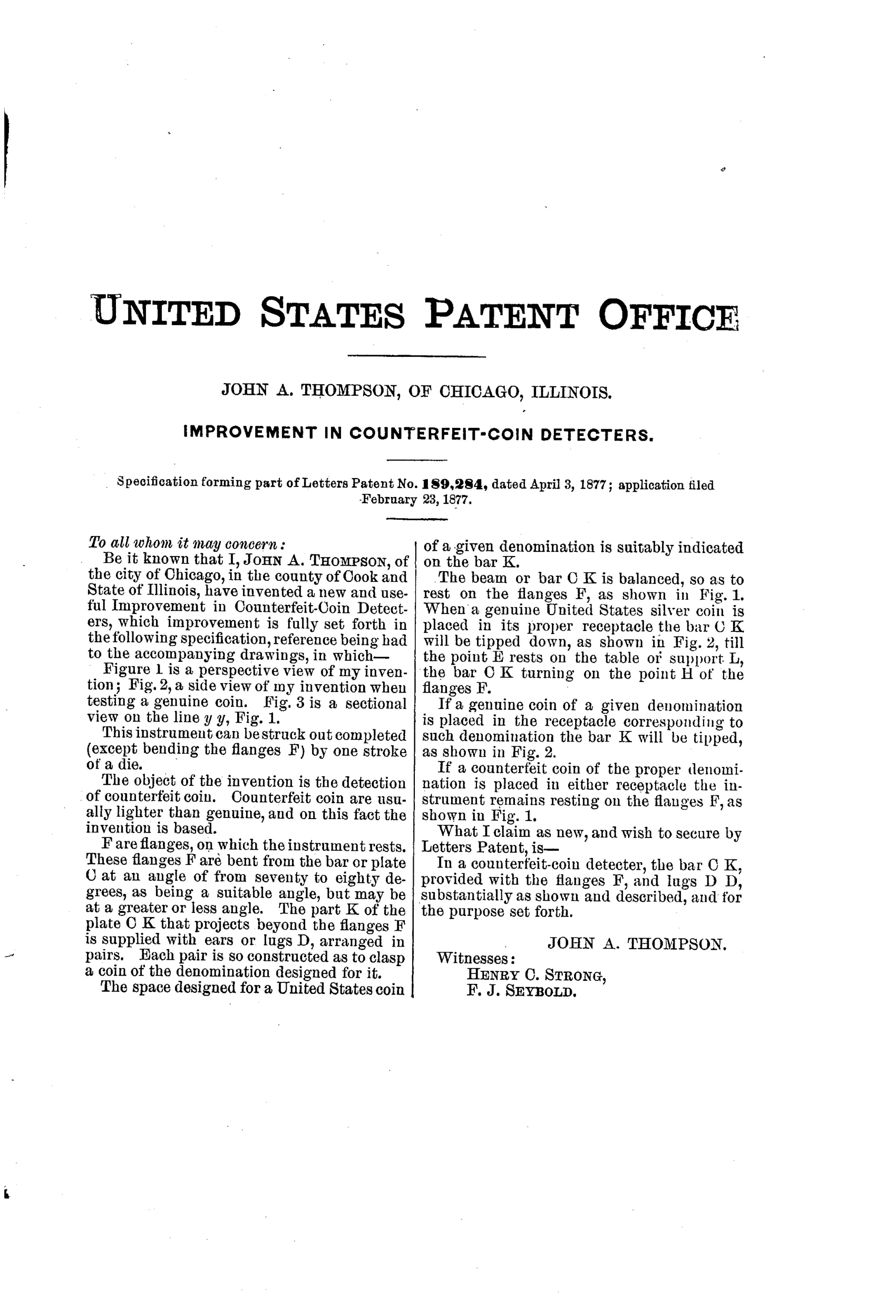
“In a counterfeit-coin detecter, the bar C K, provided with the flanges F, and lugs D D, substantially as shown and described, and for the purpose set forth.”
In plain English: The invention claimed is a rocking bar fitted with bent flanges for support and paired lugs sized to hold coins, used to test coins by weight as described.
◉ In the inventor’s words
“Counterfeit coin are usually lighter than genuine, and on this fact the invention is based.”— John A. Thompson, from the specification
Paper patent — likely never produced
No marked example of Thompson's stamped detector is known to collectors, and it left no trace in the trade; a surviving specimen would change the verdict.
◉ Commentary
By 1877 the counterfeit-coin balance was a mature idea — Allender had patented his articulated brass rocker over twenty years earlier, and Maranville had refined it. Thompson's contribution is radical simplification: the whole detector is a single flat bar with its ends bent down into flanges at seventy to eighty degrees. Those bent flanges are the fulcrum. There is no separate pivot, no counterweight arm, no hinge — the mass of the plate itself is the counterpoise, and the bar either tips or it doesn't. It could be stamped from one piece of sheet metal, which is surely the point.
The paired lugs along the projecting arm, marked 50, 25, 10, 5 in the drawing, do more than hold the coin: because each pair is sized to clasp its denomination, an oversized cast slug won't seat, so the device tests diameter along with weight, just as the classic rockers did. Fig. 2 shows the pass condition plainly — a genuine coin drives point E down to the table; a light one leaves the instrument sitting flat on its flanges.
The weakness is sensitivity. A fixed-mass tipping plate has no adjustment, and a filled coin only slightly underweight might still tip it. Thompson traded the calibrated precision of the counter-top balances for something you could make for pennies — a workmanlike late entry chasing cost, not accuracy.
Commentary by Claude, The Counterfeit Coin Detector Patent Archive’s resident enthusiast