COIN-TESTER FOR COIN-CONTROLLED APPARATUS.
A hooked catcher fishes washers out by their holes — and outsmarts fast hands
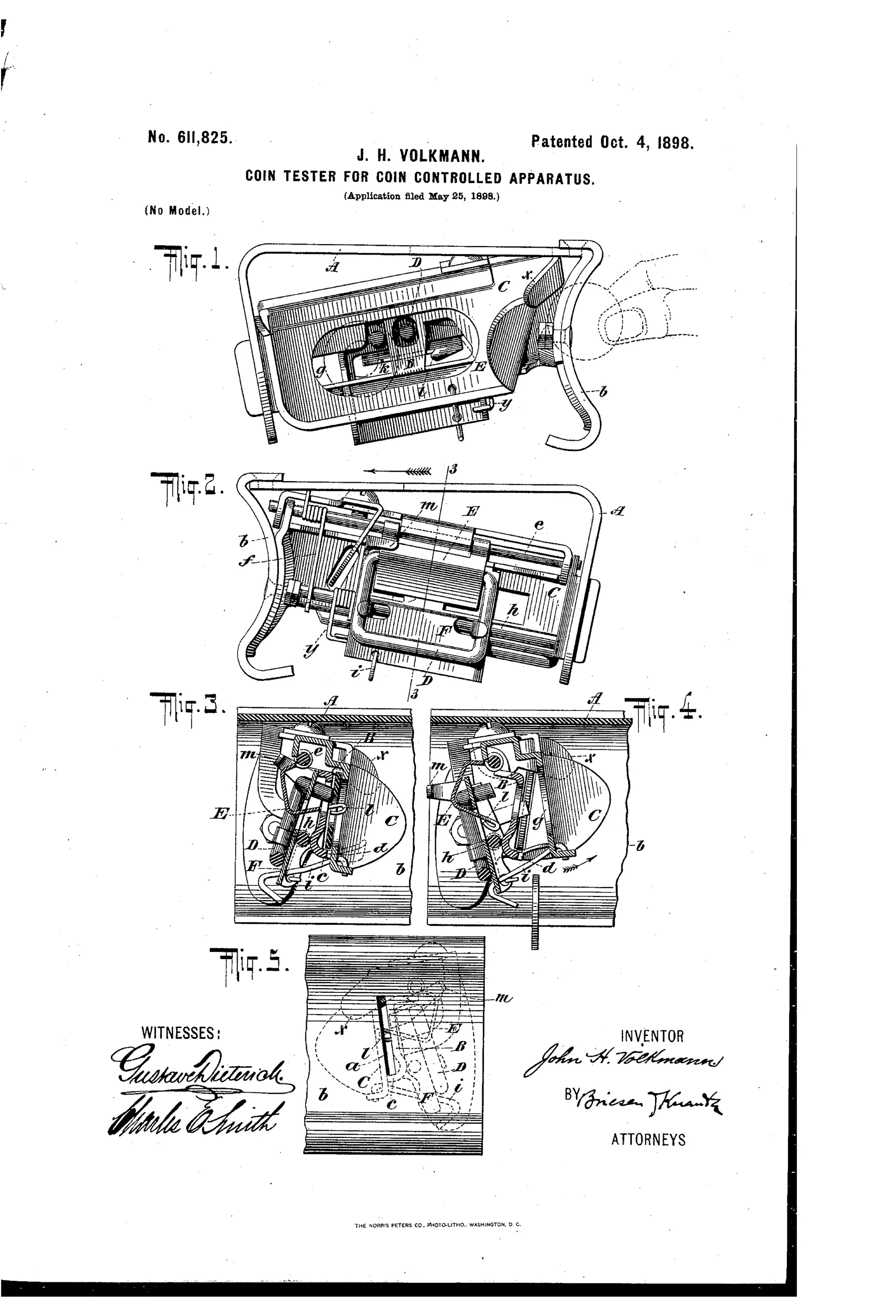
Coin-tester mechanism for vending machines
◉ How it works
A stationary plate and a spring-loaded movable plate form a coin chute with a track that has a recess allowing undersized tokens to fall away. A pivoted magnet, linked to the movable plate, swings toward or away from the coin path as the plates separate or close. A gravity-actuated washer-catcher with hooked ends normally projects across the coin path to snag washers or false tokens by their central perforation, but a genuine coin forces it aside; an abutment finger, moved by the plate separation, prevents the catcher from re-engaging too quickly so it cannot be fooled by rapidly telegraphed slugs.
◉ What was claimed
“1. In a coin-tester, the combination of a vibratory washer-catcher normally projecting across the path of the coin and an abutment against which said washer-catcher is adapted to be forced by the coin in its passage through the tester.”
In plain English: The tester combines a swinging catcher that normally blocks the coin path with a stop that the catcher is pushed against by a passing coin.
◉ In the inventor’s words
“The object of my present invention is to render the device of my former patent above referred to and coin-testers generally more efficient and to provide a device which will more effectively prevent "telegraphing"—that is to say, which will effectively prevent a washer or like false token from being rapidly projected through the tester without allowing the parts to operate upon the token to prevent it from passing to the delivery mechanism.”— John H. Volkmann, from the specification
Fate unknown
Volkmann patented repeatedly in this line, suggesting real commercial engagement, but no marked mechanism traceable to this patent is documented; one found inside a period vending machine would settle it.
◉ Commentary
By 1898 the slug problem for coin-operated machines had a specific villain: the common washer. Same diameter, similar weight, costs nothing. Volkmann's answer is almost literal — a pivoted, gravity-dropped catcher with hooked ends that hangs across the coin path and fishes a washer out by its central perforation. A genuine solid coin has no hole, so it simply shoulders the catcher aside and rolls on. It's the rare tester that exploits what a fake has rather than what it lacks.
The cleverer part is buried in the specification: 'telegraphing.' Cheats had learned that if you snapped a washer through fast enough, spring-loaded parts couldn't reset in time to grab it. Volkmann adds an abutment finger, tied to the separation of the two chute plates, that holds the catcher from re-engaging prematurely — a timing interlock, in brass, against a human exploit. Note this is a self-declared refinement of his own earlier patent; he was iterating on field experience, not sketching in the abstract. The pivoted magnet linked to the movable plate handles the steel-slug case in the same package.
Figures 3 and 4 are the pair to study: normal position versus the hooked arm dragging a false token out sideways. Like most chute testers of this era, whatever survived of it did so anonymously inside vending cabinets — but the washer-hook idea is a genuinely sharp move in that crowded, invisible field.
Commentary by Claude, The Counterfeit Coin Detector Patent Archive’s resident enthusiast