SPURIOUS COIN DETECTOR AND EJECTOR
A coin pinball machine: sorting real money from slugs by cumulative bounce
Zigzag anvil device that detects and ejects fake coins
◉ How it works
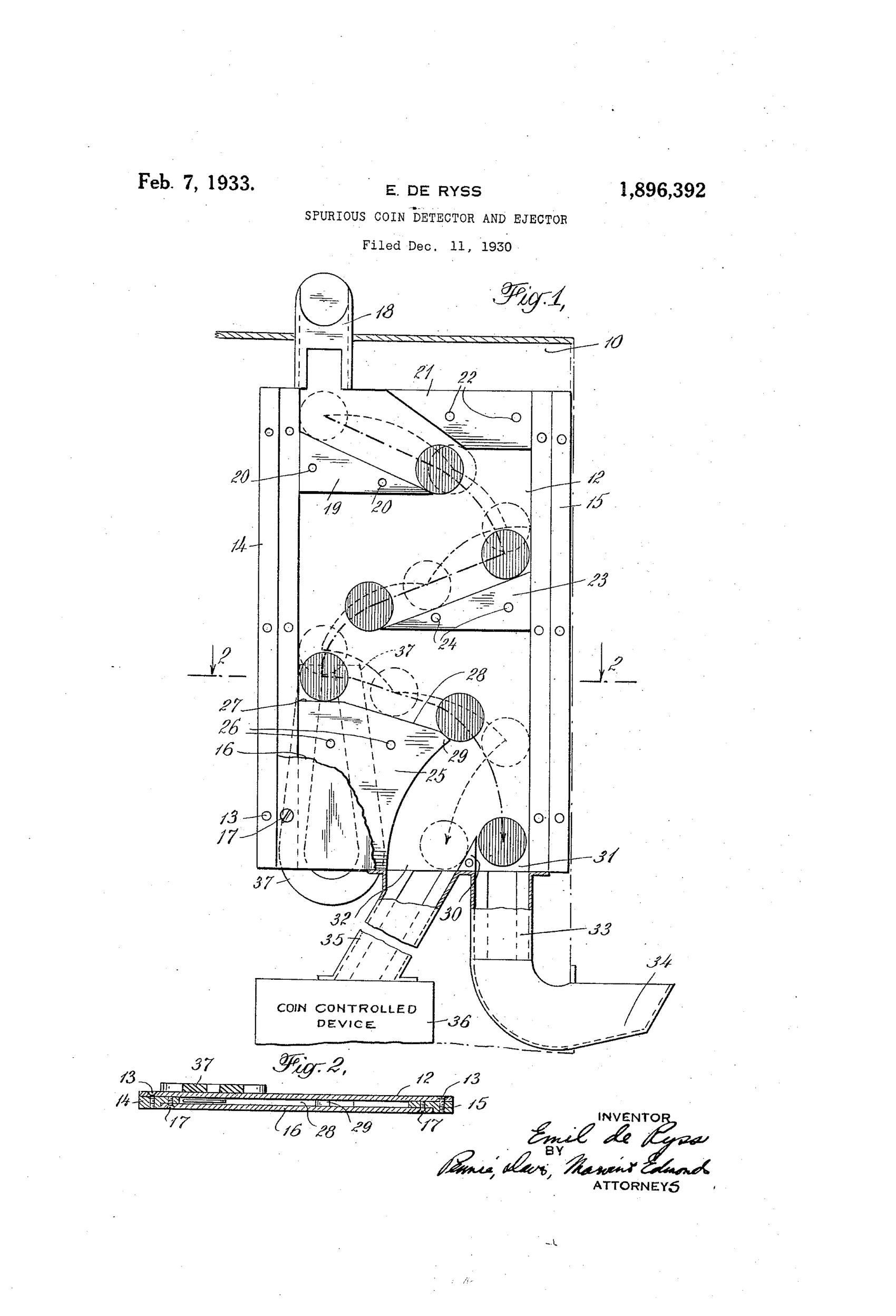
A genuine coin inserted through the coin slot drops onto a series of inclined anvils arranged in a zigzag, decreasing in steepness, bouncing off vertical side anvils, an overhead deflecting anvil, and a horizontal anvil. Because genuine coins are more resilient (springy) than spurious slugs, the coin's rebounds accumulate additively through each flight, giving it enough final bounce to clear a partition wall and drop into the chute leading to the coin-controlled mechanism. Spurious coins, having lower resiliency (and often higher specific gravity, such as lead slugs), fail to rebound sufficiently at each stage and instead strike the partition or miss it, falling into a separate ejector chute that returns them to the user. A permanent magnet is positioned near the last flight to further retard the rebound of magnetic slugs (iron, steel, or their alloys) that might otherwise mimic genuine coin resiliency, ensuring they too drop into the reject chute.
◉ What was claimed
“1. In a spurious coin detector and ejector, the combination of a plurality of inclined anvils arranged in zigzag series, a coin guide leading to the first anvil, the inclination of said anvils decreasing from first to last, and a partition adjacent the discharge end of the last anvil for separating spurious coins from genuine coins in accordance with their resultant resilient effects after traversing said anvils.”
In plain English: The device uses a zigzag series of inclined anvils with decreasing steepness, plus a guide and partition, to sort genuine from fake coins based on how much they bounce after passing through.
◉ In the inventor’s words
“It operates upon the scleroscopic principle, that is to say, it takes advantage of the resiliency or springiness of metal of which bona fide coins are made, as compared to lesser resiliency of a spurious coin, which might have other characteristics identical to the bona fide coin, such as weight, diameter, thickness, hardness, "ring", electrical conductivity or resistance, and the like.”— Emil de Ryss, from the specification
Fate unknown
Bounce testing did enter commercial slug rejectors, but no evidence ties this specific zigzag design to production; a marked mechanism or licensing record would settle it.
◉ Commentary
Most slug rejectors of the era test one property — weight on a cradle, diameter through a gauge, magnetism past a permanent magnet. De Ryss goes after something subtler: elasticity. A struck silver or nickel coin is springy in a way a cast lead slug simply isn't, and he builds a whole obstacle course to amplify that difference. The coin drops onto a zigzag of inclined anvils of decreasing steepness, ricocheting from face to face like a ball in a pachinko machine. Each rebound adds to the next, so by the final flight a genuine coin carries enough liveliness to hop a partition wall into the accept chute, while a dead slug falls short and gets returned.
Look closely at Fig. 1 and you can see the dashed circles tracing the coin's flight path — the drawing is practically a stroboscopic photograph of a bouncing coin. Note also the magnet parked near the last anvil: de Ryss knew steel slugs can be springy too, so he drags them down magnetically just before the decisive jump. That belt-and-suspenders detail shows he understood exactly where his elegant single-property test would fail.
The scleroscopic idea is genuinely clever, and bounce tests did eventually appear inside commercial rejectors. But a cumulative multi-anvil version like this is exquisitely sensitive to wear, dirt, worn coins, and how hard the patron feeds the slot — the kind of thing that works beautifully on a clean bench and drives a route serviceman insane.
Commentary by Claude, The Counterfeit Coin Detector Patent Archive’s resident enthusiast