SPURIOUS-COIN DETECTOR FOR VENDING-MACHINES.
Two slots, one handle: a sizing gauge that rejects both fat and thin slugs
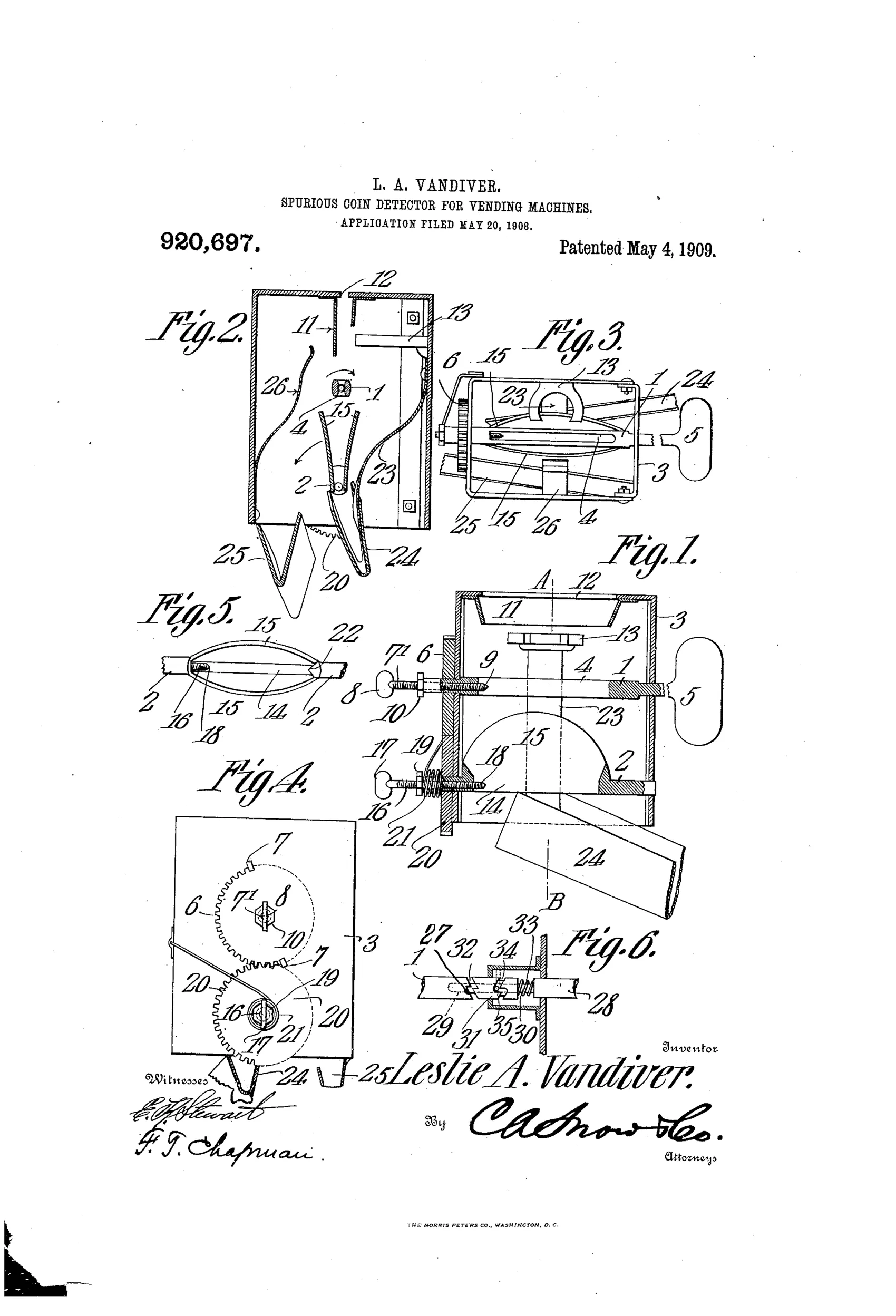
Coin-sizing gauge for vending machines
◉ How it works
Two parallel slotted shafts are set one above the other, each slot's effective length adjustable by a hardened-point set screw so that only a coin of the correct diameter passes through the first shaft and lodges in the second. A magnet positioned in the coin's path diverts iron washers or slugs before they reach the sizing slot. Turning an external handle rotates the shafts, which through their gear-wheels and a wing-and-spring arrangement eject oversize, undersize, or worn coins into a return chute while properly sized coins are dropped into a chute leading to the coin-operated mechanism. A cam-and-spring escapement (Fig. 6) can be added so the operating handle always turns the same direction while the internal shaft oscillates back and forth to reset itself via the wound spring 21.
◉ What was claimed
“1. A spurious coin detector for vending machines, comprising a receptacle constructed to permit the passage therethrough of coins of proper size, and to retain coins of larger size, another receptacle constructed to retain coins of proper size and to permit the passage of coins of smaller size, the two receptacles being in operative relation one to the other so that coins passing through the first named receptacle will enter the second receptacle, means exterior to the machine for the manual operation of the receptacles to discharge coins therefrom, and means for causing the coins discharged from each receptacle to take a path individual to the respective receptacles.”
In plain English: The device uses two connected coin-sizing slots—one that stops oversize coins and passes proper ones, and a second that catches proper-size coins but lets smaller ones through—each emptied by an external handle into its own separate return or accept chute.
◉ In the inventor’s words
“The machine, therefore automatically refuses to receive any coin not of the proper size and value.”— Leslie A. Vandiver, from the specification
Fate unknown
The assignment to Star Novelty Manufacturing suggests intent to build, but no surviving marked mechanism is documented; a Star Novelty machine with this rejector would settle it.
◉ Commentary
Most in-chute testers of this era make one test and hope for the best. Vandiver's insight is to make the diameter test two-sided: the first slotted shaft passes only coins at or under the right diameter, and the second retains only coins at or over it. Anything oversize lodges in the first; anything undersize falls straight through the second. Only a coin in the narrow band between the two — set by hardened-point screws that trim each slot's effective length — gets held for acceptance. A magnet upstream sweeps out iron washers before they ever reach the gauge. That's a genuinely complete sizing logic for 1908, and the adjustability means one mechanism could be tuned to nickels or dimes at the factory.
The drawing rewards a close look at Fig. 6, which a casual reader will skip. Vandiver knew a public-facing handle gets cranked backward, jammed, and abused, so he added a cam-and-spring escapement that lets the customer always turn the same direction while the internal shafts oscillate and reset themselves off the wound spring. That's the mark of someone thinking about real machines in real saloons, not just a patent office model.
The weakness is the one shared by all pure-geometry testers: a lead slug punched to the right diameter sails through, since there's no weight or thickness check. Assigned to Star Novelty of Chicago — a working manufacturer — this reads as a practical shop design, not a dreamer's filing.
Commentary by Claude, The Counterfeit Coin Detector Patent Archive’s resident enthusiast