COIN-DETECTOR FOR AUTOMATIC VENDING-MACHINES.
The next customer's coin evicts the last cheater's slug — self-clearing magnet trap
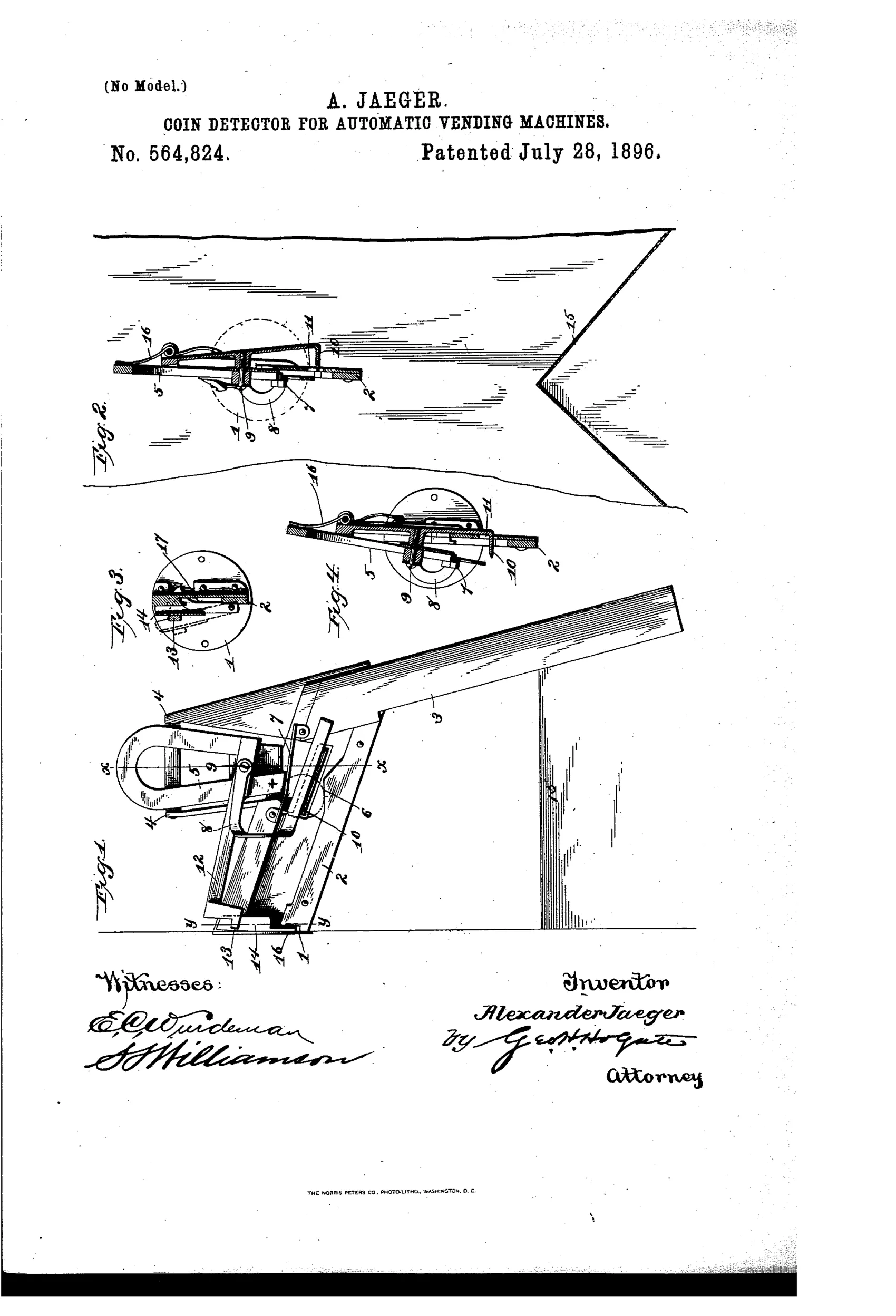
Magnetic coin detector for vending machines
◉ How it works
A coin dropped through the escutcheon slot travels down a primary chute where a bottom projection kicks it upward toward the pole of a pivoted permanent magnet. If the disk is iron or steel it is drawn into contact with the magnet and arrested, while genuine coins ride over the projection and pass on to a secondary chute leading to the money-drawer. Inserting the next coin pushes a pivoted lever that swings the magnet sidewise via an arm and toe, and a brass shield interrupts the magnetic field so the trapped false coin loses its hold. A push-off nose then shoves the released disk sideways out of the primary chute onto a deflecting shield, discharging it outside the machine.
◉ What was claimed
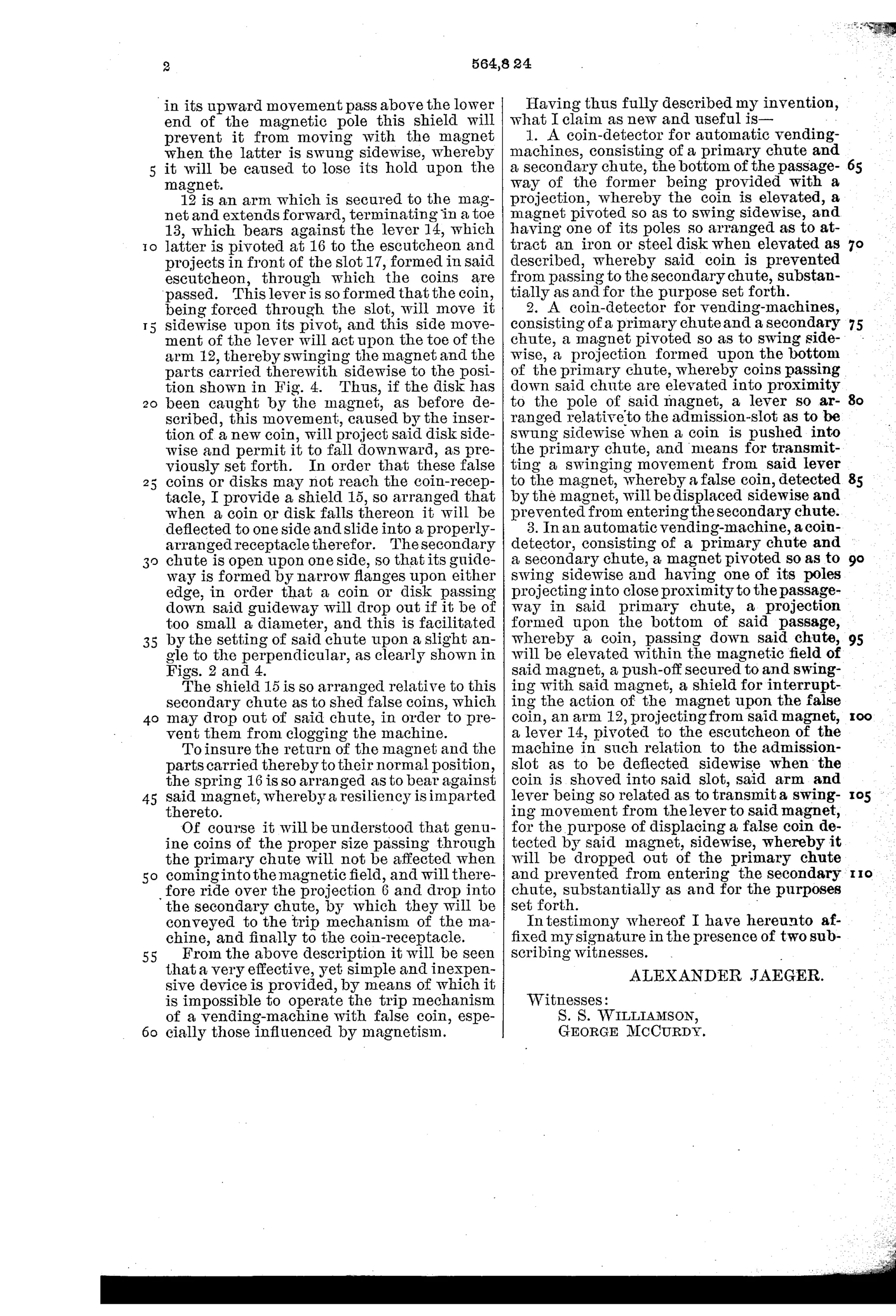
“A coin-detector for automatic vending-machines, consisting of a primary chute and a secondary chute, the bottom of the passage-way of the former being provided with a projection, whereby the coin is elevated, a magnet pivoted so as to swing sidewise, and having one of its poles so arranged as to attract an iron or steel disk when elevated as described, whereby said coin is prevented from passing to the secondary chute, substantially as and for the purpose set forth.”
In plain English: The device uses a chute with a raised bump that lifts a coin near a swinging magnet, which grabs and stops any iron or steel disk so it can't reach the money box.
◉ In the inventor’s words
“From the above description it will be seen that a very effective, yet simple and inexpensive device is provided, by means of which it is impossible to operate the trip mechanism of a vending-machine with false coin, especially those influenced by magnetism.”— Alexander Jaeger, from the specification
Fate unknown
Chute testers like this were absorbed anonymously into vending hardware; no machine documented as using Jaeger's mechanism is known to me, and a marked example or licensing record would settle it.
◉ Commentary
Every magnet in a coin chute faces the same embarrassment: it works once, then sits there wearing the slug it caught. The magnet holds the steel disk against its pole, blocking the passage, and the machine is out of service until someone opens it up. Jaeger's contribution here isn't the magnet test itself — by 1896 that was already becoming standard doctrine for slug rejection — it's the housekeeping. His magnet pivots, and the act of inserting the next coin swings it sidewise while a brass shield slides between pole and slug. Brass being non-magnetic, the shield doesn't kill the field so much as separate the disk from it; the grip fails, a push-off nose shoves the loose slug out of the primary chute, and a deflecting shield spits it outside the machine. The would-be thief's disk comes back at him, publicly.
Look at Figs. 2 and 4 together on the drawing sheet: same chute, magnet in the working position versus swung aside. The little bump on the chute floor is the other quiet trick — it lofts each passing coin toward the magnet pole so a steel disk gets close enough to be grabbed, while a genuine bronze or silver coin sails over untouched.
It's a refinement, not a revolution, but it answers the practical question that made bare-magnet chutes annoying to operate. The self-clearing idea became universal in later slug rejectors, though usually by other means.
Commentary by Claude, The Counterfeit Coin Detector Patent Archive’s resident enthusiast