COIN SELECTOR
A prong that hooks washers by their center hole and lets gravity convict them
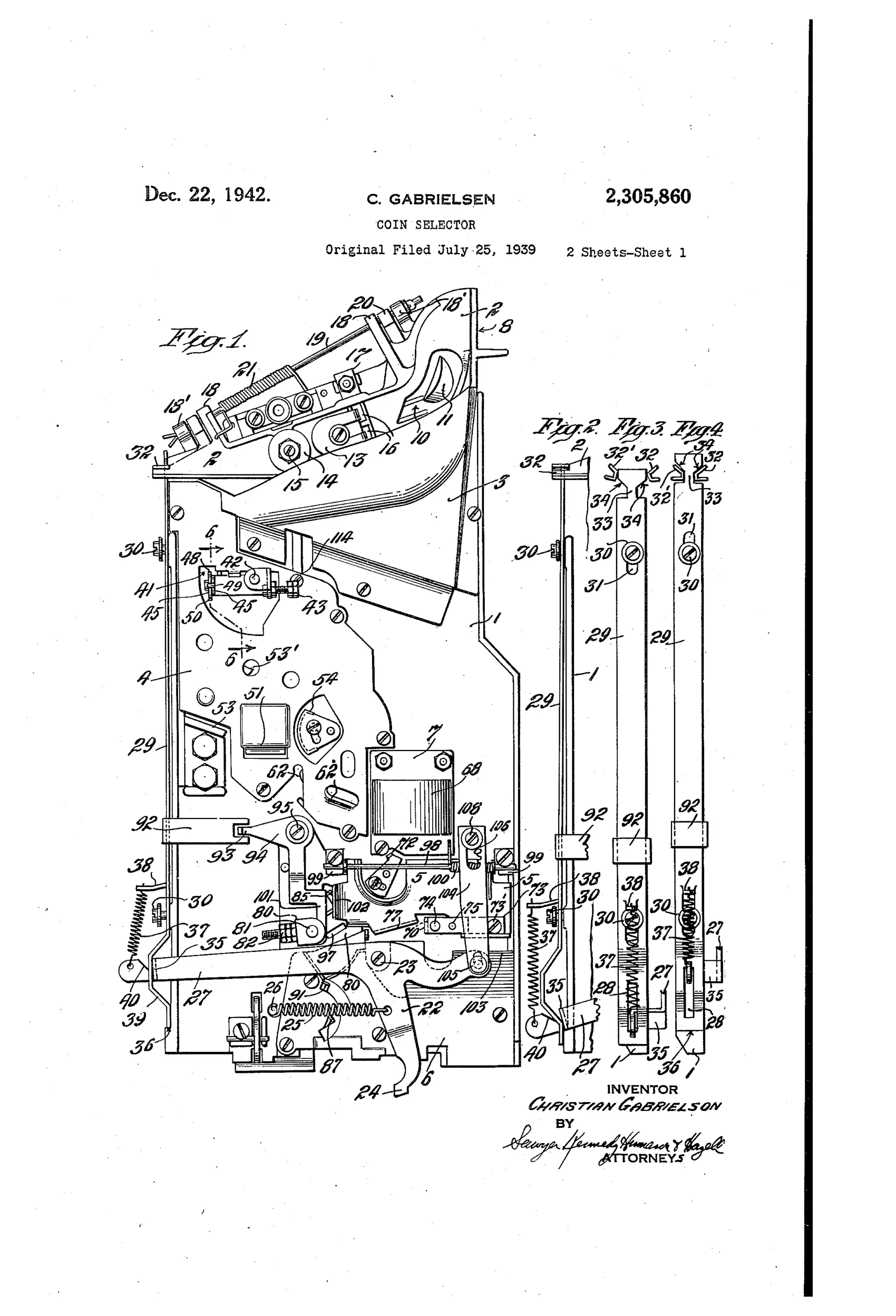
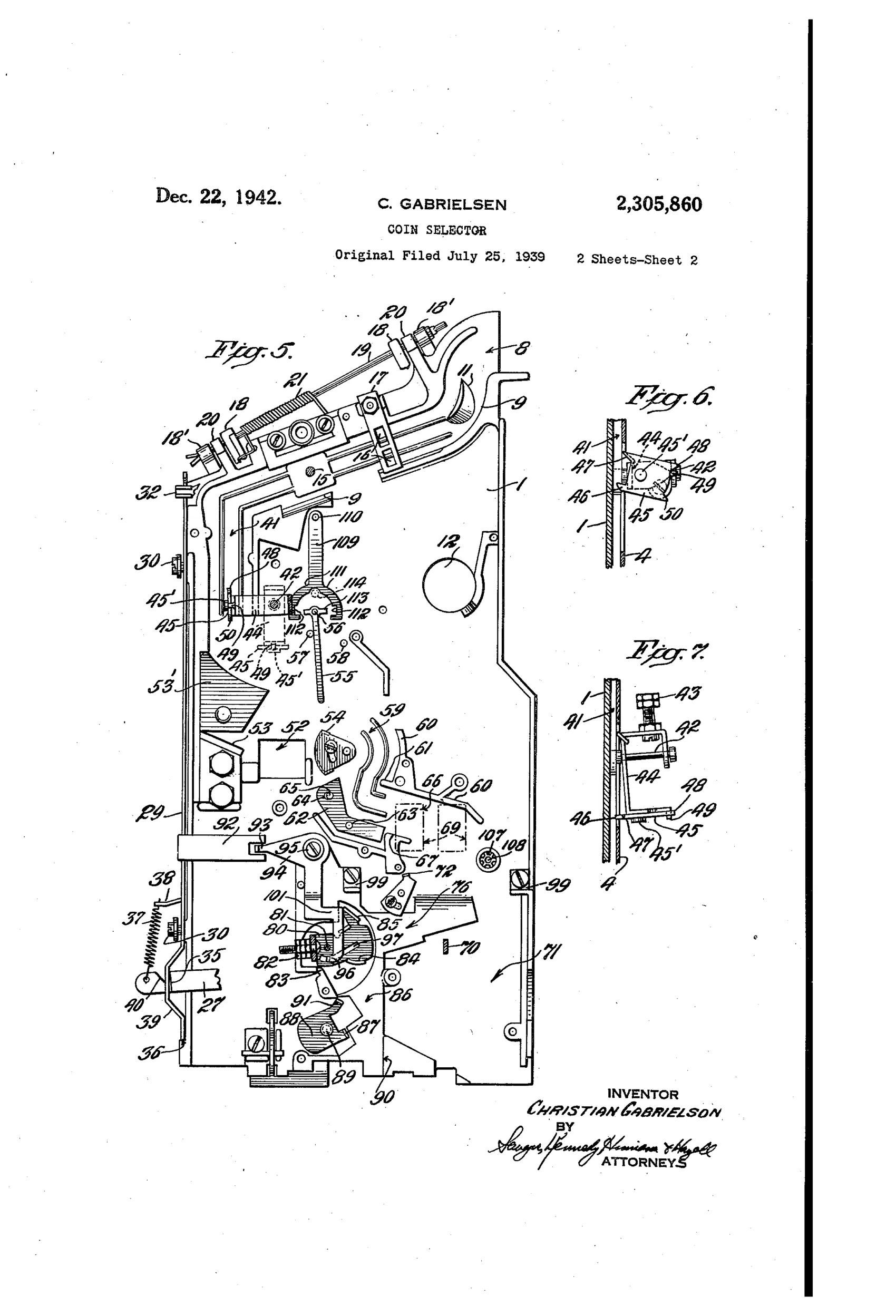
Coin-sorting mechanism with automatic washer/slug rejector
◉ How it works
A coin enters a chute between plates and passes a scavenger with hinged plates that use a magnet and thickness gauge to test for magnetic or oversize coins, releasing them via a spring-loaded pivot to a return hopper. Coins with center holes engage a pivoted washer balance whose prong catches in the hole; the weight of the washer rotates the balance so the prong swings the washer out of the coin plane and drops it into a rejection passage. Solid coins continue past the washer test and pass through a magnetic field passage where eddy currents slow them according to weight and conductivity, sorting good coins from lead, insufficiently elastic, or underweight slugs via bounce tests off an anvil and pivoted stops. A quick-action stripping mechanism, operated by a bell crank, link, and springs, snaps open the various retaining plates suddenly and with a speed independent of the operator, ejecting any improperly lodged coins into rejection chutes rather than allowing slow manual manipulation to defraud the machine.
◉ What was claimed
“In a coin selector, and in combination, a passage for solid coins, a substantially coplanar passage for washers branching therefrom, and a washer rejector comprising a member pivoted for rotation in a plane diverging downwardly from the plane of said passages, a projection upon said member extending into said passage and adapted for engagement by the edge of a coin passing down said first passage to rotate said member to move said projection from said passage, and a washer-engaging prong movable by said projection to engage in the opening of a washer and by means of the weight of a washer so engaged to rotate said member to bring said prong and said washer into said second passage and to further rotate said member to bring said prong outside the plane thereof and leave said washer therein.”
In plain English: A pivoted rejector arm with a prong catches washers by their center hole and, using the washer's own weight, swings out of the solid-coin passage to drop the washer into a separate reject passage.
◉ In the inventor’s words
“The quick action stripping mechanism of the present invention, just described, prevents defrauding of the machine by operating the stripping mechanism slowly with a view to permitting improper coins to pass the various devices provided to retain them in the machine without directing them into the rejection passages provided to receive them, so that they may enter the passages provided for proper coins.”— Christian Gabrielsen, from the specification
Fate unknown
Rowe was a major vending manufacturer and likely used its own patents, but no specific production mechanism traceable to this design is documented; a surviving Rowe rejector matching Fig. 1 would settle it.
◉ Commentary
By 1939 the slug problem had a specific villain: the plain steel or brass washer, which matched a nickel's diameter and weight closely enough to fool simple gauges. Gabrielsen's answer is elegant in a way most chute testers aren't. A pivoted arm carries a prong that intrudes into the coin path; a solid coin's edge simply pushes it aside and rolls on. But a washer's center hole catches on the prong, and the washer's own weight then rotates the arm out of the plane of the passage, carrying the washer into a reject chute before releasing it. The counterfeit convicts itself — the very feature that makes it cheap (the hole) is what the mechanism seizes on.
The second idea here is subtler and shows real fraud experience. Cheats had learned to work coin-return levers slowly, easing a lodged slug past the retaining gates instead of into the reject path. Gabrielsen's stripping linkage — the bell crank and springs in Figs. 2 through 4 — stores the operator's motion and then snaps the plates open at a speed the operator cannot control. You can pull the lever as gently as you like; the mechanism fires at its own pace.
This is a mature, layered design — magnet, thickness gauge, eddy-current retardation, bounce test off an anvil — from Rowe, a serious vending house. It sits squarely in the anonymous-chute era, but the washer prong is worth the price of admission.
Commentary by Claude, The Counterfeit Coin Detector Patent Archive’s resident enthusiast