COIN CHUTE DEFLECTOR
A ratchet-and-spring fix for the vending machine's loosening set screw
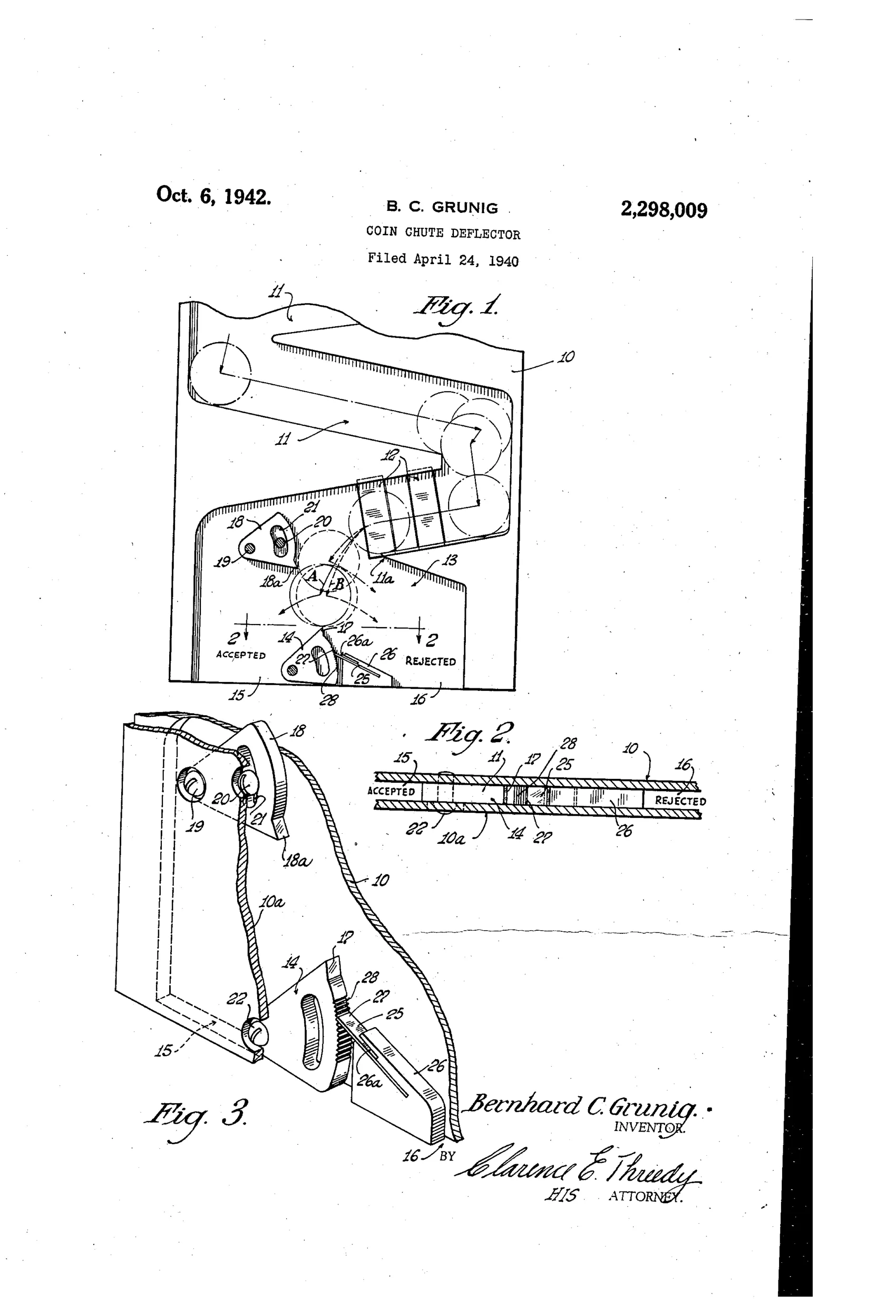
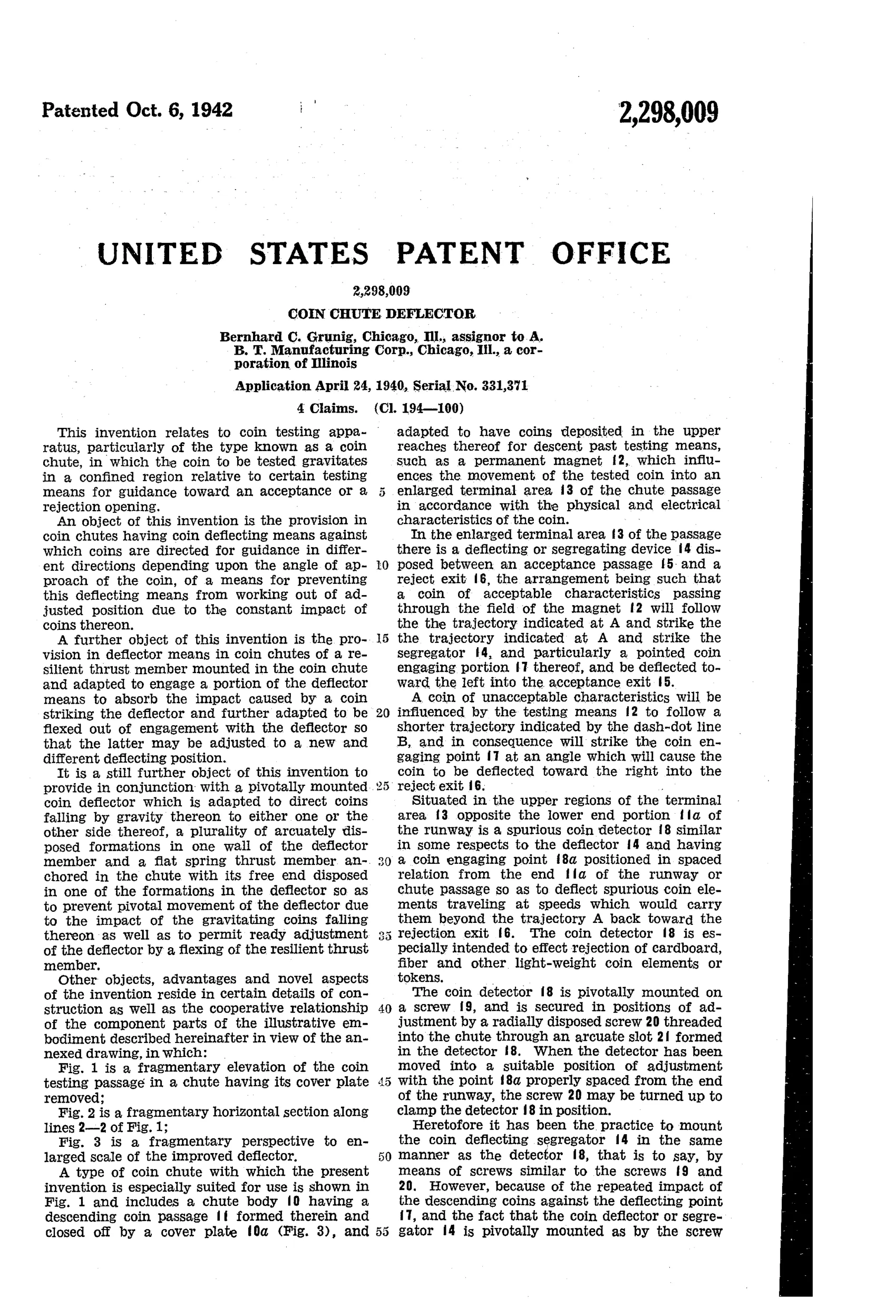
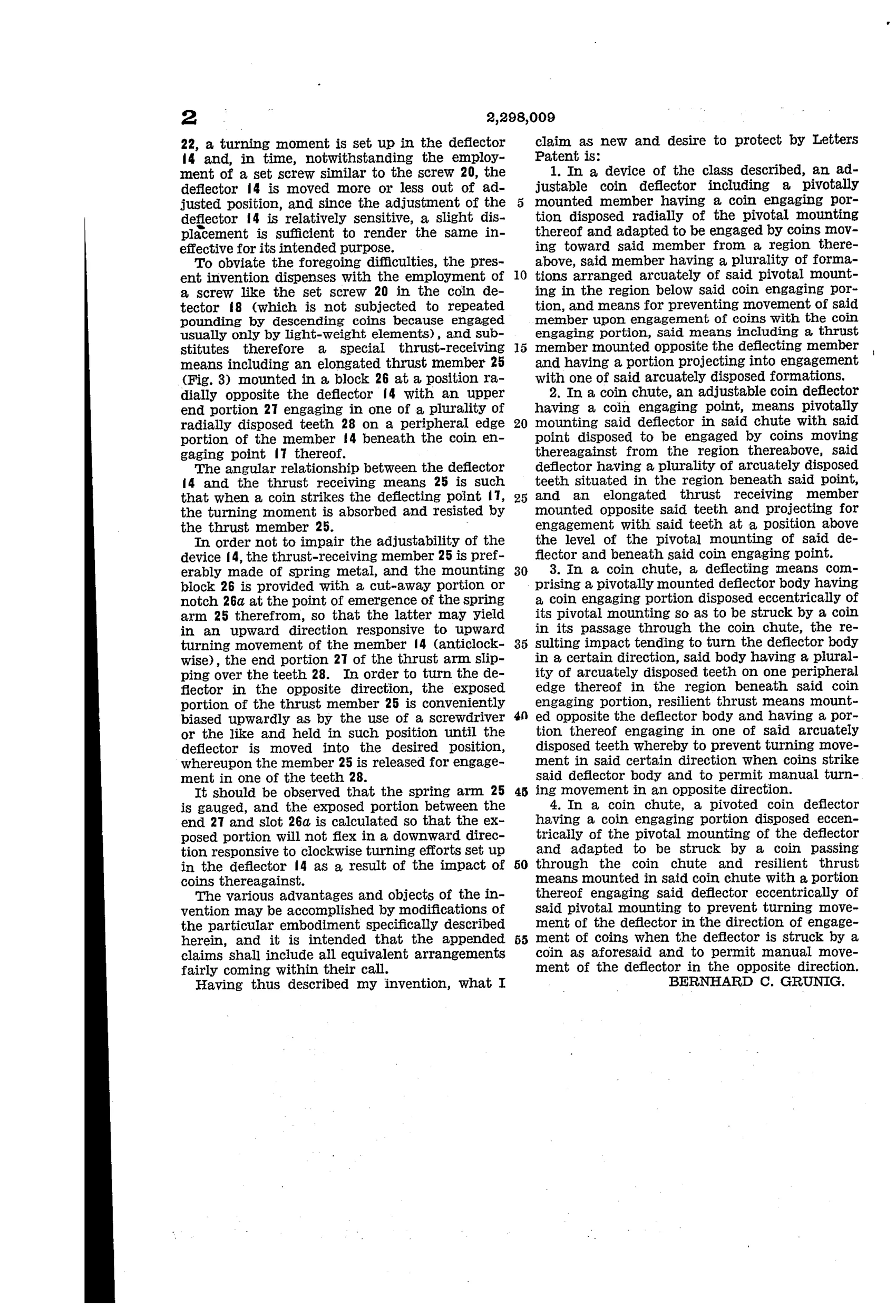
Adjustable spring-loaded coin sorting deflector for vending chutes
◉ How it works
A pivoted deflector body sits in the coin passage with a coin-engaging point struck by descending coins traveling different trajectories depending on their characteristics as sensed by a magnet. The deflector carries a series of arcuately arranged teeth on its lower peripheral edge. A resilient flat spring thrust member, anchored in a notched mounting block, projects its free end into one of these teeth to resist the turning moment created by coin impact, holding the deflector in adjusted position. To re-adjust, the spring arm is manually flexed upward out of engagement, allowing the deflector to be turned and the spring to snap into a different tooth, resetting the acceptance/rejection angle.
◉ What was claimed
“In a device of the class described, an adjustable coin deflector including a pivotally mounted member having a coin engaging portion disposed radially of the pivotal mounting thereof and adapted to be engaged by coins moving toward said member from a region thereabove, said member having a plurality of formations arranged arcuately of said pivotal mounting in the region below said coin engaging portion, and means for preventing movement of said member upon engagement of coins with the coin engaging portion, said means including a thrust member mounted opposite the deflecting member and having a portion projecting into engagement with one of said arcuately disposed formations.”
In plain English: A pivoted coin deflector with a row of arc-shaped teeth is held in place against coin impacts by a spring-loaded thrust arm that engages one of the teeth, and can be re-adjusted by disengaging and re-engaging the spring in a different tooth.
◉ In the inventor’s words
“To obviate the foregoing difficulties, the present invention dispenses with the employment of a screw like the set screw 20 in the coin detector 18 ... and substitutes therefore a special thrust-receiving means including an elongated thrust member 25 (Fig. 3) mounted in a block 26 at a position radially opposite the deflector 14.”— Bernhard C. Grunig, from the specification
Fate unknown
A.B.T. built coin mechanisms in large numbers, so production is plausible, but only a teardown of a surviving A.B.T. chute showing this toothed-deflector detail would settle it.
◉ Commentary
By 1940 the pocket balance era was long over, and the action in this class had moved inside the machines. Grunig's patent, assigned to A.B.T. Manufacturing — one of Chicago's big suppliers of coin mechanisms to the vending and amusement trades — attacks a genuinely mundane problem: the pivoted deflector that sorts coins into ACCEPTED and REJECTED slots takes a small hammer blow from every coin that falls through the chute, and the set screw holding it at the right angle works loose over thousands of impacts. Once it drifts, the machine starts rejecting good nickels or, worse, swallowing slugs.
His answer is visible in Fig. 3: the deflector's lower edge carries a fan of arc-shaped teeth, and a flat spring arm anchored in a notched block presses into one tooth. The coin's impact drives the deflector against the spring's thrust rather than against screw threads, so nothing can back off. To recalibrate, a serviceman flexes the spring clear, clicks the deflector to a new tooth, and lets go — adjustment without tools, and it can't creep.
Note in Fig. 1 the dotted trajectories labeled A and B below the magnet 12: the magnet drags steel slugs onto a different fall path than genuine coins, and the deflector's point splits the two paths. Grunig isn't inventing the magnet test — that's decades old by now — he's making its downstream sorting stay in tune. It's a refinement patent, but the kind that decides whether a mechanism survives in the field.
Commentary by Claude, The Counterfeit Coin Detector Patent Archive’s resident enthusiast