COIN SELECTOR
Mills Novelty grades magnetism on a scale to catch the Canadian nickel
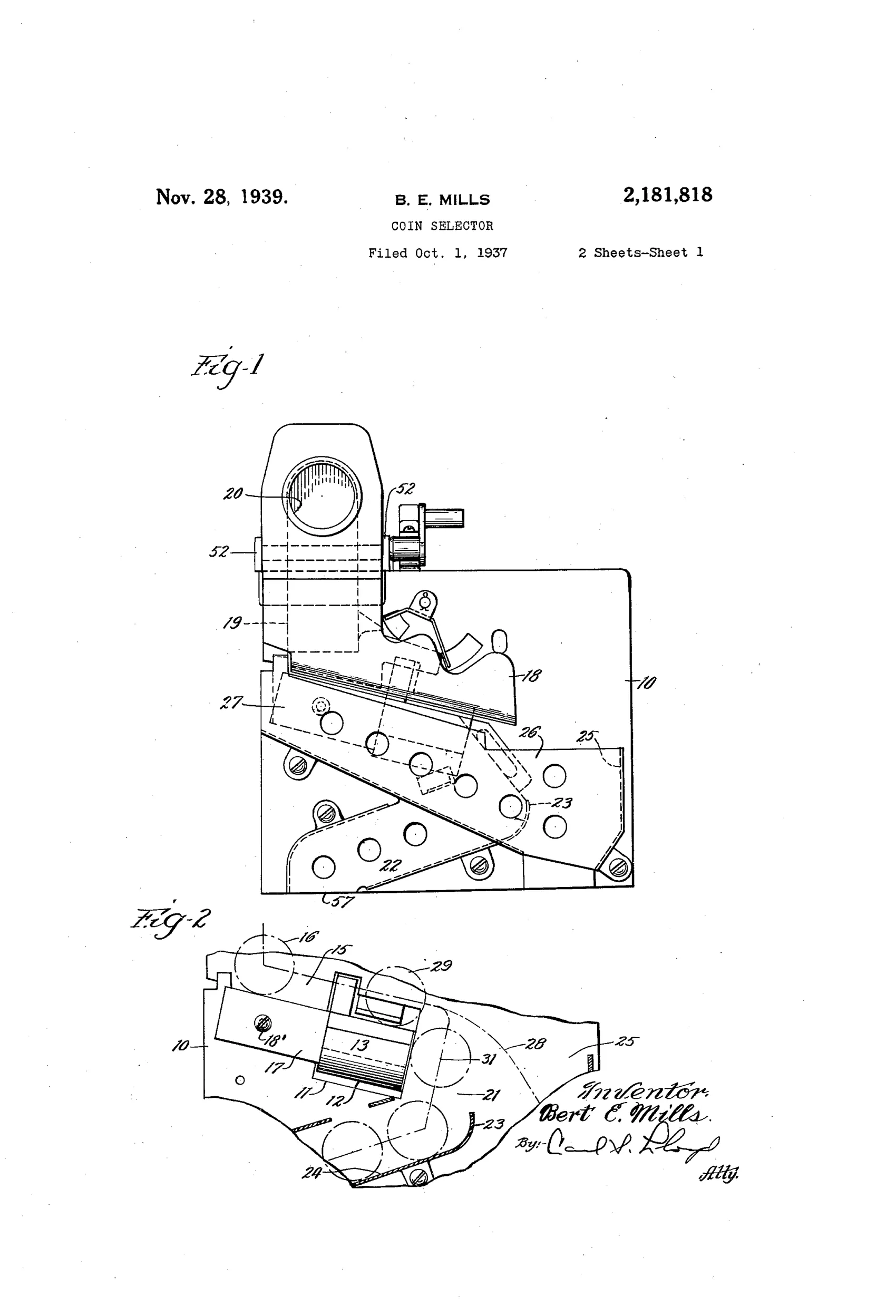
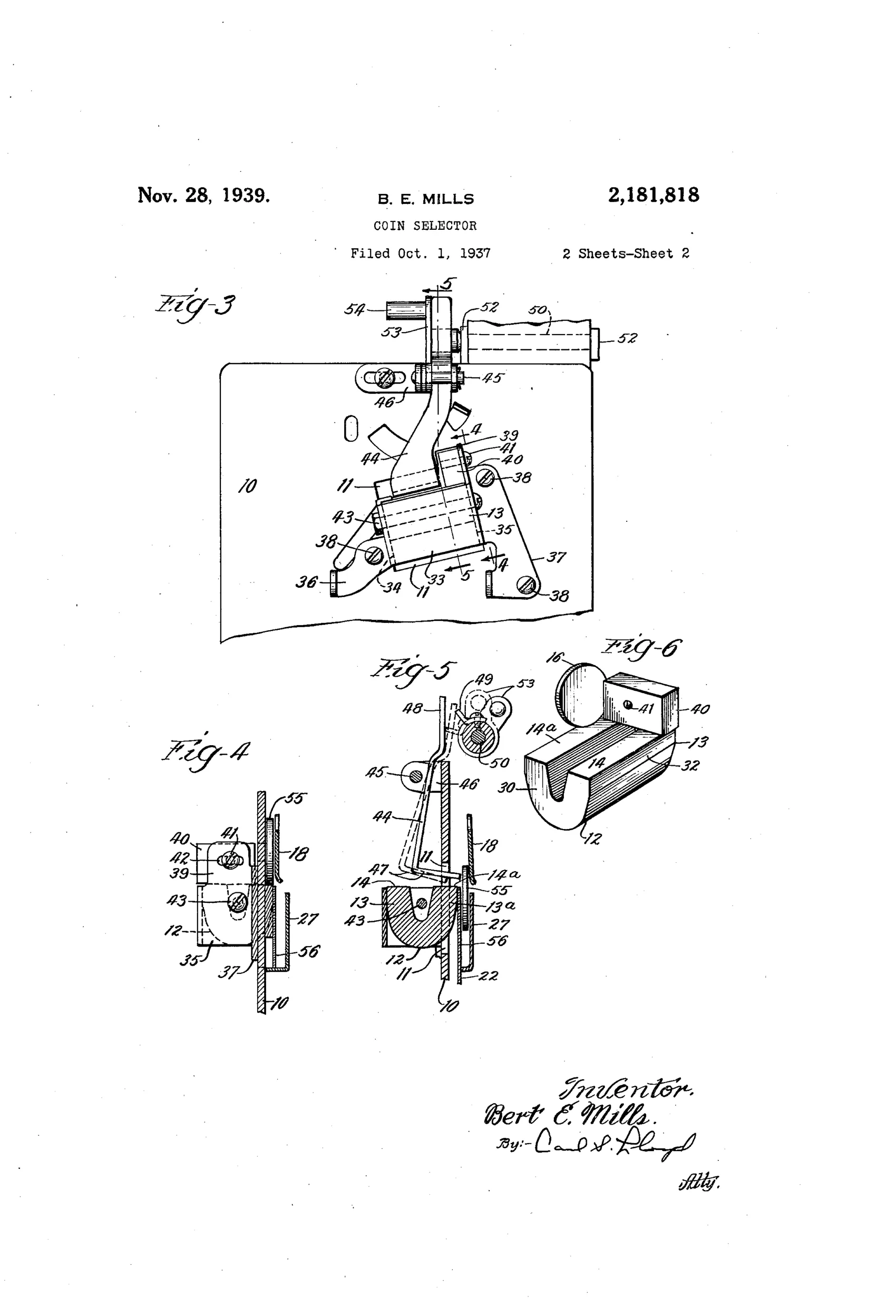
Magnetic device for sorting canadian nickel coins
◉ How it works
A coin chute directs coins to roll in direct contact along the elongated end face of a horseshoe magnet's pole piece. Weakly paramagnetic Canadian nickels are slowed and diverted around the end of the pole into a separate discharge chute, while diamagnetic (non-magnetic) coins retain enough momentum to jump across the gap into another passage. Highly paramagnetic iron or steel slugs are completely arrested by the magnet and held until a pivoted kicker, driven by a cam and shaft, later knocks them off into a scavenger chute. An adjustable iron or steel block bridging the pole faces can be slid to short-circuit part of the magnetic flux, letting the operator tune the field strength so nickels divert properly without stopping or passing incorrectly.
◉ What was claimed
“In a coin selector for paramagnetic coins, means for effecting separation of coins of intermediate paramagnetic qualities from slugs of higher paramagnetic qualities comprising a selector chute adapted to receive coins to be tested, a horseshoe magnet the pole faces of which are elongated in a direction perpendicular to the plane of the magnet, one of said faces extending longitudinally of said selector chute and forming the bottom therefor, said face being substantially longer than the diameter of a Canadian five-cent coin, a bridge of conductive material extending between the pole faces of said magnet and being adjustable to vary the magnetic attraction of the latter upon the coins, a discharge chute adjacent said magnet for receiving coins which are substantially retarded by the magnet, and a second discharge chute for receiving coins which are not substantially retarded by the magnet.”
In plain English: The device uses a horseshoe magnet with an elongated pole face forming the floor of a coin chute, plus an adjustable metal bridge between the poles to tune magnetic pull, so that coins slowed by the magnet go to one outlet and unaffected coins go to another.
◉ In the inventor’s words
“Canadian nickels have a high nickel content. Nickel is sufficiently magnetic to be classed as a paramagnetic substance, although it is not as strongly magnetic as iron or steel.”— Bert E. Mills, from the specification
Fate unknown
Mills Novelty certainly manufactured slug rejectors, but tying this specific adjustable-bridge design to a production mechanism would take a surviving marked example or factory documentation.
◉ More by Bert E. Mills
- COIN SELECTOR (1939)
◉ Commentary
Most magnetic slug rejectors treat the world as binary: a coin either sticks to the magnet (steel slug, reject) or sails past (good coin, accept). Bert Mills's problem was that the Canadian five-cent piece broke that binary. Its high nickel content made it weakly magnetic — not enough to stick, but enough to behave differently from a US nickel. So this selector sorts coins into three bins by degree of magnetic response: diamagnetic coins keep their momentum and jump a gap into the accept passage, the mildly paramagnetic Canadian nickel is dragged just enough to fall short and curl around the pole end into its own chute, and steel slugs stop dead on the pole face until a cam-driven kicker knocks them into a scavenger chute.
The genuinely clever bit is in Fig. 6: an iron bridge block slid along the horseshoe's poles to short-circuit part of the flux. That turns a fixed magnet into a tunable one, letting a route mechanic dial the field so the Canadian coin diverts reliably without stalling — a practical concession to the fact that magnets age and coins vary.
This is late-period, corporate-era work in the category: no romance of the brass rocker, but a precise answer to a real 1930s operator headache — cross-border coinage leaking into American slot and vending routes. Mills Novelty built its own mechanisms in enormous volume, so the idea had a plausible path straight into hardware.
Commentary by Claude, The Counterfeit Coin Detector Patent Archive’s resident enthusiast