COIN SELECTOR
Sorting nickels from slugs by how hard they bounce off knife edges
Coin selector separating nickels from counterfeit slugs by rebound
◉ How it works
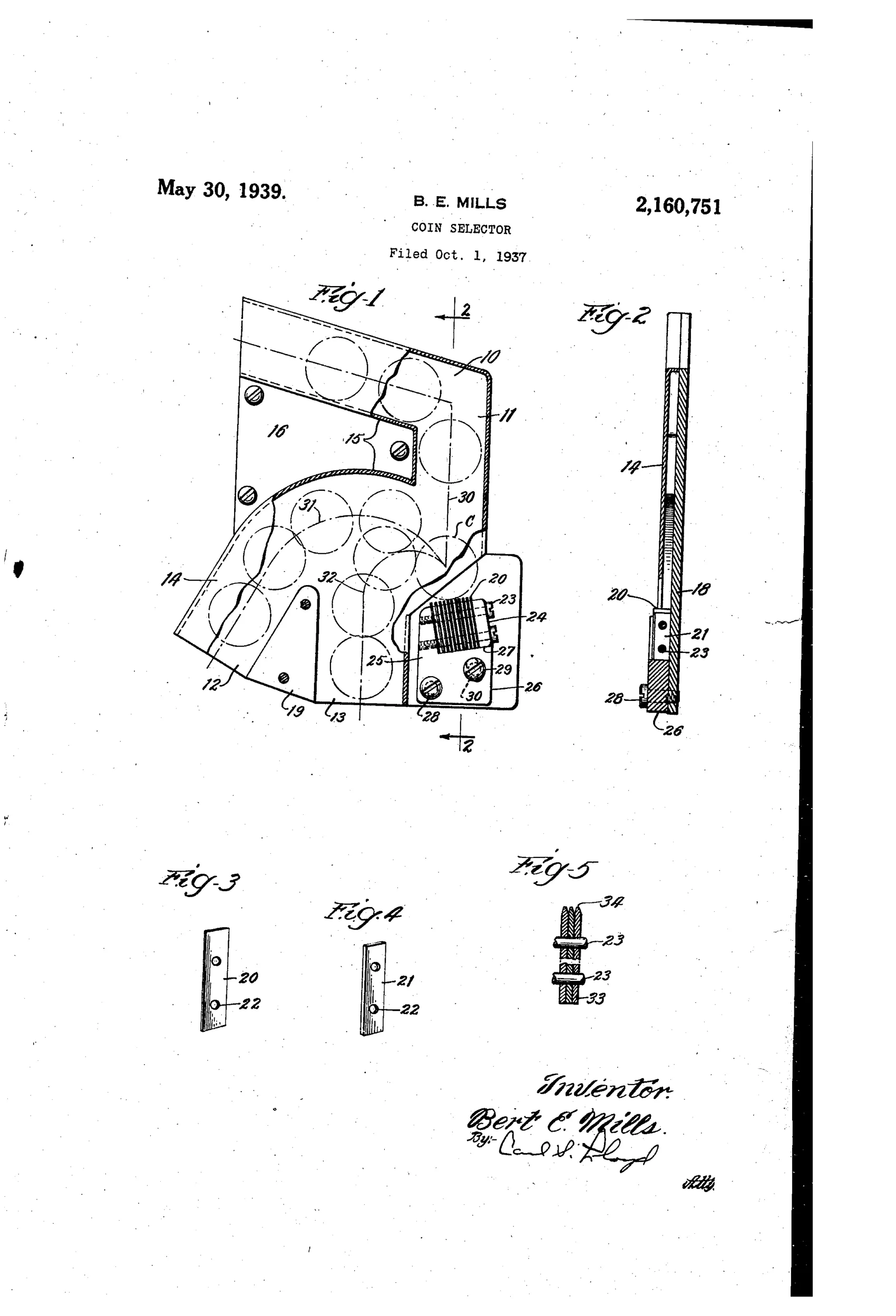
The device drops a coin down a vertical passage so that it strikes a rebound member made of a series of thin, spaced hardened steel plates forming knife edges positioned at right angles to the coin's plane of travel. Genuine United States nickels rebound strongly off these knife edges into an extended trajectory that clears a dividing barrier and enters an acceptable coin outlet passage. Die-casting metal slugs, though similar in weight and appearance, lack the toughness of the nickel-copper alloy and are penetrated by the knife edges, deadening their rebound so they fall short into a rejection outlet. A saddle and adjustable screw arrangement allows the angle of the rebound surface to be tuned, and a modified form uses beveled blade edges instead of stacked plates.
◉ What was claimed
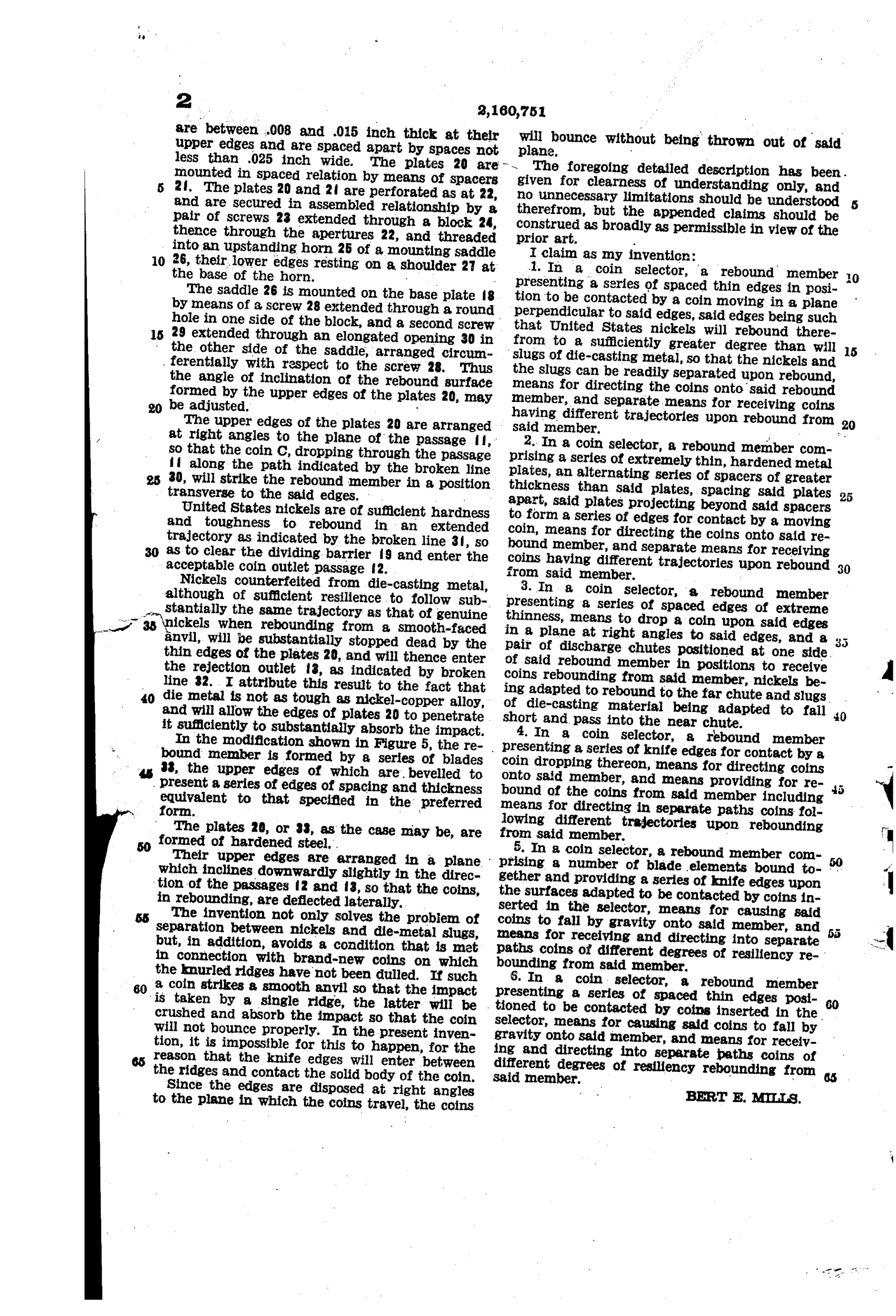
“In a coin selector, a rebound member presenting a series of spaced thin edges in position to be contacted by a coin moving in a plane perpendicular to said edges, said edges being such that United States nickels will rebound therefrom to a sufficiently greater degree than will slugs of die-casting metal, so that the nickels and the slugs can be readily separated upon rebound, means for directing the coins onto said rebound member, and separate means for receiving coins having different trajectories upon rebound from said member.”
In plain English: A coin selector uses a rebound surface made of thin edges that bounces genuine nickels much farther than counterfeit die-cast slugs, so the two can be sorted into separate paths based on how far they bounce.
◉ In the inventor’s words
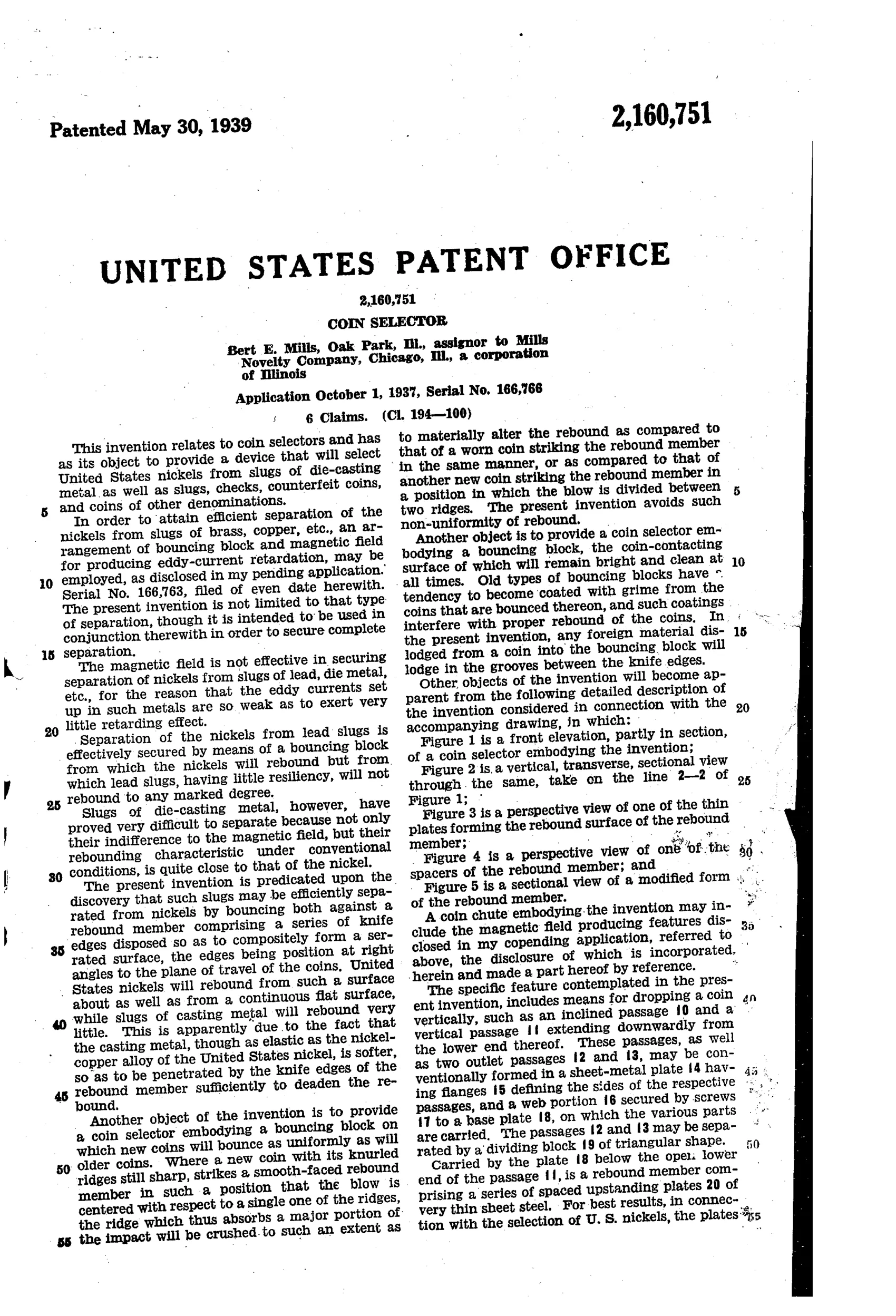
“The present invention is predicated upon the discovery that such slugs may be efficiently separated from nickels by bouncing both against a rebound member comprising a series of knife edges disposed so as to compositely form a serrated surface, the edges being position at right angles to the plane of travel of the coins.”— Bert E. Mills, from the specification
Fate unknown
Mills Novelty built coin mechanisms in enormous volume, but I know of no documented example of this specific laminated rebound unit; one found in a surviving Mills machine would settle it.
◉ More by Bert E. Mills
- COIN SELECTOR (1939)
◉ Commentary
Most slug rejectors of the 1930s test what a counterfeit is — magnetic, oversized, underweight. Bert Mills's selector tests what a slug does: it drops the coin onto a serrated anvil built from a stack of thin hardened steel plates set edge-on to the coin's path, and lets metallurgy do the sorting. A genuine cupronickel five-cent piece is tough; it rings off the knife edges and sails over a dividing barrier into the accept chute. A die-cast zinc or lead slug is soft; the edges bite into it, absorb the impact, and it drops dead into the reject path. This is a hardness-and-elasticity test with no moving parts at all in the sensing element.
The drawing rewards a close look. Figs. 3 and 4 show why the rebound member is laminated rather than machined: alternating thin plates and spacers give a serrated surface from cheap stampings, easily replaced when the edges dull — and they will dull, since the mechanism literally works by denting the counterfeits. The adjustable saddle-and-screw mount for tuning the rebound angle is the tell that Mills expected to calibrate these on real machines.
The context matters: Mills Novelty was the giant of coin-operated amusements, and die-cast slugs were the plague of the nickel trade. Filed by the company that had the most nickels at stake, this is a practical engineer's answer, not a parlor curiosity — and bounce testing genuinely discriminates where magnets fail, since zinc slugs are as nonmagnetic as nickels.
Commentary by Claude, The Counterfeit Coin Detector Patent Archive’s resident enthusiast