COIN CONTROLLED DEVICE
The push-slide coin acceptor that gives your slug back instead of eating it
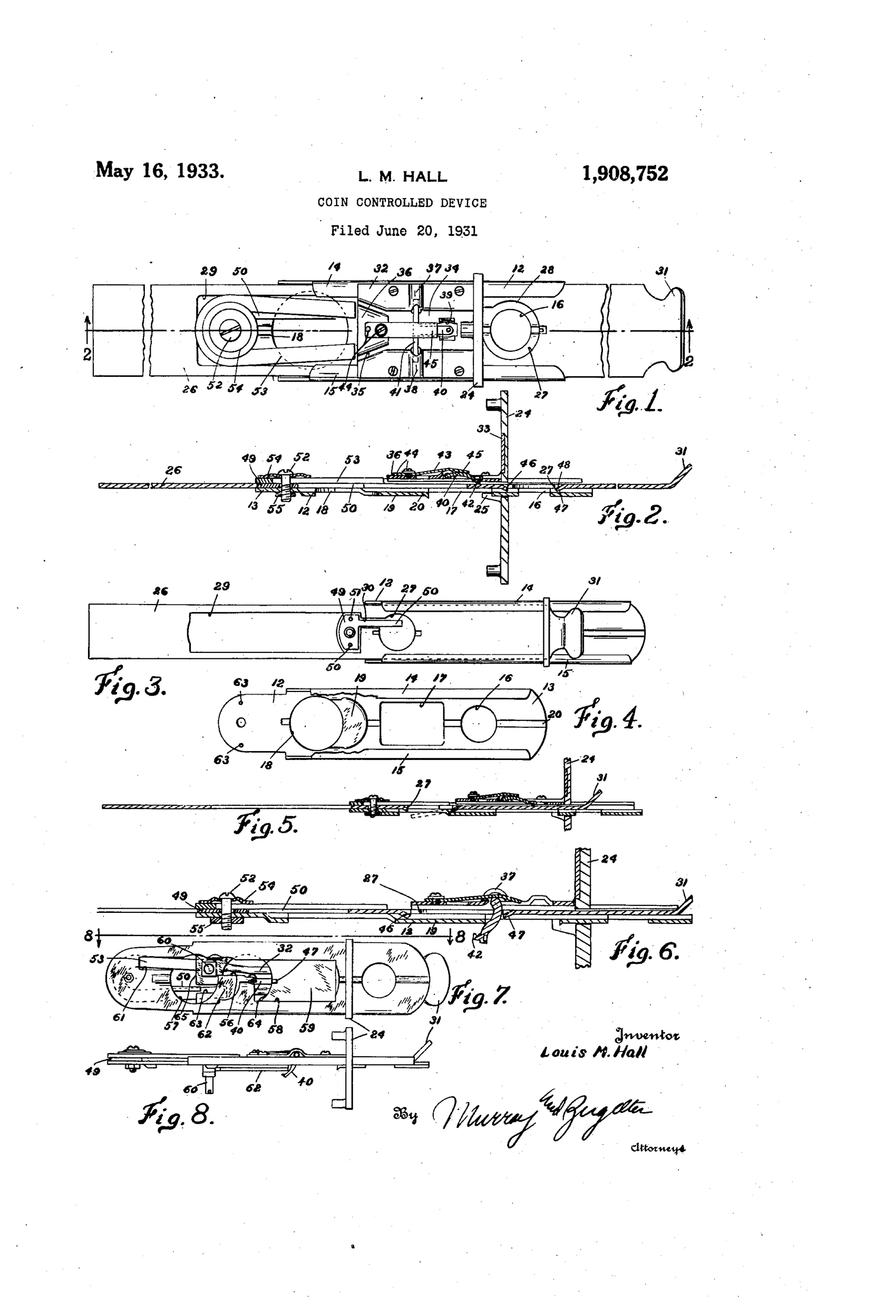
Coin-controlled slide mechanism rejecting wrong coins/magnetic slugs
◉ How it works
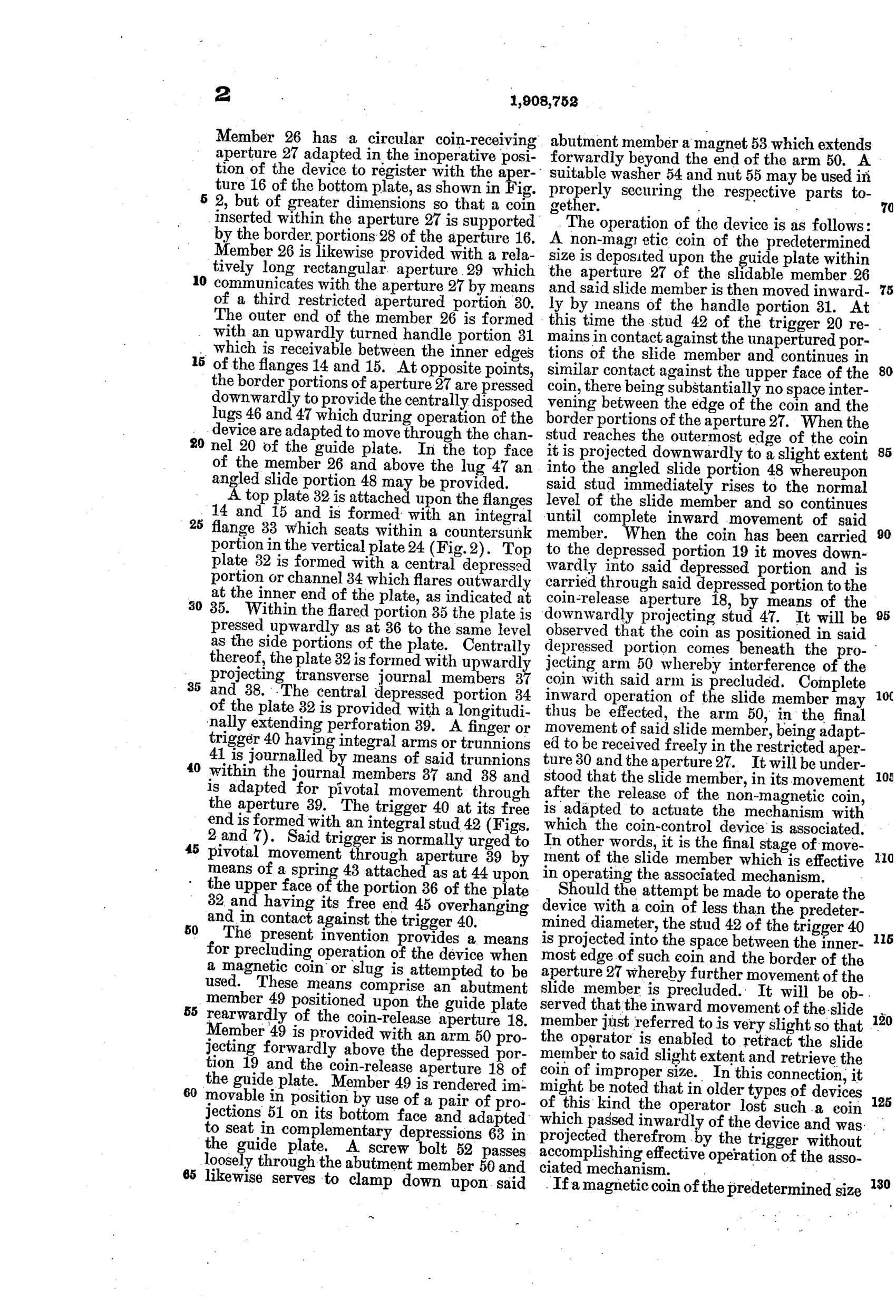
A slidable strip-like member with a circular coin-receiving aperture travels along a guide plate between overhanging flanges. A spring-loaded trigger stud rides atop the slide and drops into the coin aperture, blocking inward travel unless a coin of the correct diameter fills the gap between the coin edge and the aperture border. A depressed portion and lug carry a properly sized non-magnetic coin through to a release aperture to actuate the associated mechanism. A magnet mounted above the depressed portion attracts and upholds any magnetic coin or slug, drawing it against an abutment arm so that full inward movement—and thus actuation—is prevented, forcing the operator to retract the slide and remove the improper coin.
◉ What was claimed
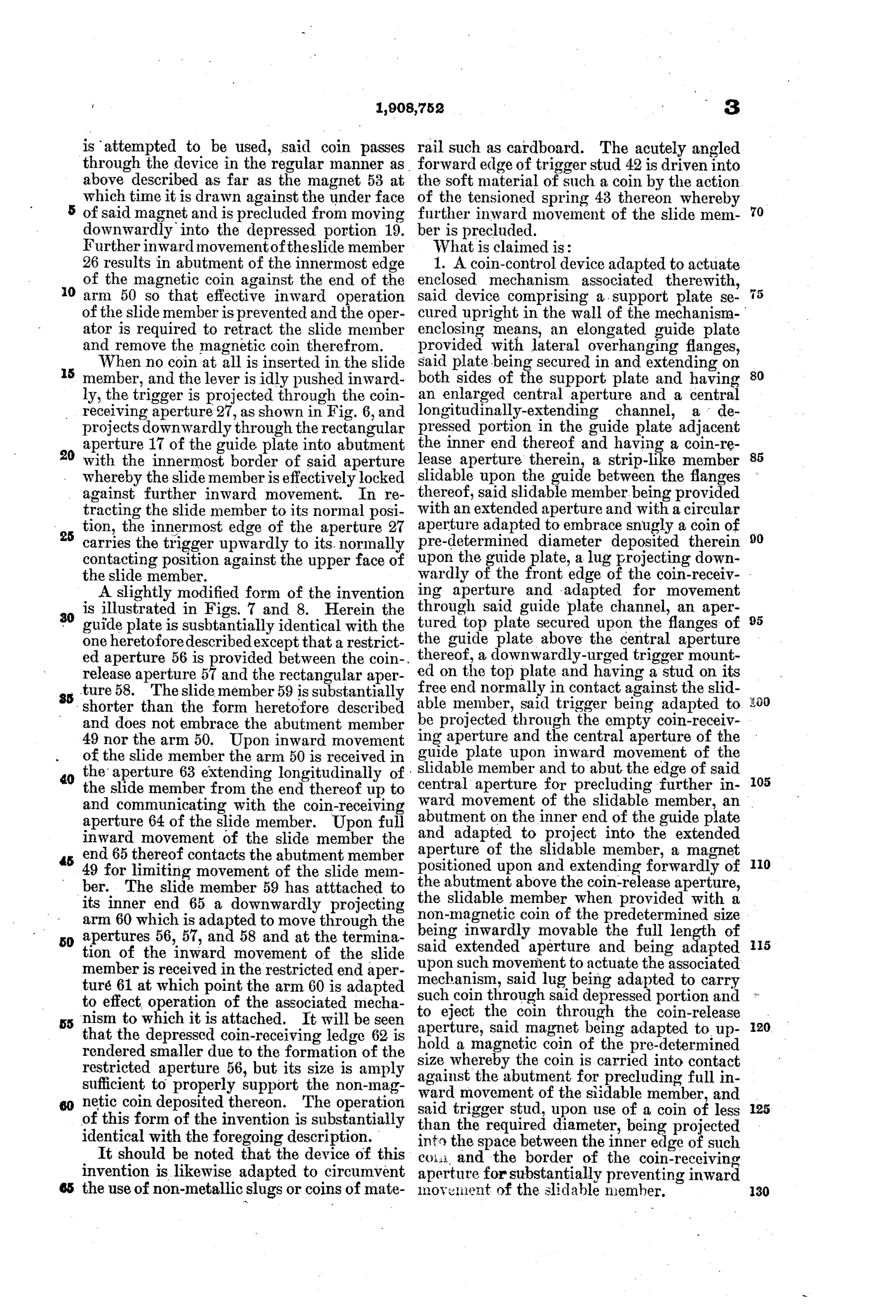
“1. A coin-control device adapted to actuate enclosed mechanism associated therewith, said device comprising a support plate secured upright in the wall of the mechanism-enclosing means, an elongated guide plate provided with lateral overhanging flanges, said plate being secured in and extending on both sides of the support plate and having an enlarged central aperture and a central longitudinally-extending channel, a depressed portion in the guide plate adjacent the inner end thereof and having a coin-release aperture therein, a strip-like member slidable upon the guide between the flanges thereof, said slidable member being provided with an extended aperture and with a circular aperture adapted to embrace snugly a coin of pre-determined diameter deposited therein upon the guide plate, a lug projecting downwardly of the front edge of the coin-receiving aperture and adapted for movement through said guide plate channel, an apertured top plate secured upon the flanges of the guide plate above the central aperture thereof, a downwardly-urged trigger mounted on the top plate and having a stud on its free end normally in contact against the slidable member, said trigger being adapted to be projected through the empty coin-receiving aperture and the central aperture of the guide plate upon inward movement of the slidable member and to abut the edge of said central aperture for precluding further inward movement of the slidable member, an abutment on the inner end of the guide plate and adapted to project into the extended aperture of the slidable member, a magnet positioned upon and extending forwardly of the abutment above the coin-release aperture, the slidable member when provided with a non-magnetic coin of the predetermined size being inwardly movable the full length of said extended aperture and being adapted upon such movement to actuate the associated mechanism, said lug being adapted to carry such coin through said depressed portion and to eject the coin through the coin-release aperture, said magnet being adapted to uphold a magnetic coin of the pre-determined size whereby the coin is carried into contact against the abutment for precluding full inward movement of the slidable member, and said trigger stud, upon use of a coin of less than the required diameter, being projected into the space between the inner edge of such coin and the border of the coin-receiving aperture for substantially preventing inward movement of the slidable member.”
In plain English: A coin mechanism uses a sliding plate with a coin-sized hole; a spring trigger blocks the slide unless a correctly sized coin is present, while a magnet catches any magnetic slug or wrong coin so it can't complete the operating stroke, forcing removal of improper coins.
◉ In the inventor’s words
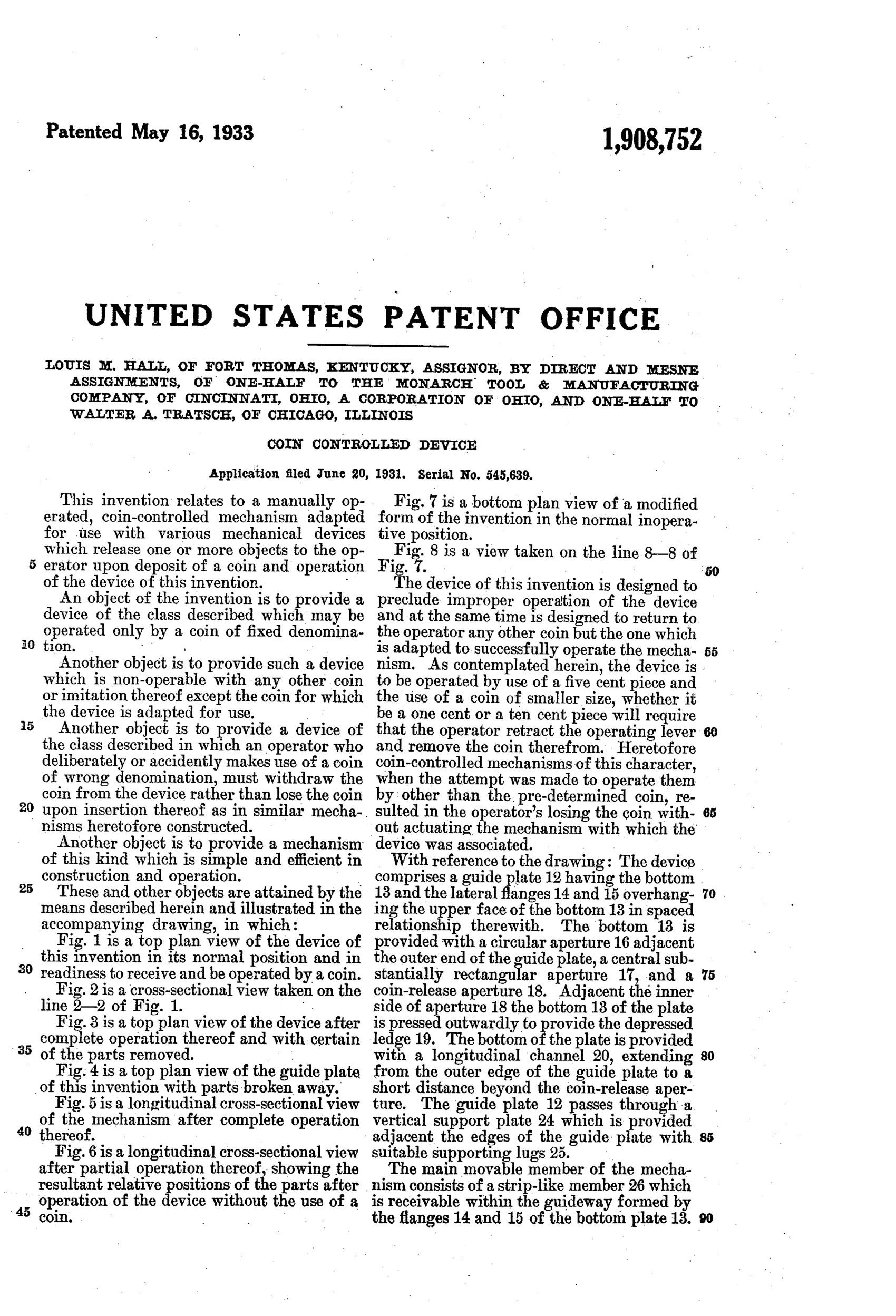
“Heretofore coin-controlled mechanisms of this character, when the attempt was made to operate them by other than the pre-determined coin, resulted in the operator's losing the coin without actuating the mechanism with which the device was associated.”— Louis M. Hall, from the specification
Manufactured and sold
Assigned to Monarch Tool & Manufacturing, whose push-slide coin acceptors of this pattern were produced commercially and remained in wide use for decades.
◉ More by Louis M. Hall
- COIN CONTROLLED DEVICE (1933)
◉ Commentary
Hall's opening complaint is the whole story: earlier coin mechanisms swallowed a bad coin and gave nothing back. His answer is a sliding strip you push inward by hand, with the coin sitting in a circular aperture that must be filled edge-to-edge. If the coin is undersized, a spring-loaded trigger stud drops into the leftover crescent of space and jams the stroke cold. If the coin is a steel slug, a magnet mounted over the release point lifts it against an abutment arm — again blocking the stroke. Either way, you pull the slide back out and retrieve your improper coin. Nothing is lost, nothing is actuated.
Compare Figs. 5 and 6 on the sheet: the same longitudinal section with a good coin completing the stroke and with the trigger stud fallen through the empty aperture partway in. That pair is the mechanism's entire logic made visible — the coin itself is the bridge the trigger rides over. It is a lovely inversion: the coin is not merely tested, it is a structural part of the machine for the length of one stroke.
The assignment tells you where this sits. Half to Monarch Tool & Manufacturing of Kentucky, half to Walter A. Tratsch of Chicago coin-machine fame — this is not a lone tinkerer's fancy but working hardware for the trade-stimulator and vending business. The manual push-slide acceptor of exactly this family became one of the most durable coin mechanisms ever built; you have pushed one on a laundromat washer.
Commentary by Claude, The Counterfeit Coin Detector Patent Archive’s resident enthusiast