COIN CONTROLLED DEVICE
Monarch's answer to the shim artist: a coin slide with interlocking teeth
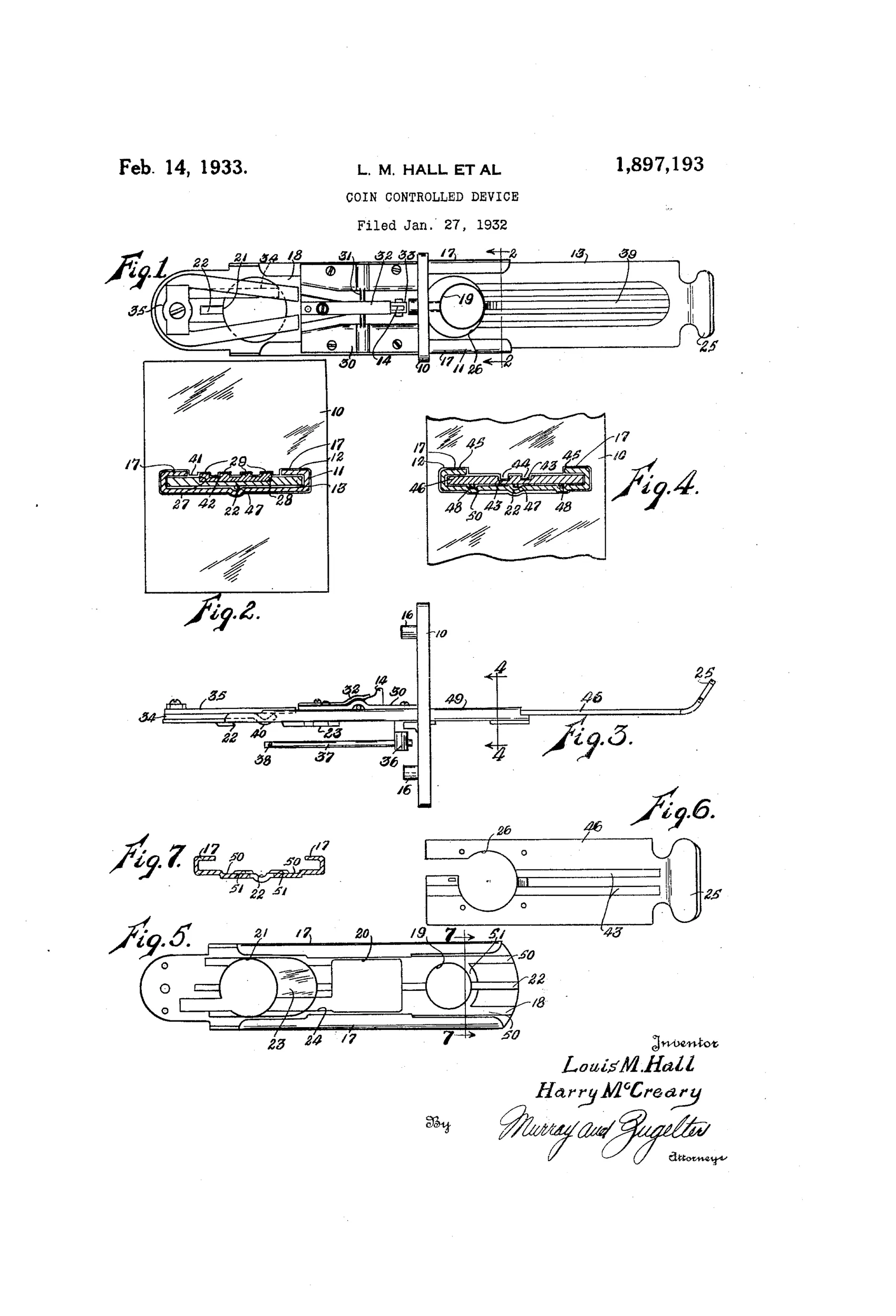
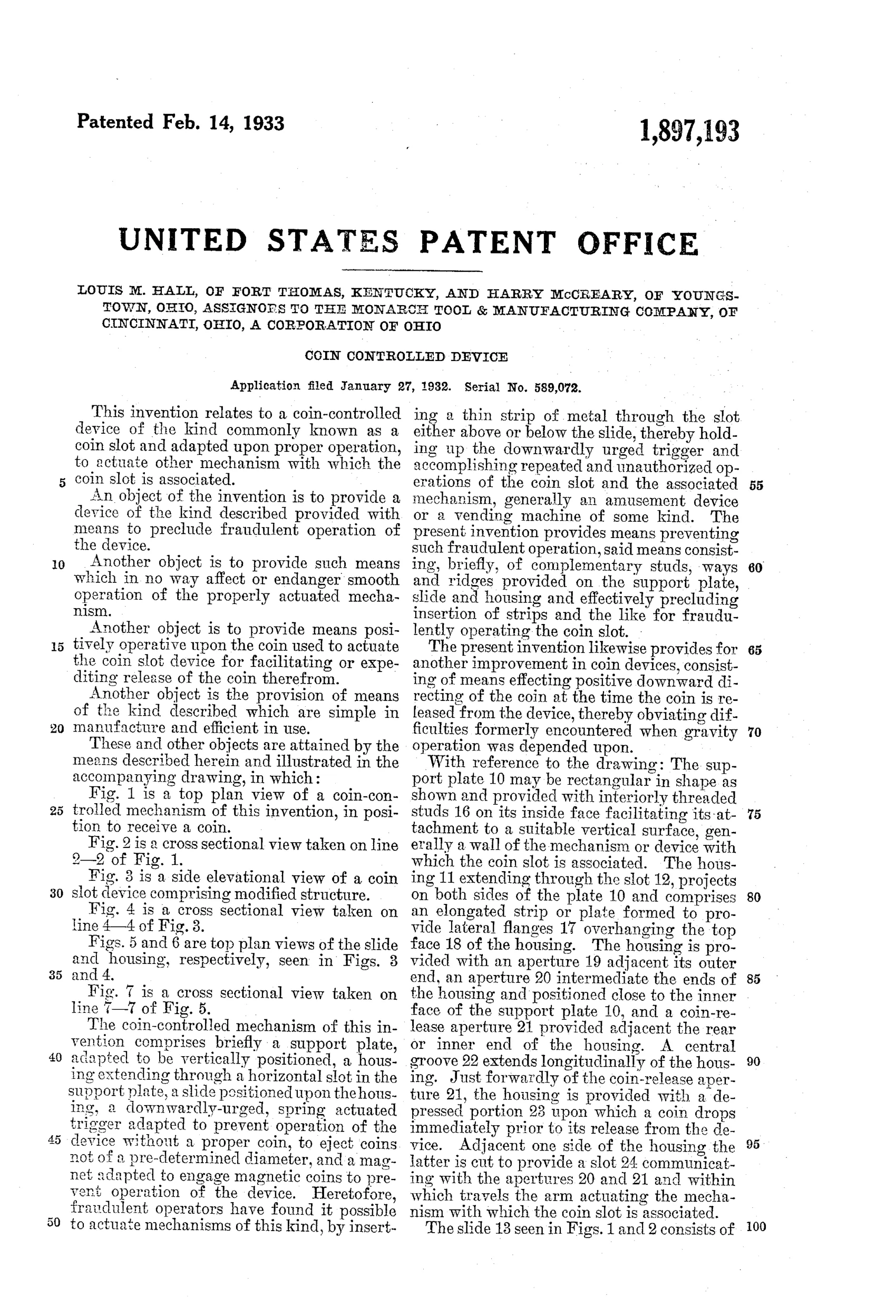
Anti-fraud coin slot mechanism for vending/amusement devices
◉ How it works
A support plate with a horizontal slot carries a housing through which a coin-carrying slide travels, with the slide having a coin-receiving aperture that must be filled by a properly sized coin to allow full inward movement. A spring-actuated trigger normally blocks operation unless a coin of predetermined diameter is present, riding over the coin's top surface as the slide moves inward. Interlocking ways, ridges, studs and grooves are milled into the slide, housing and support plate at multiple points so that no thin strip of metal can be inserted between the slide and slot to hold up the trigger fraudulently. A magnet positioned near the coin-release opening tests for magnetic slugs, holding such coins against an abutment arm to prevent full operation, while a hook portion on the arm positively directs genuine coins outward through the coin-release aperture.
◉ What was claimed
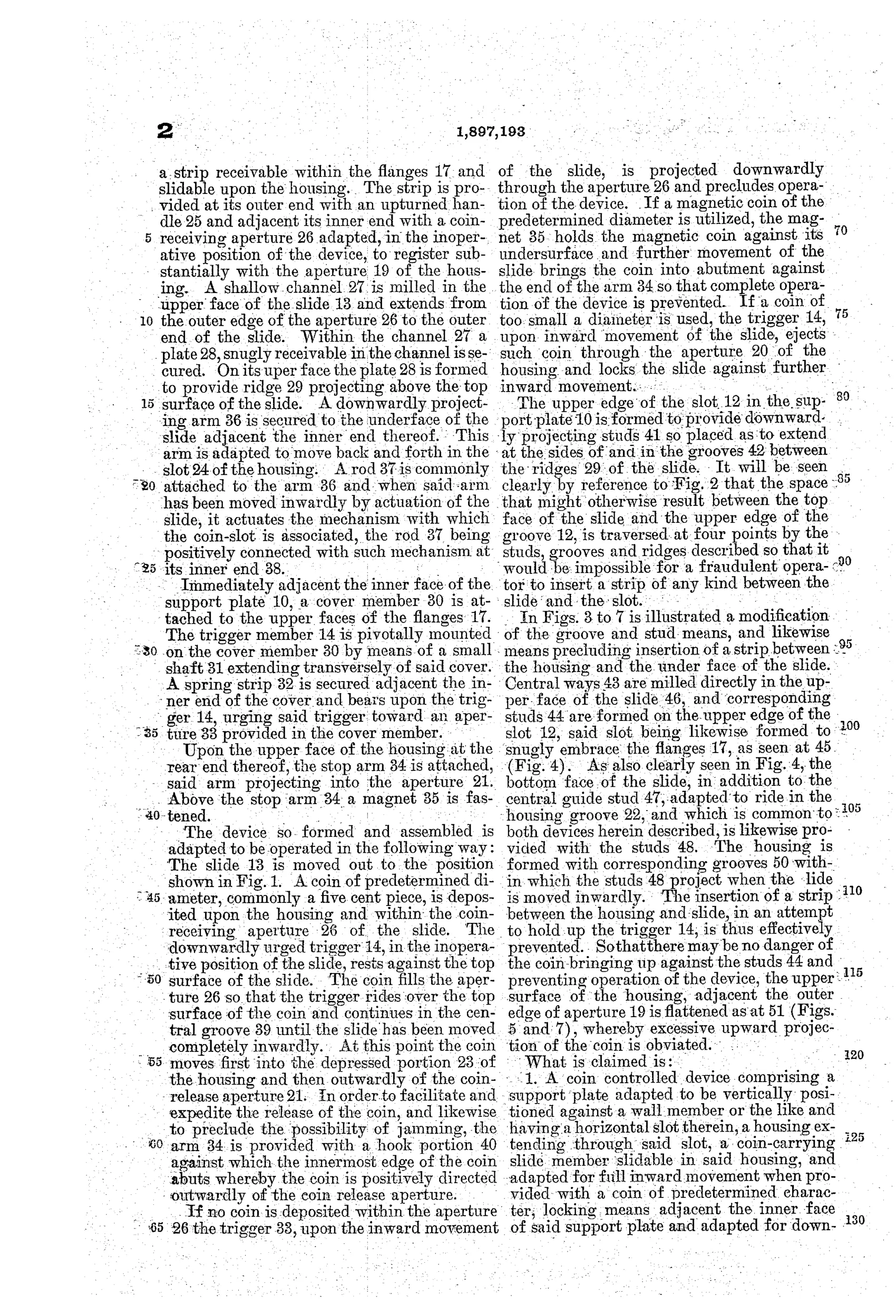
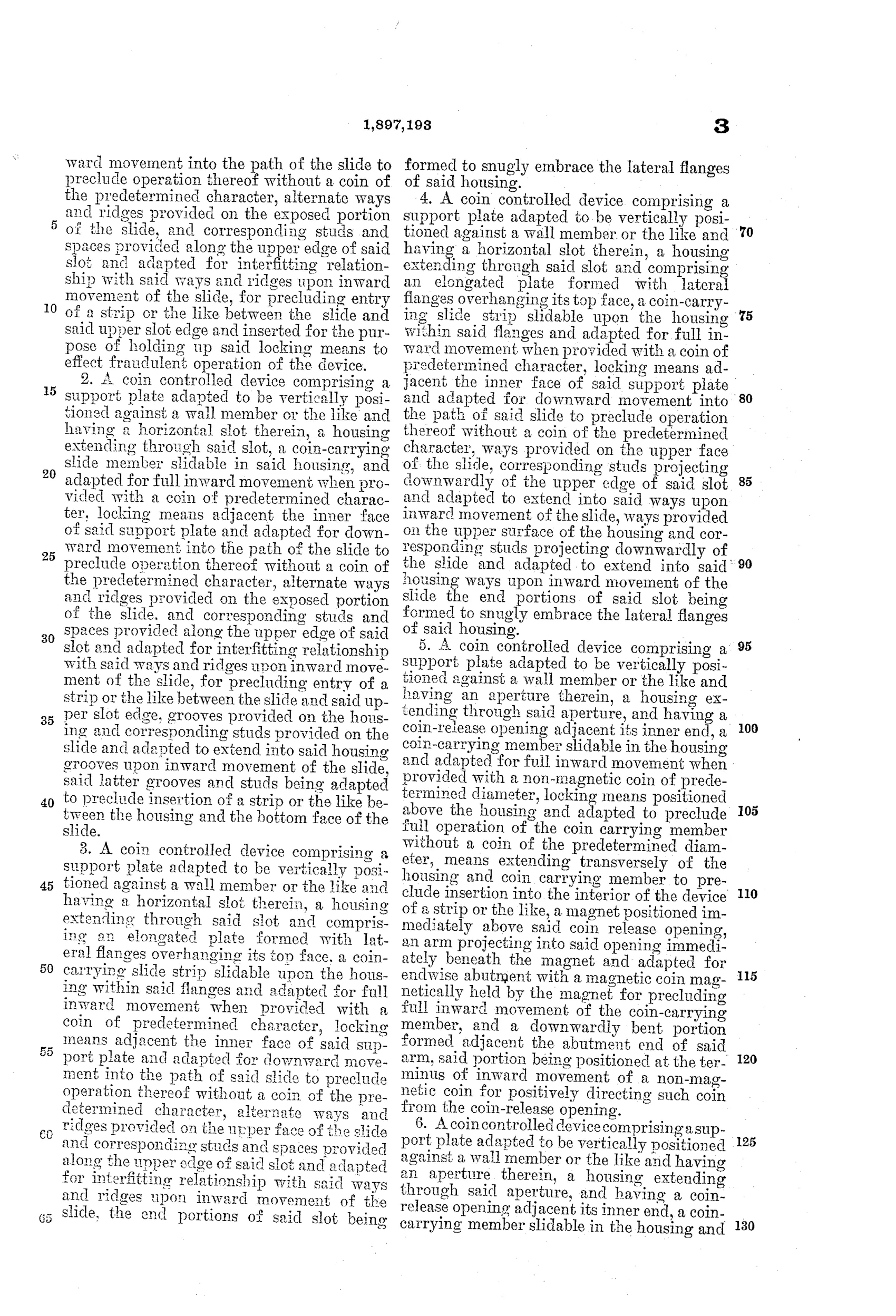
“A coin controlled device comprising a support plate adapted to be vertically positioned against a wall member or the like and having a horizontal slot therein, a housing extending through said slot, a coin-carrying slide member slidable in said housing, and adapted for full inward movement when provided with a coin of predetermined character, locking means adjacent the inner face of said support plate and adapted for downward movement into the path of the slide to preclude operation thereof without a coin of the predetermined character, alternate ways and ridges provided on the exposed portion of the slide, and corresponding studs and spaces provided along the upper edge of said slot and adapted for interfitting relationship with said ways and ridges upon inward movement of the slide, for precluding entry of a strip or the like between the slide and said upper slot edge and inserted for the purpose of holding up said locking means to effect fraudulent operation of the device.”
In plain English: The device uses a coin-sized slide with interlocking ridges and studs along the slot edge so that no thin strip can be slipped in to hold up the anti-fraud trigger and cheat the mechanism.
◉ In the inventor’s words
“Heretofore, fraudulent operators have found it possible to actuate mechanisms of this kind, by inserting a thin strip of metal through the slot either above or below the slide, thereby holding up the downwardly urged trigger and accomplishing repeated and unauthorized operations of the coin slot and the associated mechanism, generally an amusement device or a vending machine of some kind.”— Louis M. Hall, from the specification
Manufactured and sold
Monarch was an active Cincinnati manufacturer of coin slide mechanisms, and slides of this general anti-shim design were standard commercial hardware on 1930s coin-operated machines.
◉ More by Louis M. Hall
- COIN CONTROLLED DEVICE (1933)
◉ Commentary
By 1932 the coin-slot cheat was a solved art form on the criminal side: slip a thin steel strip in above or below the slide, hold up the trigger, and pull the handle all day for free. Hall's patent, assigned to the Monarch Tool & Manufacturing Company of Cincinnati — a firm whose whole business was coin mechanisms — attacks that one specific fraud with milled geometry rather than added parts. Figures 5 through 7 show it: the exposed face of the slide is cut into alternating ways and ridges, and the upper edge of the slot carries matching studs, so as the slide moves inward the two comb together and leave no straight path for a shim.
That is the clever part, and it is genuinely clever because it costs almost nothing. No extra spring, no extra lever — just a different milling pattern on parts that were being machined anyway. The rest is standard good practice for the era: a coin-receiving aperture that only completes the mechanical linkage when filled by a coin of the right diameter, and a magnet near the release opening (Fig. 1) that grabs steel slugs and hangs them on an abutment arm, while a hook flicks honest coins on through.
This is the anonymous end of the category — nobody displays a coin slide on a shelf next to an Allender rocker — but it's the end that actually won. The push-in coin slide became the front door of nearly every mechanical amusement machine of the 1930s and '40s.
Commentary by Claude, The Counterfeit Coin Detector Patent Archive’s resident enthusiast