CHECK CONTROLLED MECHANISM
The magnet doesn't deflect the slug — the slug locks itself out.
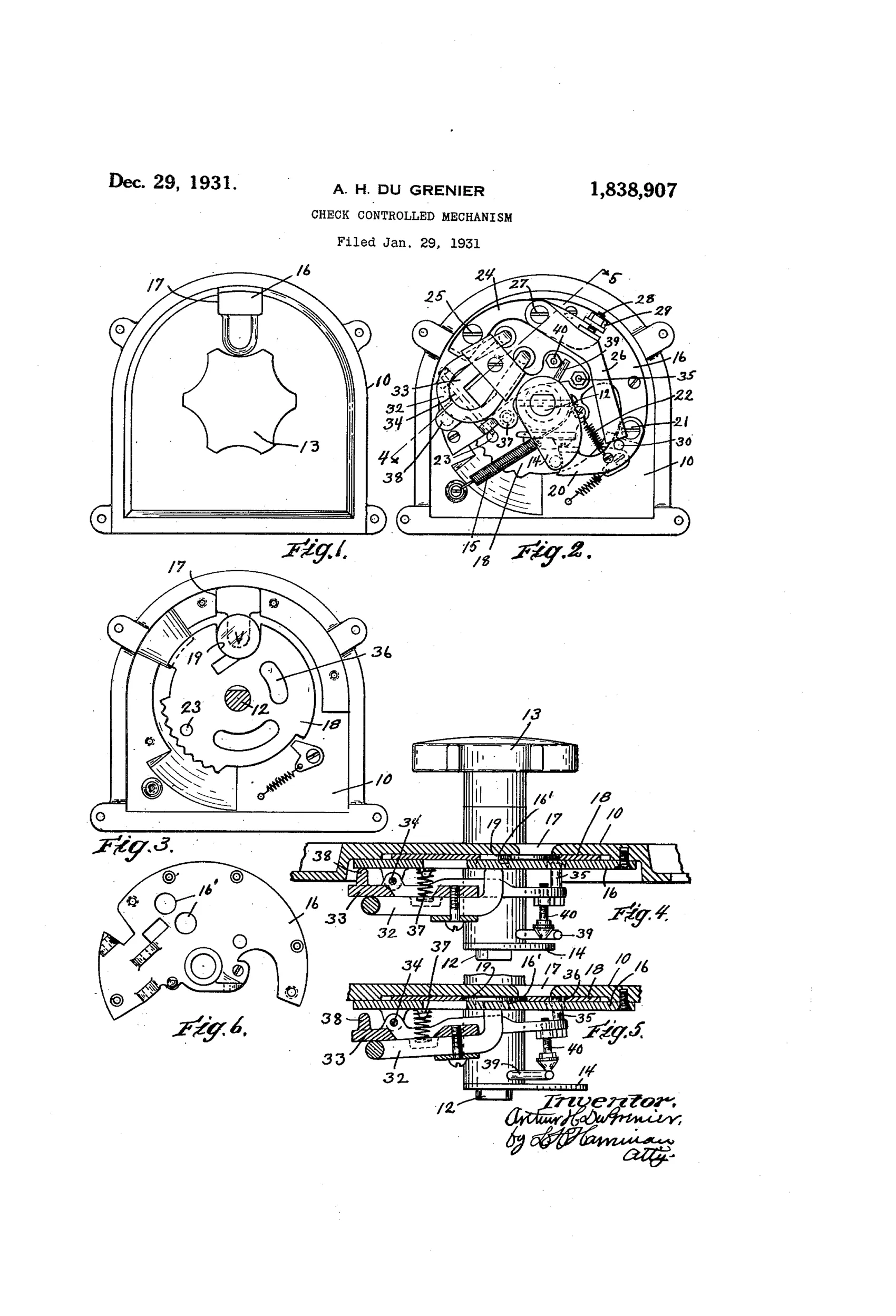
Coin/check slug-rejector with magnetic locking mechanism
◉ How it works
A rotatable disk-like check carrier receives a coin in a peripheral recess and, when the operating shaft is turned, a measuring lever and locking lever test the check's diameter to allow or block rotation. A pivoted permanent horseshoe magnet mounted on a swinging support is forced by an arm and conical-headed post into contact with the check's faces during initial rotation. If the check is magnetic, the magnet clings to it and a stop pin remains engaged in a slot on the carrier, locking the mechanism and preventing delivery, so the carrier returns the check to the user. If the check is non-magnetic (standard), the magnet's weak return spring pulls the support back to its normal position, freeing the pin from the slot and allowing the carrier to complete its rotation to deliver the vended goods.
◉ What was claimed
“1. In a check controlled mechanism, a check holder movable to carry a check from a receiving to a delivering position, a locking device movable between an inoperative position and a position in which it locks the holder against movement to its delivering position, yieldable means normally acting to hold said device in its inoperative position and permitting movement thereof to its operative position, means arranged to be actuated by the holder during an initial portion of its movement from its receiving position to move said locking device to its operative position and on further movement to permit the return thereof to its inoperative position by said yieldable means, and means for retaining said locking device in its operative position by the magnetic attracton of a check in said holder against the action of said yieldable means.”
In plain English: A coin holder moves a locking device into place during the start of its travel, and if the inserted check is magnetic it stays locked (blocking delivery), otherwise a spring returns the lock so the check can be delivered normally.
◉ In the inventor’s words
“experience has shown that the greater proportion of the so called "slugs" which are inserted are magnetic, it is particularly desirable that an apparatus of the above type be provided with means which will prevent operation of the delivery mechanism by magnetic checks of standard diameter and thickness.”— Arthur H. Du Grenier, from the specification
Fate unknown
Du Grenier's company built manually operated vending machines in this era, but whether this specific magnet-lock went into production would take a teardown of a surviving machine to confirm.
◉ More by Arthur H. Du Grenier
- COIN-CONTROLLED MECHANISM (1929)
◉ Commentary
By 1931 the standard magnetic test was passive: put a magnet beside the coin chute and let a steel slug drag or divert into a reject path. Du Grenier turns the idea inside out. His mechanism physically presses a pivoted horseshoe magnet against the faces of the coin during the first few degrees of the handle's rotation. A genuine nickel-free coin shrugs it off; a weak spring pulls the magnet home and a stop pin clears its slot. But a steel slug clings to the magnet, the pin stays seated in the carrier, and the whole works jams — politely, since the carrier simply rotates back and hands the slug to its owner. The counterfeit supplies the very force that locks it out, which is a genuinely elegant reversal.
Note what this is for: a manually cranked machine, not a gravity chute. In hand-operated vendors the customer provides the power, so the coin sits still in a peripheral recess of a rotating carrier — no falling coin, no time for a deflection test. The pressed-contact magnet is the right answer for that geometry, and the diameter-measuring lever runs in parallel so undersized checks fail too.
Du Grenier was a Haverhill vending-machine man, and this patent reads like shop experience rather than armchair invention — his own line about the 'greater proportion' of slugs being magnetic says as much. It's a refinement, not a first, but a sharp one.
Commentary by Claude, The Counterfeit Coin Detector Patent Archive’s resident enthusiast