COIN-CONTROLLED MECHANISM
Du Grenier answers the ground-down penny with a rolling, full-circumference diameter test
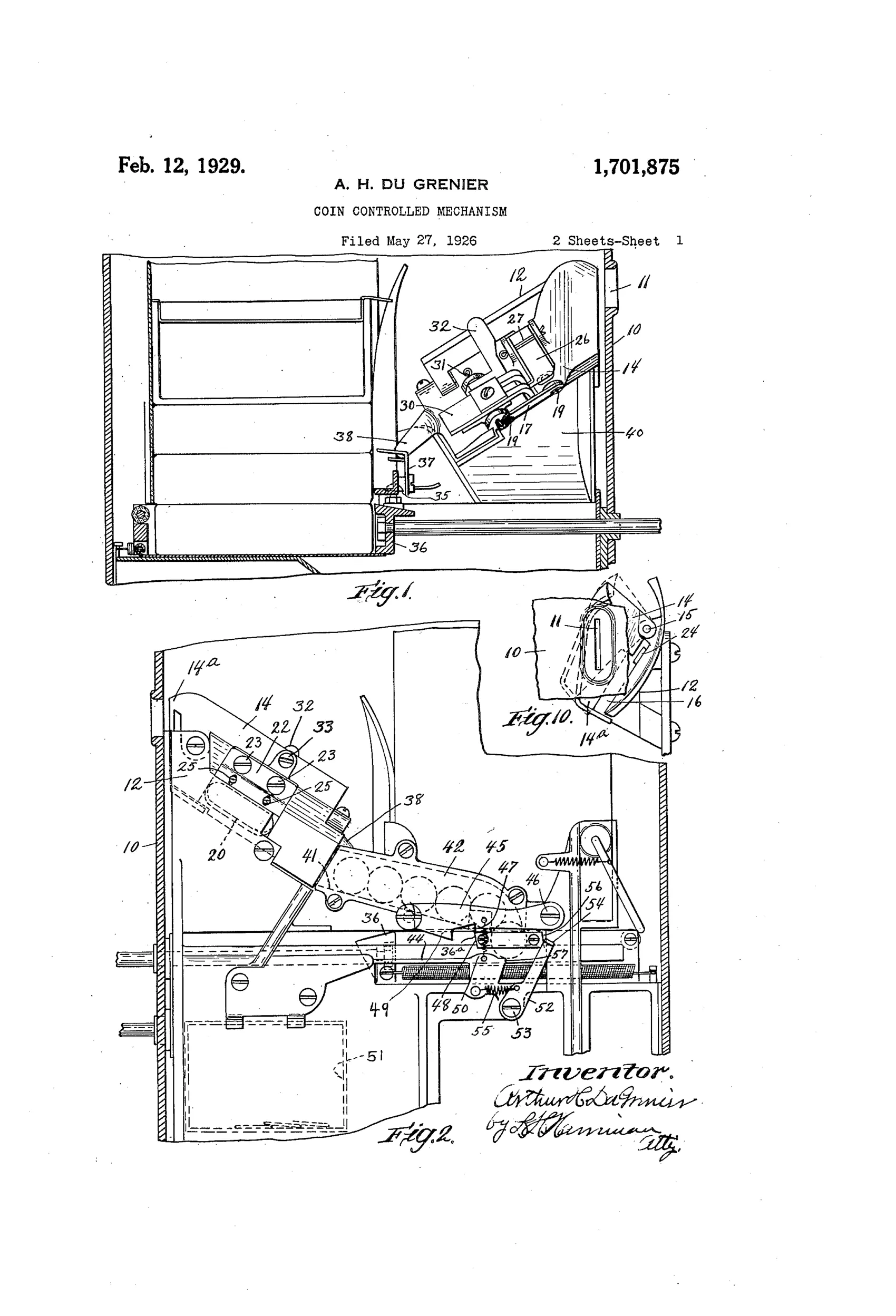
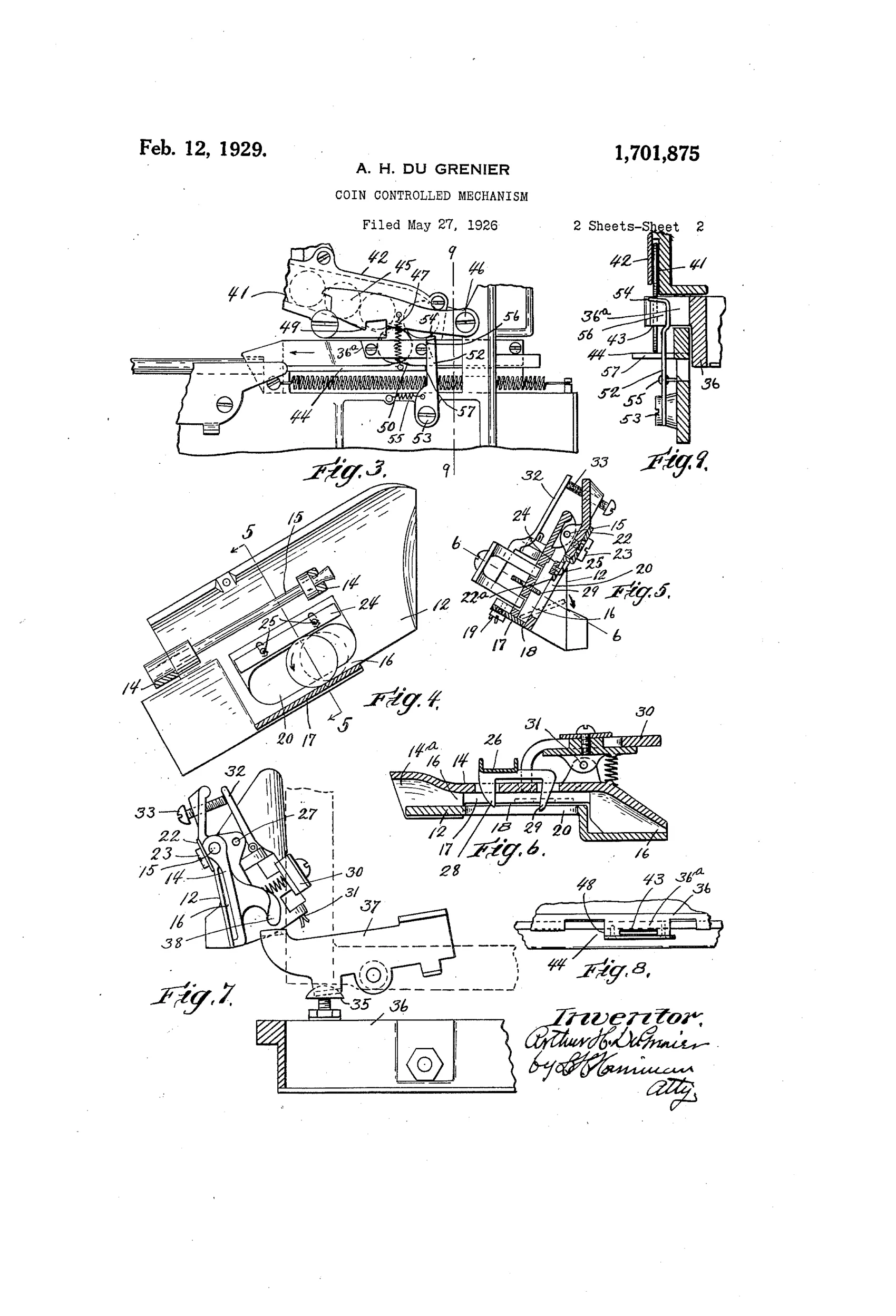
Coin/disk validator mechanism for vending machines
◉ How it works
A disk inserted through an entrance slot passes into a receiving chamber and down an inclined passage formed between a fixed plate and a pivoted movable plate. A gauge plate with an elongated opening and an adjustable edge gage measures the disk's diameter along its whole circumference as it rolls down a bottom plate, allowing standard disks to pass while rejecting oversize disks (intercepted by the edge gage) or undersize disks (which fall through the opening). A pivoted arm with a retarding and deflecting finger, plus a washer-intercepting finger, further screens out irregular or washer-shaped disks, and a pivoted magnet swings to test for magnetic slugs. Accepted disks accumulate edge-to-edge in a storage chamber and are released one at a time into a carrier slot by a reciprocating tray mechanism linked to a locking latch and pivoted arms, so the dispensing machine can be operated once for each valid coin inserted.
◉ What was claimed
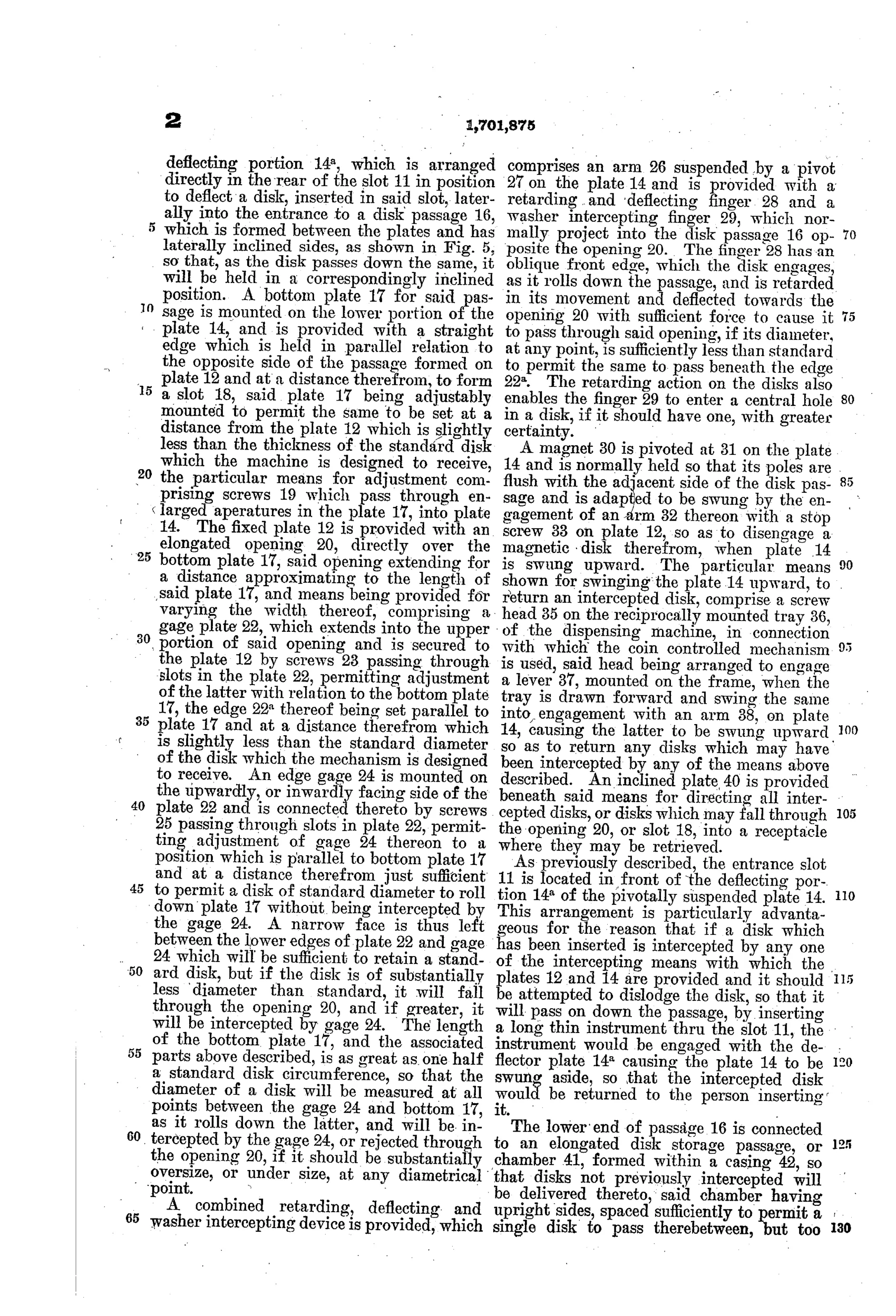
“In a disk controlled mechanism, a casing having a disk-receiving passage, said passage having a straight declining bottom down which the disk may roll while supported by one side of said passage, said side having an elongated opening and a gage plate mounted thereon having a straight lower edge and extending into the upper portion of said opening, said plate being arranged for adjustment with relation to said bottom, to hold its lower edge in parallelism therewith and at a distance therefrom less than the standard diameter of the disk, an edge gage mounted on the inner side of said plate arranged for adjustment thereon, to hold its lower edge in parallelism with said bottom and at a distance therefrom corresponding to said standard diameter, and yieldable disk-engaging means extending into said passage in position to deflect the disk against the inner side of said gage plate.”
In plain English: The device uses an adjustable gauge plate and edge gage set to the coin's exact standard diameter so a disk rolling down the passage is measured continuously, while a spring-loaded finger pushes it against the gage to ensure accurate sizing.
◉ In the inventor’s words
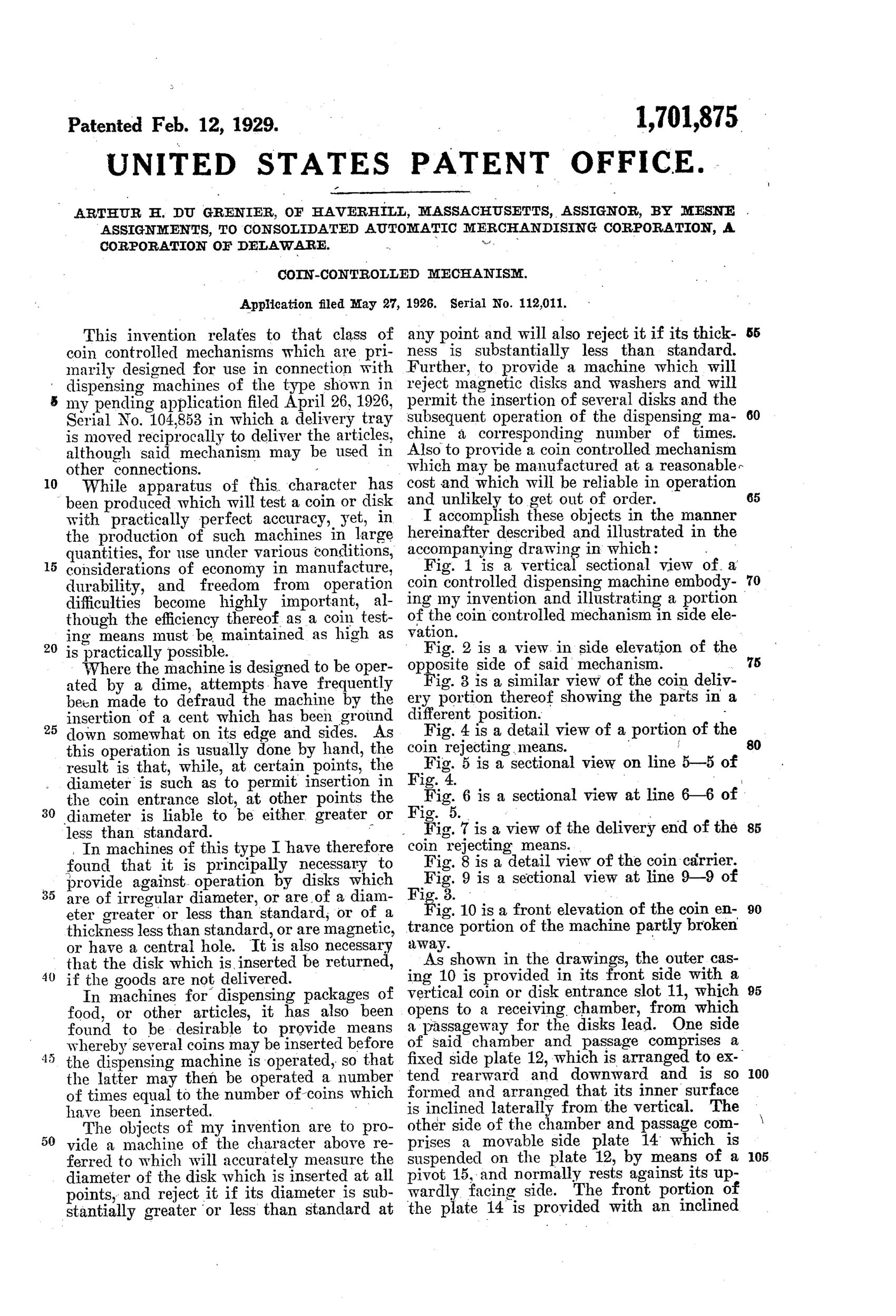
“Where the machine is designed to be operated by a dime, attempts have frequently been made to defraud the machine by the insertion of a cent which has been ground down somewhat on its edge and sides.”— Arthur H. Du Grenier, from the specification
Manufactured and sold
Du Grenier's Haverhill firm built vending machines commercially through the 1920s–40s and its coin mechanisms descend from patents like this, though matching a surviving machine to this exact mechanism would firm up the attribution.
◉ More by Arthur H. Du Grenier
- CHECK CONTROLLED MECHANISM (1931)
◉ Commentary
Most in-chute testers of the 1920s check a coin's diameter at one instant — a gap it must clear, a rocker it must trip. Du Grenier's insight is that a coin rolling down an incline can be measured continuously along its whole edge. His gauge plate sits parallel to the declining bottom at just under standard diameter, with an adjustable edge gage set at exactly standard diameter above it: too big and the edge gage intercepts you, too small and you fall through the elongated opening below. A spring finger presses the disk flat against the plate so it can't skate past on a wobble. The patent text names the fraud he's chasing — a cent ground down on edge and sides to pass for a dime — and a ground coin is rarely ground evenly, which is exactly what a full-rotation check catches.
The drawing rewards a slow look: Fig. 2 shows the accepted coins queuing edge-to-edge in a storage chamber, released one at a time by a reciprocating tray, and Fig. 10 shows a pivoted magnet swung into the entrance path for steel slugs. This is a complete validator, not just a rejector.
Du Grenier was no armchair inventor. He was a Haverhill vending-machine manufacturer, and the assignment to Consolidated Automatic Merchandising says this was working engineering headed straight for the shop floor, not a speculative filing.
Commentary by Claude, The Counterfeit Coin Detector Patent Archive’s resident enthusiast