COIN TESTING DEVICE
A cantilever spring runway that weighs coins in motion — no balance beam required
Spring-loaded coin runway that sorts genuine from spurious coins
◉ How it works
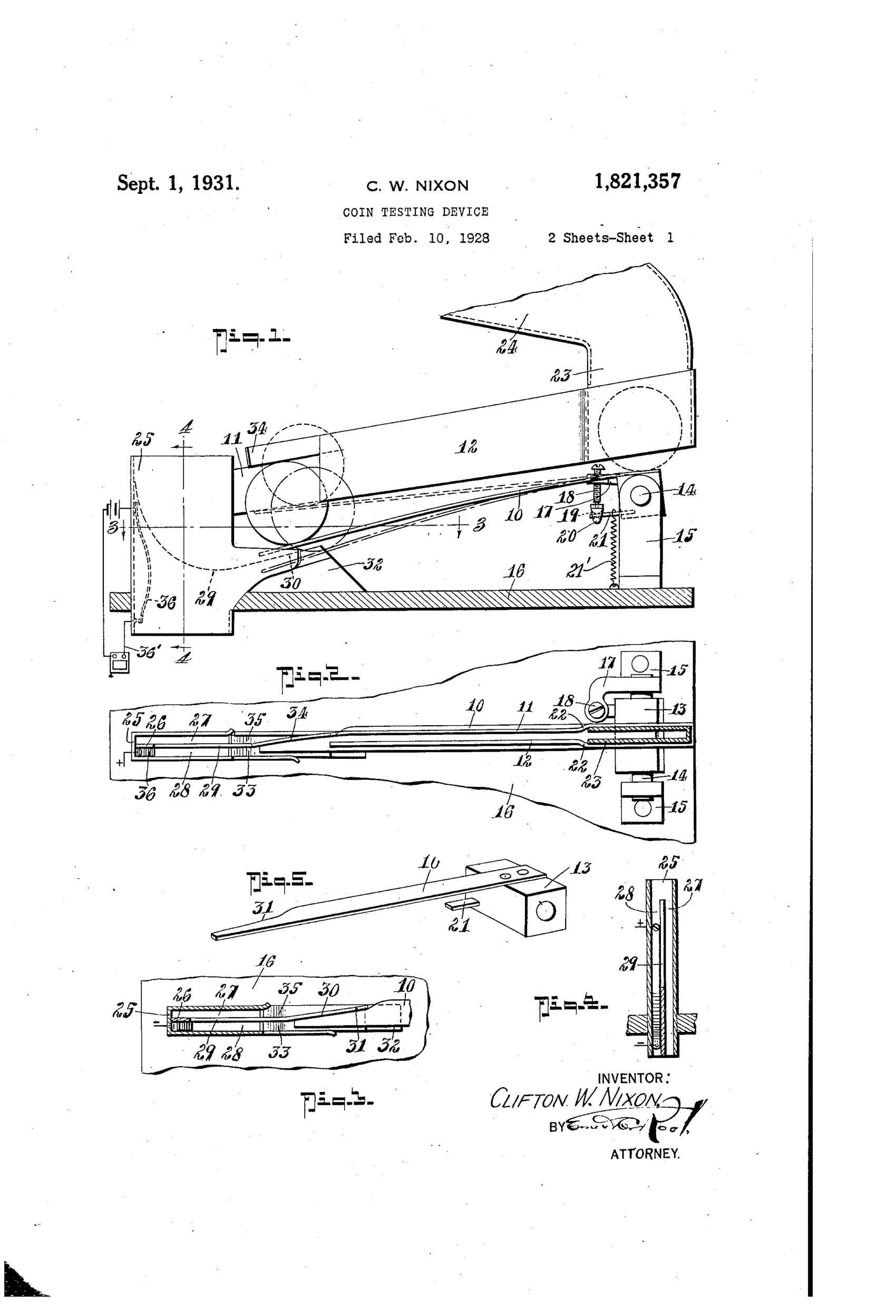
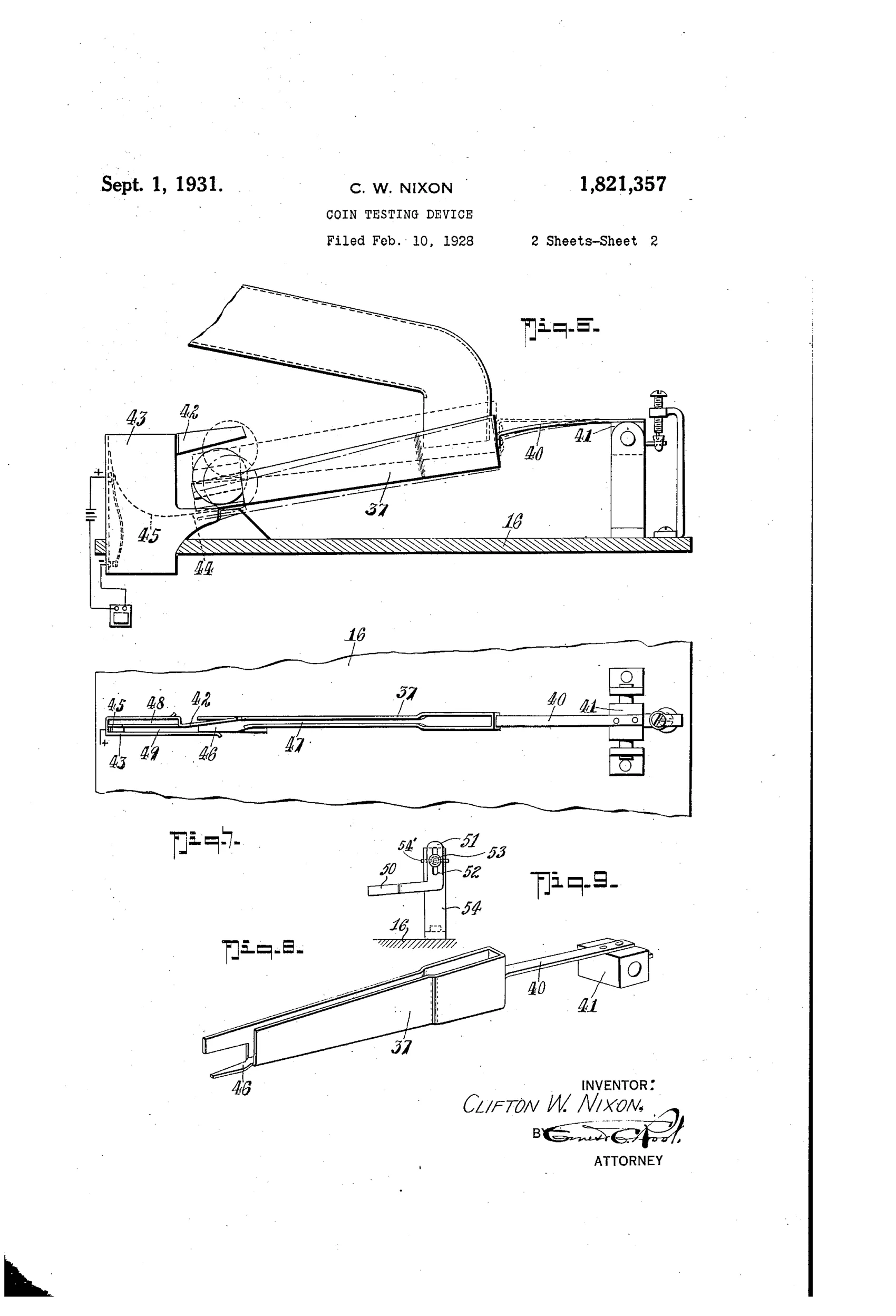
A coin rolls down a resilient spring runway held between vertical guides, and the weight of the coin depresses the spring to a degree proportional to the coin's weight. Switch fingers are positioned in transversely oblique relation to the runway at set heights so that only coins of correct weight pass between them into a genuine-coin conduit. Coins too light fail to depress the spring enough and are deflected by an upper switch finger, while coins too heavy over-depress the spring and are caught by a lower switch finger, both being diverted into a reject conduit. An adjusting screw and pull spring allow fine adjustment of the runway's downward slope, and an electrical contact spring in the reject conduit can close a circuit to sound an alarm when a spurious coin passes through.
◉ What was claimed
“1. A coin testing device comprising a longitudinally projecting downwardly sloping runway down which a coin will travel, the runway being depressible by force of the weight of a coin traveling thereon, and a switch finger arranged in transversely oblique relation to the runway for switching a traveling coin laterally from the runway at a predetermined degree of depression of the runway.”
In plain English: A tilted spring runway that bends under a coin's weight, with an angled finger that kicks the coin sideways once the runway sags to a certain point.
◉ In the inventor’s words
“The main object of the invention is the provision of a simple coin testing device which will prevent unscrupulous persons from defeating the coin-controlled machine and obtaining merchandise or change through the employment of spurious or unauthorized coins.”— Clifton W. Nixon, from the specification
Fate unknown
Assigned to Nixon's own vending-machine company, so intent to manufacture is clear, but no surviving mechanism attributed to this patent is documented; a marked Nixon machine would settle it.
◉ Patented the same day
- REJECTION MEANS FOR PERFORATED COINS — James E. Olvis
◉ Commentary
Most weight testers in the chute era stop the coin: a rocking gauge, a pivoted cradle, a moment of stillness while gravity renders its verdict. Nixon's trick is to weigh the coin without ever pausing it. The runway itself is a long flat spring — look at Fig. 5, that tapered blade projecting from the block — and a rolling coin depresses it in proportion to its own weight as it travels. Two obliquely set switch fingers do the sorting: a light slug rides too high and is skimmed off by the upper finger; a heavy one sags the blade too far and is caught by the lower. Only a coin of correct weight threads the gap between them.
That two-sided rejection is the clever part. A simple weight gate can catch underweight slugs, but an overweight casting sails through most of them. Nixon's sagging blade rejects both directions of error in one pass, and the adjusting screw and pull spring let an operator tune the slope for wear or a different denomination.
The dubious part is dynamics. A spring's deflection under a rolling coin depends on speed and bounce, not just static weight, so the calibration window must have been touchy — which may explain the adjustment hardware and the modified form in Figs. 6-8. Filed by his own vending-machine corporation in 1928, this is a serious commercial attempt at the problem every coin-op maker was chasing, even if this particular answer was fussier than the magnets and gauges that won.
Commentary by Claude, The Counterfeit Coin Detector Patent Archive’s resident enthusiast