REJECTION MEANS FOR PERFORATED COINS
A hook that literally fishes slugs out by the hole in their middle
Mechanism to detect and reject perforated slug coins
◉ How it works
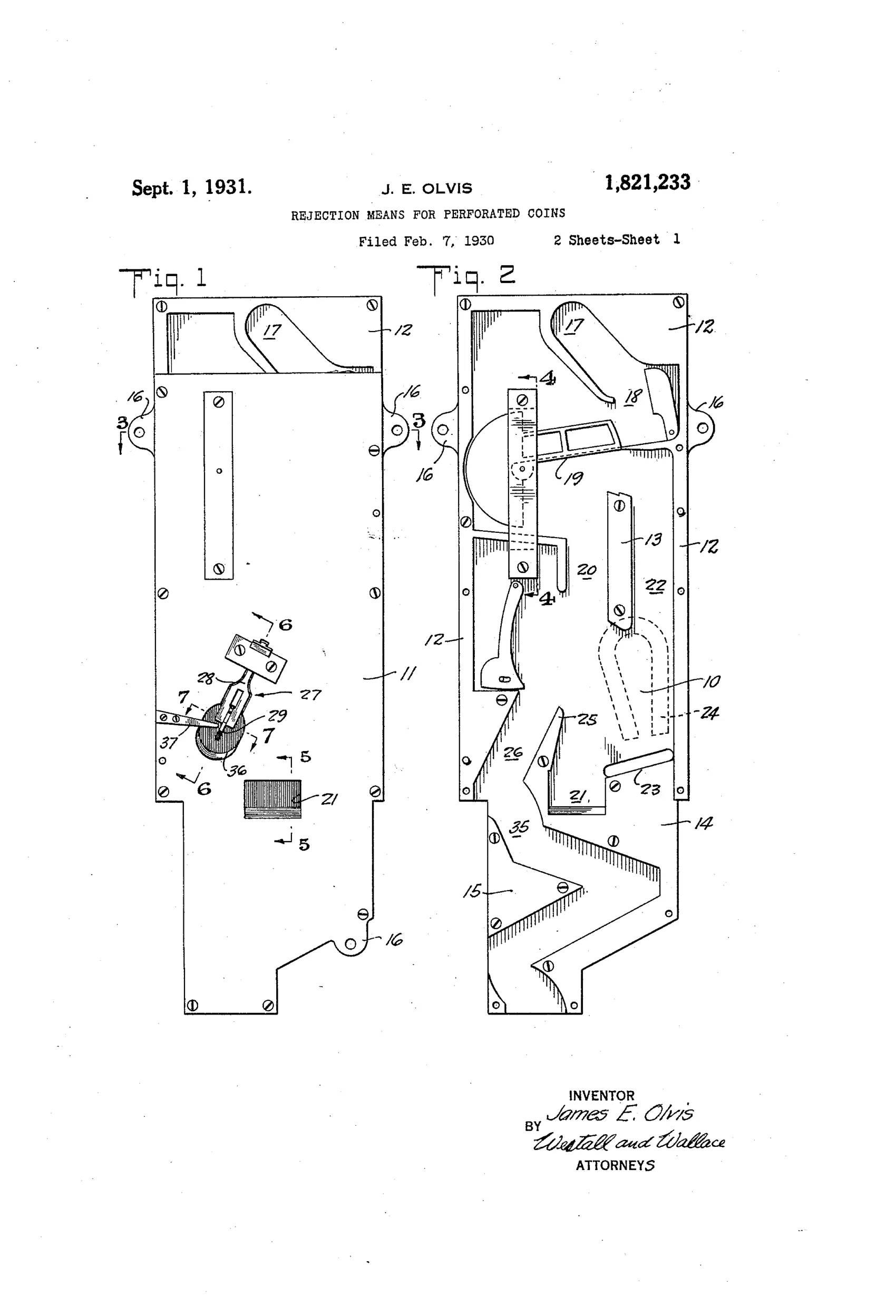
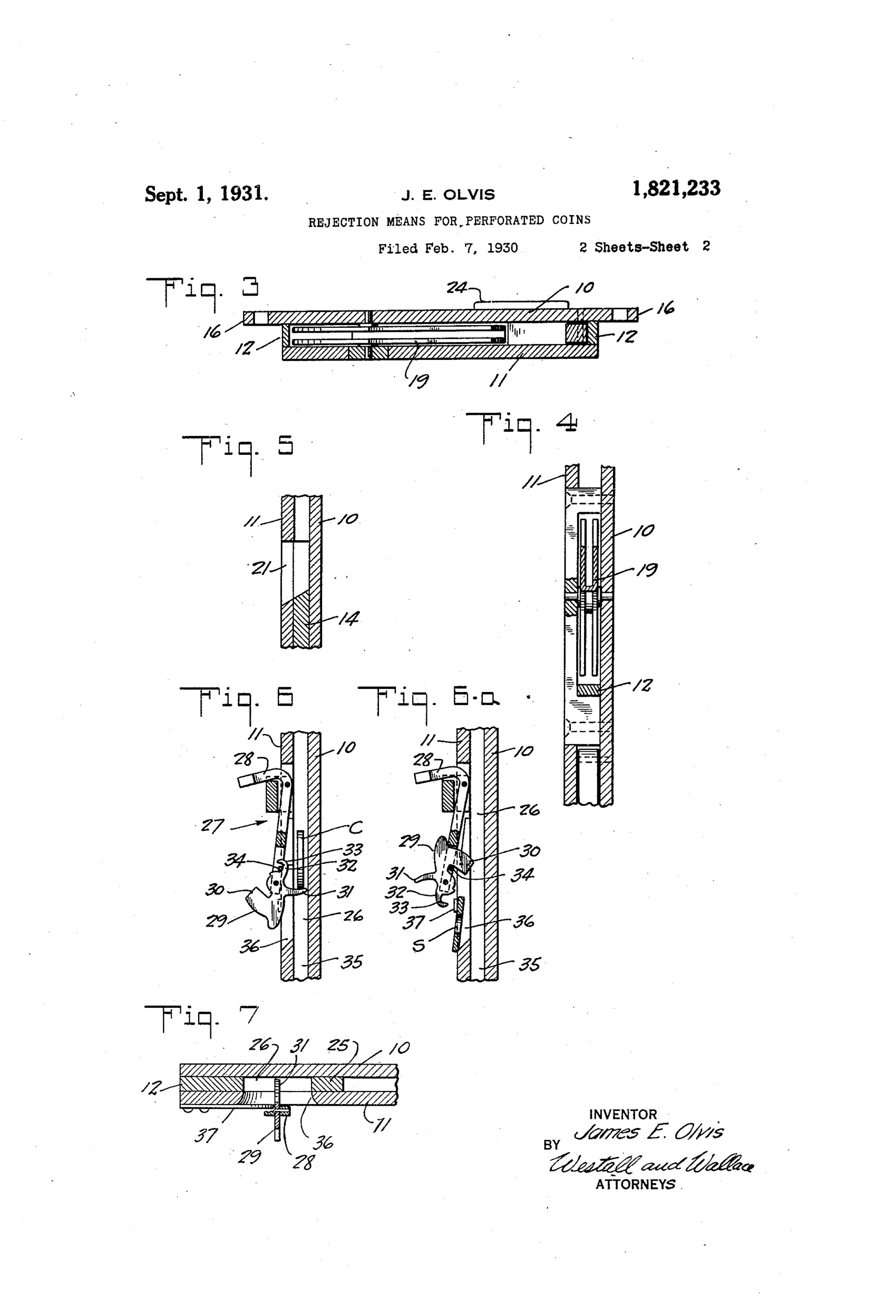
A coin chute has an offset rejection exit alongside the passage for genuine coins, with a perforated coin classifier pivoted at the junction. A counterweighted pallet with two spread fingers normally holds its lower finger across the chute in the coin's path. When a coin passes, the lower finger is pushed aside and the upper finger, fitted with a hook, projects into the chute; if the coin has a central perforation the hook engages the marginal edge of the hole and suspends the coin, swinging the pallet and deflecting the perforated coin sideways into the rejection exit. A fixed release finger at the exit arrests this deflection movement and pushes the coin off the hook, dropping it outside the detector, while genuine unperforated coins continue straight down the passage unaffected.
◉ What was claimed
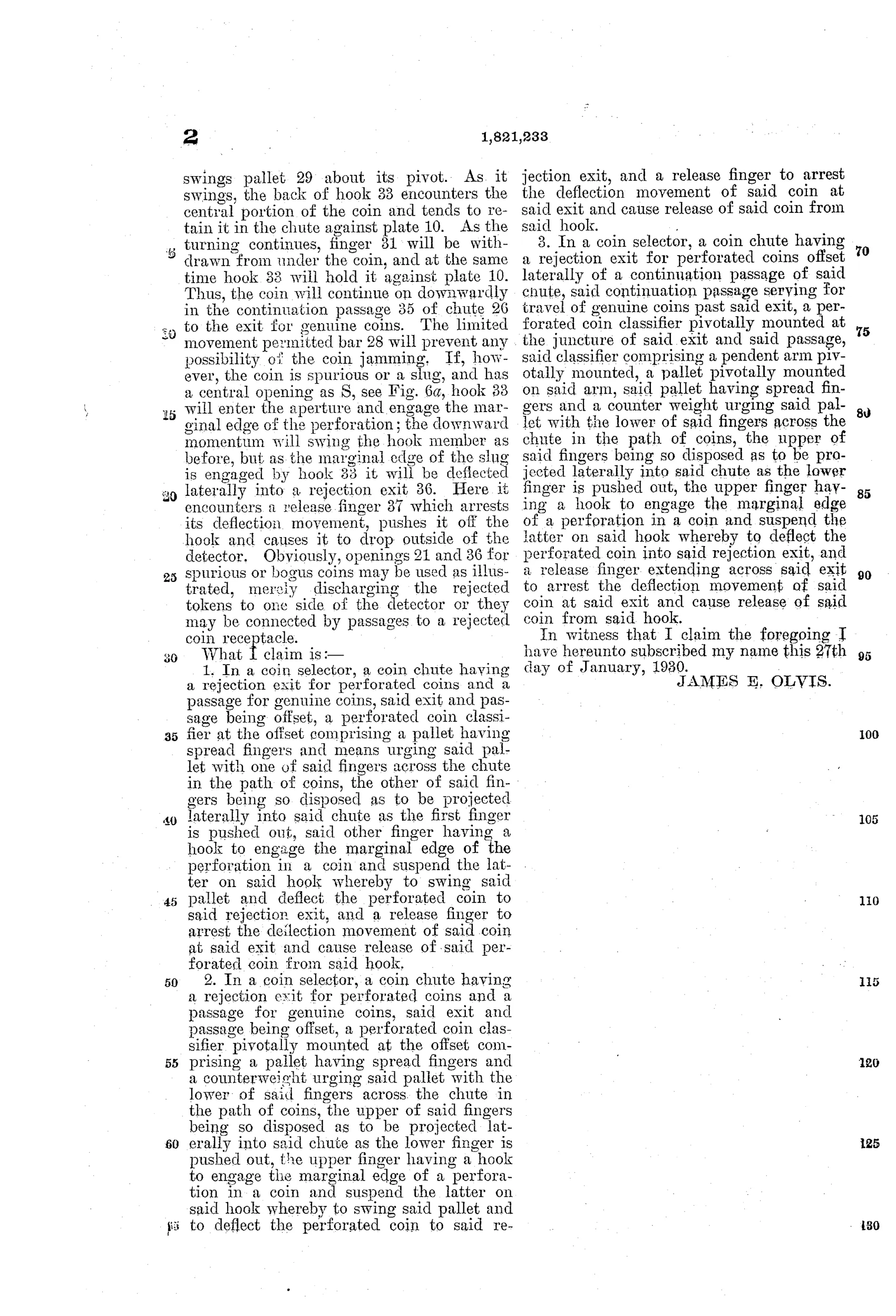
“In a coin selector, a coin chute having a rejection exit for perforated coins and a passage for genuine coins, said exit and passage being offset, a perforated coin classifier at the offset comprising a pallet having spread fingers and means urging said pallet with one of said fingers across the chute in the path of coins, the other of said fingers being so disposed as to be projected laterally into said chute as the first finger is pushed out, said other finger having a hook to engage the marginal edge of the perforation in a coin and suspend the latter on said hook whereby to swing said pallet and deflect the perforated coin to said rejection exit, and a release finger to arrest the deflection movement of said coin at said exit and cause release of said perforated coin from said hook.”
In plain English: A coin chute has a spring-loaded pallet with two fingers: one blocks the path while the other swings a hook into the chute; if a coin has a hole, the hook catches its edge and swings the pallet, diverting the perforated coin into a separate reject exit where a fixed finger knocks it free.
◉ In the inventor’s words
“The utility of such detecting devices is obvious.”— James E. Olvis, from the specification
Fate unknown
Like most chute-tester patents it would have been absorbed anonymously into vending hardware if used at all; no attributed example or licensing record is documented.
◉ Patented the same day
- COIN TESTING DEVICE — Clifton W. Nixon
◉ Commentary
Most slug rejectors of the vending era test weight, size, or magnetism. Olvis attacks a narrower and sneakier fraud: the perforated slug — a washer, or a coin-sized disc with a hole punched through it, which can pass every one of those conventional tests. His answer is disarmingly direct. Instead of measuring anything, he probes the coin's face. A counterweighted pallet holds one finger across the chute; every passing coin pushes it aside, which swings a second, hooked finger flat against the coin. A solid coin slides past the hook harmlessly. A washer gets caught — the hook drops into the hole, snags the marginal edge, and the coin's own weight swings the whole pallet over, carrying the impostor sideways into a reject exit where a fixed finger knocks it off the hook.
The detail worth lingering on in Fig. 2 is that release finger. Without it the device would jam after its first catch, the slug dangling on the hook forever. Olvis makes the deflection stroke itself do the unloading, so the pallet resets by gravity, ready for the next coin. That self-clearing action is what separates a clever demonstration from a serviceable machine part.
This is a late, specialized entry in the chute-tester crowd — not a general detector but a dedicated washer-catcher, presumably meant to sit downstream of a magnet in a coin selector stack. As the patent dryly puts it, 'the utility of such detecting devices is obvious.' In 1930, with washers flooding coin slots, it was.
Commentary by Claude, The Counterfeit Coin Detector Patent Archive’s resident enthusiast