COIN-SORTING MECHANISM
A hook feels the coin's rim: sorting by relief, not weight or magnetism
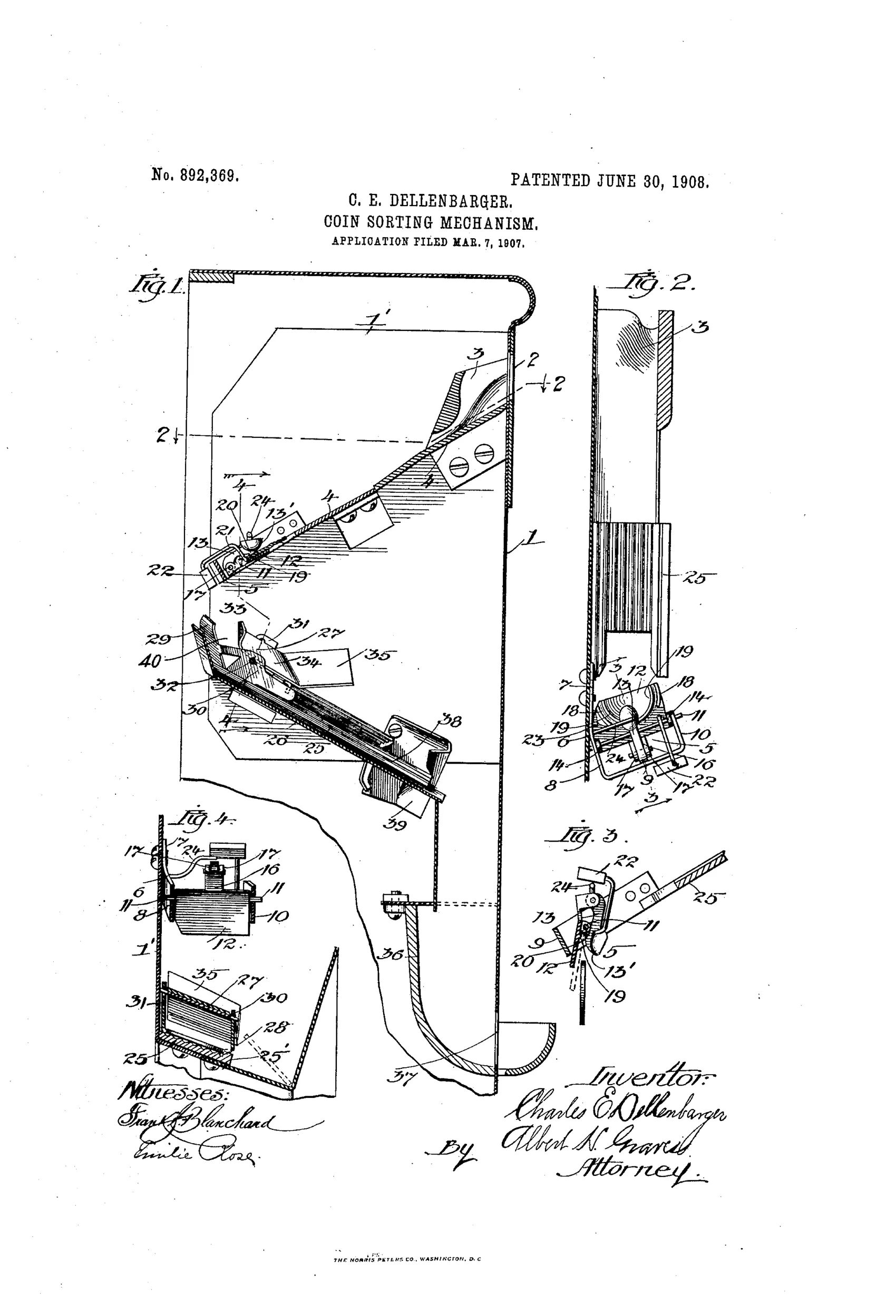
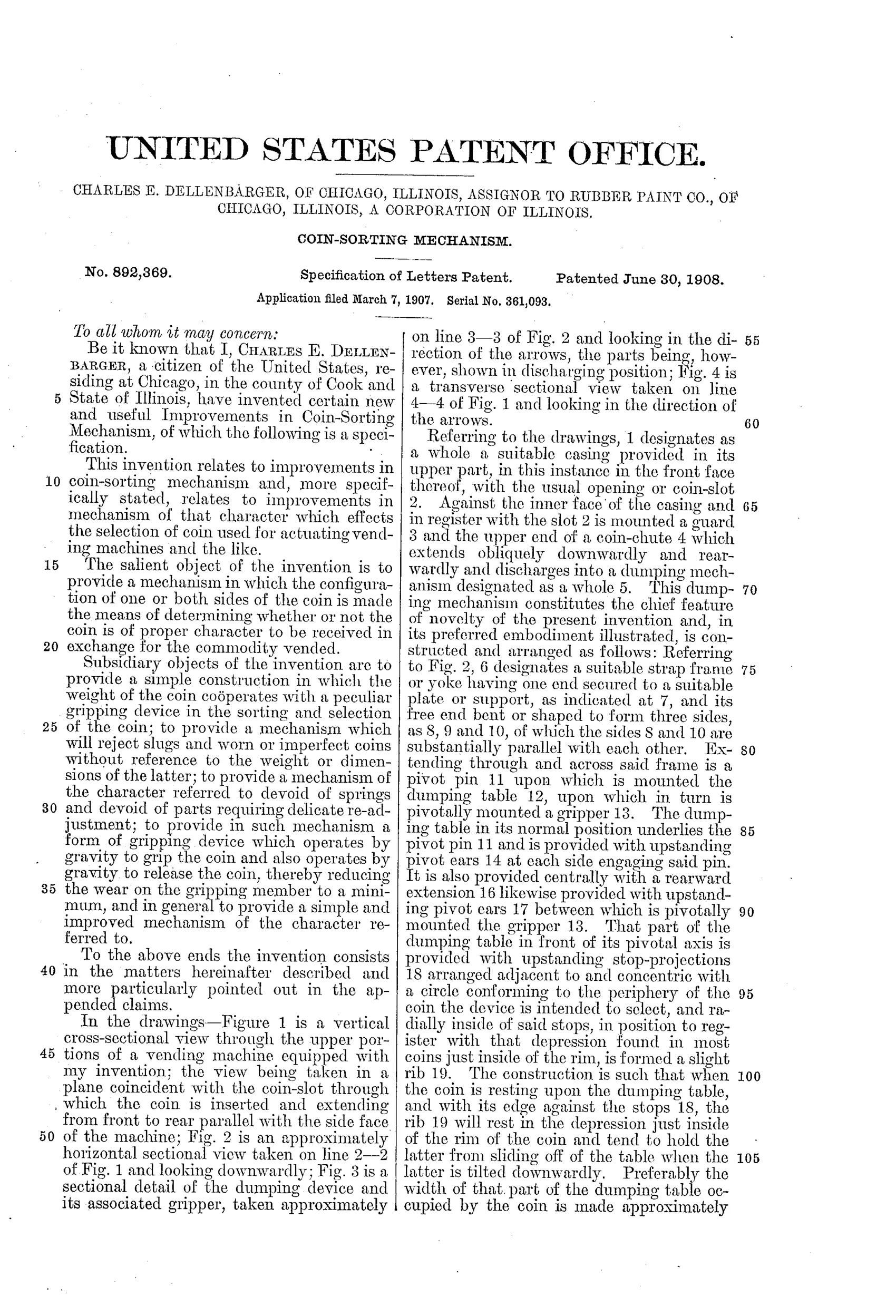
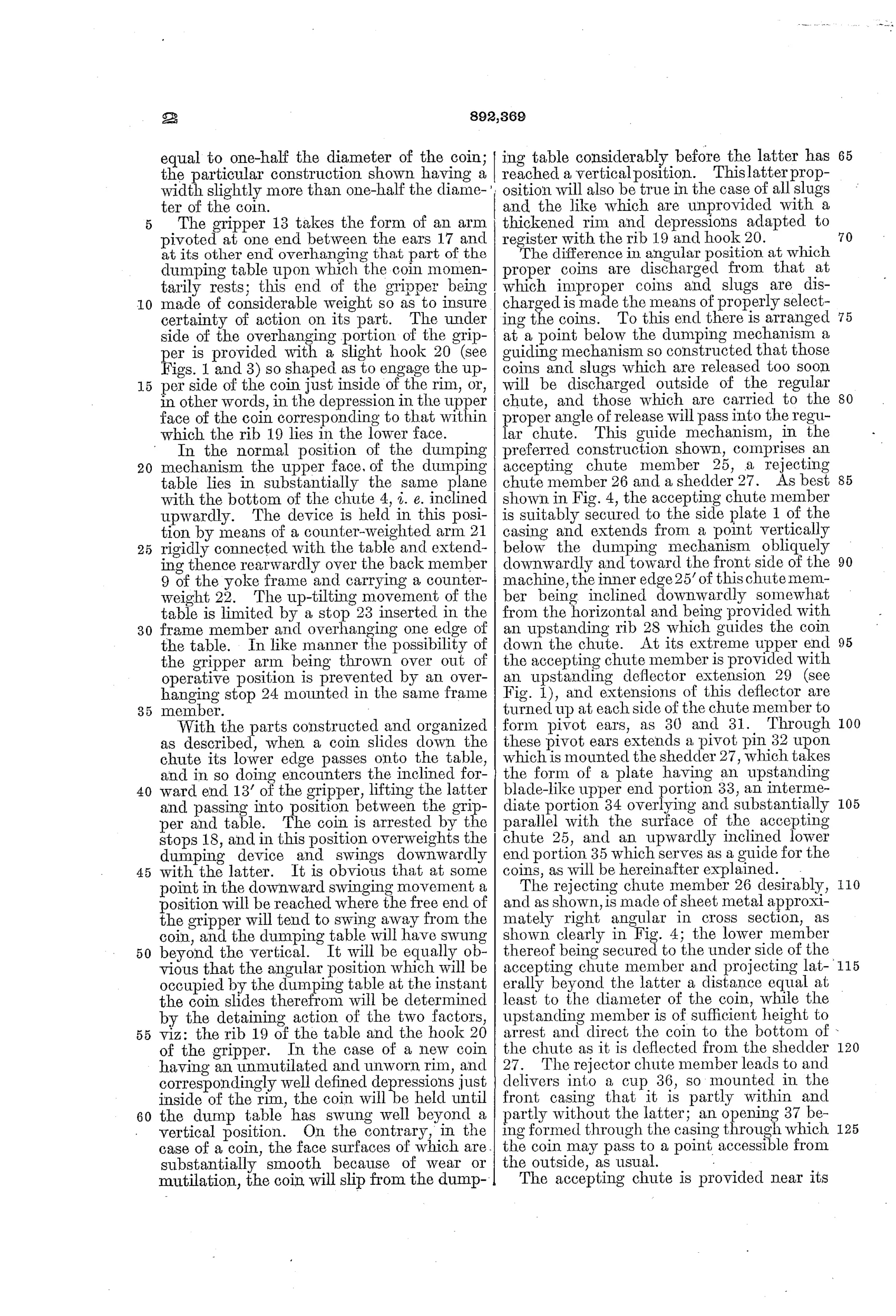
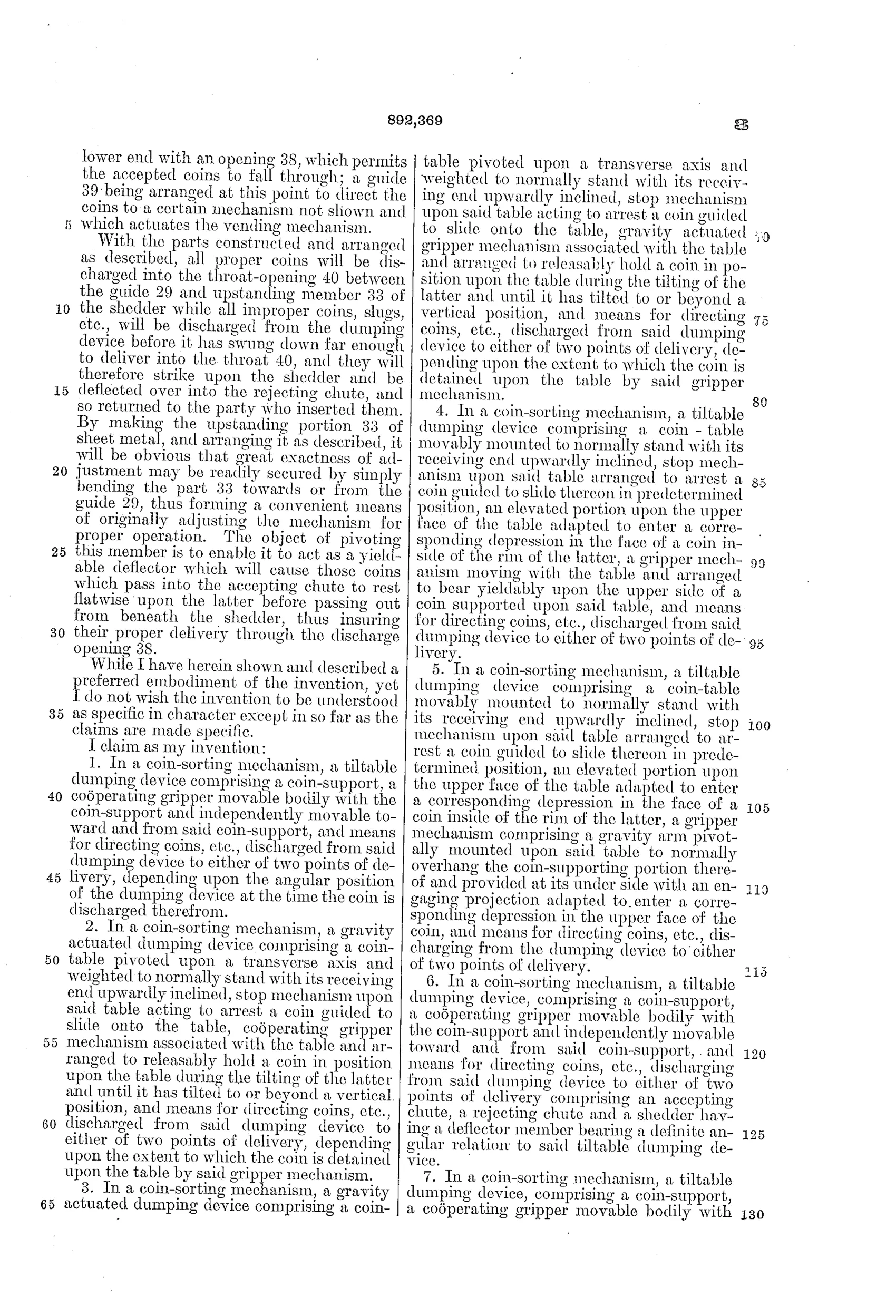
A gravity-operated coin sorting and rejecting mechanism for vending machines.
◉ How it works
A coin dropped into the slot slides down a chute onto a pivoted, counterweighted dumping table whose forward end carries a gravity-actuated gripper arm that hooks into the depression just inside the coin's rim. A genuine coin, having well-defined rim depressions, is held by the gripper's hook until the table tilts well past vertical, while slugs or worn coins with smooth faces slip free early. The angular position of the table at the moment of release determines whether the coin falls into the throat leading to the accepting chute or strikes the shedder and is deflected into the rejecting chute back to the user. A blade-like shedder pivoted below the dumping device forms the boundary between the accepting and rejecting chutes and can be bent for fine adjustment of the release angle.
◉ What was claimed
“1. In a coin-sorting mechanism, a tiltable dumping device comprising a coin-support, a coöperating gripper movable bodily with the coin-support and independently movable toward and from said coin-support, and means for directing coins, etc., discharged from said dumping device to either of two points of delivery, depending upon the angular position of the dumping device at the time the coin is discharged therefrom.”
In plain English: The device uses a tilting coin table with a gripper that can move both with the table and independently, sending coins to one of two exits depending on the table's angle when the coin is released.
◉ In the inventor’s words
“The salient object of the invention is to provide a mechanism in which the configuration of one or both sides of the coin is made the means of determining whether or not the coin is of proper character to be received in exchange for the commodity vended.”— Charles E. Dellenbarger, from the specification
Fate unknown
Assignment to a Chicago company suggests intended use, but no vending machine incorporating this gripper is documented; a surviving mechanism would settle it.
◉ Commentary
Most slug rejectors of this era test what a coin weighs, how wide it is, or whether a magnet will grab it. Dellenbarger tests something almost nobody else thought to test: the coin's surface topography. His gravity gripper hooks into the recessed field just inside the raised rim of a genuine struck coin. As the counterweighted table tilts, a real coin stays hooked past vertical and drops late — into the accepting throat. A smooth-faced slug or a slick, worn-out coin slips free early and falls against the shedder blade, which deflects it back to the customer.
The cleverness is that the release angle becomes the sorting variable, so the whole discrimination happens with one pivoted table and no springs to fatigue or magnets to weaken. Note the practical touch in the fine print: the shedder blade dividing the accept and reject chutes can simply be bent to tune the cutoff angle. That is the mark of someone who expected the thing to be adjusted on a shop bench, not admired on paper.
The weakness is equally obvious. A cast counterfeit copied from a real coin has rim depressions too, and legitimate but heavily worn coins would be rejected — a customer-relations problem the patent quietly acknowledges. So it is a dead end as a stand-alone test, but an original one: the only mechanism in this class that reads a coin like a fingertip rather than weighing it like a grocer.
Commentary by Claude, The Counterfeit Coin Detector Patent Archive’s resident enthusiast