MACHINE FOR THE ASSORTMENT OF COINS.
The whole zigzag race sinks under the coin's weight instead of tipping
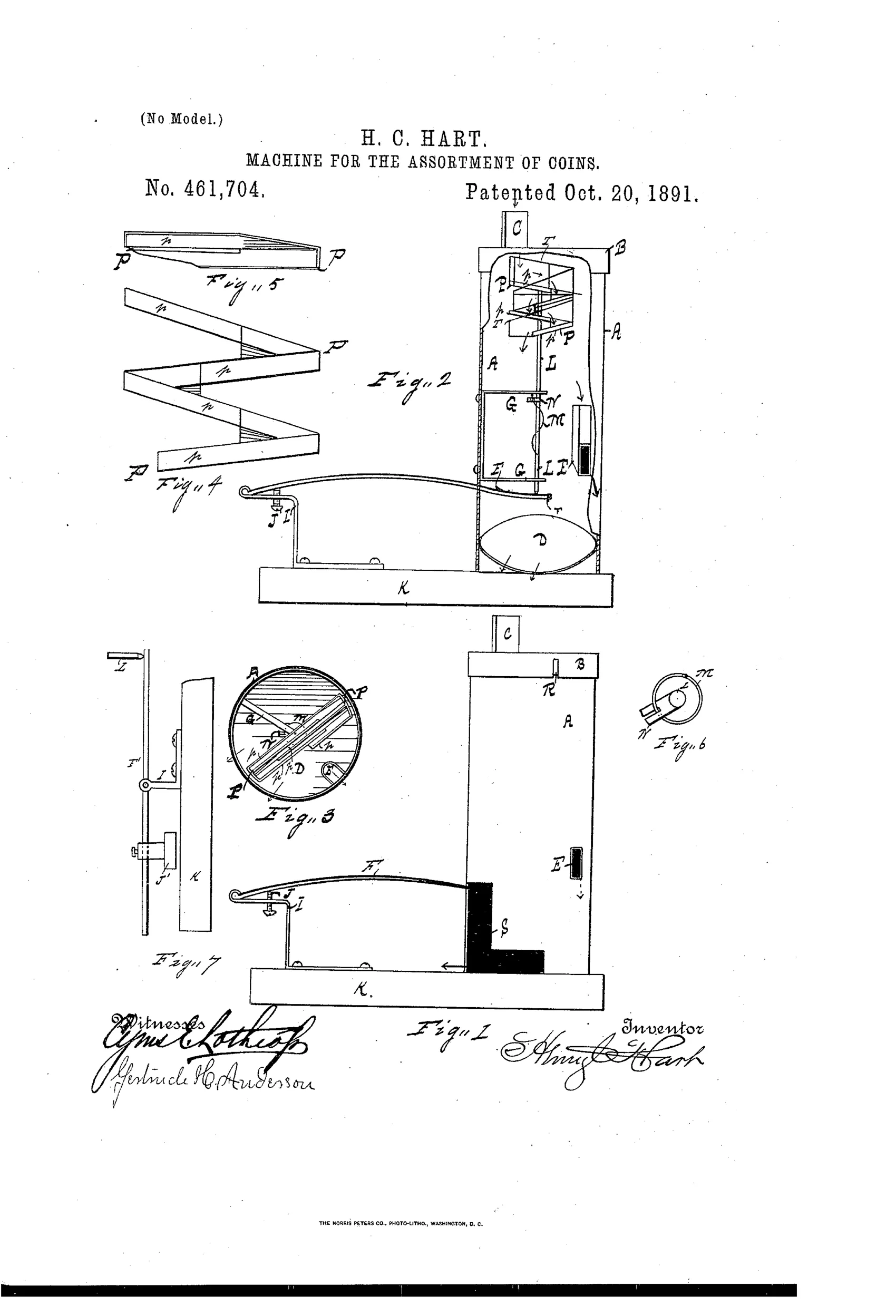
Coin-sorting mechanism for vending machines
◉ How it works
A coin dropped through a chute lands on a balanced zigzag race supported by a spring, which depresses and moves the race vertically and, via a pin engaging a spiral wire, rotates it horizontally in proportion to the coin's weight. Proper coins depress the race to the exact point where its delivery end registers with a fixed chute, dropping them into the vending mechanism, while lighter or heavier coins register above or beyond that chute and are diverted onto an inclined bottom and ejected from the machine. The race is a series of oppositely-inclined short sections forming a zigzag to slow the coin's travel enough for the weighing action to occur. A counterbalanced lever or scale-beam with an adjustable weight may be substituted for the spring to support the shaft.
◉ What was claimed
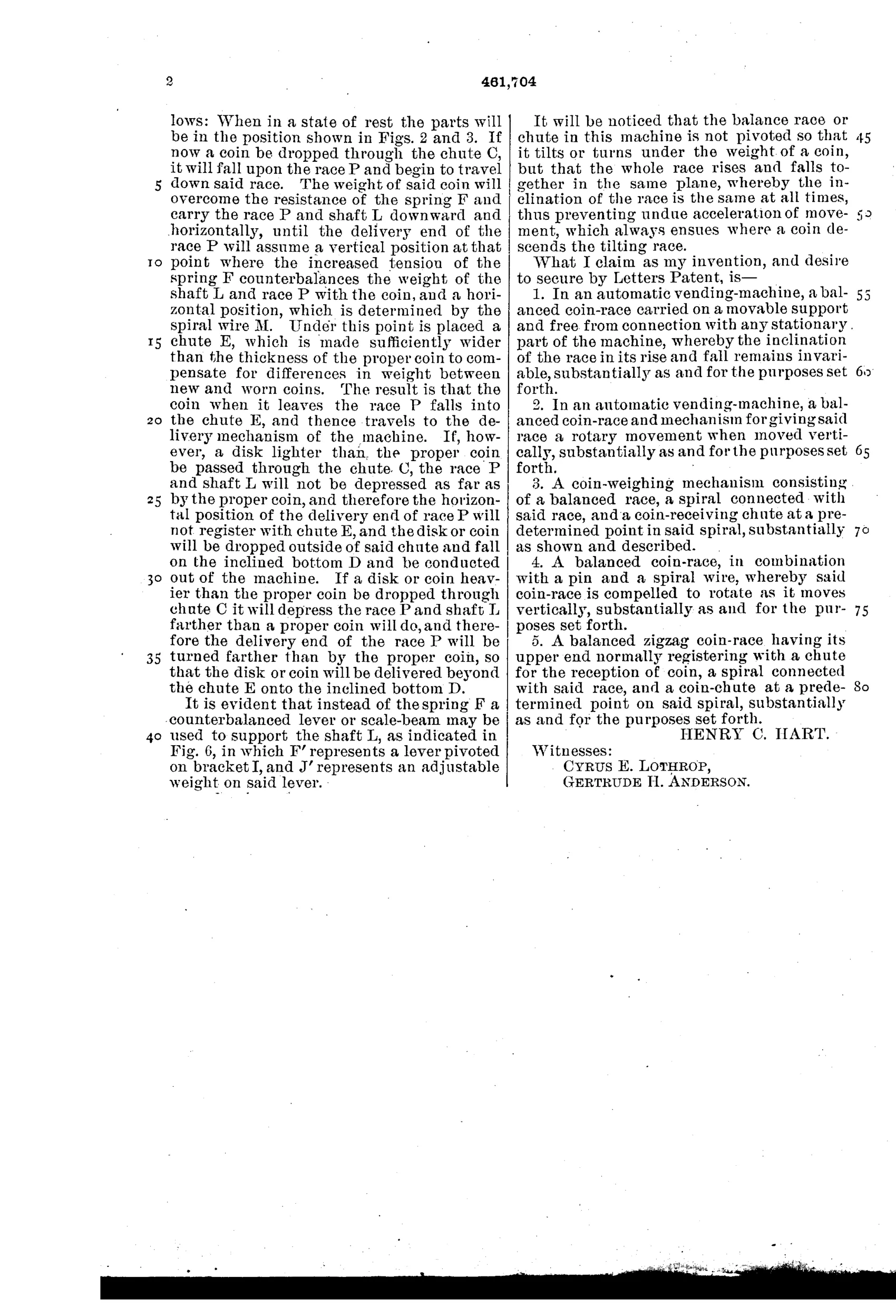
“1. In an automatic vending-machine, a balanced coin-race carried on a movable support and free from connection with any stationary part of the machine, whereby the inclination of the race in its rise and fall remains invariable, substantially as and for the purposes set forth.”
In plain English: The coin race is mounted so it can move freely up and down without being fixed to any stationary part, keeping its tilt the same at all times as it weighs coins.
◉ In the inventor’s words
“It will be noticed that the balance race or chute in this machine is not pivoted so that it tilts or turns under the weight of a coin, but that the whole race rises and falls together in the same plane, whereby the inclination of the race is the same at all times, thus preventing undue acceleration of movement, which always ensues where a coin descends the tilting race.”— Henry C. Hart, from the specification
Fate unknown
The Star Automatic Sales Company assignment suggests intent to manufacture, but no surviving machine with this mechanism is documented; a marked example or company records would settle it.
◉ Commentary
Most weight-testing chutes of the 1890s used a tilting balance: the coin lands on a pivoted arm, the arm tips, and the coin rolls off one way or the other. Hart spotted the flaw in that scheme — as the arm tilts, the coin's slope steepens and it accelerates, so the coin can shoot past its proper exit before the balance has finished settling. His answer is to keep the race free of any pivot. The entire zigzag chute rides on a spring-supported shaft and drops bodily, in the same plane, by an amount proportional to the coin's weight. The slope the coin rolls down never changes.
The zigzag itself is the second half of the trick, visible in Figs. 4 and 5: a stack of oppositely inclined short ramps that stalls the coin's travel long enough for the weighing to complete. Meanwhile a pin riding a spiral wire converts the vertical drop into rotation, swinging the delivery end around so that only a coin of correct weight lines up with the fixed accept chute. Light slugs and heavy fakes register above or beyond it and get dumped onto the inclined bottom and out.
This is squarely in the category's second act — the anonymous in-chute era — and it's a genuinely thoughtful entry, assigned to a real vending concern. Whether all that suspended, rotating delicacy survived jostling and dirt in a street machine is another question; simpler weight gates and magnets are what the trade settled on.
Commentary by Claude, The Counterfeit Coin Detector Patent Archive’s resident enthusiast