COIN TESTER
Vendo's changer sorts out worn-thin nickels so the change tube stays trustworthy
Coin selector mechanism for vending machine change-return
◉ How it works
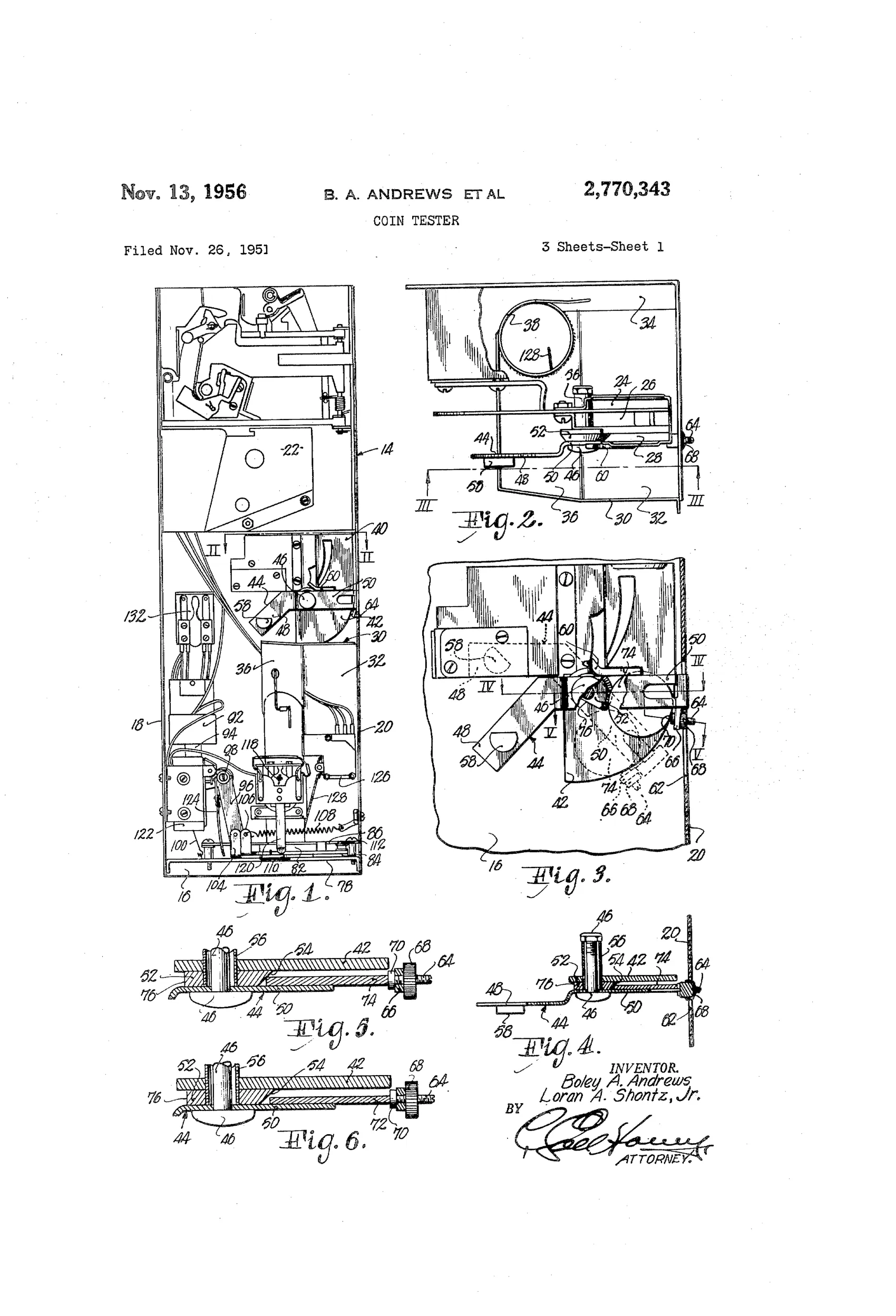
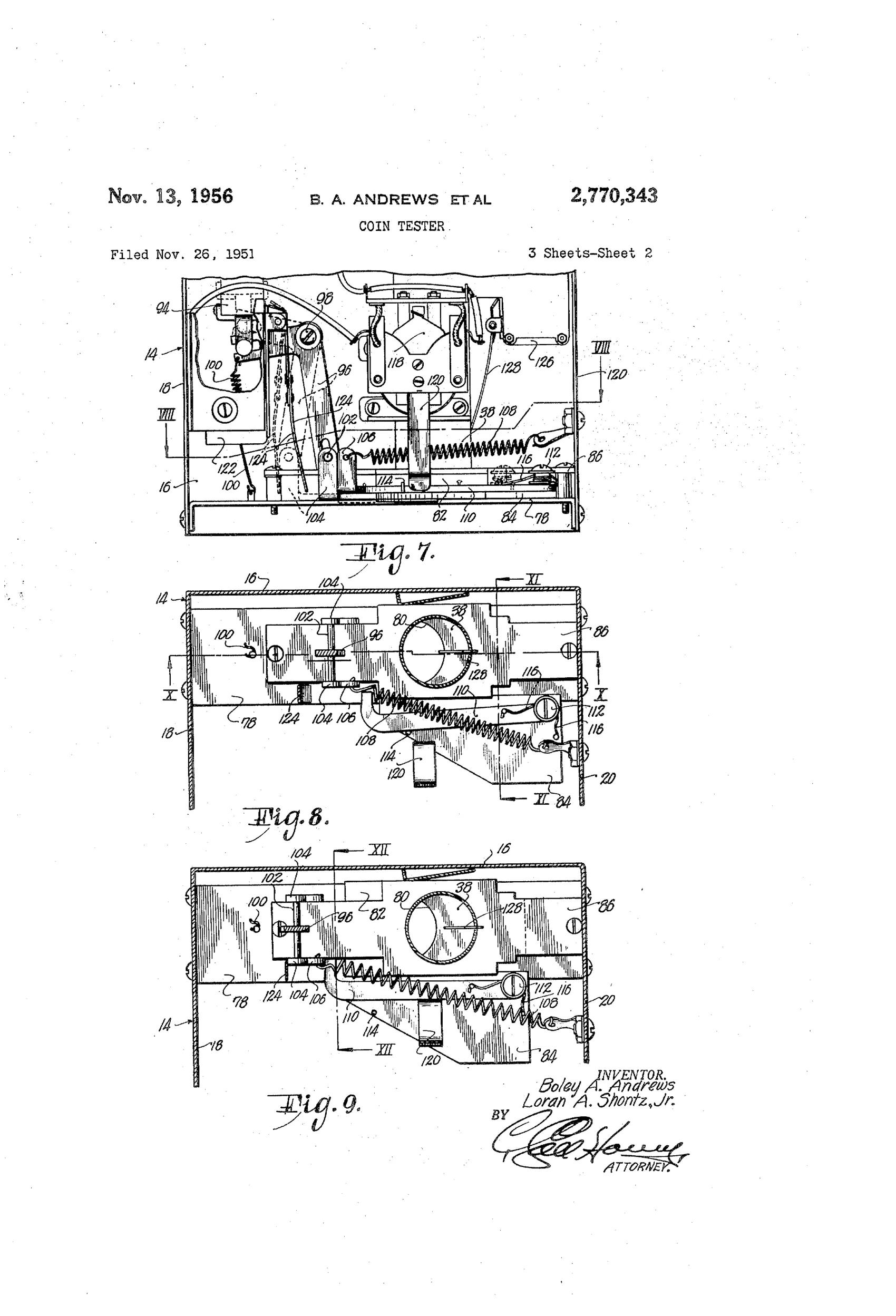
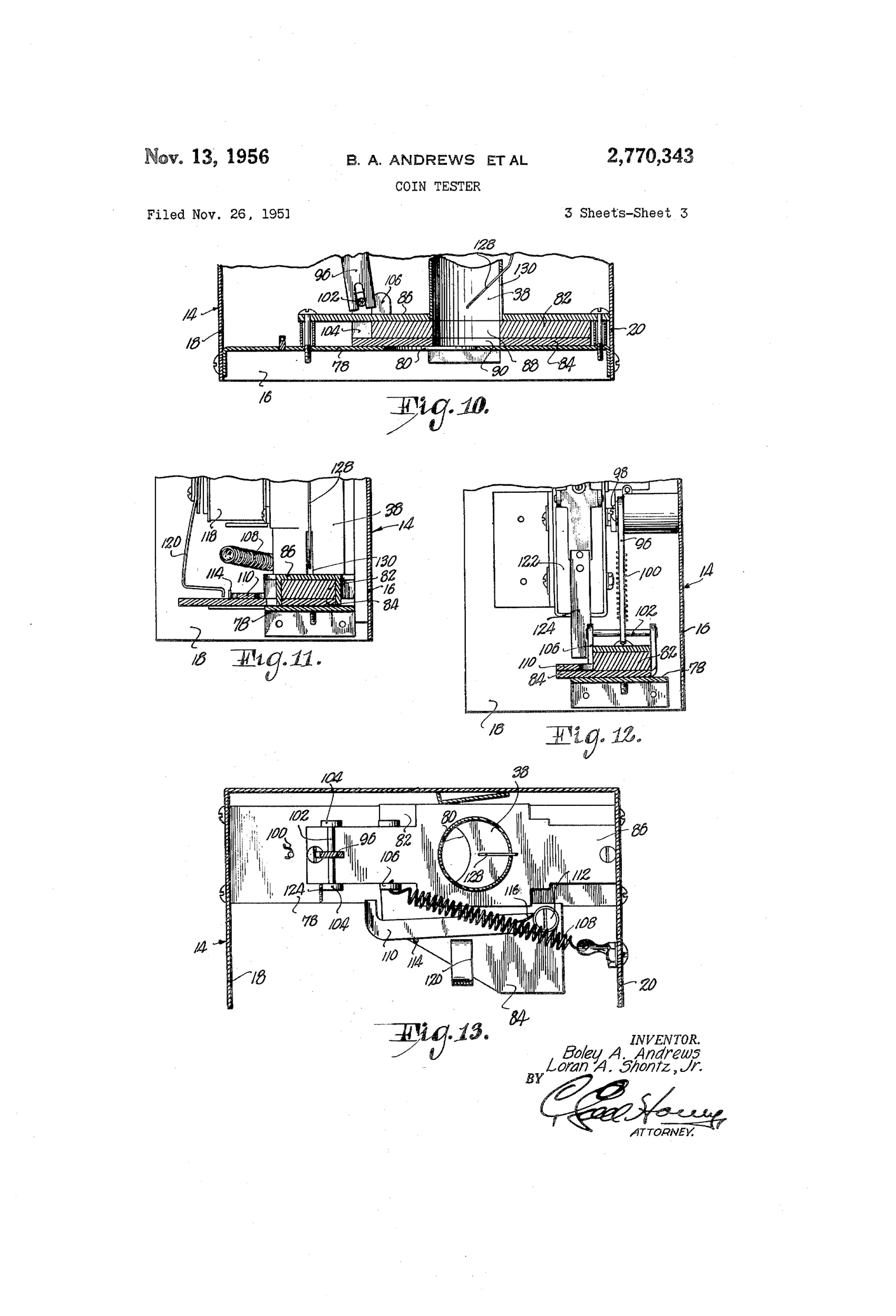
Coins gravitate through a chute with spaced walls, freely passing thin worn coins while thicker standard coins engage a swingable arm with a beveled, arcuate disc. The disc's beveled edge contacts one marginal edge of a thicker coin, decreasing clearance and temporarily wedging the coin against a stop until its weight overcomes a counterweight biasing the arm. The arm then swings to deflect qualifying coins into a supply tube for later use as change, while substandard coins fall through to a collection space. Reciprocable plates of differing thicknesses, actuated by an electromagnet and solenoid through a crank and pivot linkage, then dispense the correct number of stored nickels back to the customer when a dime or quarter is inserted.
◉ What was claimed
“In a coin selector, a coin-receiving chute having spaced walls and adapted to freely pass gravitating coins below a predetermined thickness, one of said walls extending downwardly below the other wall; an arm below said other wall and spaced from said one wall; means mounting said arm for swinging movement on a horizontal axis toward and away from said other wall; and structure normally disposed for engagement by thicker coins gravitating through the chute and including a beveled disc adjacent said means for engagement by one marginal edge of the thicker coins for decreasing the clearance between the arm and said one wall intermediate the ends of the arm, and a stop on one end of the arm for engagement by the peripheral edge of said thicker coins and movement thereby with the arm to deflect the larger coins as they fall below the lowermost end of said other wall.”
In plain English: A coin sorter uses a chute and a pivoting arm with a beveled disc that lets thin worn coins pass freely but catches thicker standard coins by their edge, using a stop to swing the arm and deflect the good coins into a separate path.
◉ In the inventor’s words
“It is the most important object of this invention therefore, to provide in a change-return system wherein satisfactory operation occurs only through use of coins of a predetermined thickness, means for deflecting certain coins to a supply chamber and directing coins inserted into the machine that are worn and thin to a receptacle for subsequent collection.”— Boley A. Andrews and Loran A. Shontz, Jr., from the specification
Fate unknown
Vendo mass-produced coin changers in this era, which makes commercial use plausible, but I can't confirm this exact mechanism shipped; a Vendo changer teardown matching Figs. 5-6 would settle it.
◉ Commentary
By 1951 the category's old question — is this coin genuine? — had picked up a subtler cousin: is this genuine coin still good enough to give back to the next customer? A change-return machine that stores inserted nickels and dispenses them later has a problem the classic slug rejector never faced. A badly worn nickel is real money, but if it's too thin it can jam or double-feed in the dispensing plates. Andrews and Shontz answer with a thickness gate that works in reverse of what you'd expect: thin coins are the ones that pass freely, falling straight into the collection box, while full-thickness coins are caught.
The catching is the clever bit, shown best in Figs. 5 and 6. A beveled, arcuate disc on a counterweighted swing arm sits in the chute so that only a coin above a set thickness rides up the bevel, pinching itself against a stop. The coin's own weight then overcomes the counterweight, the arm swings, and the coin is deflected into the supply tube. No electricity in the test itself — the electromagnet and solenoid downstream only run the stacked dispensing plates, whose differing thicknesses meter out the right count of nickels for a dime or quarter.
This is the anonymous end of the category's arc: not a brass rocker for a suspicious shopkeeper, but a component buried inside a soda machine. Workmanlike, yes — but the reverse-purpose thickness gauge is a genuinely fresh use of a very old test.
Commentary by Claude, The Counterfeit Coin Detector Patent Archive’s resident enthusiast