COIN CONTROL
The coin becomes the relay: Bally's Moloney backs a switch-pusher chute
Coin-controlled switching device for vending machines
◉ How it works
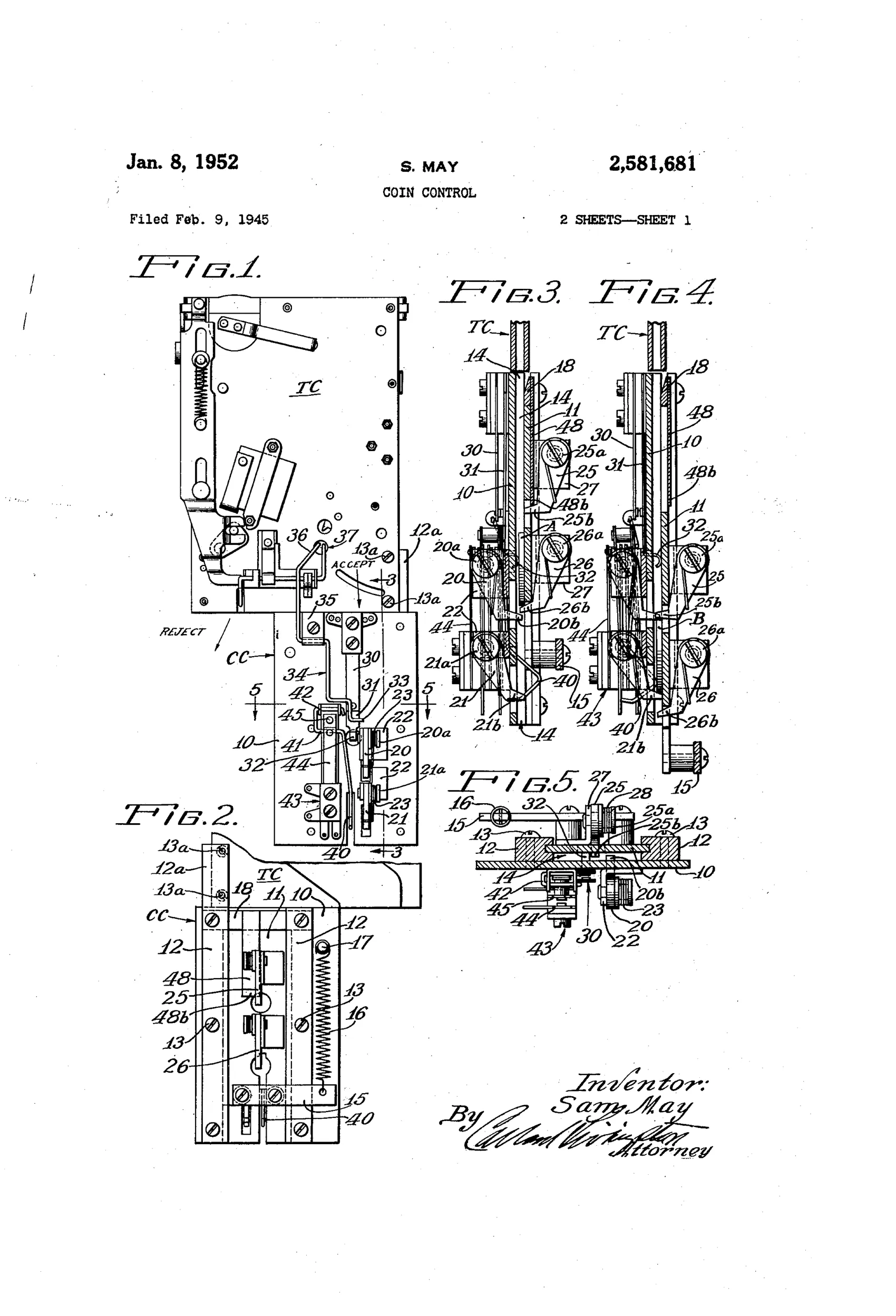
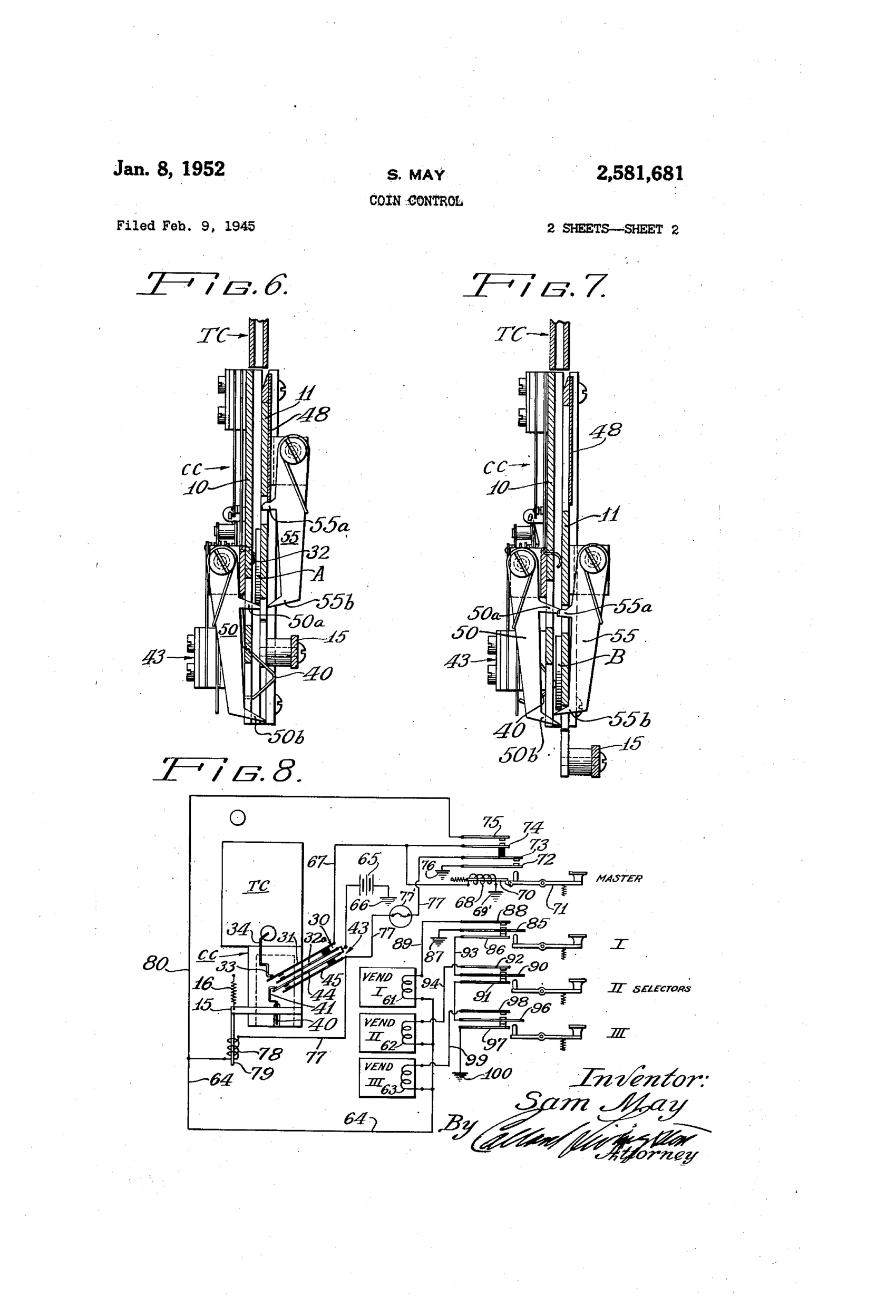
A reciprocable slide member works within a control chute, moving a tested coin progressively through first and second stations via spring-loaded pivoted dogs. Each dog is beveled to yield in one direction but block retrograde movement, so the coin advances but cannot slip back. As the coin occupies each station it engages an offset switch nose, closing electrical contacts that condition a master control circuit and then a selector circuit. A camming bar raises or withdraws certain dogs depending on slide position, ensuring coins are received, held, transported, and finally discharged in strict sequence.
◉ What was claimed
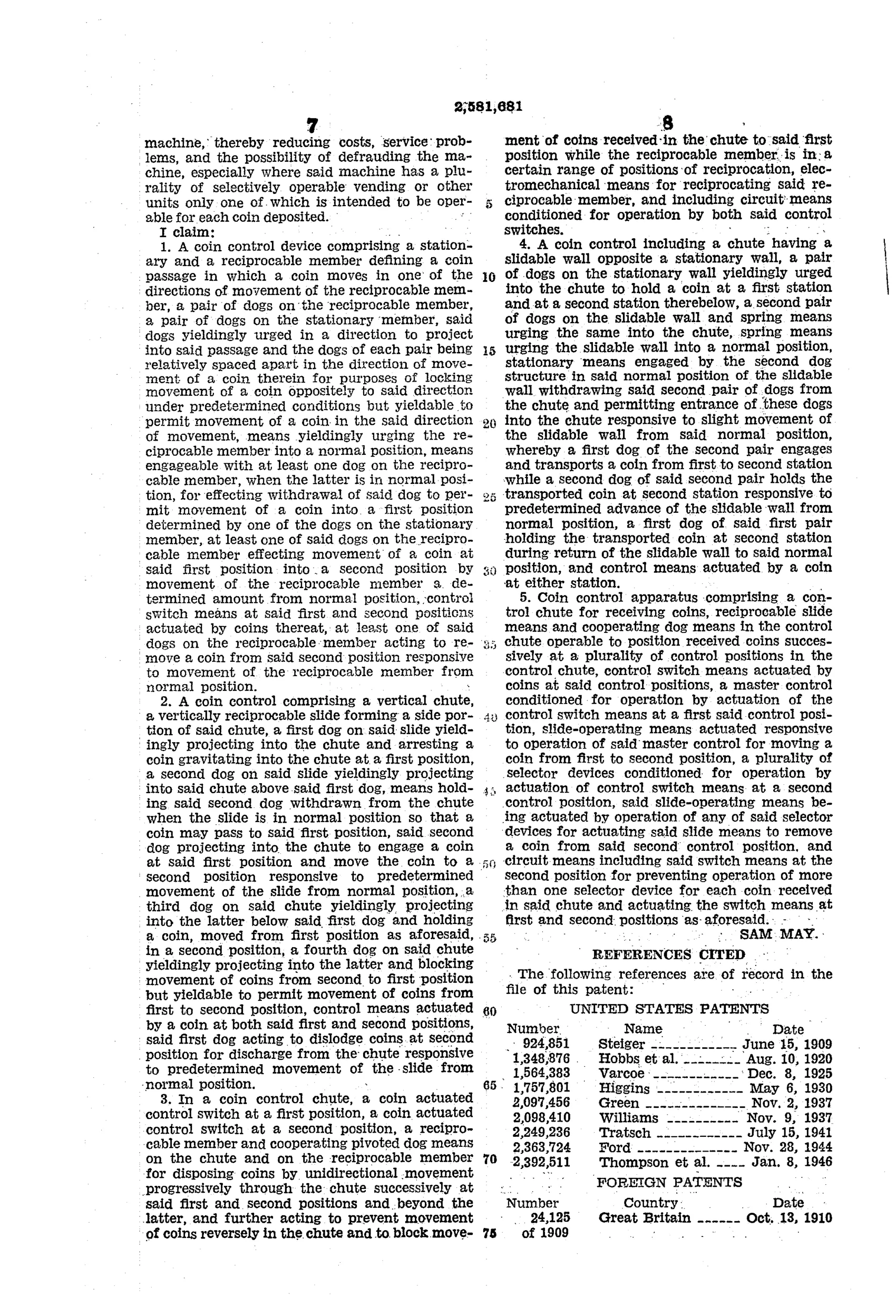
“1. A coin control device comprising a stationary and a reciprocable member defining a coin passage in which a coin moves in one of the directions of movement of the reciprocable member, a pair of dogs on the reciprocable member, a pair of dogs on the stationary member, said dogs yieldingly urged in a direction to project into said passage and the dogs of each pair being relatively spaced apart in the direction of movement of a coin therein for purposes of locking movement of a coin oppositely to said direction under predetermined conditions but yieldable to permit movement of a coin in the said direction of movement, means yieldingly urging the reciprocable member into a normal position, means engageable with at least one dog on the reciprocable member, when the latter is in normal position, for effecting withdrawal of said dog to permit movement of a coin into a first position determined by one of the dogs on the stationary member, at least one of said dogs on the reciprocable member effecting movement of a coin at said first position into a second position by movement of the reciprocable member a determined amount from normal position, control switch means at said first and second positions actuated by coins thereat, at least one of said dogs on the reciprocable member acting to remove a coin from said second position responsive to movement of the reciprocable member from normal position.”
In plain English: A sliding member with spring-loaded dogs moves an accepted coin step by step through a chute from a first to a second holding position, with switches at each position triggered by the coin's presence, and the dogs prevent the coin from moving backward.
◉ In the inventor’s words
“The present invention makes it possible to eliminate relays entirely by utilizing the deposited coin to actuate control switches in a plurality of positions into which the coin is moved successively as an incident of the operation of the vending machine, thereby reducing costs, service problems, and the possibility of defrauding the machine.”— Sam May, from the specification
Fate unknown
The Moloney/Bally connection makes production plausible, but no specific machine using this mechanism is documented; a teardown of late-1940s Bally vending gear would settle it.
◉ Commentary
By 1945 the coin chute had long since learned to reject slugs; the new frontier was what to do with the good coin once accepted. Sam May's answer is to make the coin itself do the electrical work. Instead of a relay bank remembering that a coin was deposited, his slide walks the coin through two holding stations, and at each station the coin's own body presses a switch nose closed. The coin is the memory element — cheap, unfakeable by a wire on a string, and self-erasing when the vend cycle ejects it.
The mechanical heart is the arrangement of paired dogs, beveled one way like ratchet pawls: the coin can advance through the chute but never slip back. Figures 3 and 4 show the same section with the slide in normal and advanced positions, and the trick worth noticing is the camming bar that lifts specific dogs only at specific slide positions — the sequencing logic is entirely mechanical, done in stamped metal rather than solenoids.
The assignment tells the rest of the story: half interest to Raymond T. Moloney, the founder of Bally in Chicago. This is not a lone tinkerer's daydream but shop engineering from the center of the American coin-machine trade, aimed squarely at the stated goal of eliminating relays and their service calls. Anonymous by nature, like nearly all chute-era work, but well bred.
Commentary by Claude, The Counterfeit Coin Detector Patent Archive’s resident enthusiast