COIN SELECTOR
The magnet as anvil: sorting coins by how long they cling
Magnetic coin selector distinguishing coin types by paramagnetism
◉ How it works
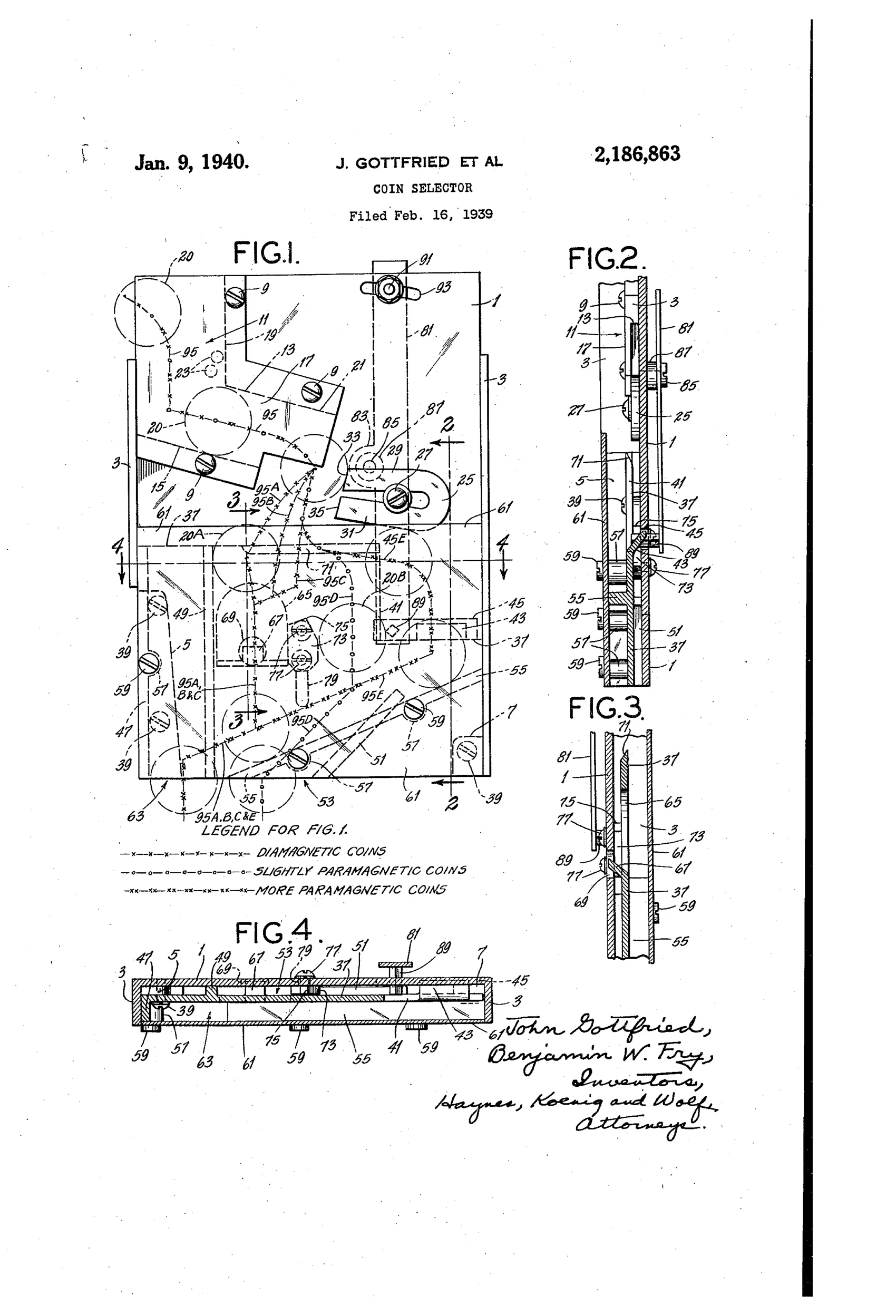
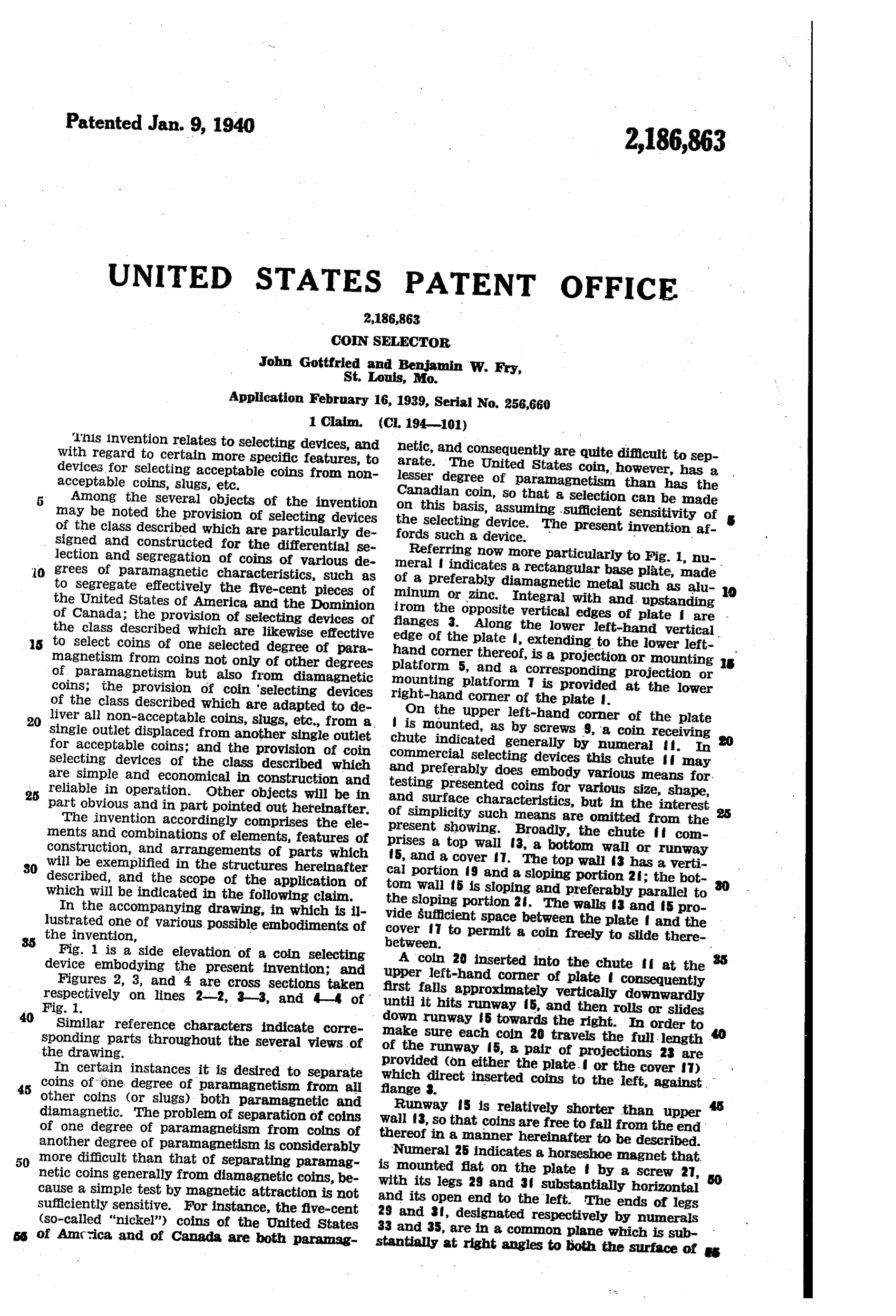
Coins slide down a chute and runway to acquire uniform velocity, then bounce off the end face of a horseshoe magnet's leg. Diamagnetic coins simply bounce away from the magnet face like off an anvil, falling to the left into the reject outlet. Weakly paramagnetic coins cling briefly, roll along the magnet's second leg where field strength weakens, then drop off at a position that guides them via a sloping projection and rib into the accepted-coin outlet. More strongly paramagnetic coins adhere longer, rolling further along the leg before dropping, and are deflected by a separate projection into the same reject outlet as diamagnetic coins, achieving differential separation based on degree of paramagnetism.
◉ What was claimed
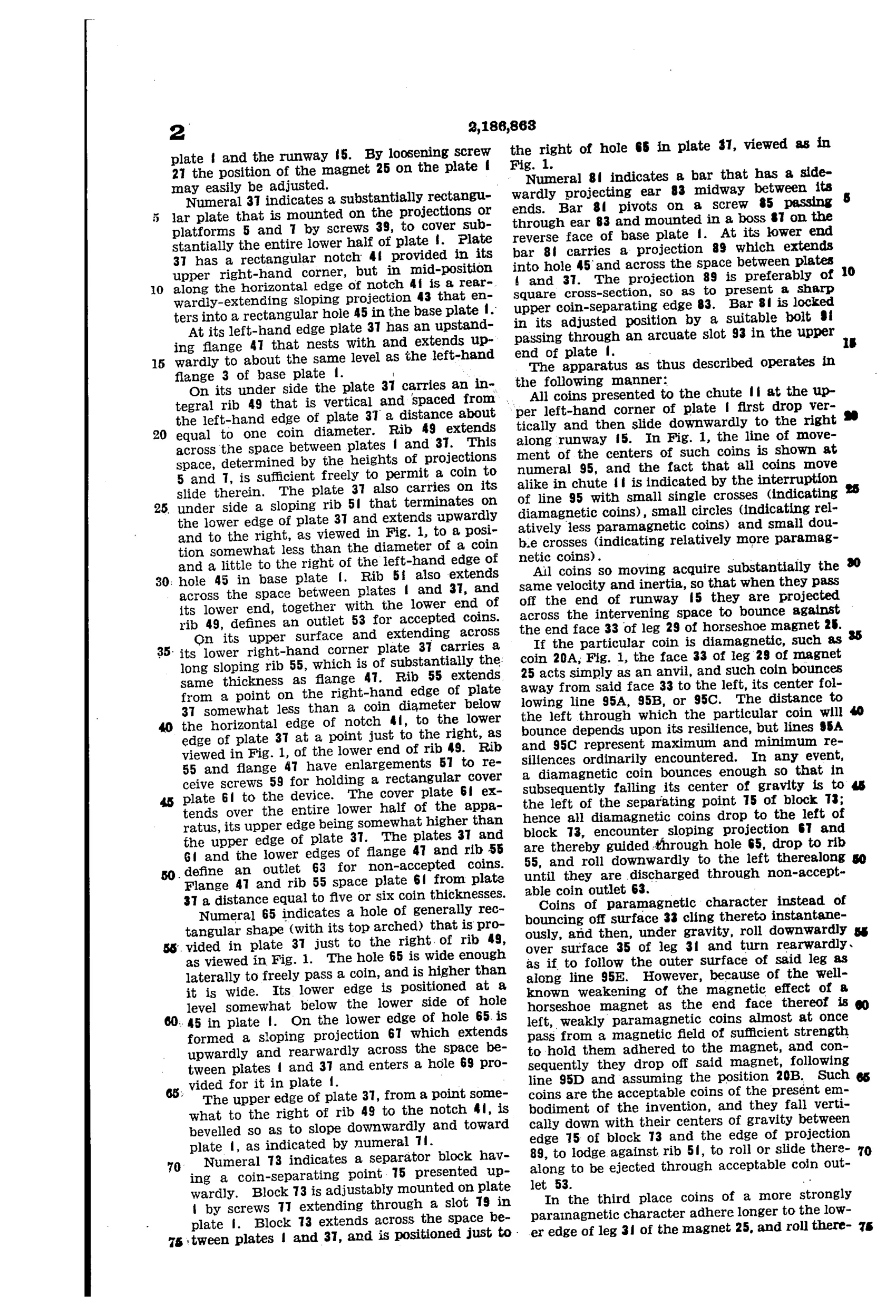
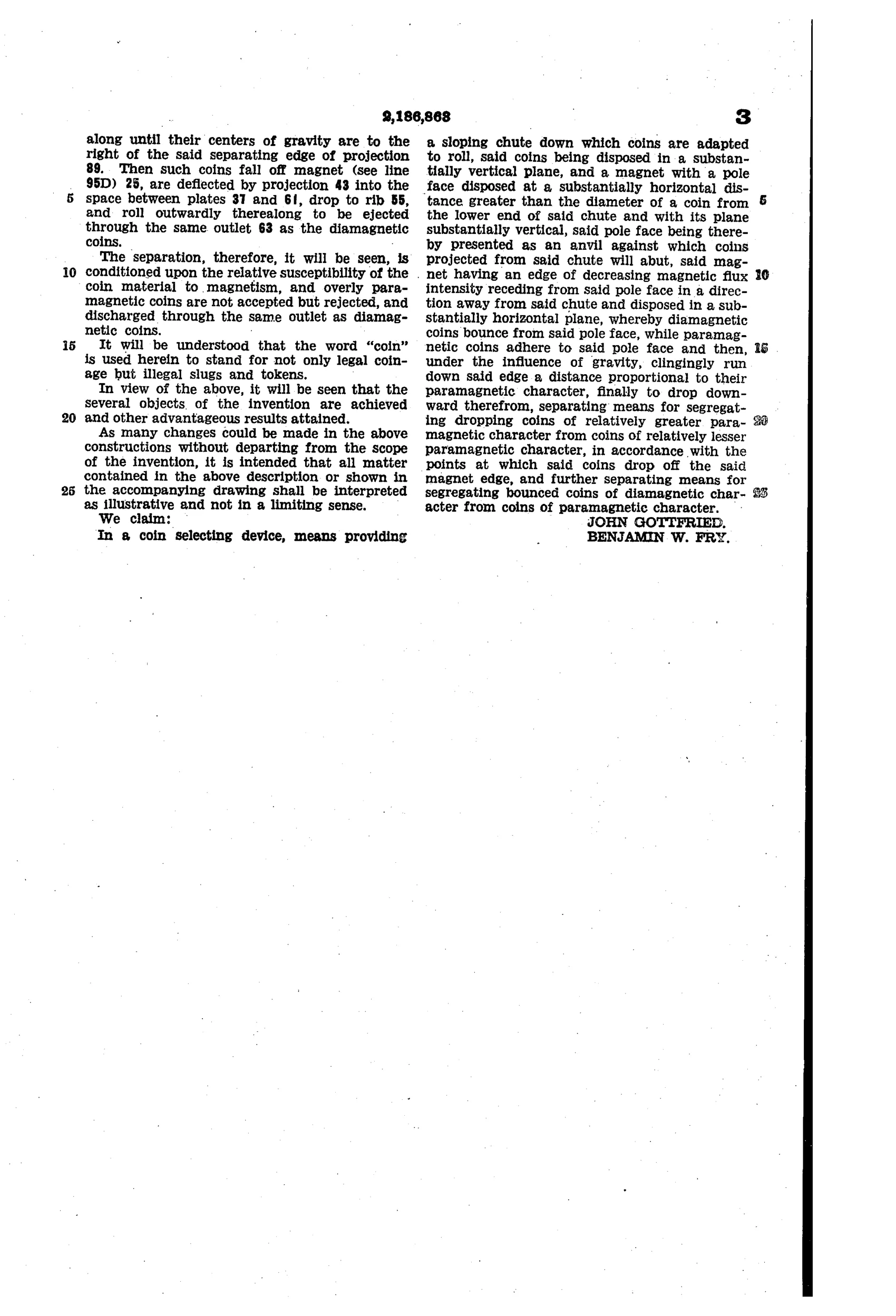
“In a coin selecting device, means providing a sloping chute down which coins are adapted to roll, said coins being disposed in a substantially vertical plane, and a magnet with a pole face disposed at a substantially horizontal distance greater than the diameter of a coin from the lower end of said chute and with its plane substantially vertical, said pole face being thereby presented as an anvil against which coins projected from said chute will abut, said magnet having an edge of decreasing magnetic flux intensity receding from said pole face in a direction away from said chute and disposed in a substantially horizontal plane, whereby diamagnetic coins bounce from said pole face, while paramagnetic coins adhere to said pole face and then, under the influence of gravity, clingingly run down said edge a distance proportional to their paramagnetic character, finally to drop downward therefrom, separating means for segregating dropping coins of relatively greater paramagnetic character from coins of relatively lesser paramagnetic character, in accordance with the points at which said coins drop off the said magnet edge, and further separating means for segregating bounced coins of diamagnetic character from coins of paramagnetic character.”
In plain English: The device uses a chute to launch coins at a magnet's pole face acting as an anvil; diamagnetic coins bounce off while paramagnetic coins stick and slide down the magnet's tapering flux edge a distance proportional to their magnetism before dropping, allowing separate outlets to sort coins by degree of paramagnetism.
◉ In the inventor’s words
“The problem of separation of coins of one degree of paramagnetism from coins of another degree of paramagnetism is considerably more difficult than that of separating paramagnetic coins generally from diamagnetic coins, because a simple test by magnetic attraction is not sufficiently sensitive.”— John Gottfried and Benjamin W. Fry, from the specification
Fate unknown
Like most chute-tester patents this would have vanished anonymously into vending hardware; a mechanism marked with the patent number would settle it, and none is documented.
◉ Commentary
Most chute-tester patents use a magnet as a simple bouncer — steel slug sticks or deflects, everything else passes. Gottfried and Fry ask a harder question: what if you need to tell apart coins that are all slightly magnetic, just to different degrees? Their answer is genuinely elegant. Coins launch off a chute at uniform speed and strike the pole face of a horseshoe magnet head-on. A diamagnetic coin bounces off as if the magnet were an anvil. A paramagnetic coin sticks, then rolls under gravity along the magnet's leg, where the flux weakens with distance — so the coin drops off at a point proportional to its magnetic character. The magnet becomes a graduated scale, and fixed projections below sort the drop points into accept and reject channels.
The drawing rewards a close look: Fig. 1 carries an actual legend, with three dashed-line styles tracing the trajectories of diamagnetic, slightly paramagnetic, and more paramagnetic coins across the plate. It reads like a ballistics chart, and it's the clearest statement of the invention on the page.
The worry is repeatability. Drop-off position depends on launch velocity, coin condition, and magnet strength holding constant over years of service — a lot to ask of a 1939 vending mechanism. It sits late in the chute-tester era, a refinement chasing alloy discrimination rather than crude slug rejection, and its logic anticipates the eddy-current and alloy-sensing selectors that followed.
Commentary by Claude, The Counterfeit Coin Detector Patent Archive’s resident enthusiast