COIN TESTING DEVICE
Slugs bounce out; real coins bounce right — a Depression-era ballistics test
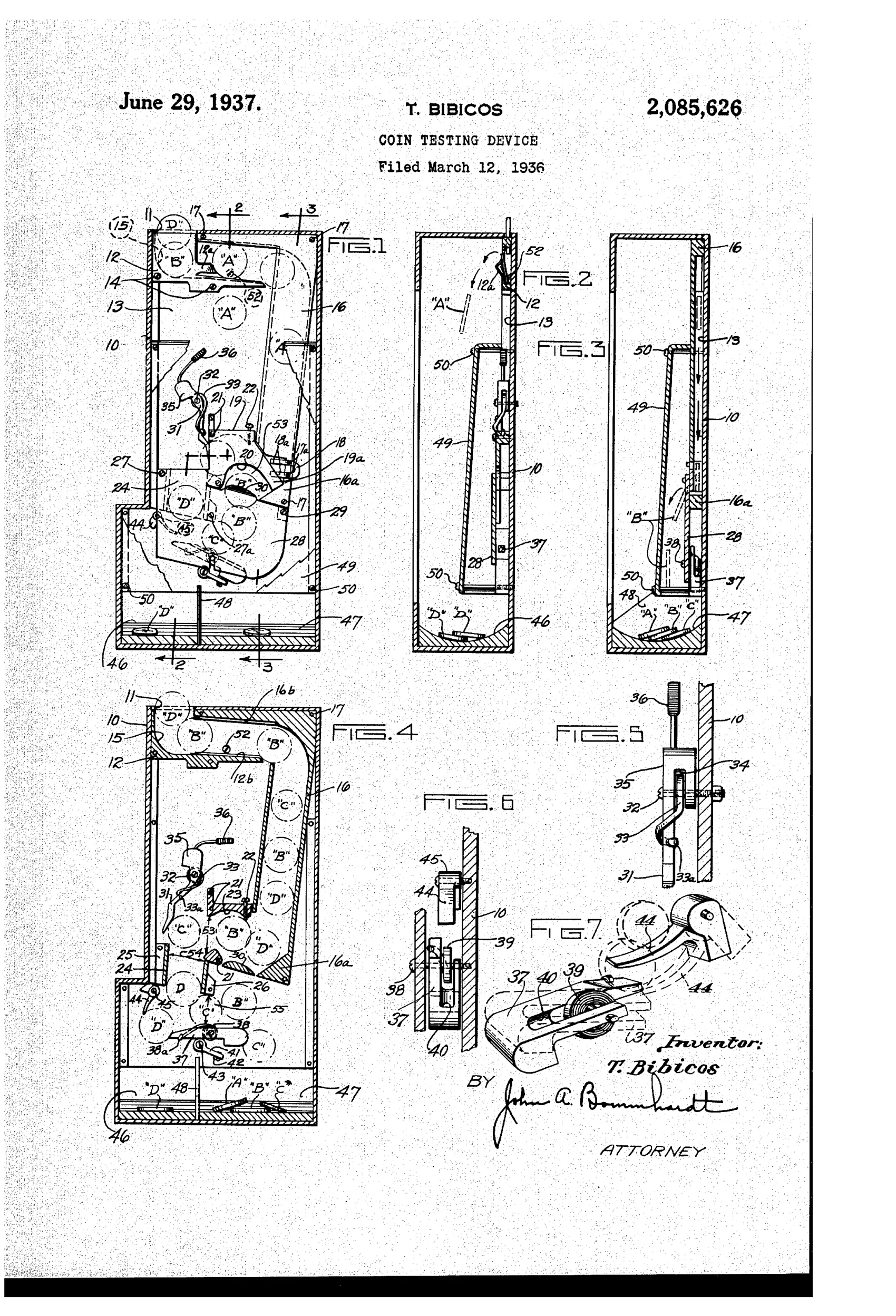
Mechanical slot-machine slug and coin sorter
◉ How it works
A coin dropped in the slot passes through an angular passage and elongated chute where its size and thickness determine which sloping track and bouncing block it strikes. Small or lightweight slugs are tipped off balance by a set screw and fall through an offset ear into the slug compartment, while large slugs bound off an adjustment screw into a curved aperture and are deflected outward. A genuine coin's weight is checked as it passes beneath a magnet, causing it to bounce off a triangular block at the correct angle to strike a spring gate and pivoted release beam, tilting both to drop the coin into the coin compartment. Spring-loaded pivot arms and coil springs return the gates and beams to their normal position after each coin passes.
◉ What was claimed
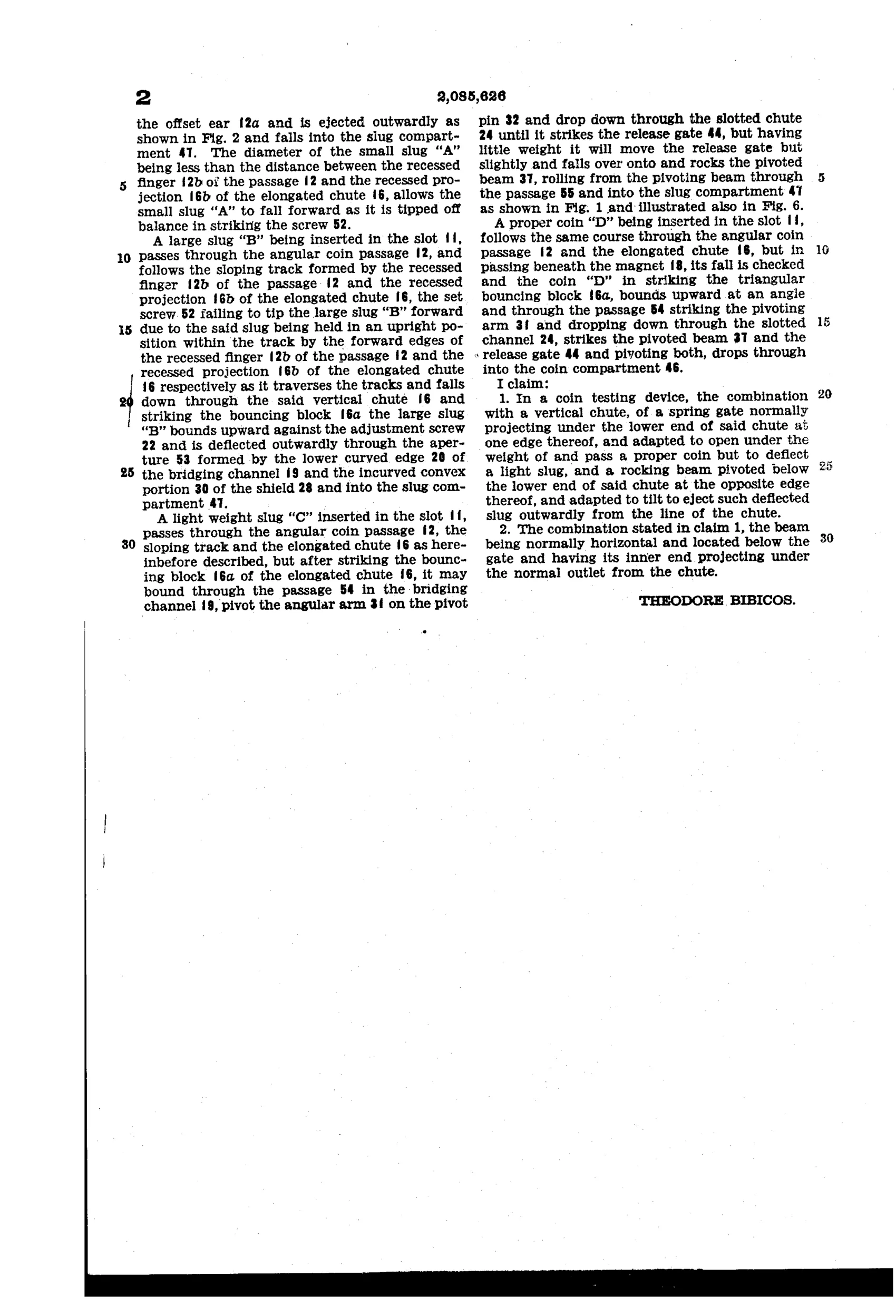
“1. In a coin testing device, the combination with a vertical chute, of a spring gate normally projecting under the lower end of said chute at one edge thereof, and adapted to open under the weight of and pass a proper coin but to deflect a light slug, and a rocking beam pivoted below the lower end of said chute at the opposite edge thereof, and adapted to tilt to eject such deflected slug outwardly from the line of the chute.”
In plain English: A spring-loaded gate under a coin chute lets a real coin's weight push it open, but deflects lightweight slugs onto a pivoting beam that tips them out of the machine.
◉ In the inventor’s words
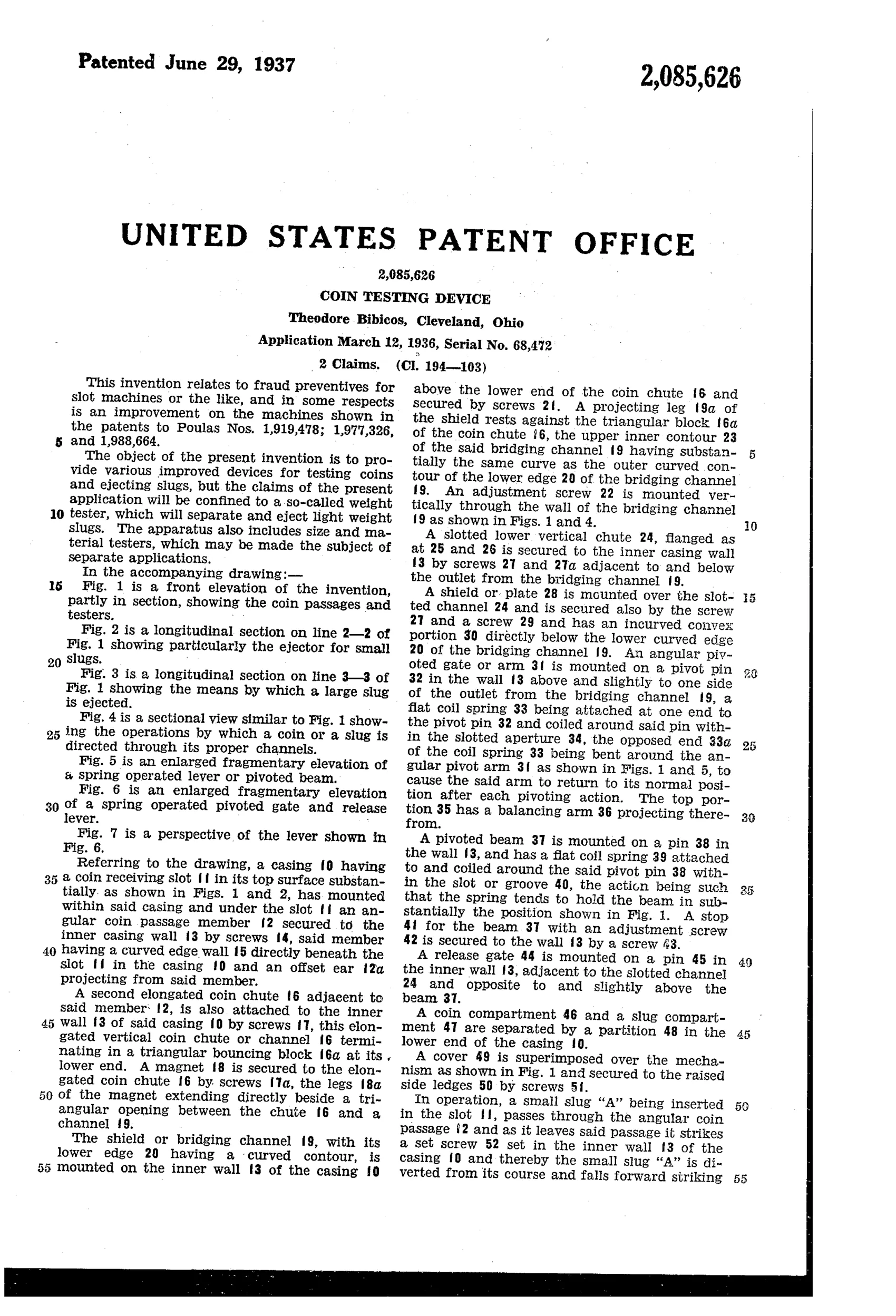
“This invention relates to fraud preventives for slot machines or the like, and in some respects is an improvement on the machines shown in the patents to Poulas Nos. 1,919,478; 1,977,326, and 1,988,664.”— Theodore Bibicos, from the specification
Fate unknown
No marked example or licensing record is documented; a slot machine mechanism traceable to this patent or to the cited Poulas line would settle it.
◉ Commentary
By 1936 the slug problem was serious business — Depression-era vending and slot operators were losing real money to washers and pot-metal fakes, and the Patent Office was thick with rejector designs. Bibicos's entry is notable for how much of its testing is done by bounce. Instead of simply weighing coins on gates, he lets them fall, strike a triangular block, and ricochet: a genuine coin of correct weight and hardness rebounds at the right angle to push through a spring gate, while a light slug caroms differently and lands on a pivoted beam that tips it out of the chute entirely. The coin is, in effect, being asked to hit a target only its own mass and momentum can reach.
The drawing rewards a slow look. Figures 2 and 3 show separate ejection paths for small slugs and oversized slugs — a set screw tips undersized pieces off balance, an adjustment screw deflects large ones out a curved aperture. Those screws matter: they make the tester tunable for wear and denomination, which is the mark of someone who has serviced these machines, not just imagined them. Fig. 7's little perspective lever is drawn with obvious affection.
Bibicos cites three Poulas patents as his starting point, so this is refinement work inside an established Cleveland lineage rather than a first. Like most chute testers, if it survived at all, it survived anonymously inside someone's cabinet.
Commentary by Claude, The Counterfeit Coin Detector Patent Archive’s resident enthusiast