COIN DETECTOR
A well of nitric acid built into the cash register counter, 1936
Chemical coin-testing device for cash registers
◉ How it works
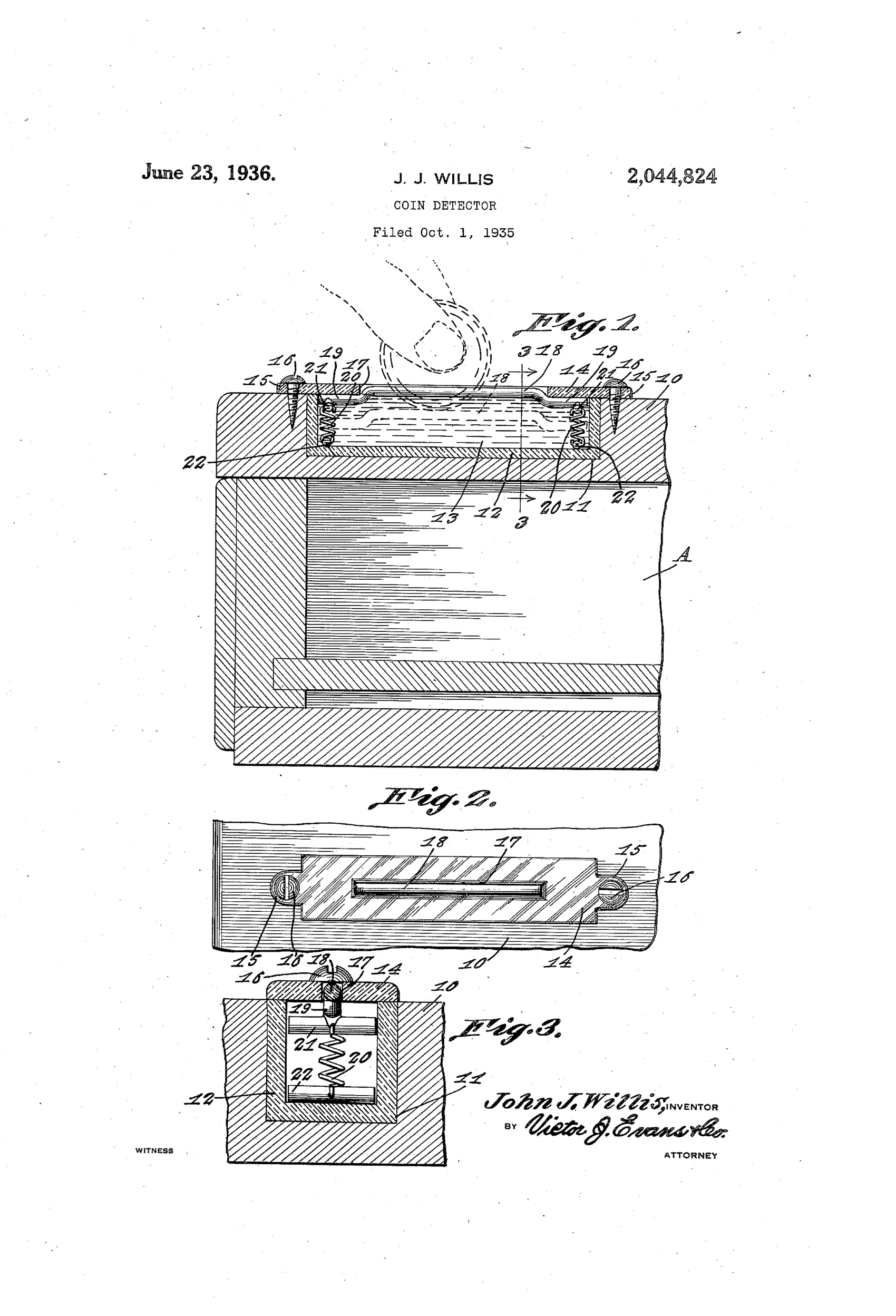
An elongated body forms a well that holds a testing solution of nitric acid, silver nitrate, and distilled water. The body is countersunk into a counter slab and covered by a slotted plate through which coins are inserted to contact the solution. A spring-loaded bar with an upstruck portion normally seals the slot, its cross pieces and rest bars fitted with expansible coiled springs urging it back into the slot after use. If a coin reacts improperly to the solution it is revealed as spurious or not silver.
◉ What was claimed
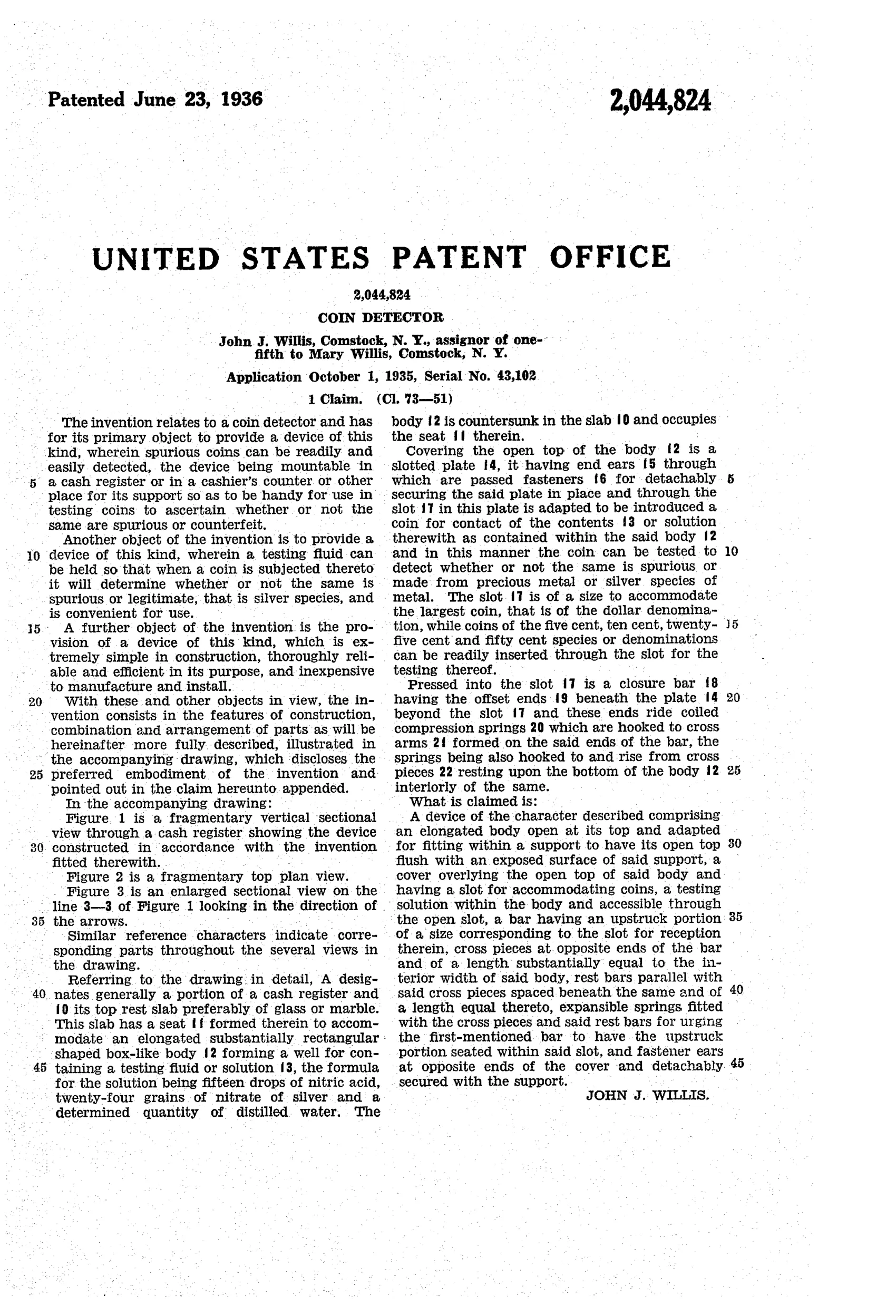
“A device of the character described comprising an elongated body open at its top and adapted for fitting within a support to have its open top flush with an exposed surface of said support, a cover overlying the open top of said body and having a slot for accommodating coins, a testing solution within the body and accessible through the open slot, a bar having an upstruck portion of a size corresponding to the slot for reception therein, cross pieces at opposite ends of the bar and of a length substantially equal to the interior width of said body, rest bars parallel with said cross pieces spaced beneath the same and of a length equal thereto, expansible springs fitted with the cross pieces and said rest bars for urging the first-mentioned bar to have the upstruck portion seated within said slot, and fastener ears at opposite ends of the cover and detachably secured with the support.”
In plain English: A coin-testing well built into a counter, covered by a spring-loaded slotted bar, that holds a chemical solution coins are dipped into to check if they are genuine silver.
◉ In the inventor’s words
“The formula for the solution being fifteen drops of nitric acid, twenty-four grains of nitrate of silver and a determined quantity of distilled water.”— John J. Willis, from the specification
Paper patent — likely never produced
An acid well permanently installed in a shop counter is impractical enough that production seems unlikely, and no commercial example is known; a marked fixture would overturn this.
◉ Commentary
By 1935 the category had spent fifty years perfecting mechanical slug rejection — magnets, rocking gauges, weight gates hidden inside vending chutes. Willis went the other way entirely and reached back to the oldest test of all: the acid touch. Jewelers and bank tellers had been dabbing coins with silver nitrate solution for a century. Willis's contribution was to plumb it into the counter itself — a little trough of nitric acid, silver nitrate, and distilled water, countersunk flush with the surface next to the register, with a slot on top through which the clerk dips a suspect coin.
The mechanical heart is all in Fig. 3: a spring-loaded bar with an upstruck ridge that seals the slot when nothing is being tested, so the acid doesn't evaporate, splash, or eat the till. The coiled springs press the closure back up automatically after each dip. That closure is really the whole invention — the chemistry is public domain, and the patent even publishes the recipe (fifteen drops of nitric acid, twenty-four grains of silver nitrate).
As a workplace fixture, it's hard to love. An open acid reservoir at a busy counter, however well sealed, is a maintenance and safety headache, and the test marks every genuine coin it touches. The timing was also poor: within a decade the concern was slugs in machines, not filed silver at the till. A charming dead end, honestly drawn.
Commentary by Claude, The Counterfeit Coin Detector Patent Archive’s resident enthusiast