COIN SELECTOR
A push-pull coin drawer that measures thickness at the coin's center
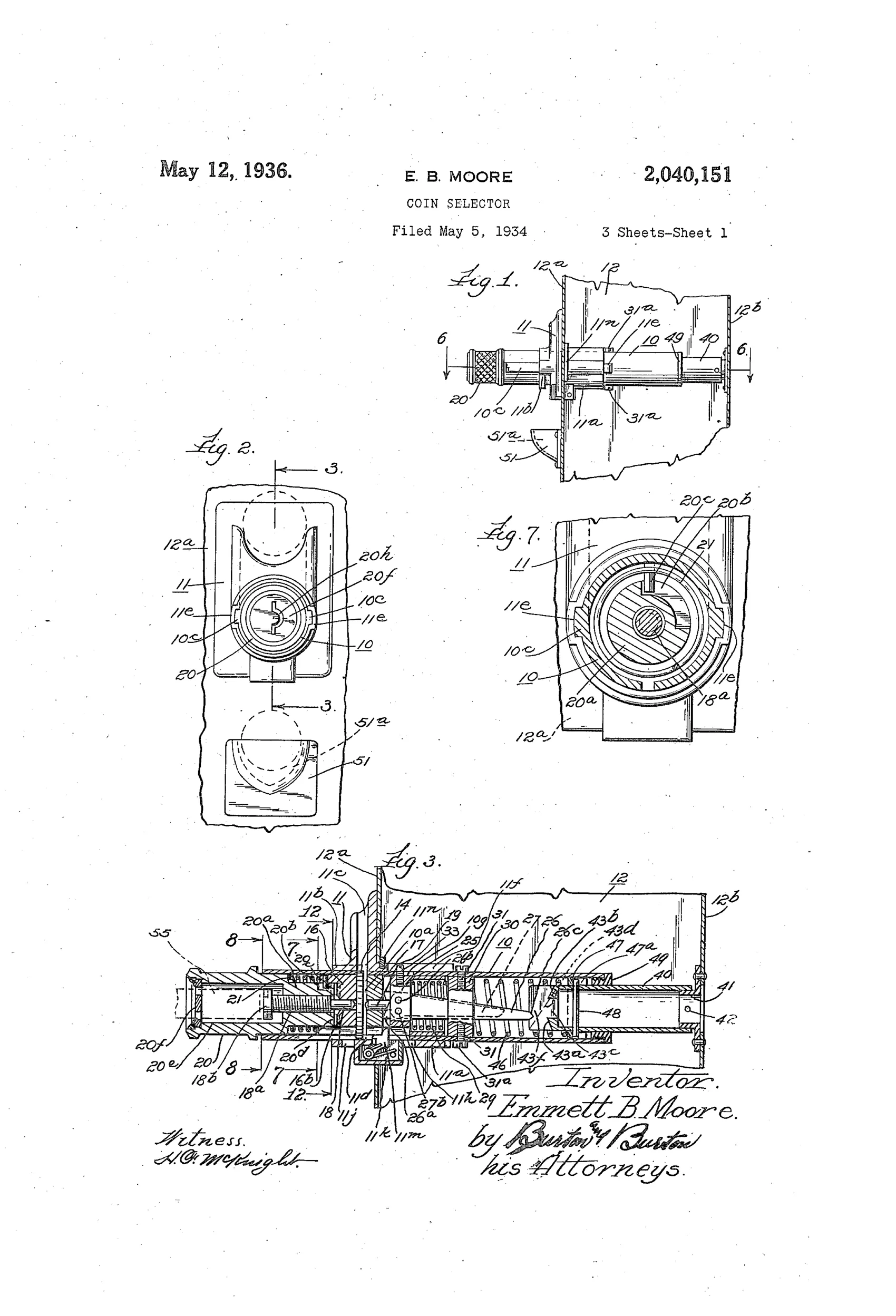
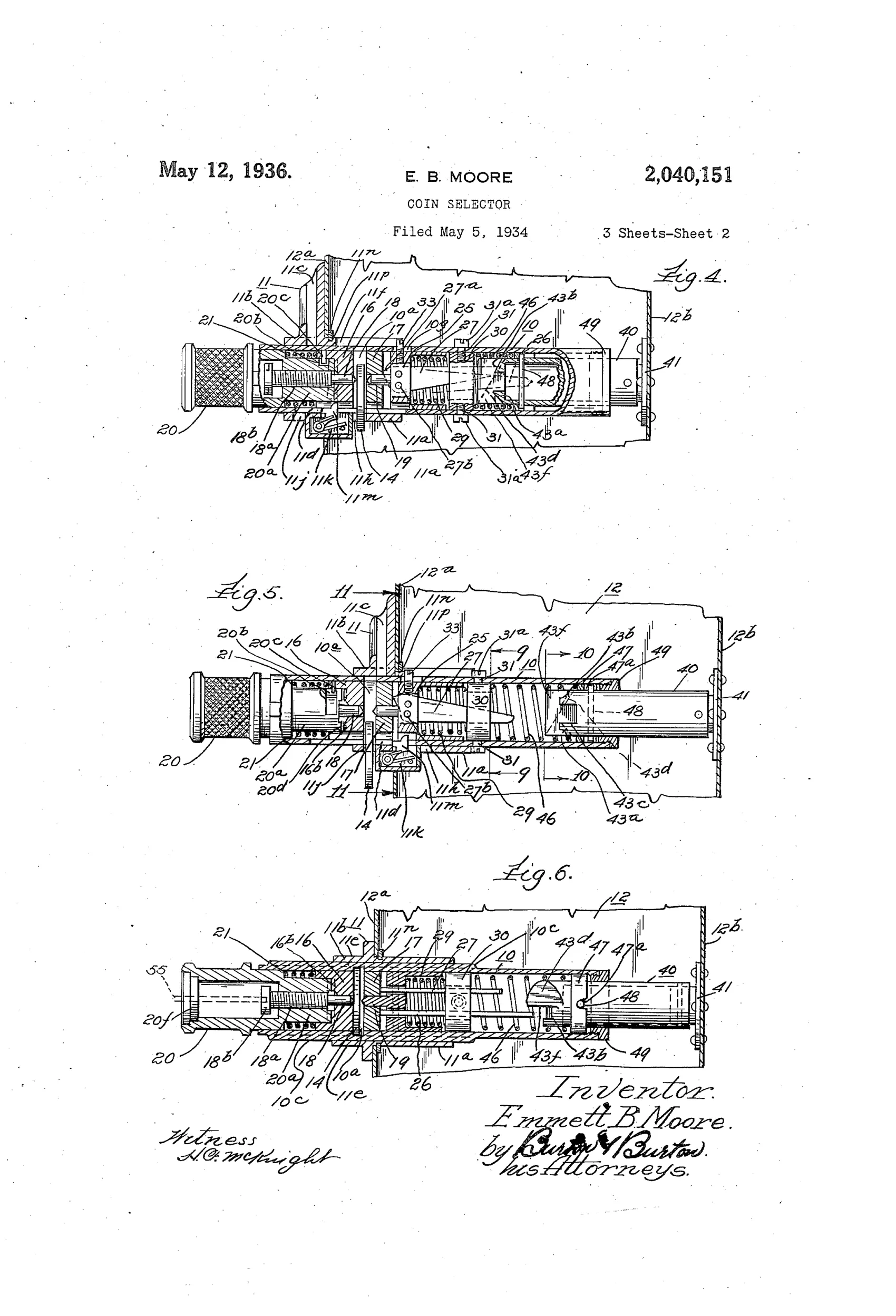
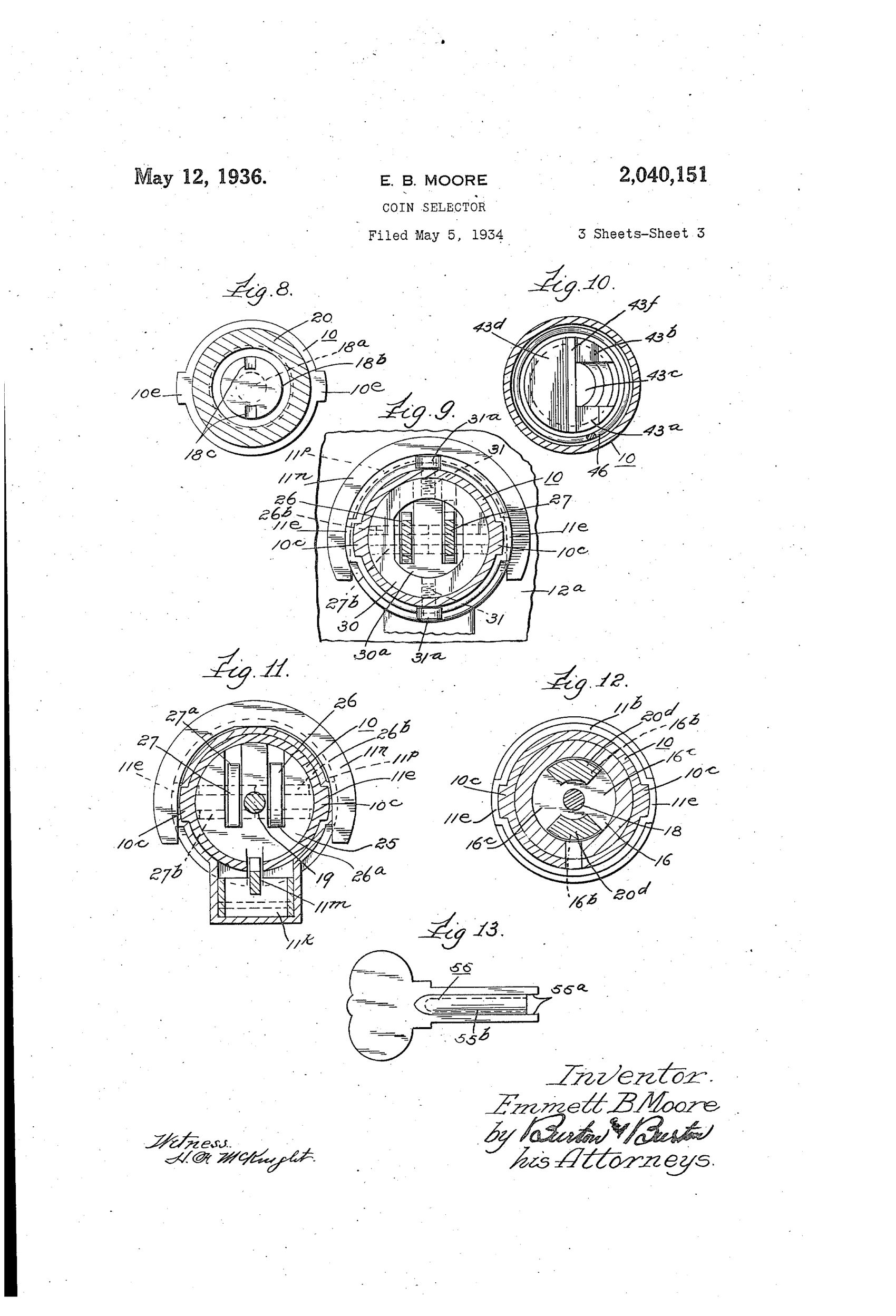
Coin thickness-gauging selector for vending machine slots
◉ How it works
A tubular coin transfer member reciprocates in bearings on an escutcheon plate mounted to a vending machine casing, with a coin-receiving slot that aligns with the machine's slot. A pair of coin-engaging pins mounted on adjustable blocks embrace opposite sides of an inserted coin near its center, calibrating its thickness. If the coin's thickness falls within the predetermined range, a spring-urged control lever aligns with a fixed aperture on a sleeve abutment, permitting full reciprocable travel of the transfer member so the coin can be delivered inside the machine. If the coin is too thick, too thin, or a slug, the lever strikes fixed inclined abutment surfaces and blocks further travel, and pulling the knob outward ejects the spurious coin through a discharge slot into a catch pocket. An adjustable knob with a keyed screw lets an operator reset the pin spacing to accommodate coins of different denominations or two species of the same denomination.
◉ What was claimed
“1. In a device of the character described, a coin transfer member reciprocably movable in a predetermined range, and having a coin-receiving opening, means normally blocking movement of said transfer member during a portion of its range of movement, and measuring means carried by the transfer member and adapted to engage both sides of a coin adjacent its center while it reposes in said opening, the coin-engaging portions of said means being spaced apart a distance greater than the thickness of the coin and being movable into contactual engagement with said coin during an initial portion of movement of said transfer member, and said measuring means being movable in response to a predetermined thickness of a coin for reacting on said blocking means, during such initial movement of the transfer member, for rendering said blocking means ineffective, and permitting maximum reciprocable movement of said transfer member.”
In plain English: A sliding coin carrier has two pins that squeeze the center of an inserted coin, and only if the coin's thickness matches the correct value does this squeezing release a lock so the carrier can slide all the way through and deposit the coin.
◉ In the inventor’s words
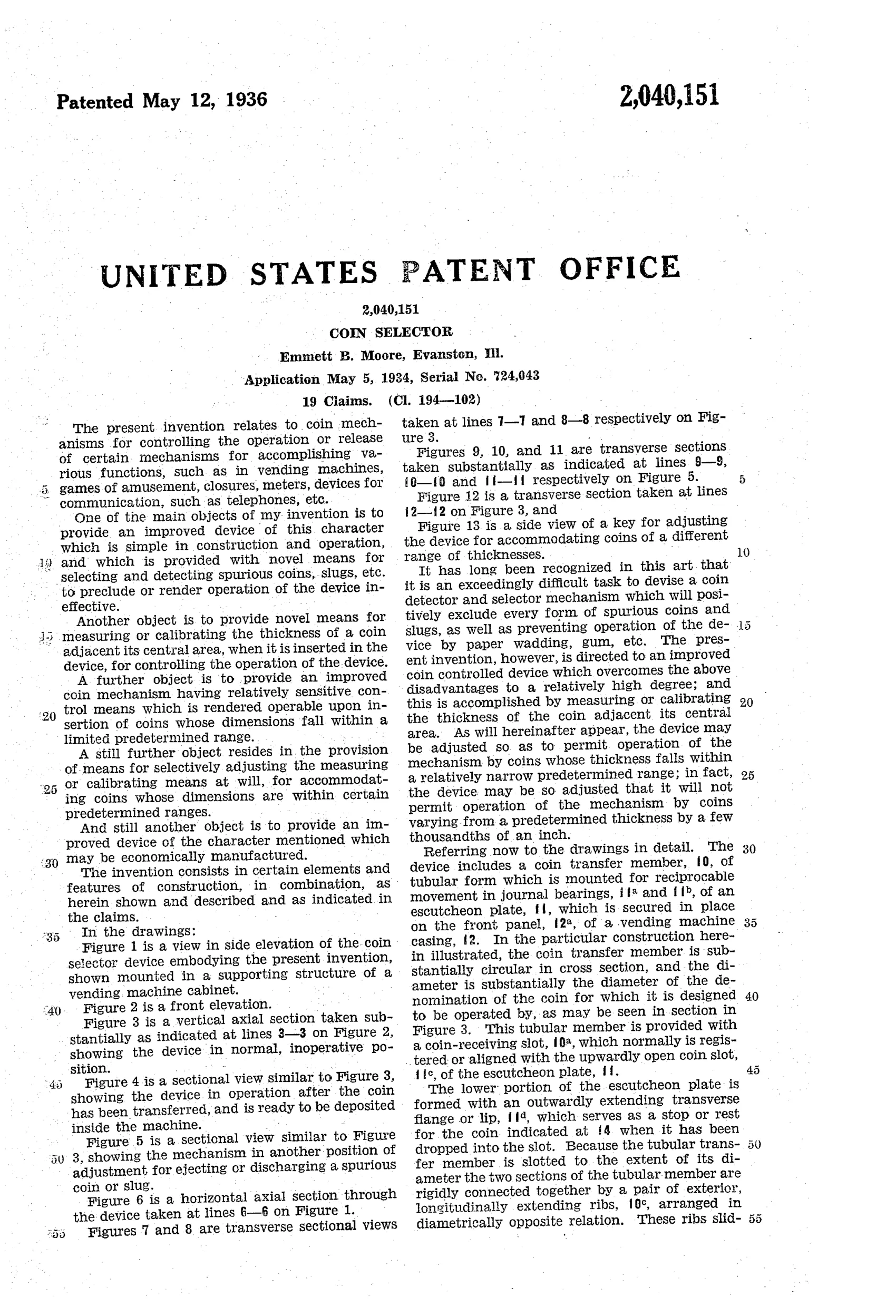
“It has long been recognized in this art that it is an exceedingly difficult task to devise a coin detector and selector mechanism which will positively exclude every form of spurious coins and slugs, as well as preventing operation of the device by paper wadding, gum, etc.”— Emmett B. Moore, from the specification
Fate unknown
No assignee is named and no surviving mechanism is documented; a marked coin drawer matching Fig. 3 would settle it.
◉ Commentary
Most 1930s slug rejectors are gravity chutes: drop the coin, let magnets and rails sort it on the way down. Moore goes the other direction entirely. His selector is a manually operated push-pull drawer — a tubular transfer member you shove inward with a knob — and the thickness test happens under the user's own hand. Two pins embrace the coin near its center as the tube starts to move; only if the gap they find matches the calibrated thickness does a spring-urged lever line up with an aperture and let the tube travel its full stroke. Wrong thickness, and the lever jams against an inclined abutment. Pull the knob back out and the offending slug drops into a return pocket.
Measuring at the center is the shrewd detail. Rim-riding gauges can be fooled by slugs with upset or filed edges; the middle of a coin is harder to fake to tolerance. The keyed adjustment screw is also worth noticing — an operator with the right key could recalibrate the pin spacing for a different denomination without disassembly, which is a genuine service-friendly touch.
Still, thickness alone is a thin defense — a lead disc of the right gauge sails through — and the mechanism is elaborate for what it checks. Fig. 3 shows the density of springs, sleeves, and levers packed into that tube. It reads as one clever answer in a crowded decade, absorbed into the anonymous stream of vending mechanism art rather than founding anything.
Commentary by Claude, The Counterfeit Coin Detector Patent Archive’s resident enthusiast