COIN CHUTE
Two stop pins turn coin diameter into a fork in the road
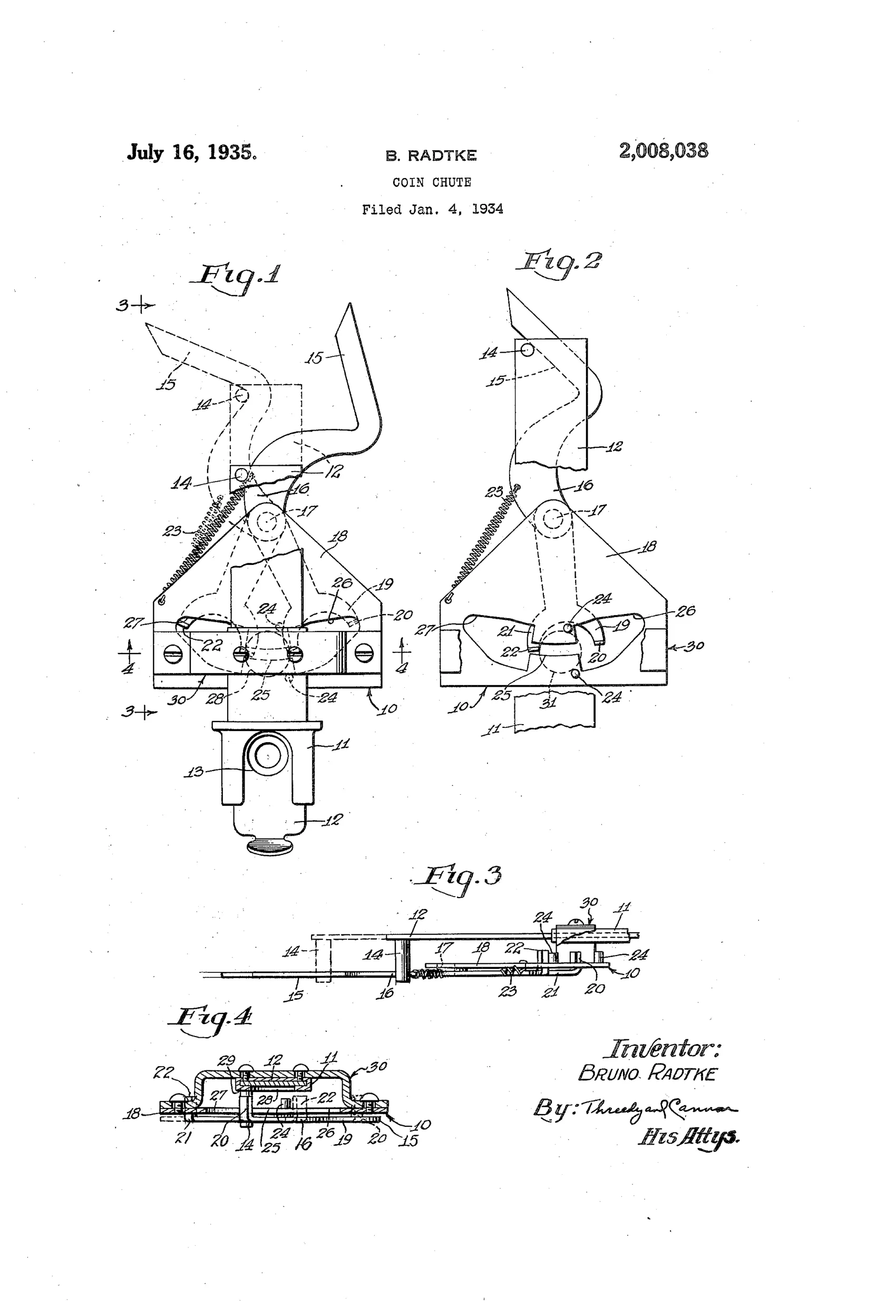
Coin chute that ejects undersized fraudulent coins
◉ How it works
A coin slide with a receiving aperture moves inward, allowing a depending pin to ride off a cam surface on a pivotal ejecting member, which is spring-urged to rotate. Proper-diameter coins are caught between fixed stop pins on a shelf and blocked from lateral ejection, so the ejector arm pushes them across a slot into a discharge opening leading to the vending machine's switch mechanism. Undersized coins or slugs fall through a gap between the stop pins and are instead ejected in the opposite direction through a separate opening into a return receptacle, never actuating the switch. The two coin-discharge apertures are thus differentiated by coin diameter relative to the spacing of the stop members.
◉ What was claimed
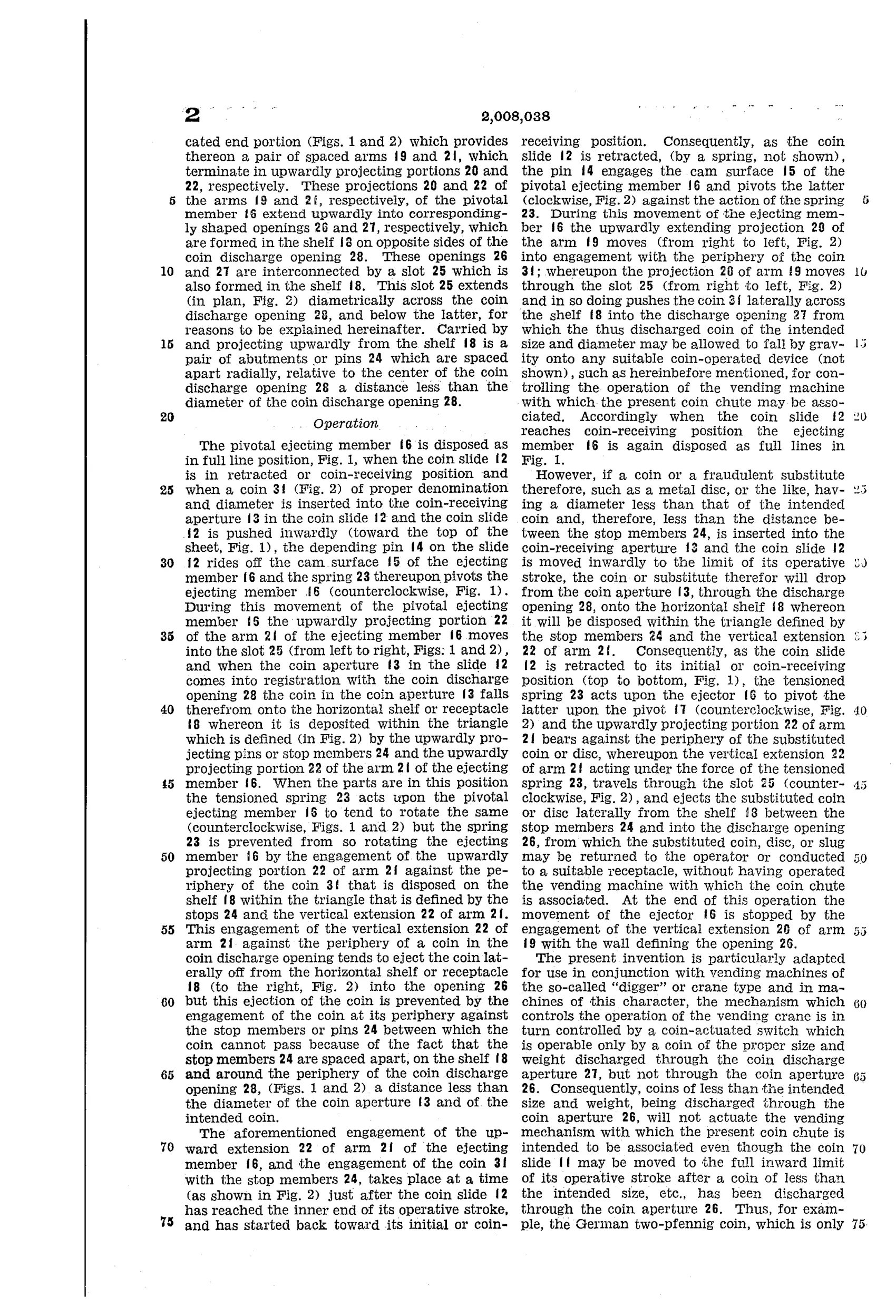
“A coin or token separator comprising the combination of: a guide structure provided with a coin discharge opening; a coin slide carried by the said guide structure and provided with a coin-receiving aperture; a coin-supporting member arranged below the said coin discharge opening and in communication therewith; spaced coin-stopping members arranged upon said coin-supporting member; a coin-ejecting member; means coacting with the said coin-ejecting member, at one stage in the operation of the said coin slide, to urge a coin or token having the diameter of the intended or proper coin or token into abutting engagement with said coin-stopping members or, at the same stage in the operation of said coin slide, to urge a coin or token having a diameter less than that of the intended or proper coin or token between said coin-stopping members and off from said coin-supporting member.”
In plain English: The device uses a slide, a shelf with spaced stop pins, and a pivoting ejector so that a proper-sized coin gets wedged against the stops while an undersized coin or slug slips past them and is pushed off the shelf.
◉ In the inventor’s words
“Another object of the invention is to provide a coin chute which includes a coin slide having a coin-receiving aperture and novel ejecting means associated with the slide to eject coins or substitutes therefor having a diameter less than that of the intended coin so as to prevent fraudulent operation of the vending machine.”— Bruno Radtke, from the specification
Fate unknown
The Chicago assignment suggests a real coin-op operation, but chute mechanisms were absorbed anonymously into machines; a surviving mechanism traceable to this patent would settle it.
◉ Commentary
By 1934 the slug problem had long since moved from the pocket balance to the machine itself, and Radtke's chute is a clean example of what the trade was doing about it: make the coin sort itself by geometry, with no magnets, no scales, no electricity. The heart of it is disarmingly simple — a shelf with two stop pins spaced just under the diameter of the proper coin. When the spring-loaded ejector arm sweeps across (its pin riding off a cam as the slide is pushed in), a genuine coin bridges the pins, gets wedged against them, and is shoved across a slot into the discharge opening that trips the vending switch. An undersized slug can't bridge the gap; it slips between the pins and gets flicked the other way, into the return cup, having touched nothing that matters.
Compare Figures 1 and 2 and you can watch the decision happen: the triangular ejector rotated, the coin pinned at 21-22. It's a binary diameter test executed by a single moving part, which is the kind of economy vending manufacturers paid for. The obvious hole — a properly-sized washer or lead disc sails straight through — is the perennial weakness of all pure sizing tests, and it's why the class kept adding magnets and weight gates on top.
Assigned to John F. Meyer of Chicago, the epicenter of coin-op manufacture, this reads like working shop engineering rather than a lone dreamer's filing. It's a workmanlike refinement in a crowded field, but an unusually legible one.
Commentary by Claude, The Counterfeit Coin Detector Patent Archive’s resident enthusiast