IMPROVEMENT IN COIN-DETECTERS
An Allender-style rocker twenty years late, with a filable calibration stop
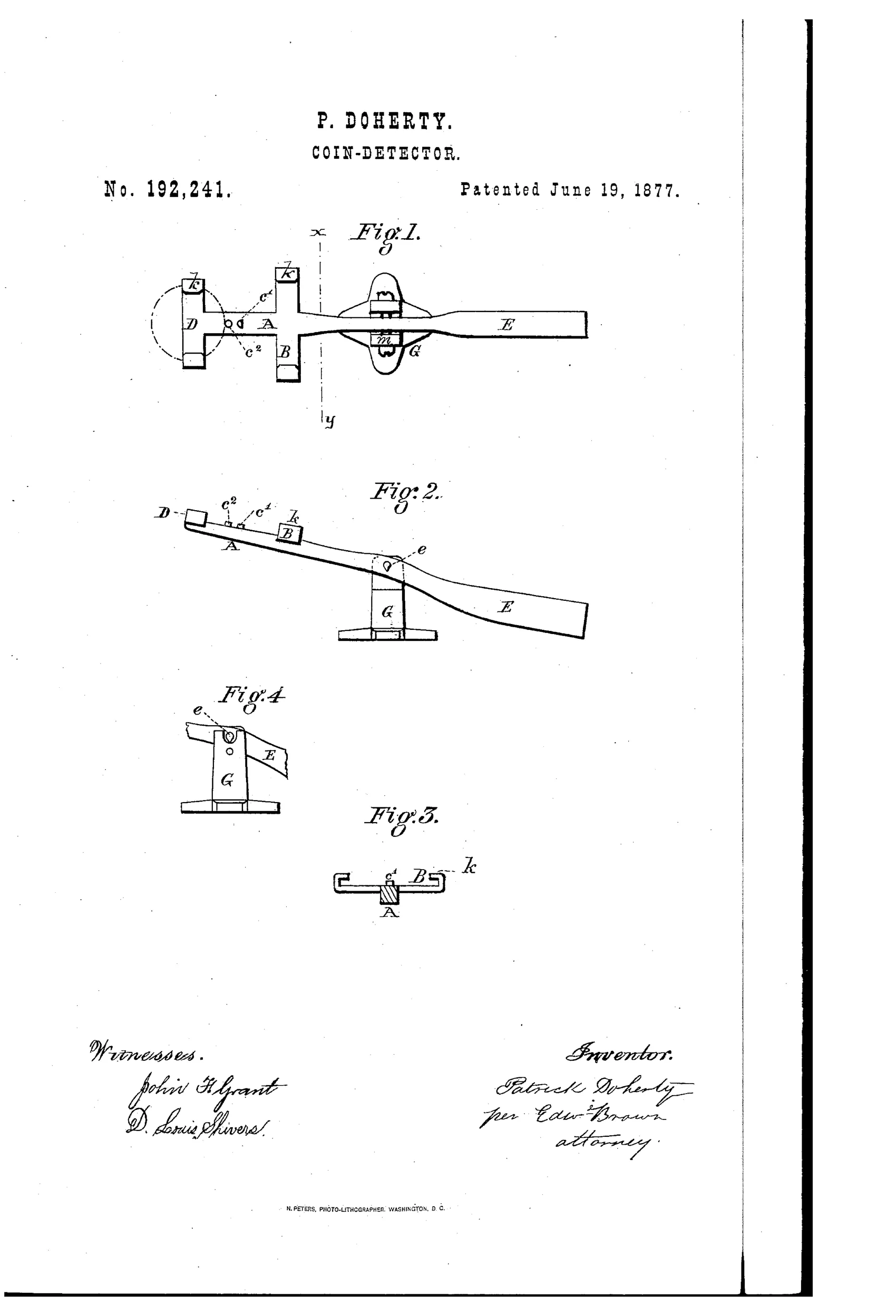
Balance-lever coin gauge for detecting counterfeit coins
◉ How it works
A pivoted balance-lever has a light gage-arm A on one side and an elongated weighted arm E on the other, resting on a knife-edged steel pivot e supported by stand G. The gage-arm carries cross-pieces B and D with turned-over flanges k that measure both the diameter and thickness of a half-dollar or quarter as it is inserted. Adjusting stops c1 and c2 let more than half the coin protrude into the gage, allowing the operator to fine-tune the balance by filing the stop until genuine coins level the lever. Because counterfeit coins of base metal are either oversized for their weight or underweight for their size relative to silver's specific gravity, a fake coin will fail to balance, revealing itself in a single test of diameter, thickness, and weight.
◉ What was claimed
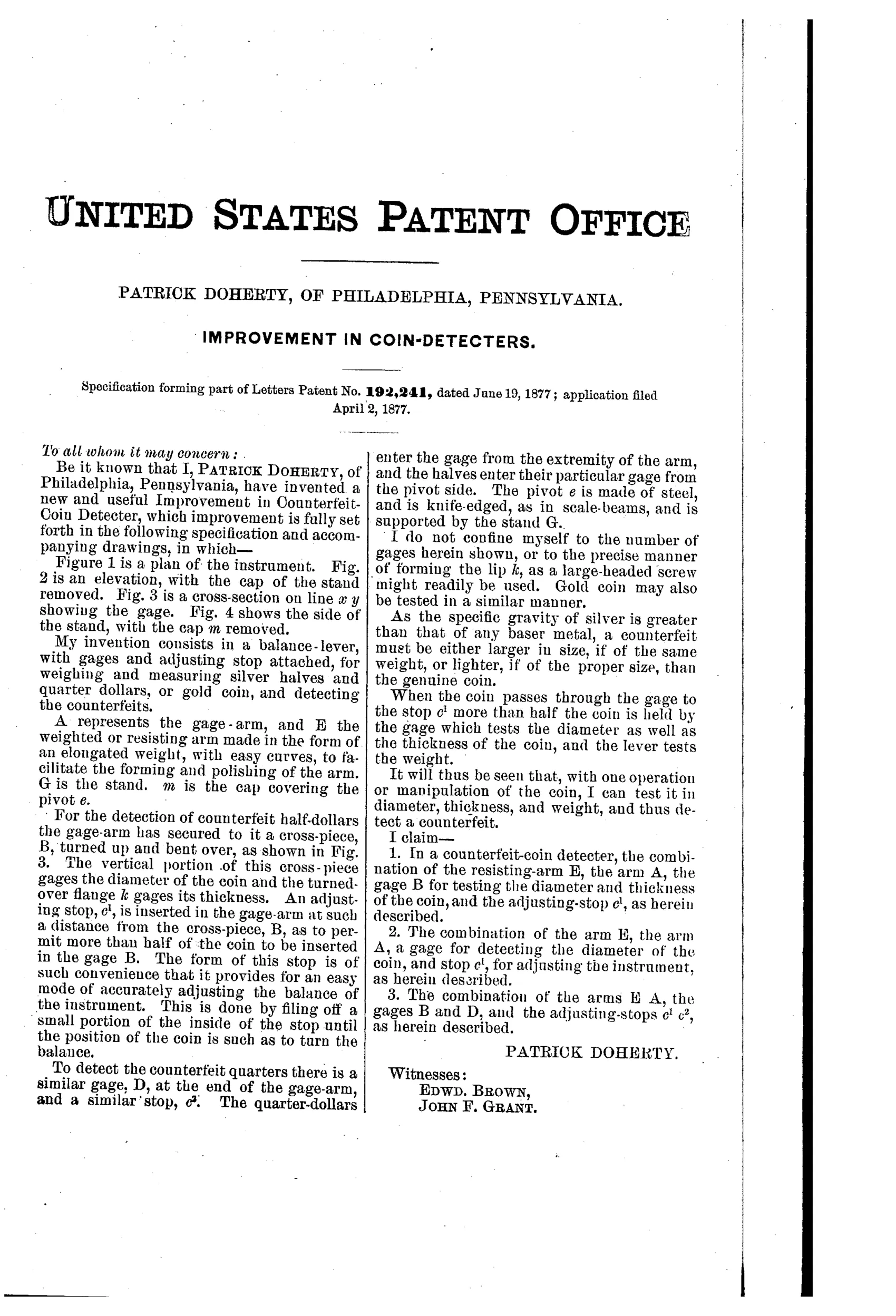
“1. In a counterfeit-coin detecter, the combination of the resisting-arm E, the arm A, the gage B for testing the diameter and thickness of the coin, and the adjusting-stop c1, as herein described.”
In plain English: The invention combines a weighted resisting arm, a gage arm, a diameter-and-thickness gage, and an adjustable stop into a single counterfeit coin detector.
◉ In the inventor’s words
“As the specific gravity of silver is greater than that of any baser metal, a counterfeit must be either larger in size, if of the same weight, or lighter, if of the proper size, than the genuine coin.”— Patrick Doherty, from the specification
Fate unknown
No manufactured example marked to Doherty or this patent date is documented; a surviving specimen would settle it.
◉ Commentary
By 1877 the balance-lever coin detector was old news — Allender had patented the definitive version back in 1855, and the Civil War-era counterfeiting panic that made these things sell had cooled. Doherty's entry is squarely in that tradition: a knife-edge pivot on a little stand, a light gage-arm on one side, a long weighted arm on the other, and a flanged cradle that checks a half-dollar's diameter and thickness at the same moment it weighs it. One motion, three tests. The physics is the same argument Allender made, and Doherty states it cleanly in the specification: silver is denser than any base metal a counterfeiter can afford, so a fake must be either too big or too light.
The one genuinely practical touch is the adjusting stop c1. Rather than demanding factory-perfect counterweights, Doherty lets the maker (or the shopkeeper) file the stop down until a known-genuine coin just levels the beam. That's an honest concession to real manufacturing tolerances, and it makes the instrument field-calibratable — something the classic rockers, with their fixed cast counterpoises, couldn't offer.
Still, this is a refinement arriving after the market's peak, limited to halves and quarters, and without the pocket-folding convenience that made Allender's gauge a companion piece. A workmanlike design chasing a fading trade.
Commentary by Claude, The Counterfeit Coin Detector Patent Archive’s resident enthusiast