SPURIOUS COIN DETECTOR
The coin must fight back: a spring calibrated to lose to genuine silver only
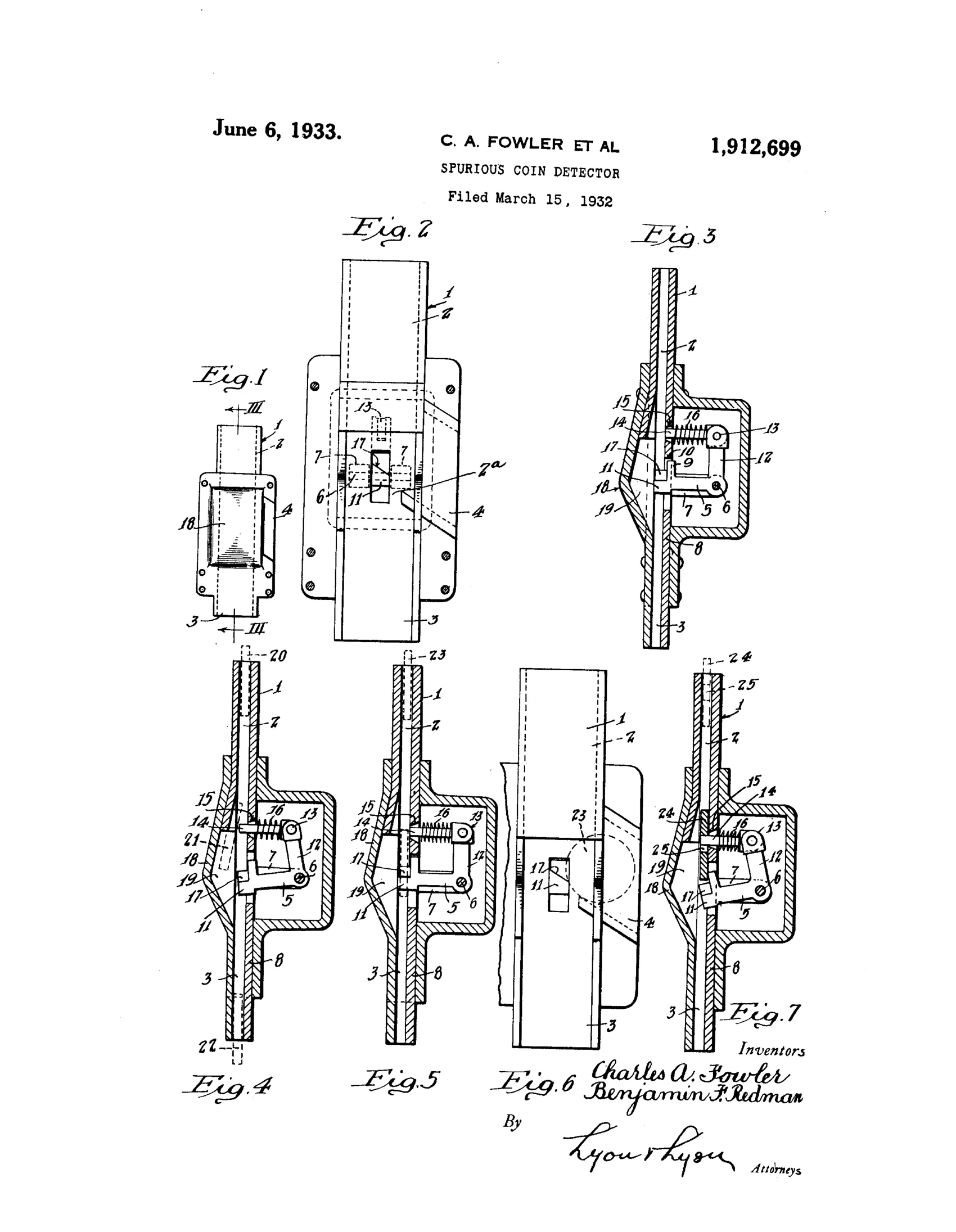
Mechanical device to reject spurious or lightweight coins.
◉ How it works
A coin chute branches into a collection passage and a rejection passage, with a spring-loaded bell crank pivoted adjacent the chute so one arm projects into the coin's path. A properly weighted true coin descending the chute strikes and depresses the bell crank with sufficient force (weight plus momentum) to overcome the spring, driving a pin on the crank's other arm forward to push the coin off the crank and into the collection chute. Light-weight or spurious coins lack sufficient force to depress the crank fully, so they rest momentarily on an angled face of the crank and slide sideways into the rejection chute. Coins with an aperture (tokens) cause the pin to project into the hole rather than push the coin, while the bell crank and pin can be permanently magnetized to retard and reject coins made of magnetic material.
◉ What was claimed
“In a spurious coin detector, a coin chute having a passageway divided at a junction into a collection passage and a refund passage, a bell crank pivoted adjacent said chute, one arm of which projects into said passageway at said junction to receive the impact of a coin descending in said chute, a pin pivotally connected to the other arm of said bell crank and projectable into said passageway by movement of said bell crank under impact, and a spring associated with said bell crank normally resisting movement thereof under impact, said spring exerting resistive force upon said bell crank slightly in excess of the force exerted by the weight of a true coin upon said bell crank.”
In plain English: A coin chute has a spring-loaded bell crank that a falling coin strikes; if the coin is heavy enough (a true coin), it depresses the crank and a pin pushes it into the collection passage, otherwise it is diverted to the refund passage.
◉ In the inventor’s words
“It is an object of this invention to provide a spurious coin detector which will automatically measure all coins, imitation coins, tokens, or other devices deposited, and reject the spurious or imitation coins while permitting operation of the machine by true coins.”— Charles A. Fowler, from the specification
Fate unknown
No assignee and no documented commercial adoption; a marked mechanism or vending-machine service literature citing it would settle the question.
◉ Commentary
Most chute testers of this era are passive — the coin rolls past a magnet or over a gauge and gravity does the sorting. Fowler's device is more theatrical: the falling coin has to strike a spring-loaded bell crank and beat it. The spring is set to resist with a force just above the static weight of a true coin, so weight alone isn't enough — the coin needs its full momentum from the drop. A genuine coin punches the crank down, and here's the clever second act: that same motion drives a pin forward that shoves the coin off the crank and into the collection passage. The coin's own energy powers its acceptance. A light slug bounces feebly, comes to rest on the crank's angled face, and slides sideways into the refund chute.
Figure 7 shows the detail a casual reader would miss: against washers and holed tokens, the pin simply passes through the aperture instead of pushing, and the token is stranded. Fowler also suggests permanently magnetizing the crank and pin to drag on steel slugs — three tests folded into one moving part.
The weakness is obvious to anyone who has serviced vending gear: a mechanism that depends on impact force is sensitive to drop height, coin wear, dirt, and spring fatigue. By 1932 the industry was converging on multi-stage rejectors that tested diameter, weight, and magnetism separately, and those won. This is a clever dead end, but a genuinely clever one.
Commentary by Claude, The Counterfeit Coin Detector Patent Archive’s resident enthusiast