COIN CHECKING MEANS AND METHOD
A Wheatstone bridge asked to tell a nickel from a slug, in 1928
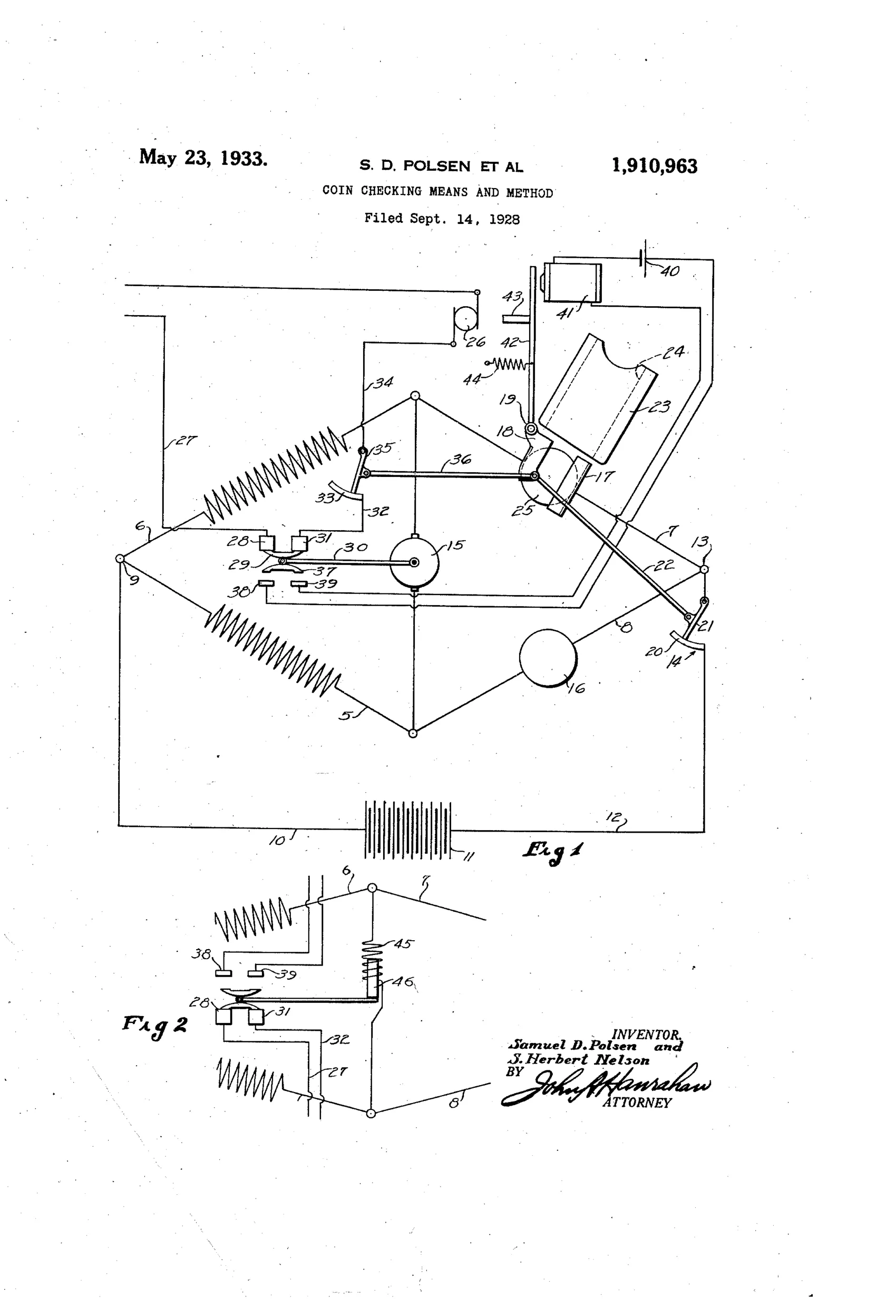
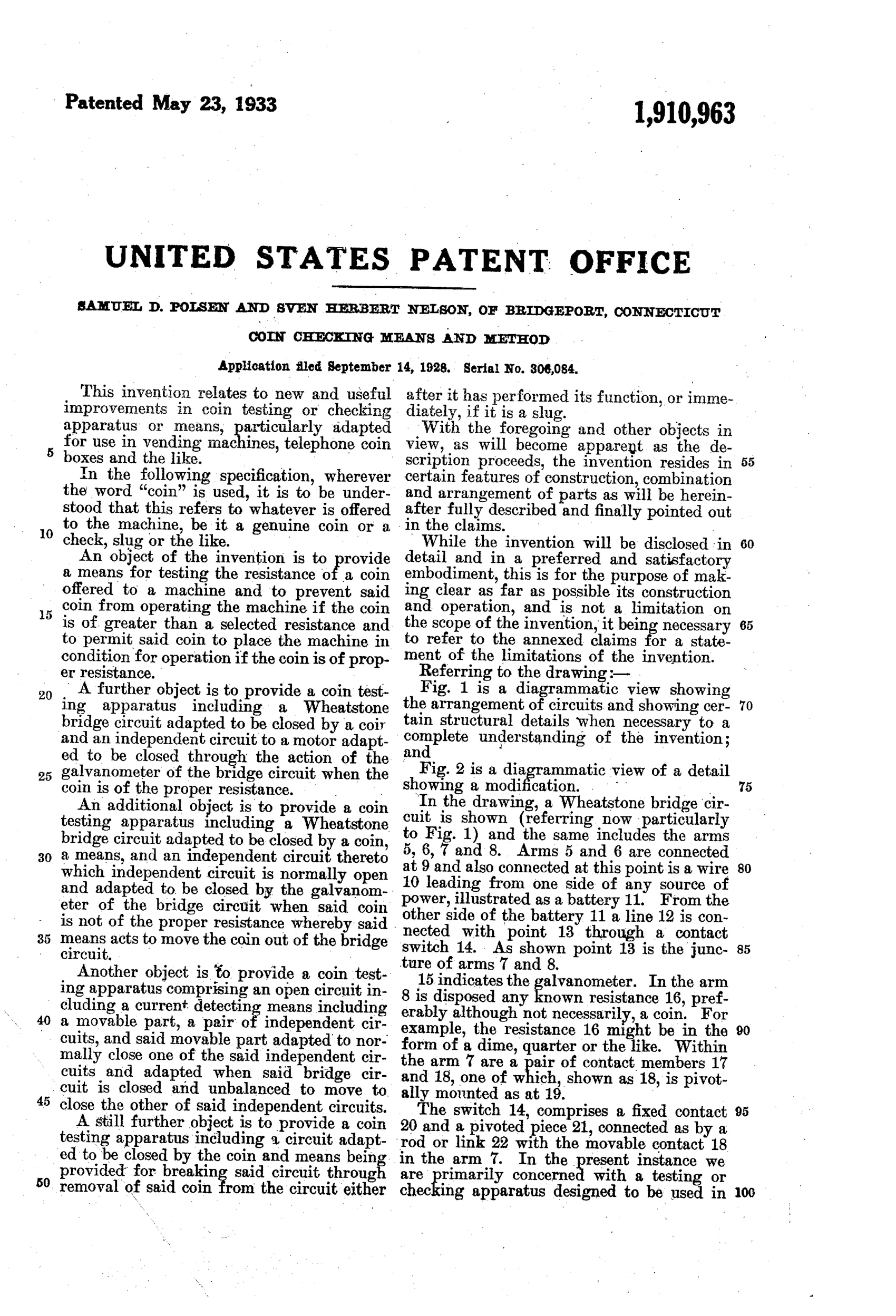
Wheatstone-bridge electrical coin resistance tester for vending machines
◉ How it works
A coin inserted through a sizing slot bridges two contact members to close one arm of a Wheatstone bridge circuit against a fixed resistance. A galvanometer detects whether the coin's electrical resistance balances the bridge; if balanced, a switch closes to complete a separate motor circuit that operates the vending mechanism. If the coin's resistance unbalances the bridge, the galvanometer pointer moves and closes an alternate circuit energizing a magnet, which swings a pivoted contact to eject the slug from the circuit. A modification substitutes a solenoid coil and core for the galvanometer and pointer, reversing the normally open and closed contact pairs but performing the same balancing and ejection function.
◉ What was claimed
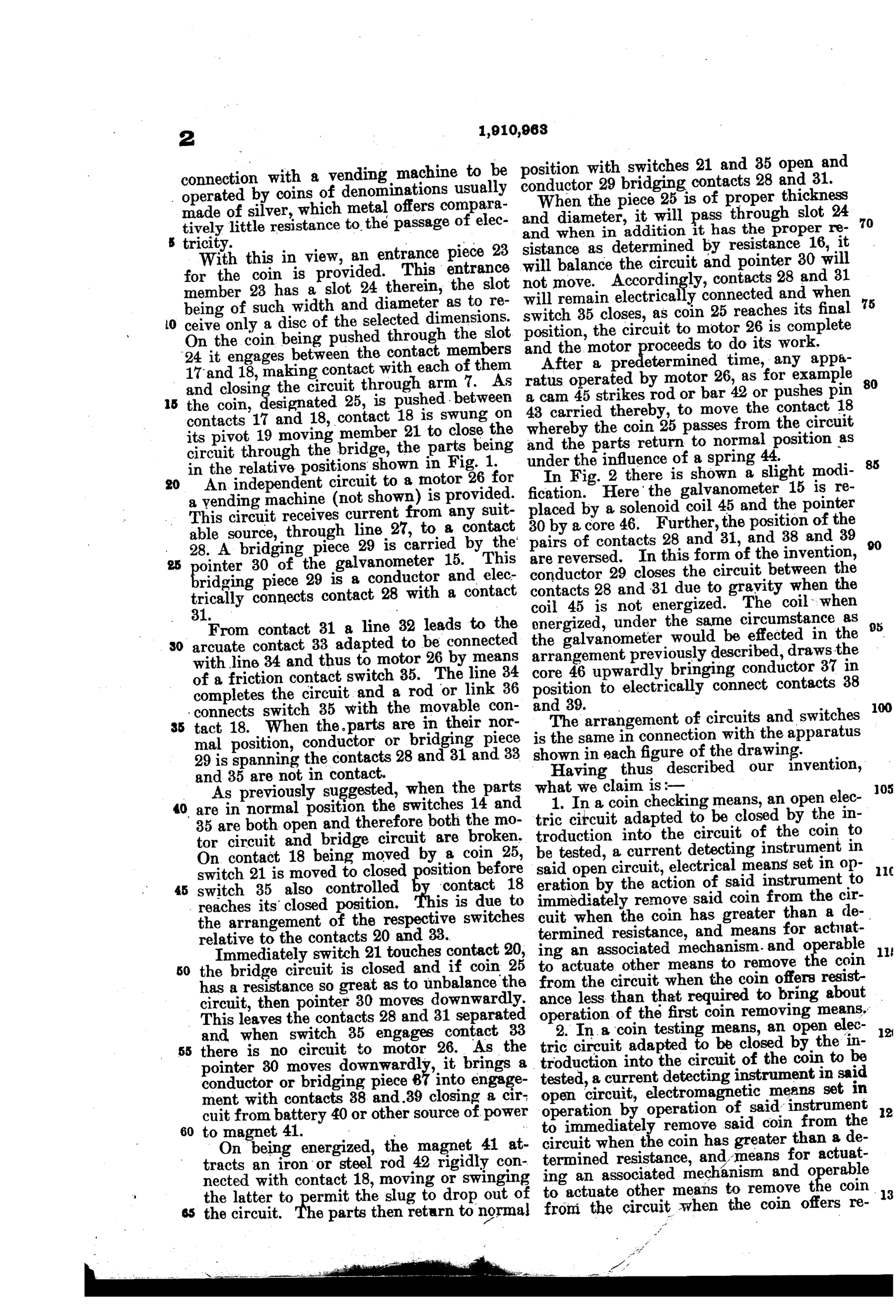
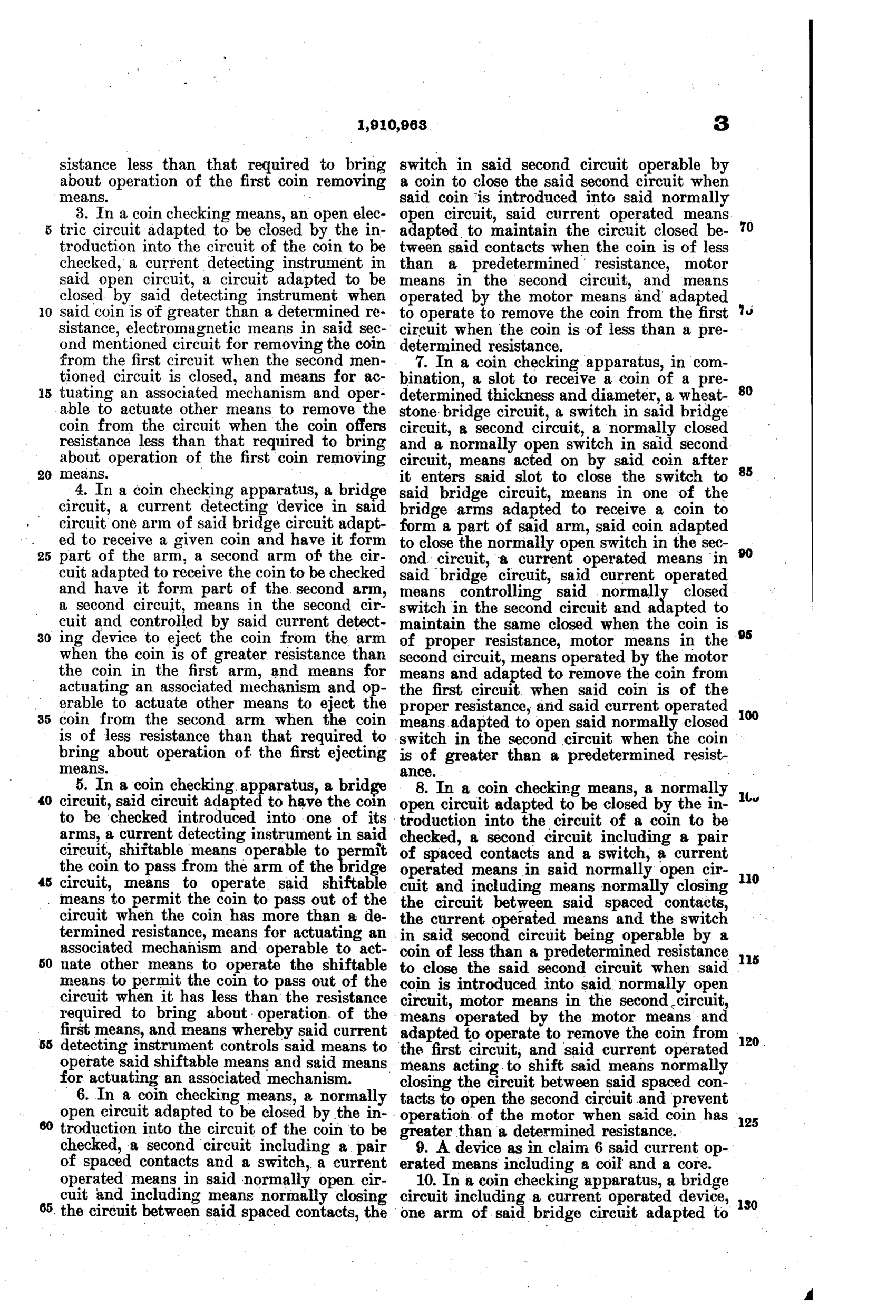
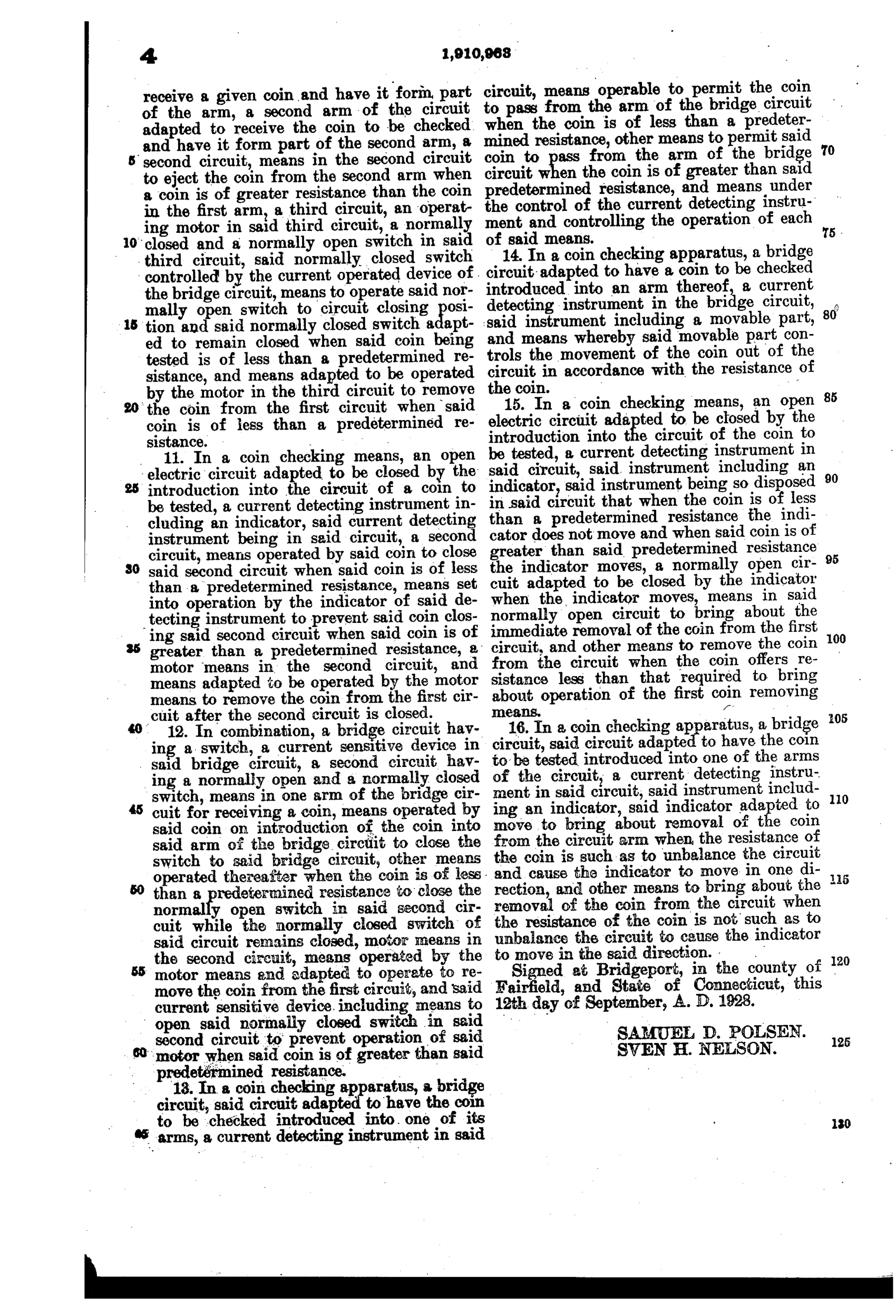
“1. In a coin checking means, an open electric circuit adapted to be closed by the introduction into the circuit of the coin to be tested, a current detecting instrument in said open circuit, electrical means set in operation by the action of said instrument to immediately remove said coin from the circuit when the coin has greater than a determined resistance, and means for actuating an associated mechanism and operable to actuate other means to remove the coin from the circuit when the coin offers resistance less than that required to bring about operation of the first coin removing means.”
In plain English: The device uses a current-sensing instrument in an open circuit to detect a coin's electrical resistance, ejecting it if too high, and otherwise triggering a separate mechanism if the resistance is too low.
◉ In the inventor’s words
“In the following specification, wherever the word "coin" is used, it is to be understood that this refers to whatever is offered to the machine, be it a genuine coin or a check, slug or the like.”— Samuel D. Polsen and Sven Herbert Nelson, from the specification
Fate unknown
No commercial embodiment is documented; a vending or telephone coin box traceable to this circuit would settle it.
◉ Commentary
By the late 1920s the coin-detector class had mostly exhausted the mechanical tricks — magnets, weight gates, sizing rockers — and inventors began reaching for electricity. Polsen and Nelson reach for the classic laboratory instrument: the coin itself becomes one arm of a Wheatstone bridge, tested against a fixed resistance. If the bridge balances, a motor circuit fires and vends. If it doesn't, the galvanometer needle swings, closes an alternate contact, and an electromagnet physically kicks the offending disc out of the circuit. The slug isn't merely refused; the machine's own detection instrument organizes its expulsion.
The drawing rewards a close look. What seems a tangle of springs and pivots in Fig. 1 is really a schematic wired to hardware — those two long helical springs are the bridge resistances, and the coin drops through a sizing slot before it ever touches the contacts, so dimension is tested mechanically before conductivity is tested electrically. Fig. 2 swaps the delicate galvanometer for a solenoid and core, a tacit admission that a needle instrument doing switching duty in a public vending machine is a fragile idea.
That fragility is the rub. Contact resistance on a dirty coin swamps the tiny resistance difference between alloys, and galvanometers hate vibration. But as a direction, this is prophetic: conductivity testing is exactly how coin validators eventually worked, once electronics replaced the needle.
Commentary by Claude, The Counterfeit Coin Detector Patent Archive’s resident enthusiast