FRAUD PREVENTIVE DEVICE
A felt-lined chute slows the coin so a half-gram margin can judge it
Coin-weighing anti-fraud device for vending machines
◉ How it works
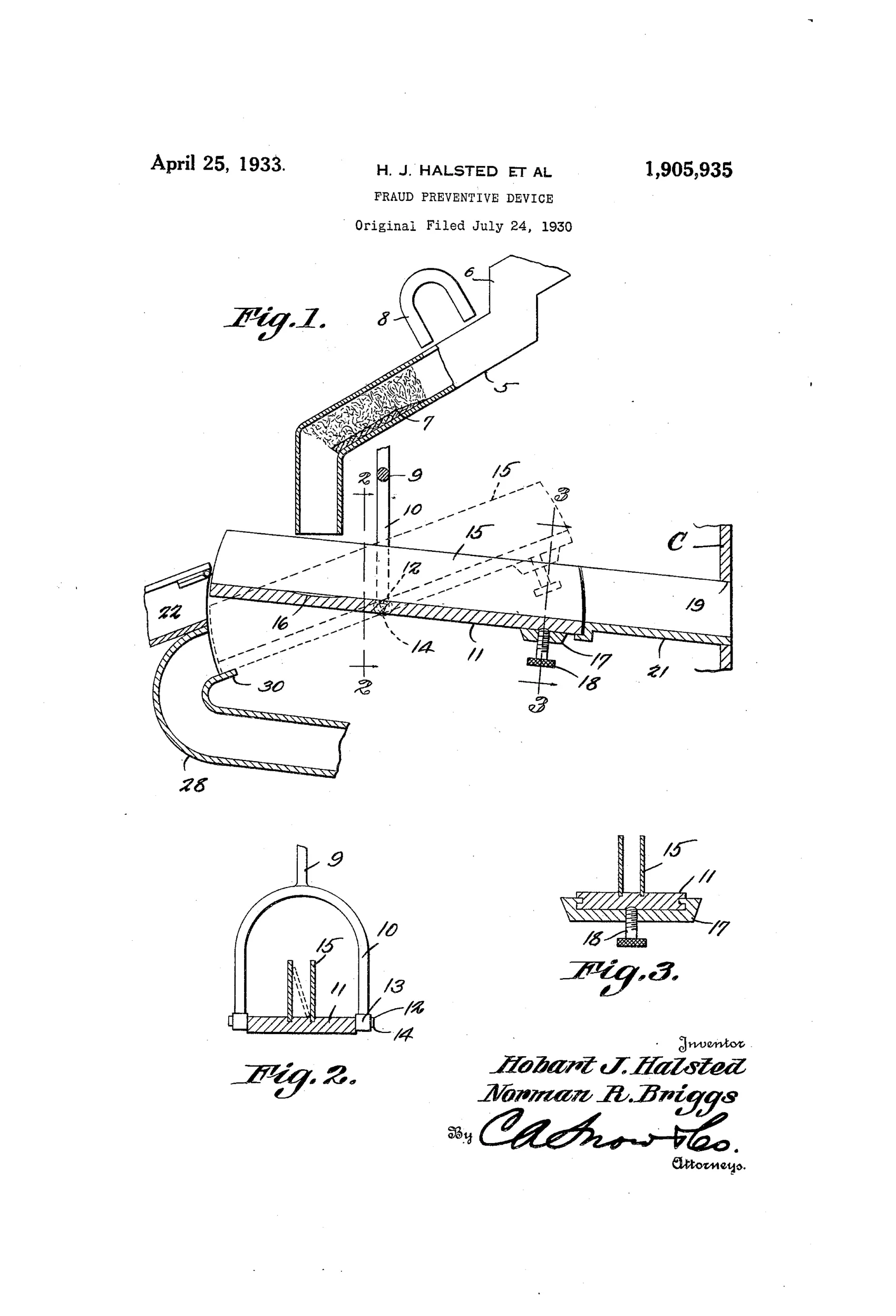
An inclined guide tube delivers a coin, retarded by an offset bend and a felt lining, onto a tiltable scale beam. The scale is balanced with an adjustable counterweight so that only a coin of correct weight tips it toward the receiving channel. Overweight coins or checks tilt the scale abruptly against a stop and are diverted into a return channel instead, while underweight coins or slugs roll back out through an outlet slot. Permanent magnets positioned over the tube intercept iron or steel slugs before they reach the scale.
◉ What was claimed
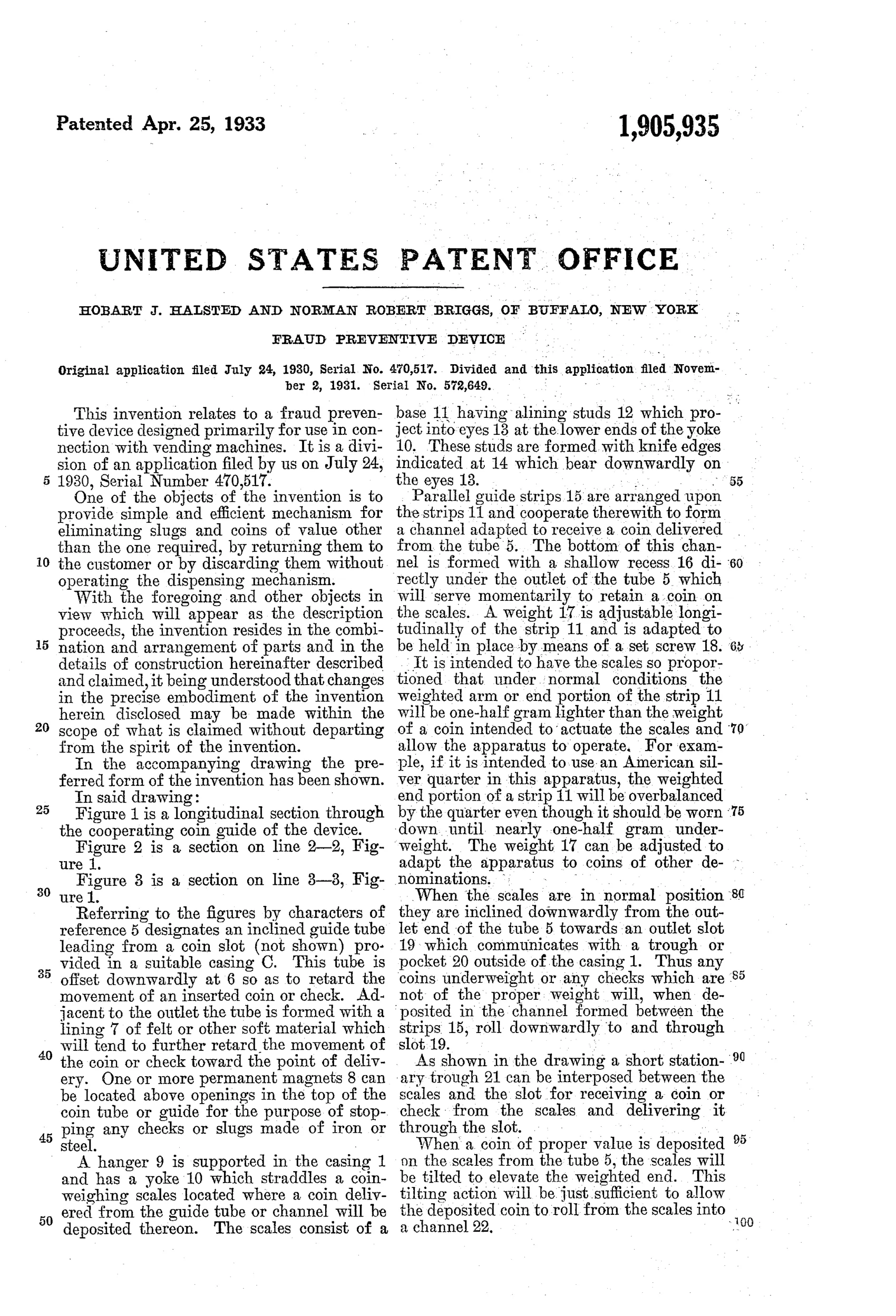
“The combination with a casing, of an inclined coin guide tube having an outlet end extending downwardly at an obtuse angle thereto, an inclined stationary delivery trough opening through a wall of the casing, scales tiltably mounted and alining normally at one end with said trough, the other end being extended under the outlet end of the coin tube, parallel upstanding strips on the scales for guiding a rolling coin to the trough from the outlet of the coin tube, a weight on the scales and adjustable along the bottom thereof, a coin receiving channel, a coin returning channel, said channels having superposed coin receiving ends normally positioned below the adjacent coin receiving end of the scales and cooperating to define an arc close to and parallel with the path of movement of said end of the scales, said scales when subjected to the correct weight of a coin being tiltable to deliver said coin into the receiving channel and, when subjected to overweight, being adapted to deliver the coin into the return channel, and a stop on said channel for the scales.”
In plain English: A vending-machine coin guide feeds coins onto a tilting, adjustably weighted scale that sends correctly weighted coins into a receiving channel but diverts overweight or improper coins into a return channel via a stop-limited tilt.
◉ In the inventor’s words
“It is intended to have the scales so proportioned that under normal conditions the weighted arm or end portion of the strip 11 will be one-half gram lighter than the weight of a coin intended to actuate the scales and allow the apparatus to operate.”— Hobart J. Halsted, from the specification
Fate unknown
No assignee and no documented production; like most chute-tester patents, only a marked mechanism inside a surviving machine would settle whether it was made.
◉ Commentary
By 1930 the slug-rejector class was crowded with rocking gauges and magnet gates, and Halsted's entry is a fairly pure weight test — a tilting beam that only a coin of the right heft can tip. The clever part isn't the beam; it's everything upstream of it. Look at Fig. 1: the guide tube takes an offset bend and is lined with felt (the stippled patch at 7). A coin dropped into a slot arrives with unpredictable momentum, and a beam balanced to a half-gram tolerance would be fooled by a fast light slug slamming into it. The bend and the felt bleed off that kinetic energy so the coin arrives at nearly its static weight. That's the kind of detail that separates a patent that would work on the bench from one that only works on paper.
The sorting logic is neat, too: three outcomes from one beam. Correct weight tips the scale gently into the receiving channel; overweight pieces slam the beam against a stop and are shunted into a return channel; underweight slugs never tip it at all and roll back out. Magnets over the tube catch steel before it ever reaches the scale — belt and suspenders.
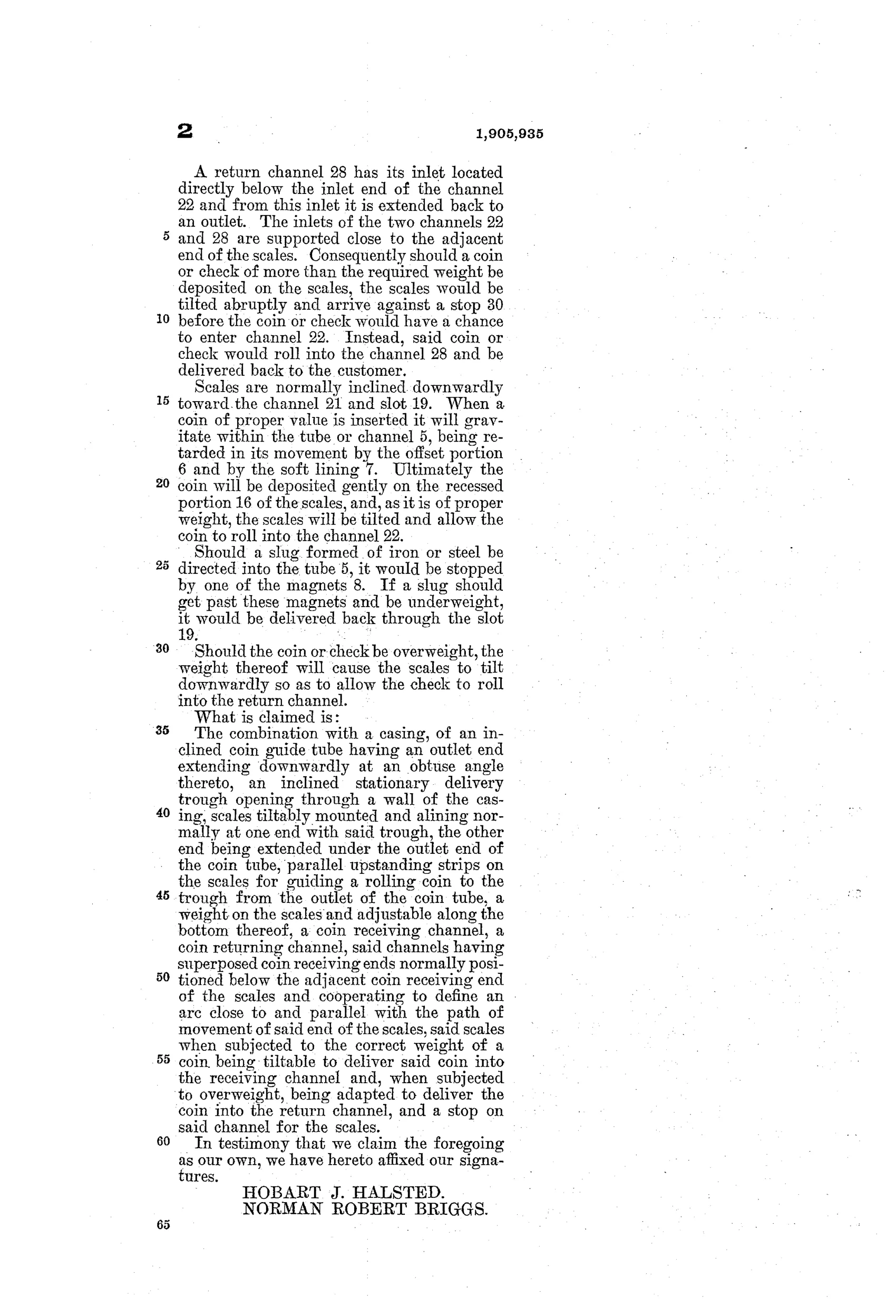
As history, this is a refinement, not a first. The half-gram counterweight bias, adjustable by set screw (Fig. 3), shows an inventor who had actually fought with real coin tolerances. Like most in-chute testers, though, any commercial life it had would have been anonymous, buried inside someone's vending cabinet.
Commentary by Claude, The Counterfeit Coin Detector Patent Archive’s resident enthusiast