COUNTERFEIT-COIN DETECTOR.
Two years before Allender: a pass-through gate where the coin grades itself
Gold coin authenticity gauge and counterfeit detector
◉ How it works
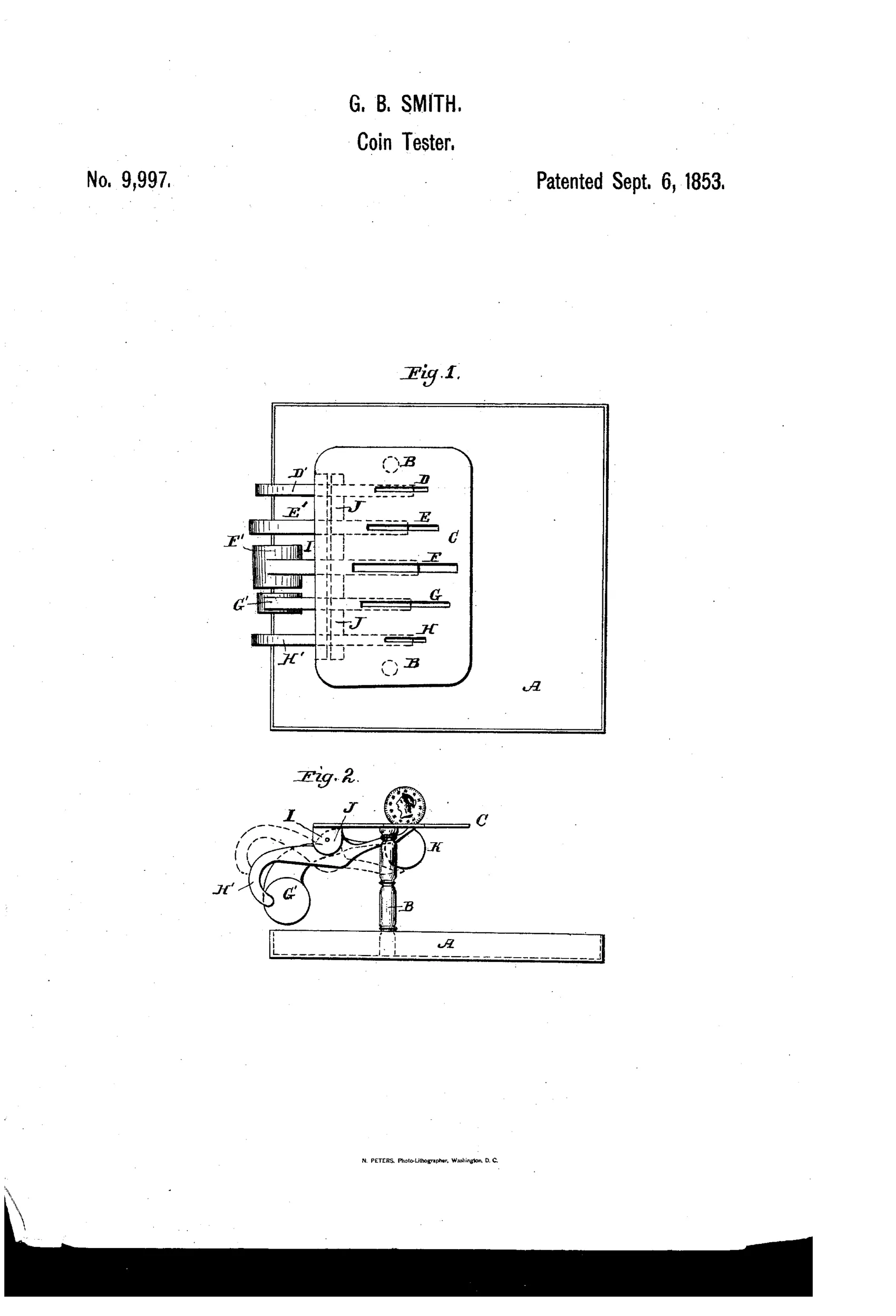
A gage plate with sized slots (D, E, F, G, H) is mounted atop two posts on a base, each slot matching the diameter of a specific US gold coin denomination. Beneath each slot sits a pivoting, counterweighted lever (D', E', F', G', H') that vibrates on a common rod I, resting against projections J J on the underside of the gage plate. A genuine coin passes through the properly sized slot and its weight depresses the balanced lever enough to let it slip through and fall out below, then the lever returns to position. Any spurious coin that is too large will not fit the gage at all, and any coin that is too light will not sufficiently depress the counterweighted lever, so it remains trapped in the gage rather than passing through.
◉ What was claimed
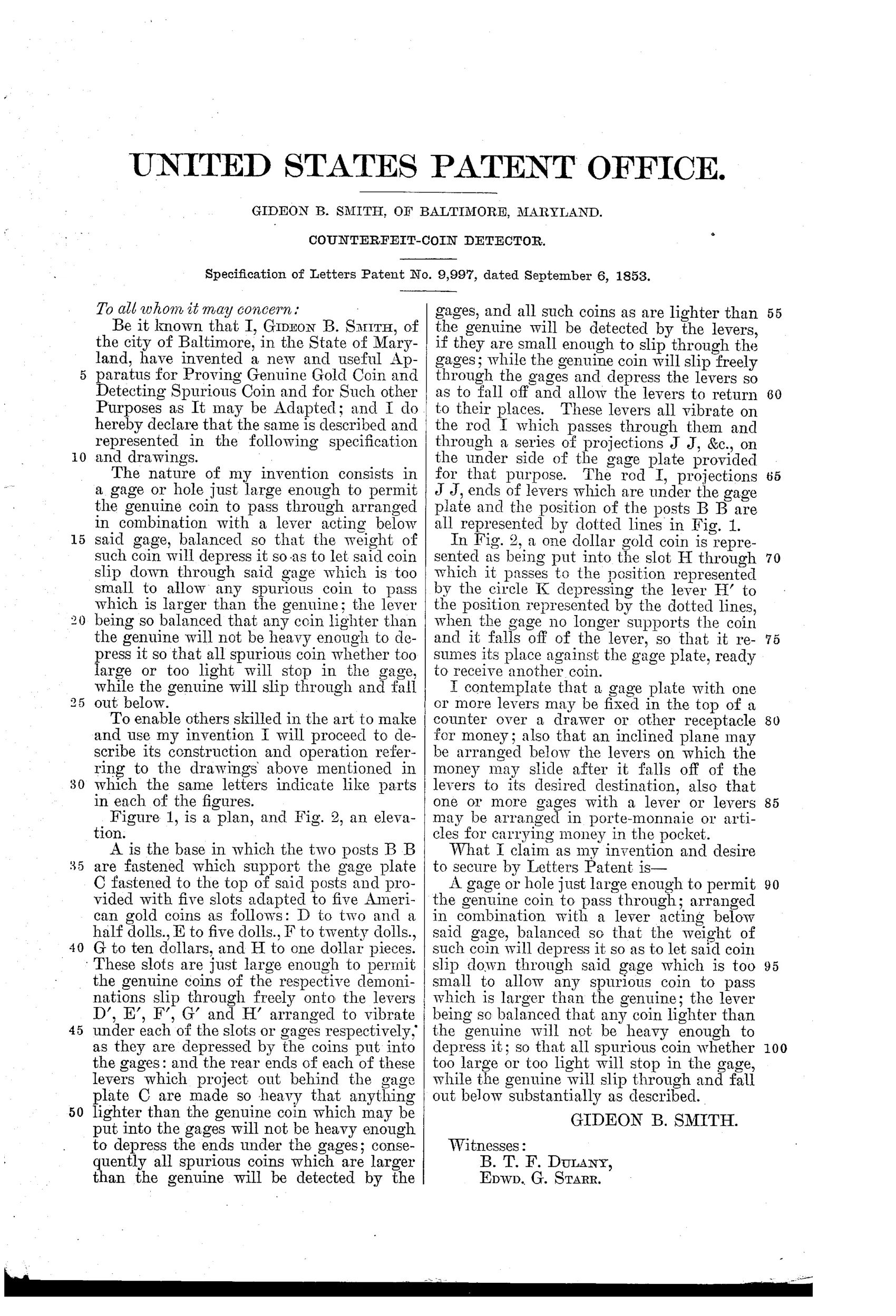
“A gage or hole just large enough to permit the genuine coin to pass through; arranged in combination with a lever acting below said gage, balanced so that the weight of such coin will depress it so as to let said coin slip down through said gage which is too small to allow any spurious coin to pass which is larger than the genuine; the lever being so balanced that any coin lighter than the genuine will not be heavy enough to depress it; so that all spurious coin whether too large or too light will stop in the gage, while the genuine will slip through and fall out below substantially as described.”
In plain English: The invention claims a coin-sized hole combined with a weighted lever beneath it, calibrated so only a genuine coin's exact size and weight will let it pass through and drop out, while any counterfeit that is too big, too small, too light, or too heavy gets stopped.
◉ In the inventor’s words
“I contemplate that a gage plate with one or more levers may be fixed in the top of a counter over a drawer or other receptacle for money; also that an inclined plane may be arranged below the levers on which the money may slide after it falls off of the levers to its desired destination, also that one or more gages with a lever or levers may be arranged in porte-monnaie or articles for carrying money in the pocket.”— Gideon B. Smith, from the specification
Fate unknown
No surviving example or period advertisement of Smith's gate is documented to my knowledge; a marked specimen or Baltimore trade listing would settle it.
◉ Commentary
This 1853 patent predates Allender's famous rocker by two years, and it takes a genuinely different approach to the same twin test of diameter and weight. Allender-style detectors make you place the coin and read a result; Smith's device is a pass/fail gate. Drop a coin in the correct slot and, if it is full weight, it depresses a counterweighted lever underneath, slips through, and falls into the till. If it is too big it never enters; if it is too light the lever refuses to yield and the coin sits there, trapped in the gage, publicly accused.
The drawing rewards a close look. Fig. 1 shows five slots, one per gold denomination, each with its own lever pivoting on the common rod I — a multi-denomination battery in one plate, which most later hand detectors handled with a row of separate apertures and a single beam. Fig. 2 shows the coin's whole journey in dotted lines: through the slot, riding the lever down, dropping free while the counterweight resets the trap for the next coin. Smith even sketches the applications in the text — set the plate into a countertop over the cash drawer, or shrink it into a porte-monnaie. That countertop idea is, in embryo, the automatic in-chute tester the vending era would need thirty years later.
The weak spot is calibration: a lever balanced to reject a light coin but pass a worn genuine one is asking a lot of 1853 tolerances, and worn gold coins were the norm. Still, as a self-acting detector this is remarkably early thinking.
Commentary by Claude, The Counterfeit Coin Detector Patent Archive’s resident enthusiast