FRAUD-PREVENTIVE DEVICE FOR COIN MECHANISMS.
A coin slot that hands your bad nickel back instead of eating it
Coin chute rejector for vending machine fraud
◉ How it works
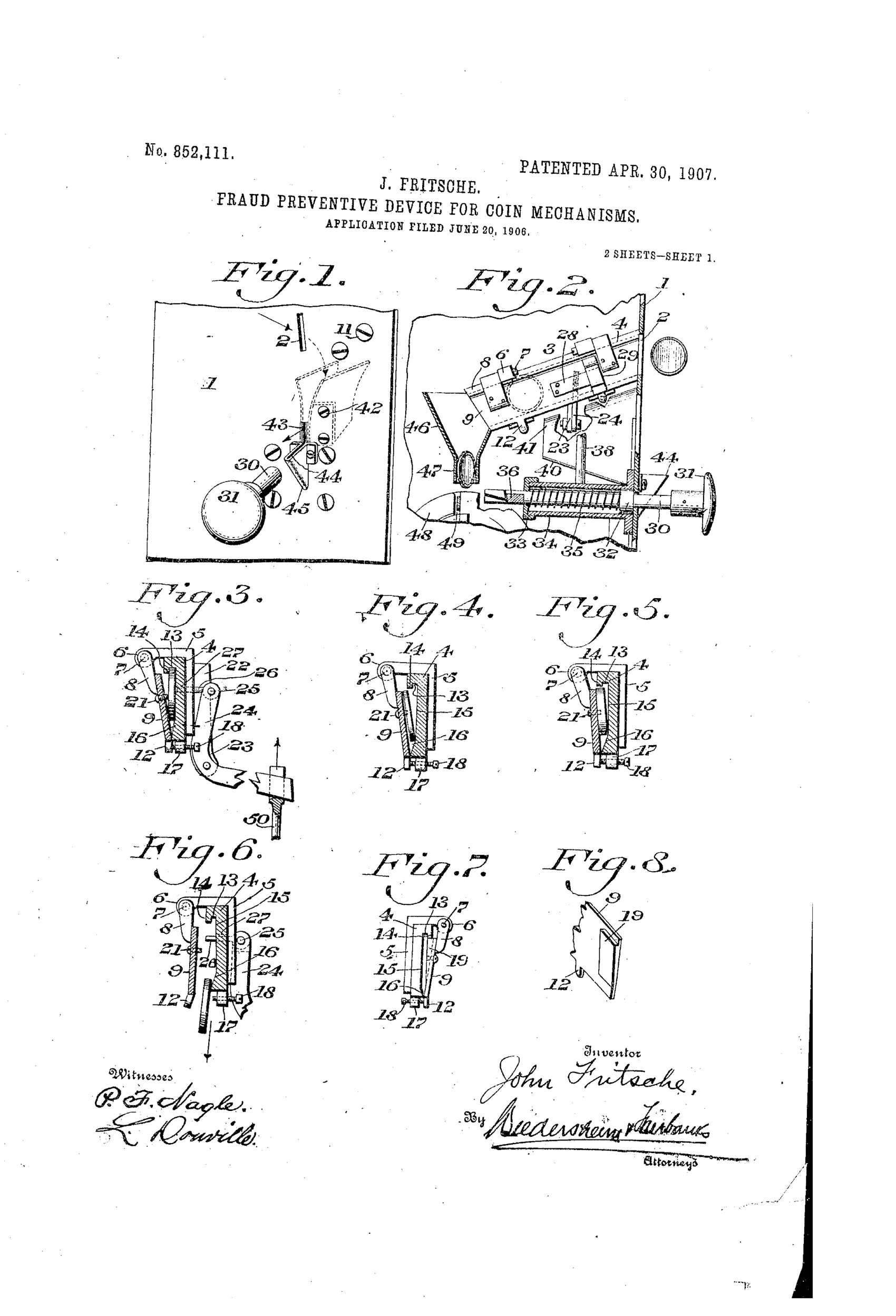
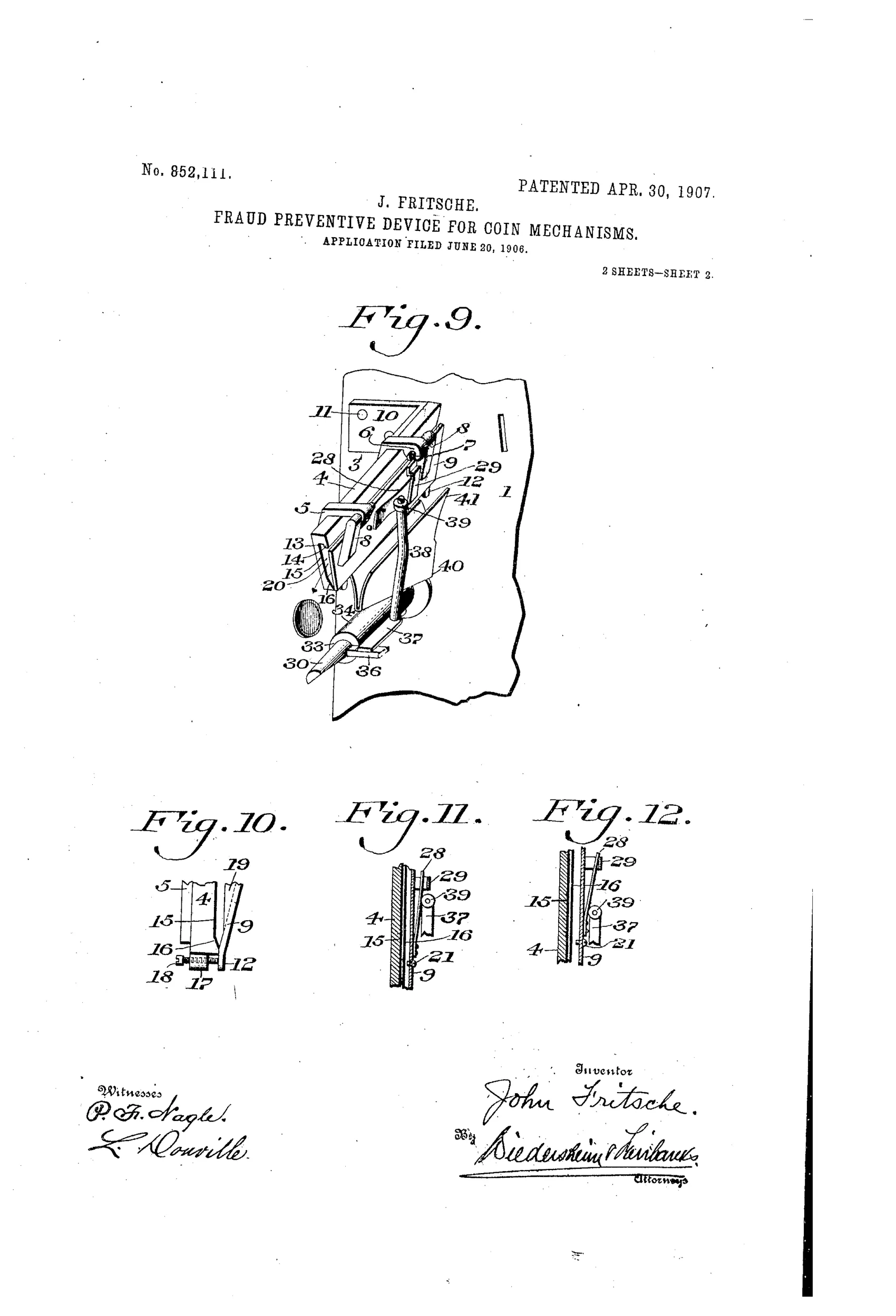
A coin chute is formed between a stationary member and a spring/roller-loaded pivoted member, creating an adjustable slot sized to standard coin dimensions. A grooved, beveled inner face guides a proper coin straight through, while a bent, thin, or worn coin drops into a V-shaped lower gap and falls to one side, engaging an adjustable stop pin. Coins caught by the stop fall into an inclined return chute leading to an external receiver accessible to the purchaser. Pushing the handle moves a rod and roller along a spring to swing the pivoted member outward, opening the chute to release any stopped coin for return; a separate lever and stop rod can also be actuated to positively block passage of even a correctly-sized coin, e.g., when the machine is empty.
◉ What was claimed
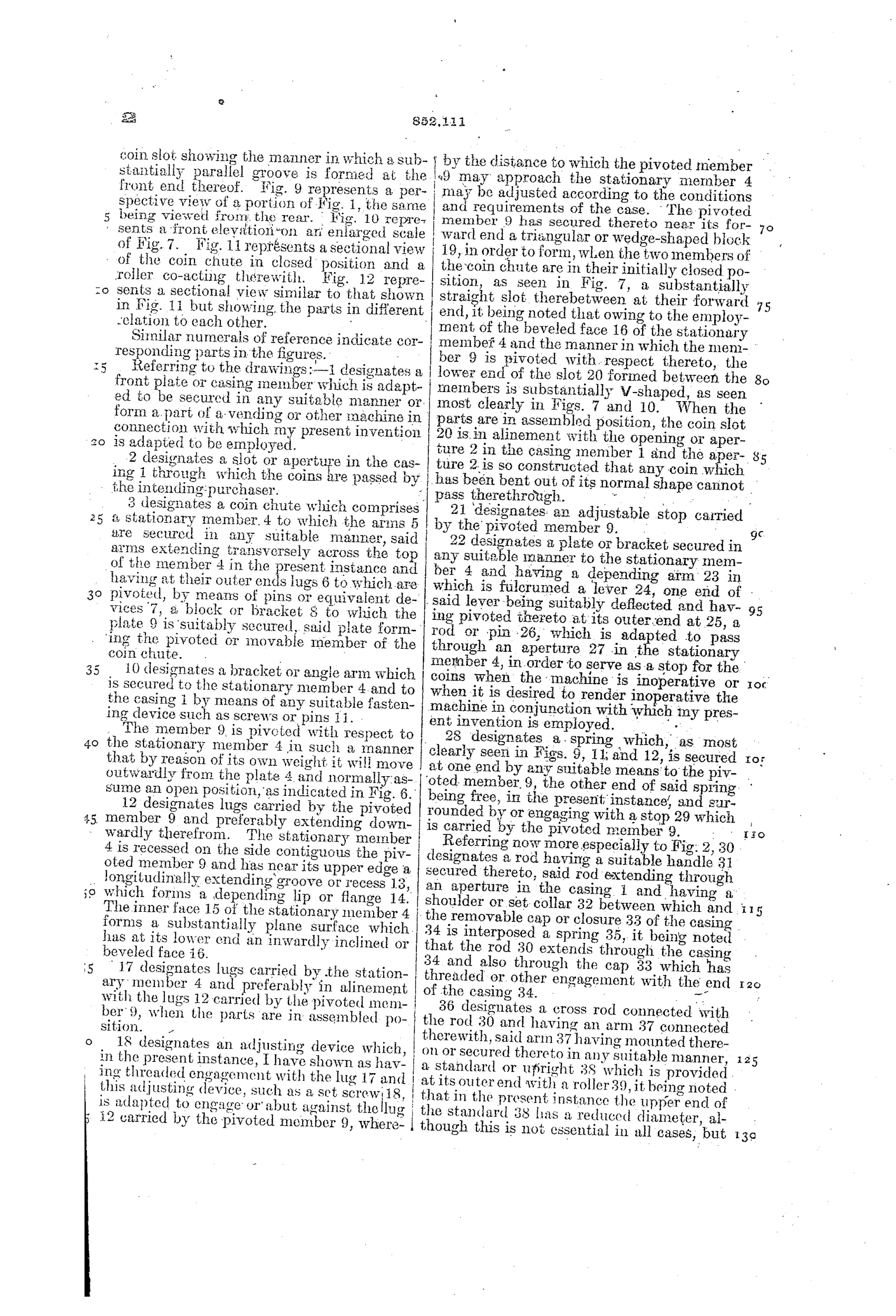
“1. In a coin controlled apparatus, a coin chute, comprising a stationary member and a pivoted member, said members forming a coin slot therebetween, means for adjusting the size of said slot, an adjustable stop carried by said pivoted member, and means for causing an abnormally thin coin to engage said stop.”
In plain English: The coin chute has an adjustable slot between a fixed and a pivoted plate, with an adjustable stop on the pivoted plate that catches coins that are too thin.
◉ In the inventor’s words
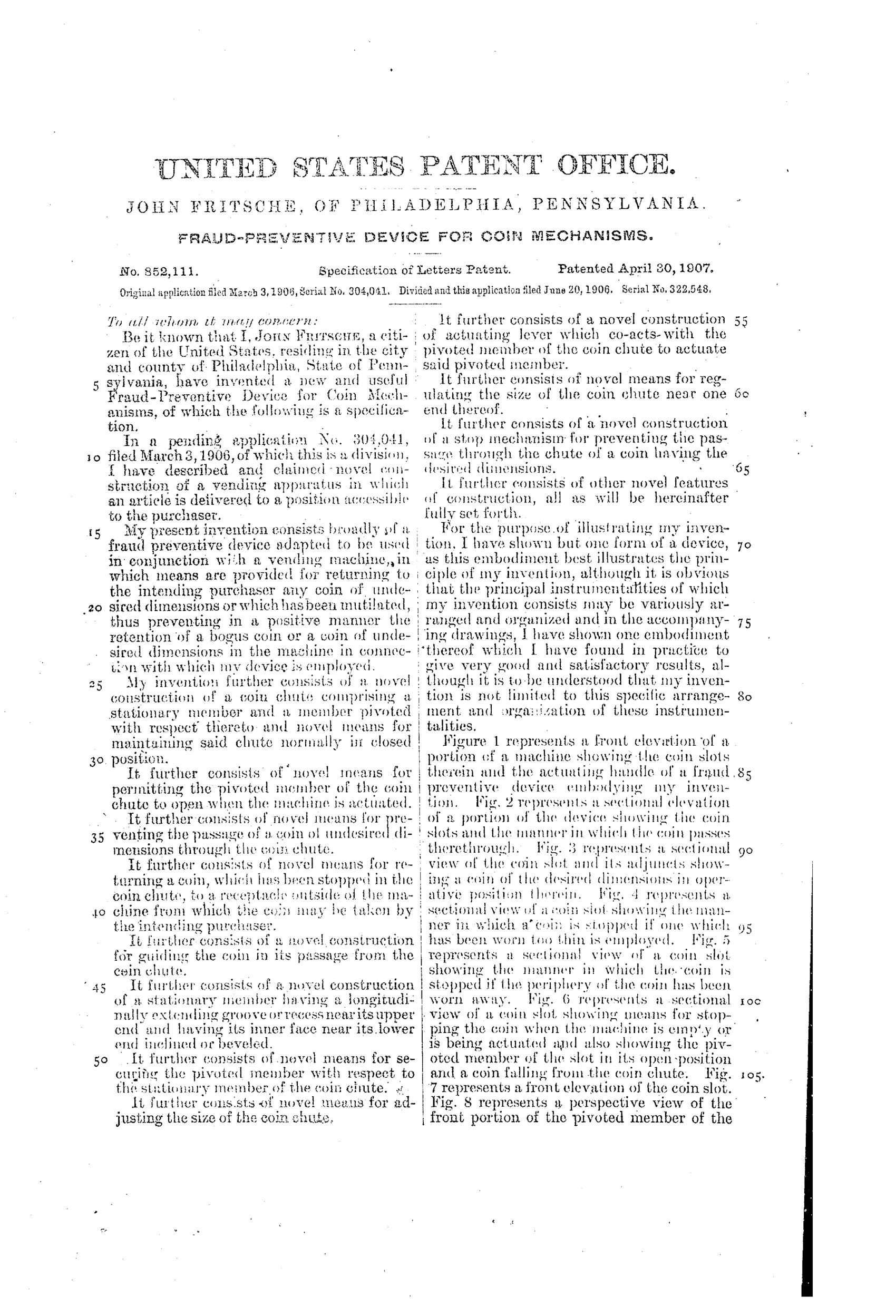
“My present invention consists broadly of a fraud preventive device adapted to be used in conjunction with a vending machine, in which means are provided for returning to the intending purchaser any coin of undesired dimensions or which has been mutilated, thus preventing in a positive manner the retention of a bogus coin or a coin of undesired dimensions in the machine in connection with which my device is employed.”— John Fritsche, from the specification
Fate unknown
No marked example or licensed vending machine using this design is documented; a surviving mechanism or trade-catalog reference would settle it.
◉ Commentary
Most chute testers of this era quietly swallow a rejected slug or dump it into a reject box inside the cabinet, which was a problem when the coin wasn't a slug at all — just a worn or slightly bent nickel. Fritsche's Philadelphia patent builds the whole mechanism around returning the offending coin to the customer. The slot is formed between a fixed plate and a pivoted one, spring-loaded through a roller; a good coin rides a grooved, beveled face straight through, while a thin or bent coin drops into a V-shaped gap and lands on an adjustable stop pin. Pull the handle and the pivoted plate swings open, spilling the caught coin into a return chute that leads back outside.
The sectional figures 3 through 6 are the heart of it: the same slot shown with a correct coin, a worn-thin coin, a coin with a worn edge, and finally the plate swung open. It's a patient piece of drafting that makes the discrimination logic legible — thickness and edge condition tested passively by geometry, not by weight or magnetism.
He also thought about the operator's side: a separate lever can block even a good coin when the machine is empty. That's a working vending man's detail. This is a solid refinement in the crowded 1900s chute-tester field, though like nearly all of them it was destined to disappear anonymously into somebody's cabinet — if it was ever built at all.
Commentary by Claude, The Counterfeit Coin Detector Patent Archive’s resident enthusiast