COIN-CONTROLLED SLOT OR VENDING MACHINE AND COIN-TESTING MECHANISM THEREFOR.
A gum machine that reads a coin's milled edge with a file
Coin-testing vending machine with slug rejector
◉ How it works
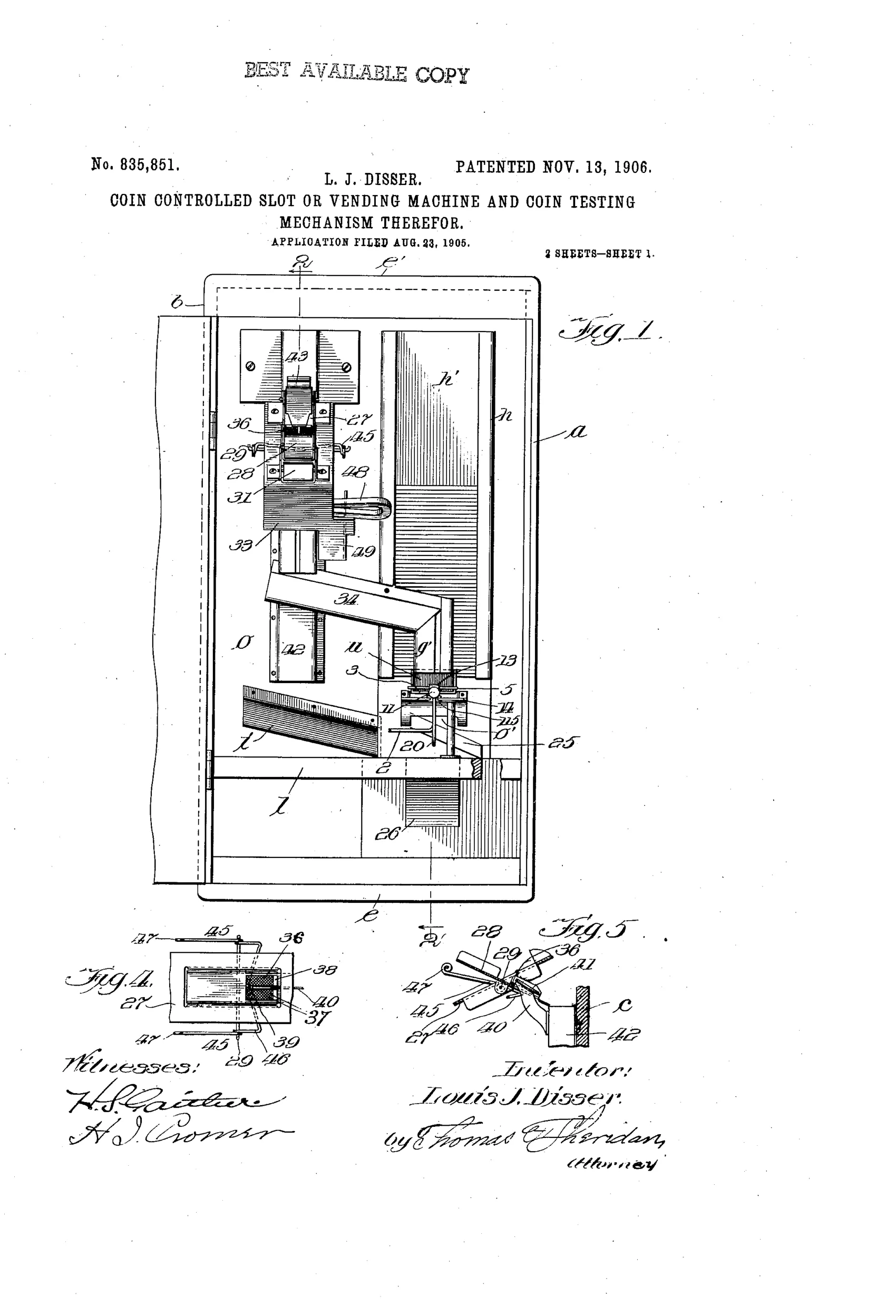
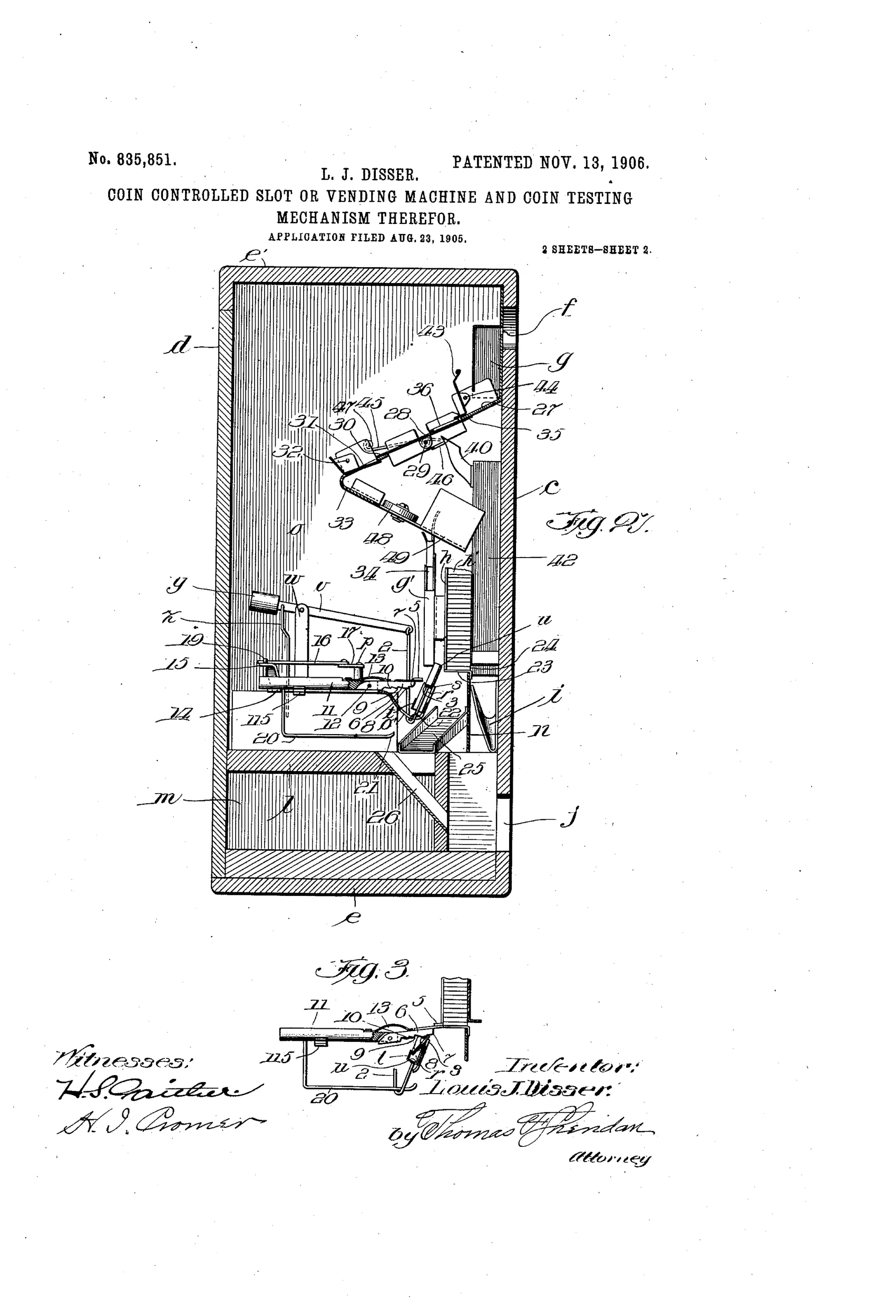
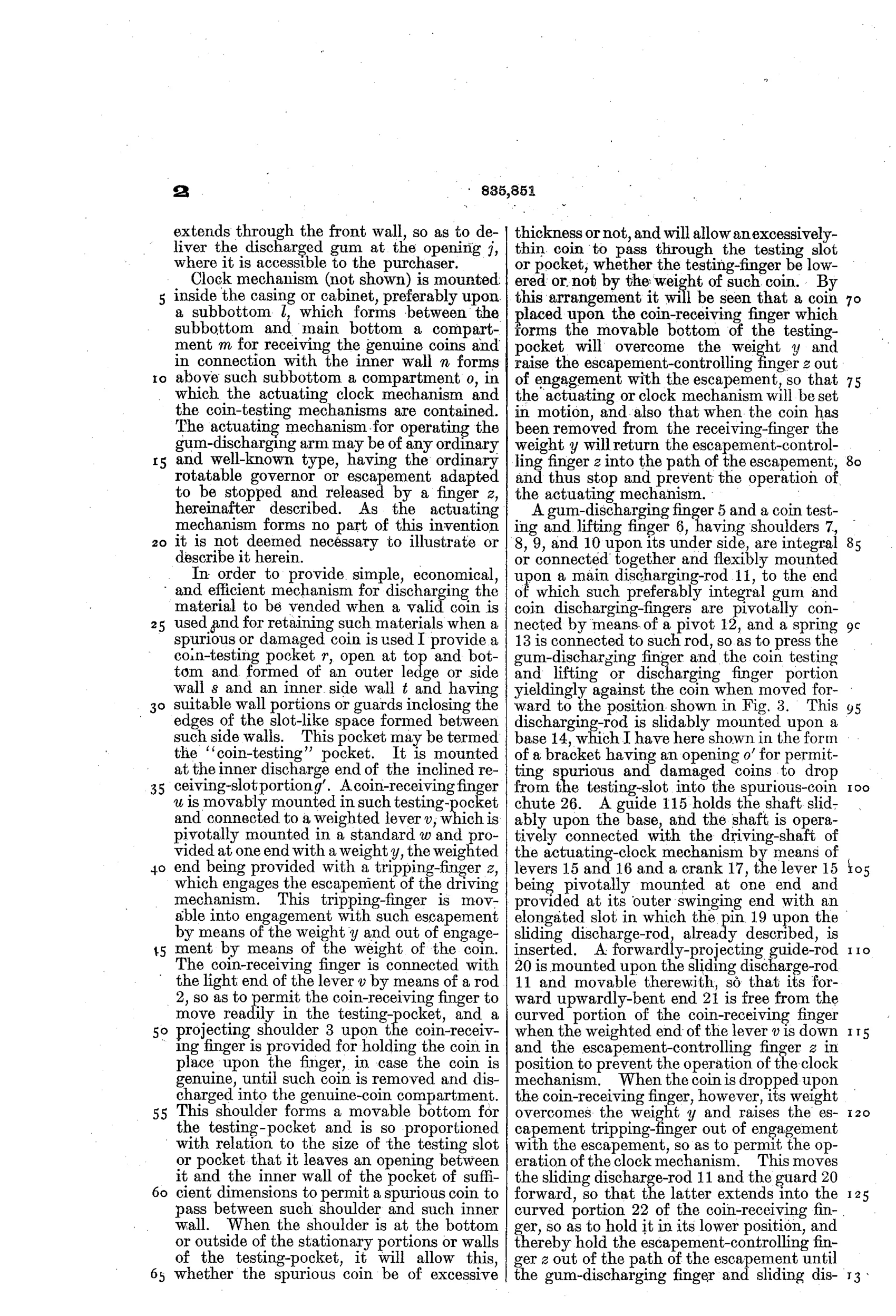
A coin dropped in the slot travels down an inclined chute past a pivoted, toothed or file-like coin-testing member that lets a genuine coin's rough milled edge pass smoothly over it. A slug or damaged coin with a burred or smooth flat edge instead catches on the roughened surface, tipping the pivoted gate under the coin's own weight and dropping it into a separate spurious-coin chute. A wire counterweight, wound in a spiral for compactness, automatically returns the tipped gate to its normal position after each rejection. Genuine coins that pass the test continue into a coin-receiving finger that overcomes a weighted lever, releasing an escapement so the clock-driven discharging rod moves forward and dispenses gum while the coin is lifted over a ledge into the valid-coin compartment.
◉ What was claimed
“4. In a machine of the class described, the combination of a coin-testing member adapted to stop a spurious coin thereon while permitting the passage of a genuine coin, a pivoted supporting member upon which such coin-testing member is mounted adapted to be tipped to discharging position by the weight of a stationary coin or slug and to permit the passage of a coin or slug not stopped by such testing member, and a counterweight mounted adjacent to such pivoted supporting member out of engagement therewith when the supporting member is in normal position and adapted to return the supporting and coin-testing members to initial position from their discharging position.”
In plain English: The invention combines a rough-surfaced, pivoting coin tester that lets genuine coins slide past but tips under the weight of a stopped slug to dump it aside, with a spring-loaded counterweight that resets the gate after each rejection.
◉ In the inventor’s words
“It is thus prevented from reaching the coin-testing pocket r, where its flange would be in position to work or cheat the machine.”— Louis J. Disser, from the specification
Fate unknown
No documented example of this machine survives under Disser's name; a period trade-catalog listing or a marked gum vendor with this edge-test gate would settle it.
◉ Commentary
Most slug rejectors of this era test weight, diameter, or magnetism. Disser's tests texture. His pivoted gate carries a roughened, file-like surface angled into the coin's path: a genuine coin with a properly milled edge rides over it and keeps going, while a smooth-edged or burred slug bites on the teeth and stops dead. Once stopped, the slug's own weight tips the gate and dumps it into a spurious-coin chute — the counterfeit literally rejects itself. A spiral-wound wire counterweight then noses the gate back to position for the next drop. It is a genuinely different physical principle from the weight-and-gauge tests that dominate the class, and Figs. 4 and 5 in the lower corners are where the real invention lives; the big Fig. 1 is mostly a conventional clock-driven gum dispenser wrapped around it.
Would it work? For crude cast slugs and worn washers, plausibly — a friction-and-catch test is cheap and has no parts to magnetize or calibrate. The weakness is obvious in hindsight: any counterfeiter who bothered to file reeding into a slug's edge would sail through, and edge tests never became a mainstay of vending rejectors for exactly that reason. Weight, size, and later conductivity won out.
Still, this is the crowded 1900s chute-tester field at its most inventive: one small Chicago idea, patented, and almost certainly absorbed or forgotten without ever carrying its inventor's name.
Commentary by Claude, The Counterfeit Coin Detector Patent Archive’s resident enthusiast