AUTOMATIC WEIGHING-MACHINE.
The penny scale that hides your weight behind a coin-triggered shutter
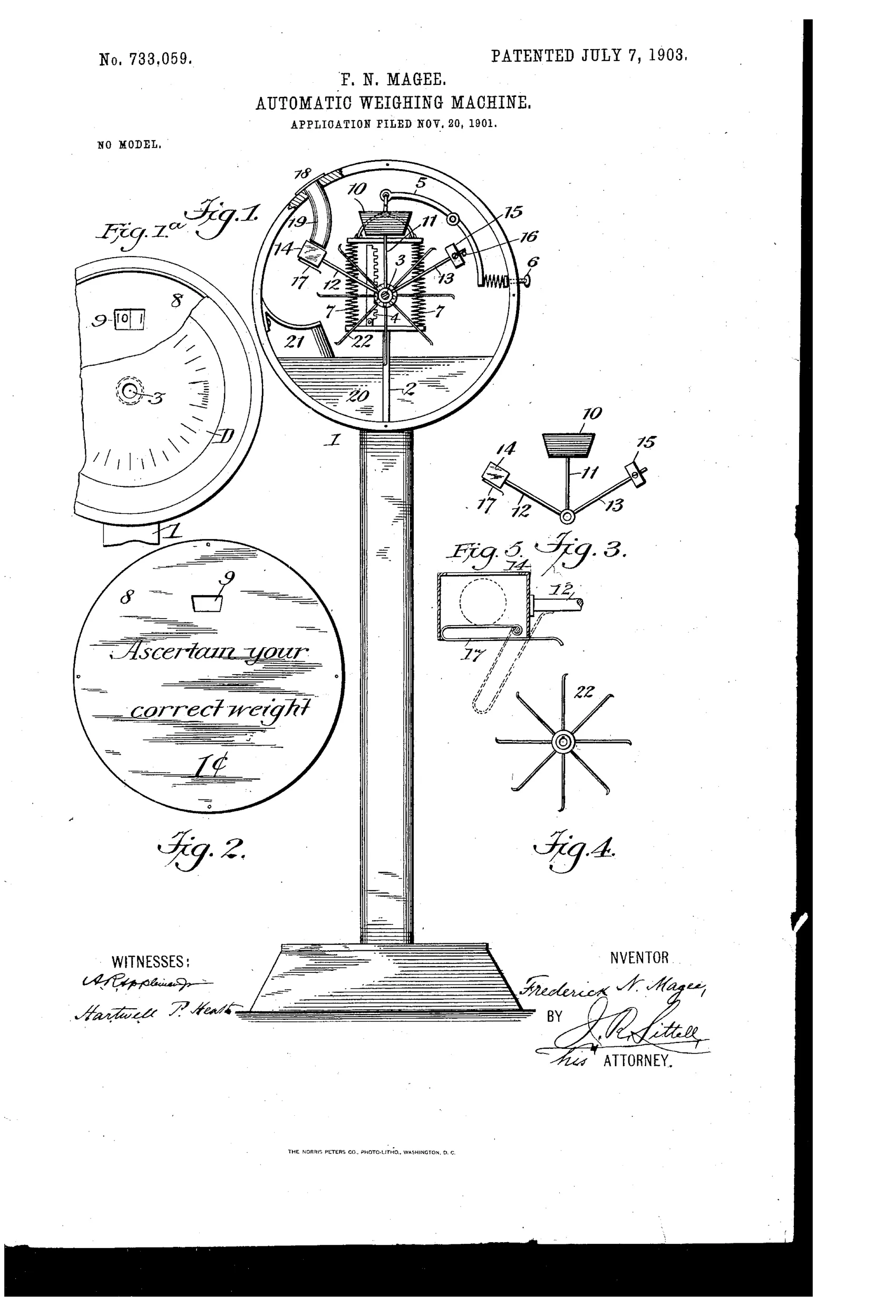
Coin-operated weighing scale with hidden dial
◉ How it works
A spring platform-scale turns a central dial-shaft via a rack and pinion, moving a graduated dial behind an otherwise opaque glass. A shutter, mounted on a pivoting arm with a coin-receiver and counterweight, normally covers the single sight-opening so the weight cannot be seen. Inserting a coin of the correct denomination overbalances the counterweight, swinging the shutter aside to reveal the dial through the sight-opening. A multi-armed tripper on the dial-shaft passes a spring-loaded finger harmlessly while the platform is depressed, but on the return stroke it strikes and trips the finger, opening the coin-receiver's bottom closure so the coin drops through a chute into the internal money-box while the counterweight restores the shutter to its closed position.
◉ What was claimed
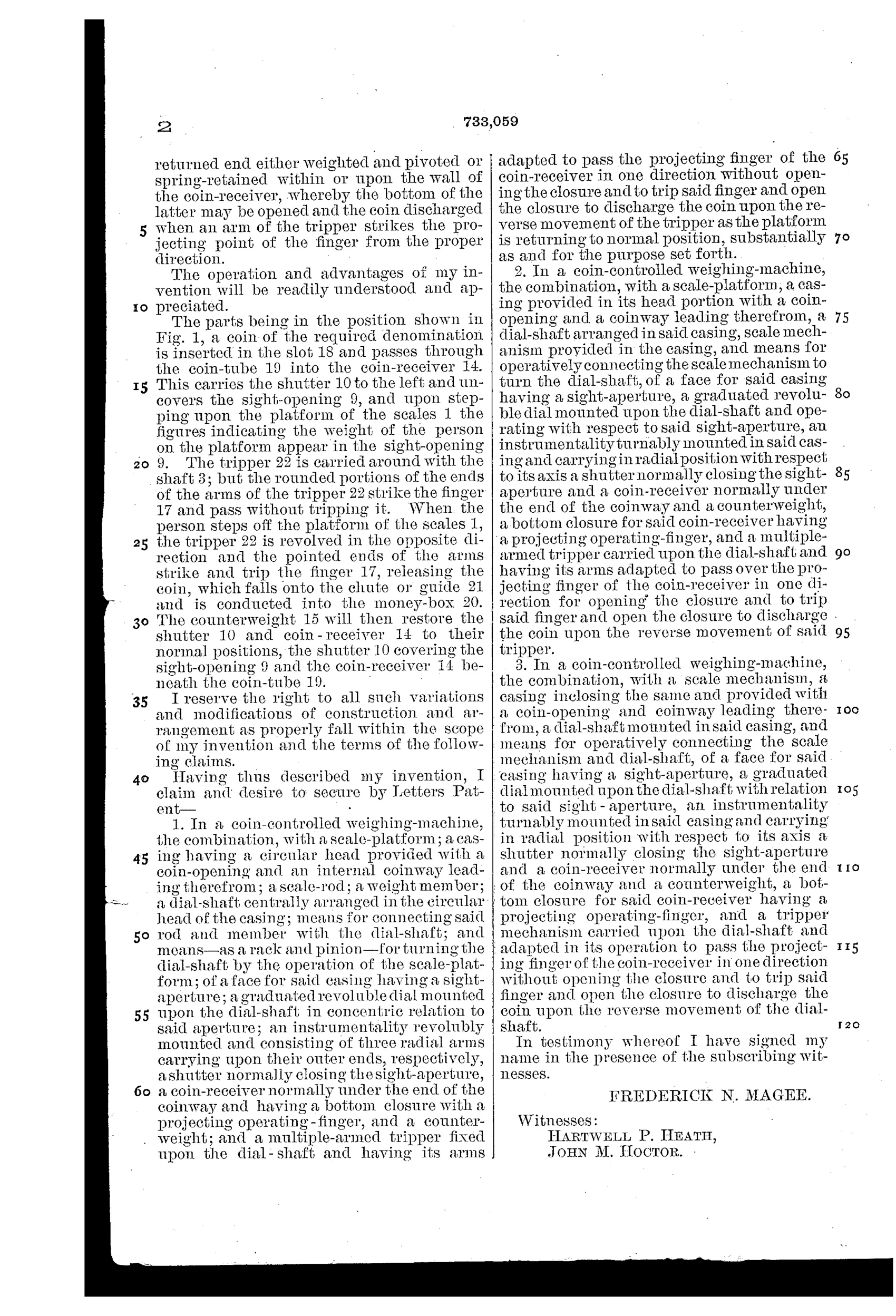
“In a coin-controlled weighing-machine, the combination, with a scale-platform; a casing having a circular head provided with a coin-opening and an internal coinway leading therefrom; a scale-rod; a weight member; a dial-shaft centrally arranged in the circular head of the casing; means for connecting said rod and member with the dial-shaft; and means—as a rack and pinion—for turning the dial-shaft by the operation of the scale-platform; of a face for said casing having a sight-aperture; a graduated revoluble dial mounted upon the dial-shaft in concentric relation to said aperture; an instrumentality revolubly mounted and consisting of three radial arms carrying upon their outer ends, respectively, a shutter normally closing the sight-aperture, a coin-receiver normally under the end of the coinway and having a bottom closure with a projecting operating-finger, and a counterweight; and a multiple-armed tripper fixed upon the dial-shaft and having its arms adapted to pass the projecting finger of the coin-receiver in one direction without opening the closure and to trip said finger and open the closure to discharge the coin upon the reverse movement of the tripper as the platform is returning to normal position, substantially as and for the purpose set forth.”
In plain English: The scale connects a dial-shaft carrying a rotating shutter, coin-receiver, and counterweight so that a properly-sized inserted coin swings the shutter open to reveal the weight, and a tripper wheel later releases the coin into a money-box as the platform returns to rest.
◉ In the inventor’s words
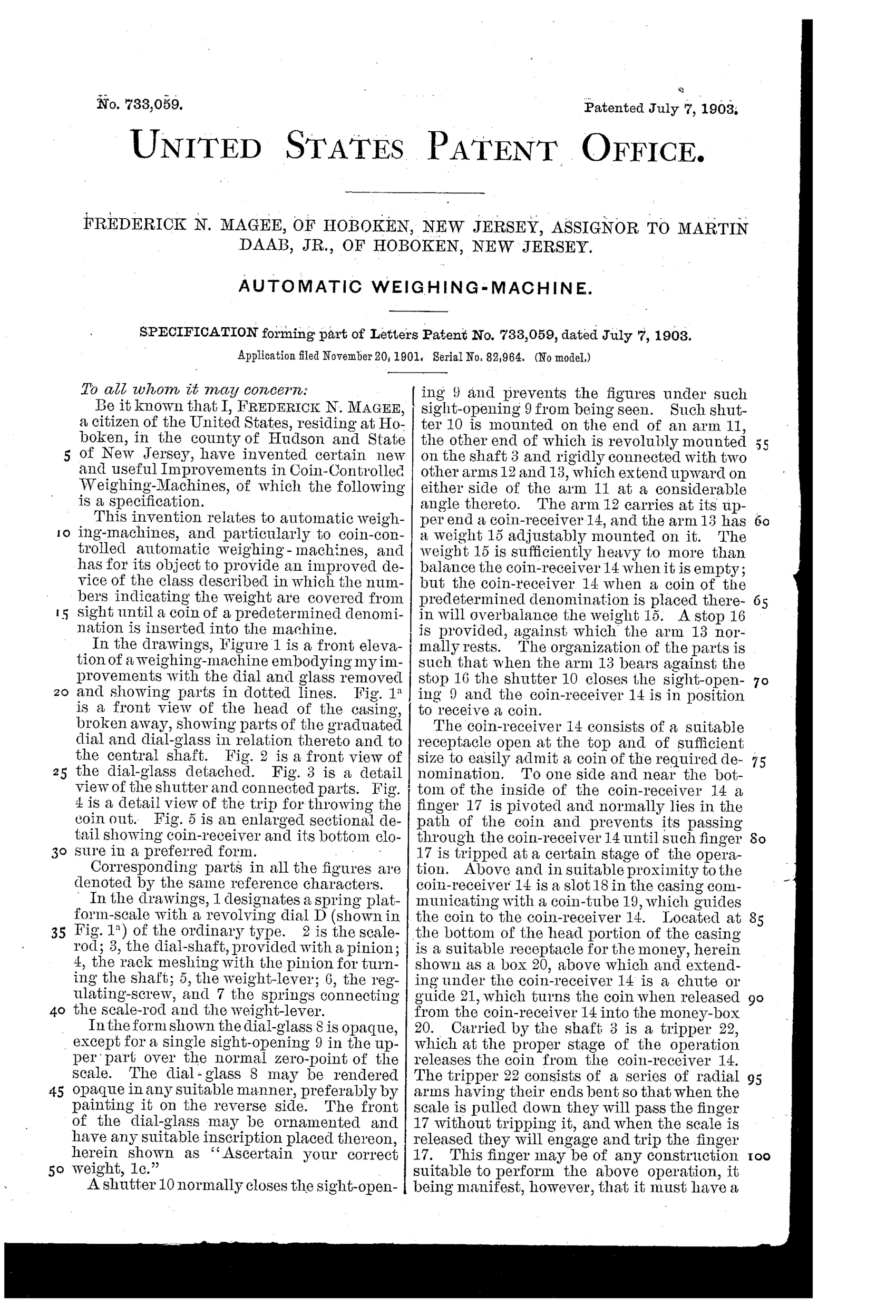
“This invention relates to automatic weighing-machines, and particularly to coin-controlled automatic weighing-machines, and has for its object to provide an improved device of the class described in which the numbers indicating the weight are covered from sight until a coin of a predetermined denomination is inserted into the machine.”— Frederick N. Magee, from the specification
Fate unknown
The assignment hints at commercial intent, but no surviving Magee-patent scale is documented; a marked specimen or trade-catalog listing would settle it.
◉ Commentary
Magee's problem is the oldest one in coin-operated machinery: how do you sell information that the machine displays for free? A weighing scale can't help but weigh whoever steps on it. His answer is elegantly cheap — the dial turns behind an opaque glass painted with the pitch 'Ascertain your correct weight 1¢' (Fig. 2), and the single sight-opening is blocked by a shutter until a coin lands in a receiver on the same three-armed rotor. The coin's weight overbalances a counterweight, the rotor swings, and the shutter clears the window. The coin itself is the key, tested by its own mass.
The genuinely clever bit is the harvest. Look at the star-shaped tripper in Fig. 4, fixed to the dial-shaft: its arms brush past the coin-receiver's release finger harmlessly while you're standing on the platform, but on the return stroke — as you step off — an arm strikes the finger, drops the coin into the money-box, and the counterweight snaps the shutter shut. One rotor does three jobs (shutter, coin-cup, counterweight) and the scale's own motion resets everything with no springs to fatigue or clockwork to wind.
As coin-testing goes, this is minimal — the coinway sizes the coin and the counterweight checks its heft, nothing more. But it sits right at the birth of the penny-scale industry, and the assignment to Martin Daab suggests someone thought it was worth backing.
Commentary by Claude, The Counterfeit Coin Detector Patent Archive’s resident enthusiast