COIN-CONTROLLED CIGAR-VENDING MACHINE
The coin itself becomes a battery: electrolytic testing in a 1901 cigar vendor
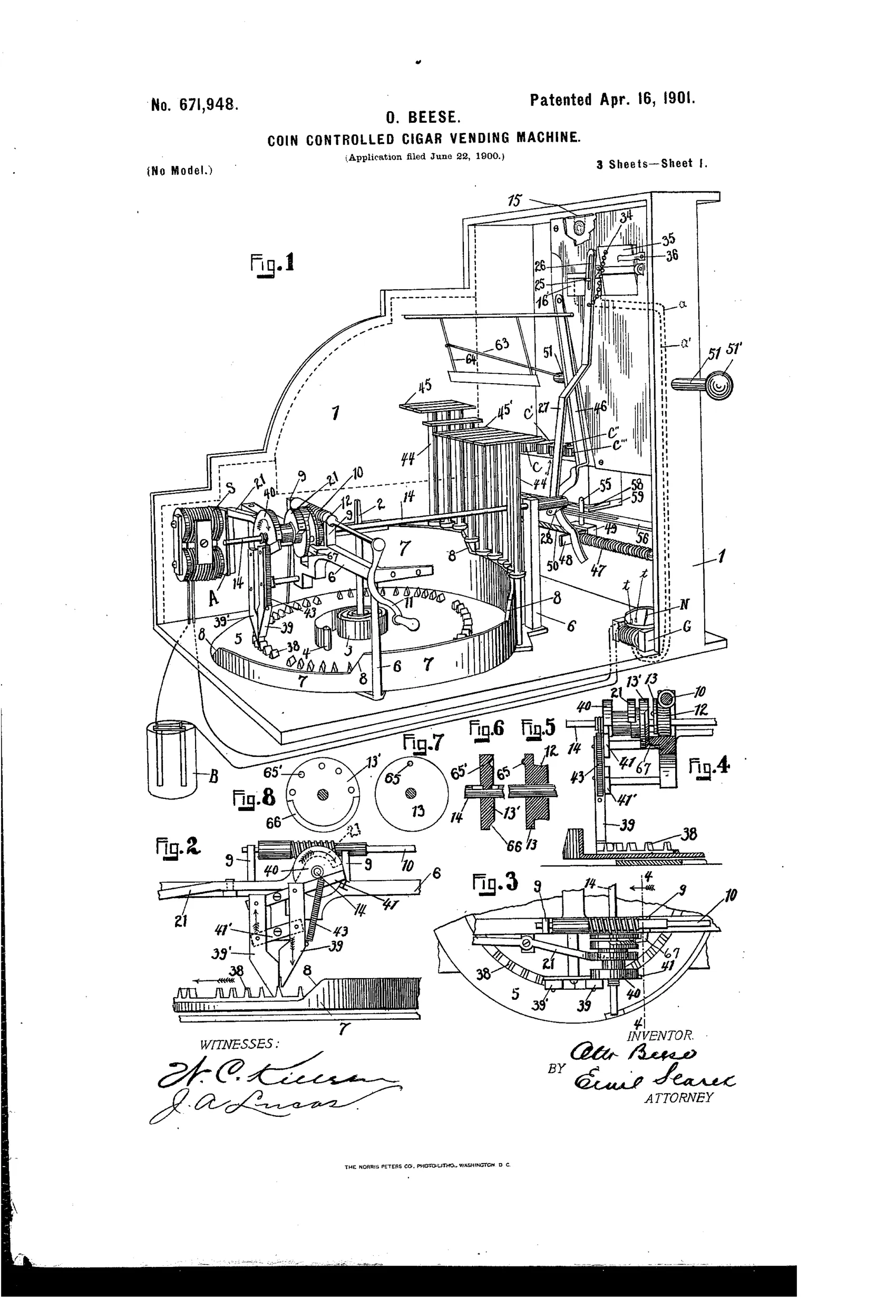
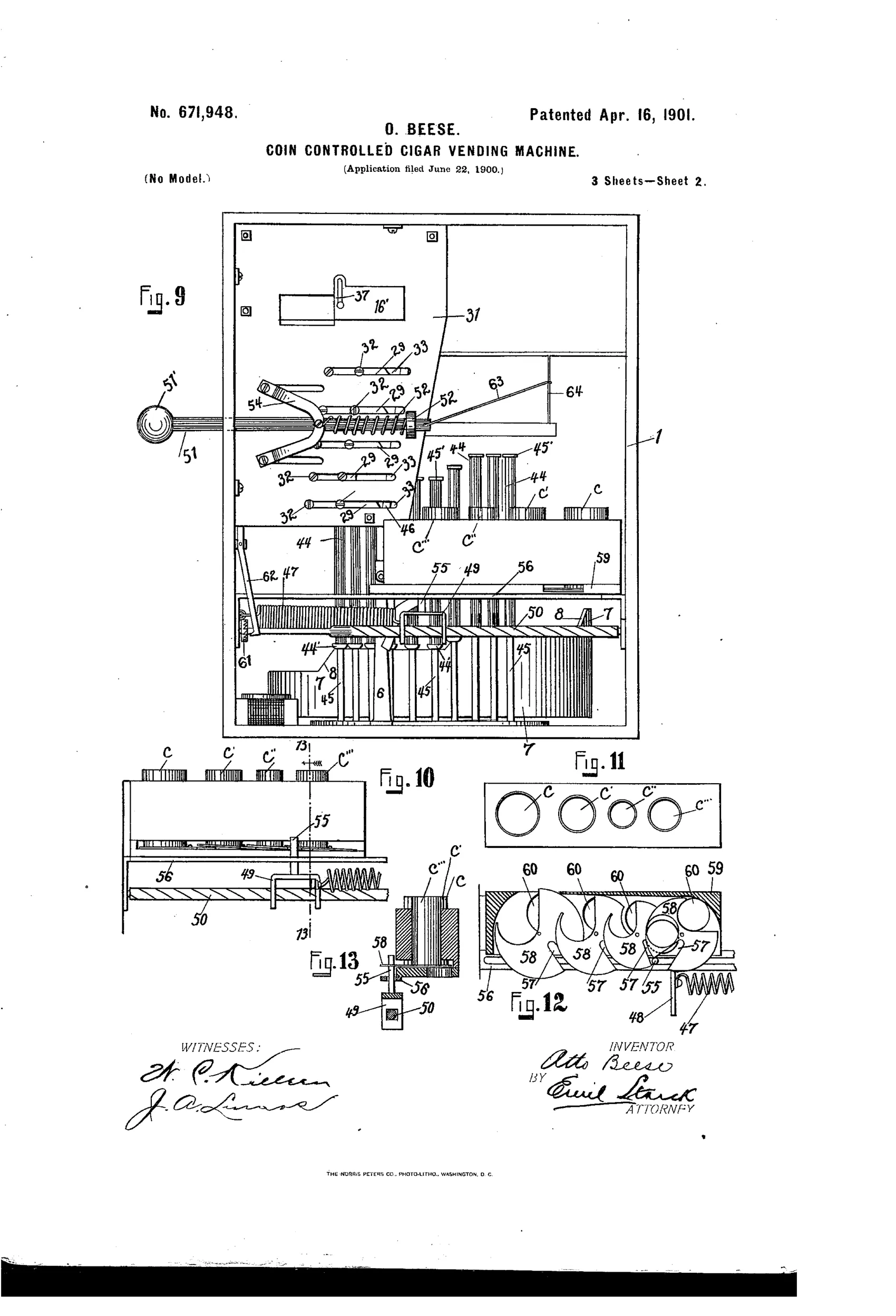
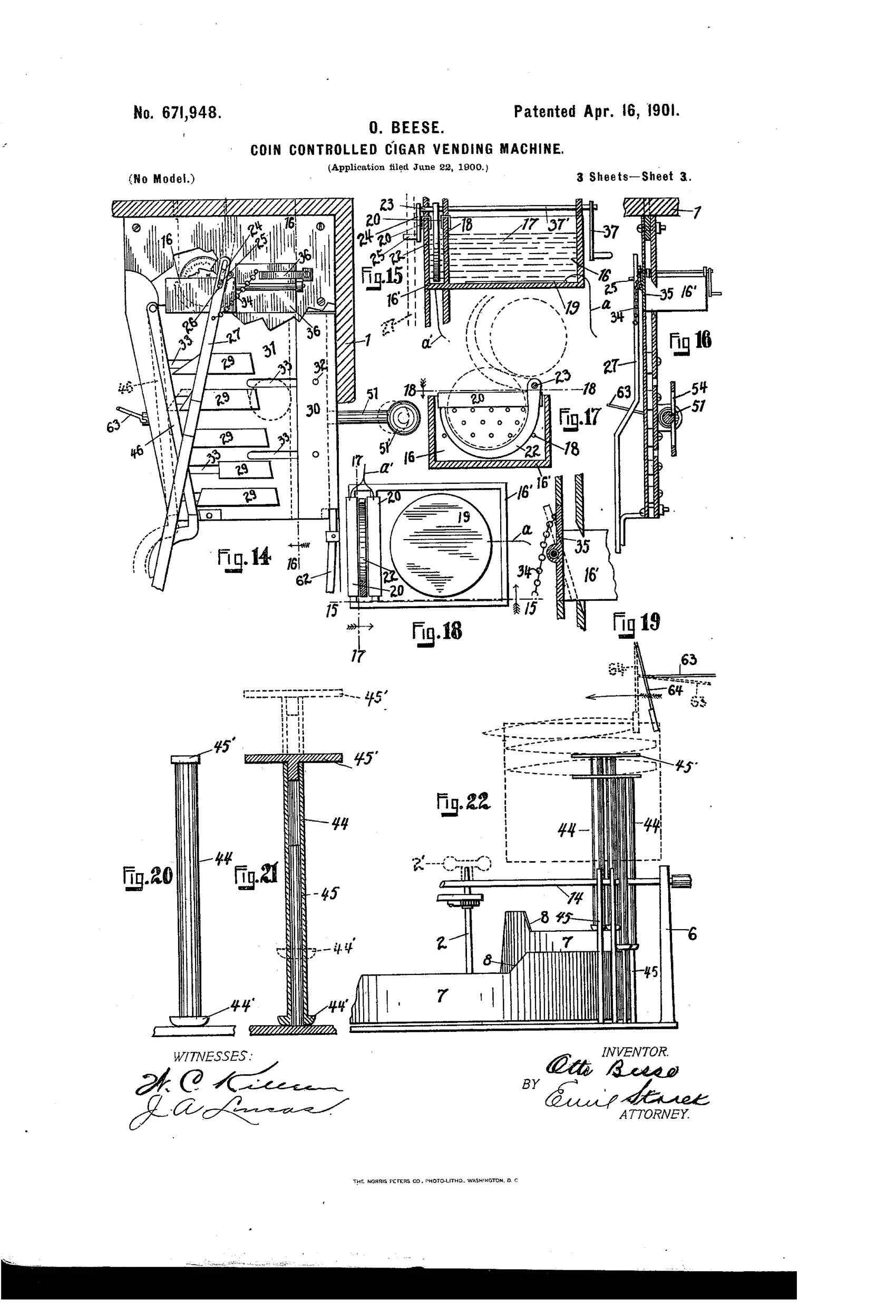
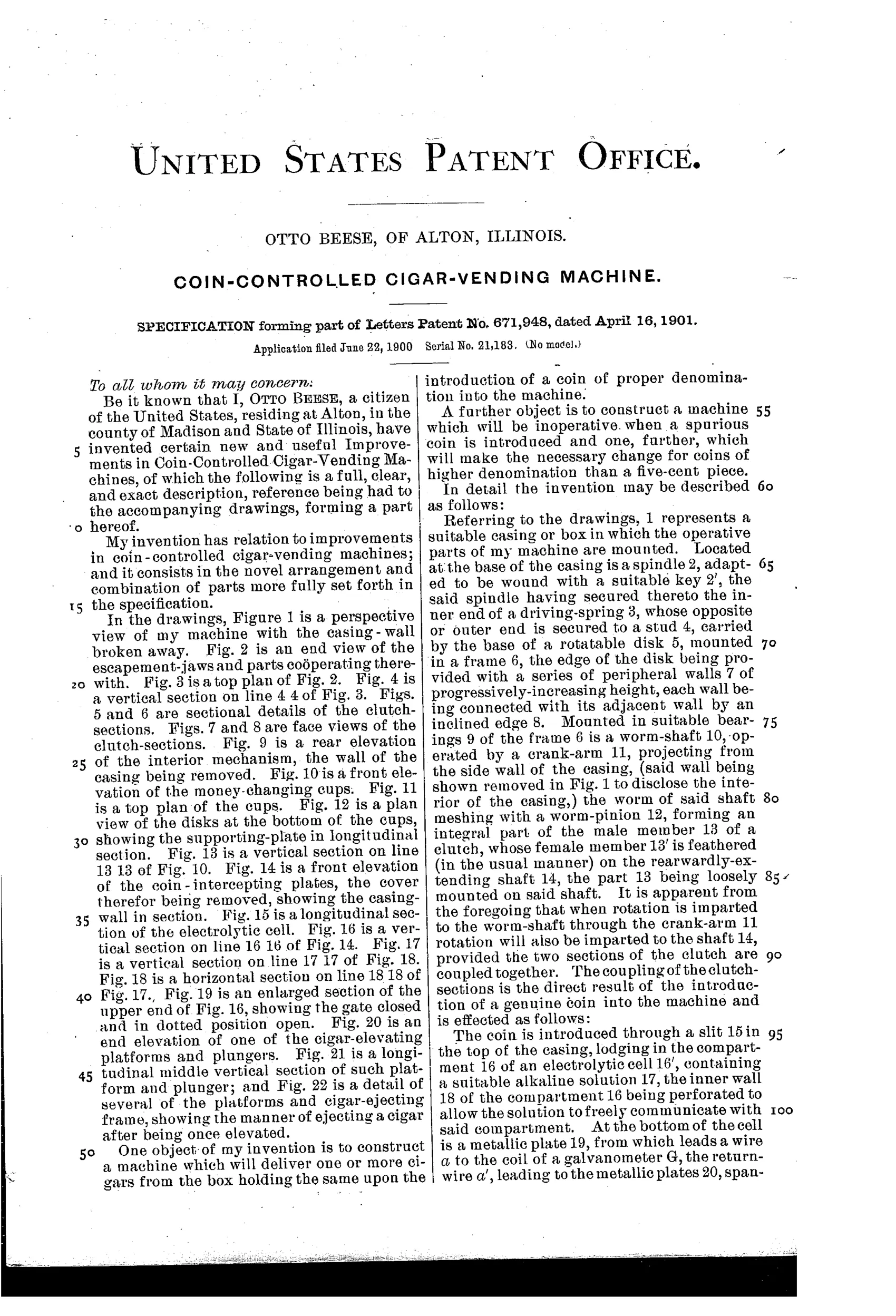
Electrolytic-cell coin-tested cigar vending machine with change
◉ How it works
A coin dropped through a slot lands in an electrolytic cell containing alkaline solution; a genuine coin generates a current that deflects a galvanometer needle, closing a local battery circuit that energizes a solenoid to couple a clutch on the worm-shaft to a driven shaft. This coupling permits rotation that ejects the coin from the cell, advances a spring-driven disk with peripheral walls of progressively increasing height past escapement-jaws, and raises tubular plunger platforms to elevate a cigar for delivery. Depending on which coin-intercepting plate the coin passes (dollar, half, quarter, dime, nickel), a swinging bar and reciprocating rider travel a distance proportional to coin size, rotating lobed change-cups to dispense the correct change through eccentric openings. A spurious coin generates no current, leaving the gate open so the coin drops out of the machine instead of into the mechanism.
◉ What was claimed
“1. In a coin-controlled cigar-vending machine, a suitable electrolytic cell adapted to receive the coin and complete the couple by which the current is generated, a needle adapted to be deflected by said current, a second electric circuit adapted to be closed by the deflection of the needle, a solenoid located in the path of said second circuit, a clutch controlled by said solenoid, and suitable mechanism adapted to be operated upon the coupling of the clutch-sections for ejecting the coin from the cell, and simultaneously actuating a cigar, substantially as set forth.”
In plain English: The machine uses an electrolytic cell that generates current from a genuine coin, which deflects a needle to close a circuit energizing a solenoid-controlled clutch, and this clutch engagement both ejects the coin and triggers delivery of a cigar.
◉ In the inventor’s words
“A further object is to construct a machine which will be inoperative when a spurious coin is introduced and one, further, which will make the necessary change for coins of higher denomination than a five-cent piece.”— Otto Beese, from the specification
Paper patent — likely never produced
No manufactured example or trade record is known, and the wet-cell galvanometer arrangement is far too delicate and costly for commercial vending; a surviving specimen or catalog listing would overturn this.
◉ Commentary
Most slug rejectors of this era are mechanical — a magnet to pull aside steel, a rocker to weigh, a gauge to size. Otto Beese went a different direction entirely: drop your coin into a cell of alkaline solution, and if it's genuine silver or gold it completes a galvanic couple and generates its own current. That trickle of electricity deflects a galvanometer needle, the needle closes a second, battery-powered circuit, and a solenoid throws a clutch that lets the works turn. A base-metal slug generates nothing, and the gate simply lets it fall through. The coin is not merely tested — it is the sensing element. That's a genuinely early conductivity-style test, decades before electrical coin validation became routine.
The rest of the machine is almost recklessly ambitious. Look past the cutaway cabinet in Fig. 1 and you'll find a spring-driven disk with peripheral walls of progressively increasing height metered by escapement-jaws, telescoping plungers that lift each cigar into reach, and — the boldest part — a change-making train of lobed cups that reads coin diameter mechanically and pays out correct change on anything up to a dollar. Twenty-two figures for a nickel cigar.
The electrolytic idea is clever but fragile in practice: cell fouling, wet coins, varying coin surface condition, and the sheer delicacy of a galvanometer relay in a saloon-counter machine all argue against it. As a signpost toward electrical coin testing, though, it deserves its place.
Commentary by Claude, The Counterfeit Coin Detector Patent Archive’s resident enthusiast