COMBINED PENCIL-HOLDER, ERASER-HOLDER, AND COIN-TESTER.
Your pencil folds out into a coin scale, denominations marked on the sleeve
Pocket pencil-holder with built-in coin scale
◉ How it works
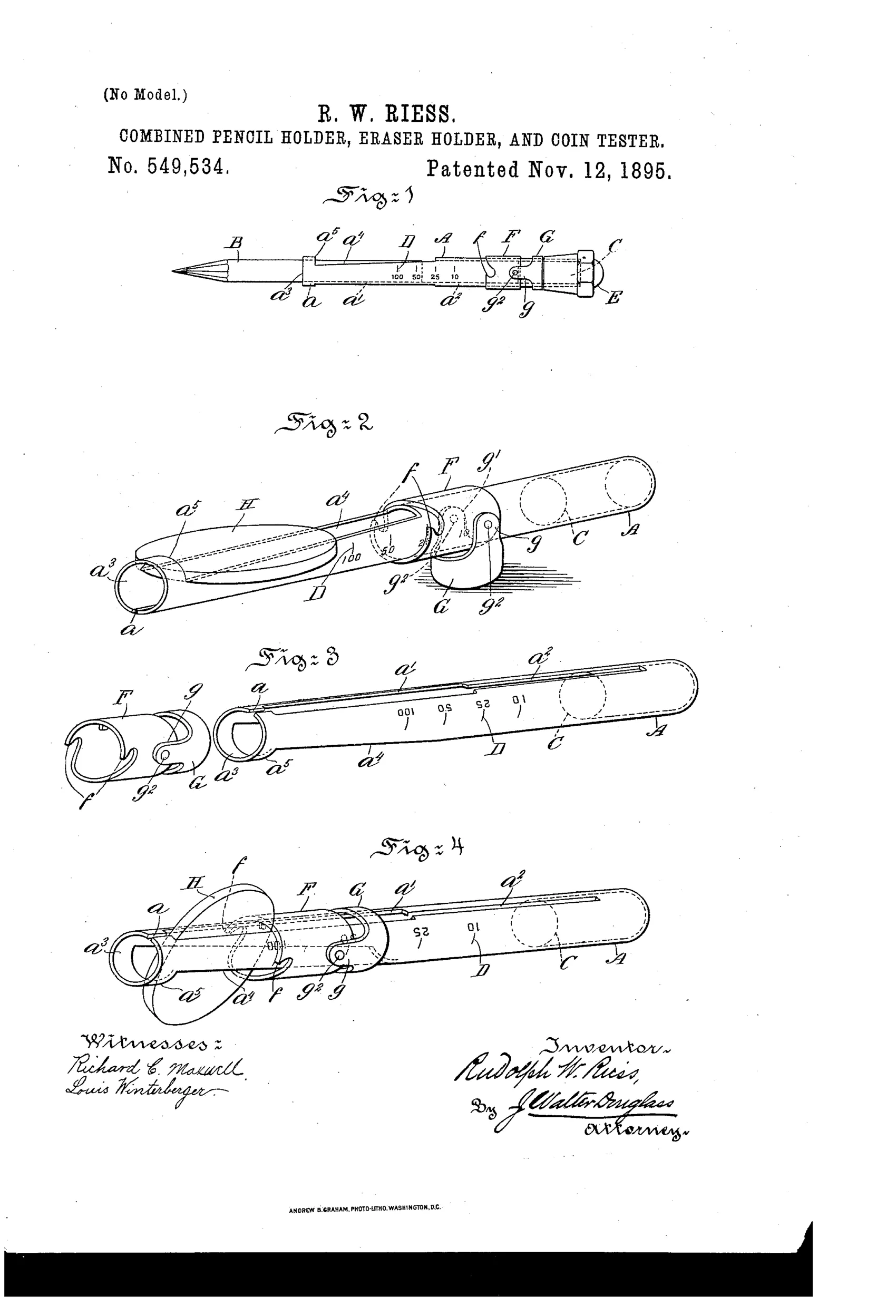
A hollow metal tube open at one end holds a pencil or pen and is internally weighted with a metal plug at the other end, which bears a detachable eraser. A slidable notched sleeve carries a pivotal trunion that swings out to form a standard, converting the tube into a beam scale; the sleeve's pointer is set opposite a graduated scale marked for different coin denominations. A coin inserted through a tapering guideway and slot rests on the forward end of the tube, and if genuine it overbalances the weighted rear end, tipping the holder at an angle; a spurious (thicker/heavier) coin fails to tip it, revealing the counterfeit. The oblong slot, guideway, and terminal slit are sized to admit coins of correct thickness while excluding bulkier counterfeit coins.
◉ What was claimed
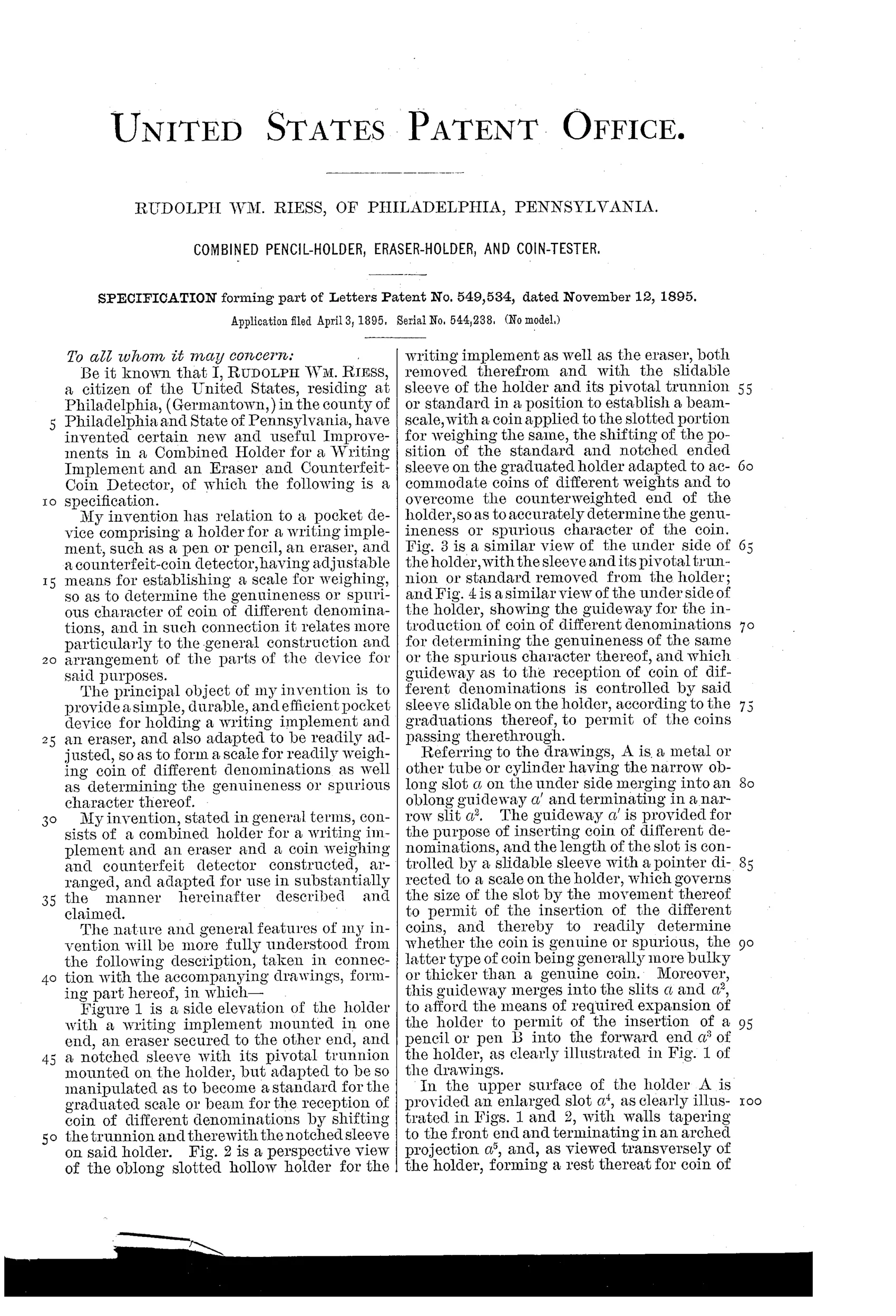
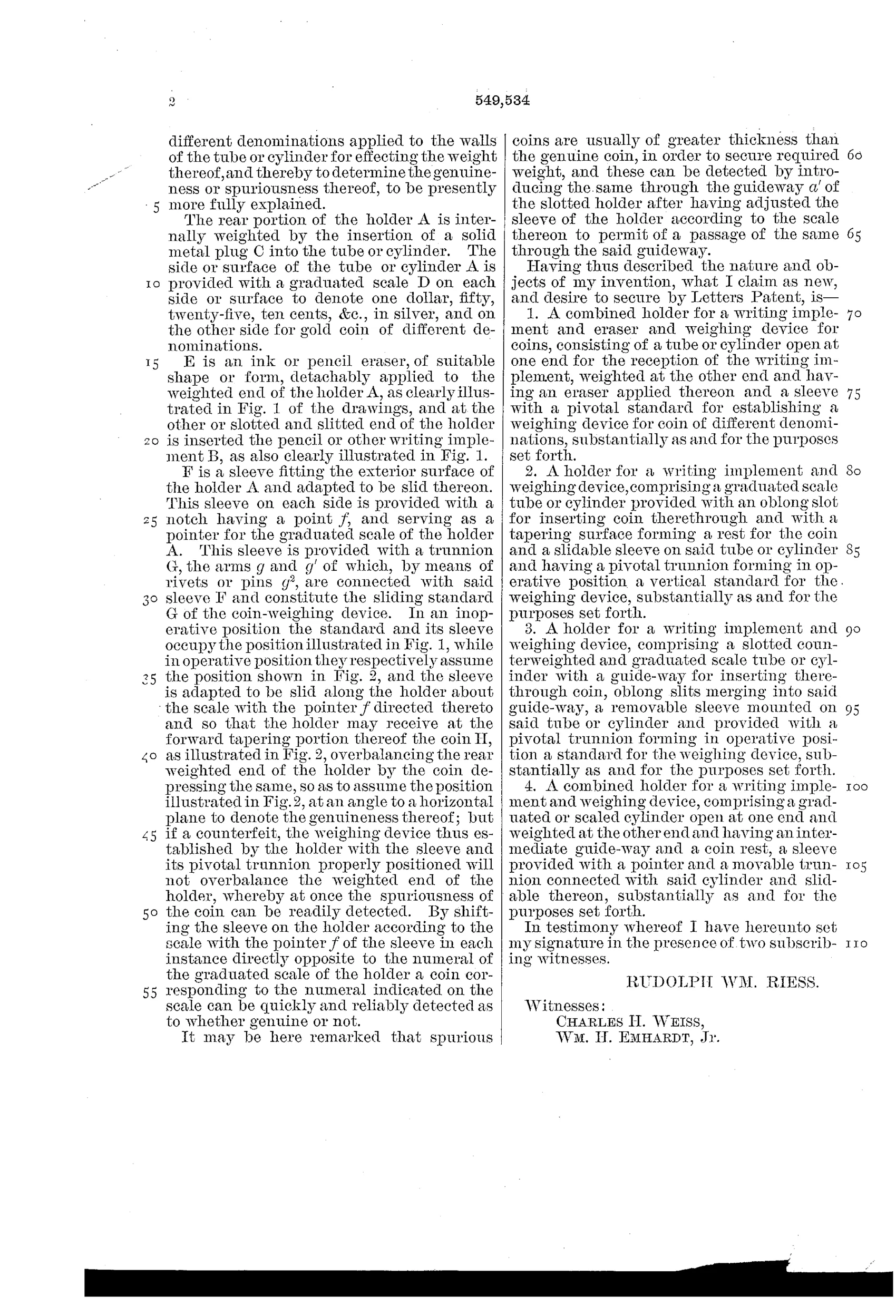
“A combined holder for a writing implement and eraser and weighing device for coins, consisting of a tube or cylinder open at one end for the reception of the writing implement, weighted at the other end and having an eraser applied thereon and a sleeve with a pivotal standard for establishing a weighing device for coin of different denominations, substantially as and for the purposes set forth.”
In plain English: A pencil holder that is weighted at one end, has an eraser on that end, and includes a sliding sleeve with a swing-out arm that turns the whole holder into a small balance scale for testing coins.
◉ In the inventor’s words
“but if a counterfeit, the weighing device thus established by the holder with the sleeve and its pivotal trunnion properly positioned will not overbalance the weighted end of the holder, whereby at once the spuriousness of the coin can be readily detected.”— Rudolph Wm. Riess, from the specification
Paper patent — likely never produced
No manufactured example or advertisement is known, and the calibration-sensitive novelty design makes production unlikely; a surviving marked specimen would overturn this.
◉ Commentary
By 1895 the great brass rockers of Allender's era had largely given way to slot-machine chutes, but Riess was still chasing the pocket-detector dream — and he decided the detector should also write. The whole pencil holder is the beam: a metal plug weights the eraser end, a notched sleeve slides along the barrel to a graduation for the denomination you're testing, and a little trunnion swings down from the sleeve to become the fulcrum. Set the coin in the slot at the pencil end and, if it's honest silver, it overbalances the weighted tail and tips the tube. Fig. 2 shows the arrangement mid-test, perched on its stubby leg like a seesaw.
The clever detail a casual reader misses is in Fig. 4: the coin doesn't just sit anywhere. A tapering guideway and slit admit coins of proper thickness and position them at a fixed distance from the fulcrum, so the test checks thickness and weight together — the same double-gate logic as Allender's gauge, compressed into a writing instrument.
The dubious part is everything a pocket does to a precision balance. The sleeve's friction fit sets your calibration; a worn notch or a dented barrel and the scale lies. And balancing a pencil on a swing-out peg atop a shop counter, coin trembling on the tip, asks a lot of the user's patience. It's a charming dead end — the Victorian multi-tool instinct applied to a problem the vending chute was already solving anonymously.
Commentary by Claude, The Counterfeit Coin Detector Patent Archive’s resident enthusiast