TELEPHONE.
The operator's ear as coin detector: Hartford's answer to the paid call
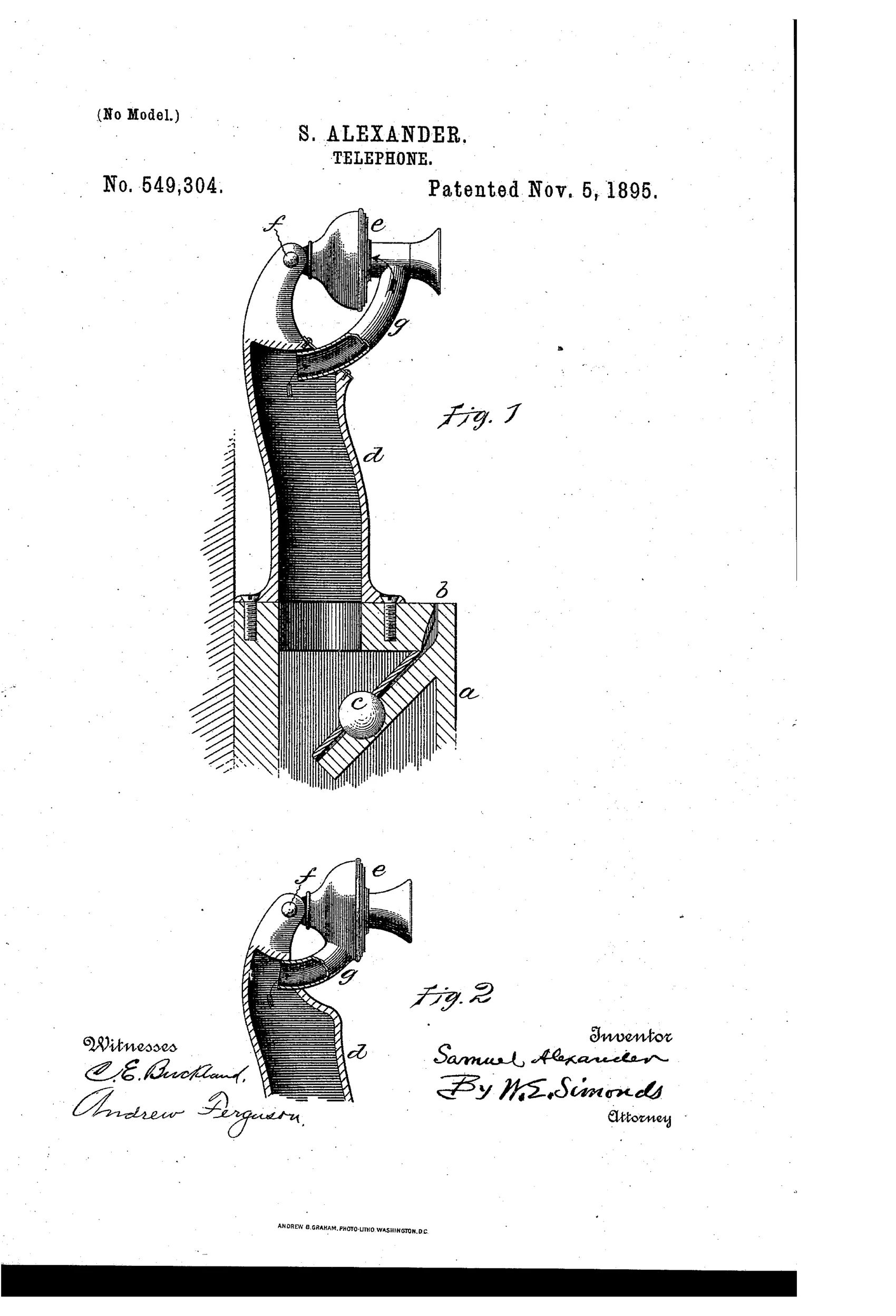
Pay-station telephone coin-sound transmitting apparatus
◉ How it works
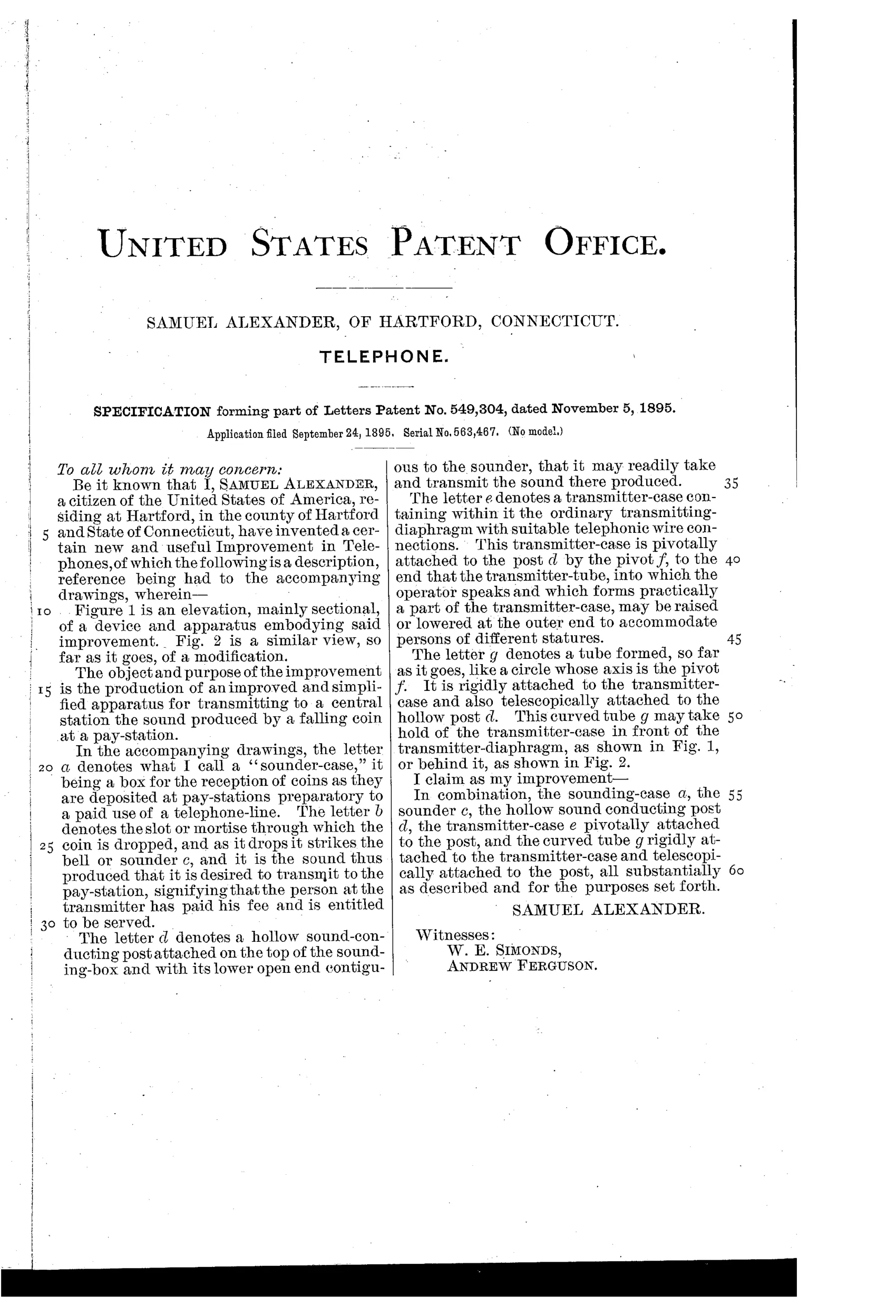
A coin dropped through a slot into a sounding-case strikes a bell or sounder inside, producing an audible signal that a fee has been paid. That sound travels up a hollow sound-conducting post to a pivoted transmitter-case containing a diaphragm, which converts it into a signal for the central station. A curved tube, telescopically fitted to the post and rigidly attached to the transmitter-case, keeps the sound path connected even as the transmitter tube is pivoted up or down to suit the operator's height. The tube can be positioned in front of or behind the transmitter diaphragm depending on the desired configuration.
◉ What was claimed
“In combination, the sounding-case a, the sounder c, the hollow sound conducting post d, the transmitter-case e pivotally attached to the post, and the curved tube g rigidly attached to the transmitter-case and telescopically attached to the post, all substantially as described and for the purposes set forth.”
In plain English: The invention combines a coin-sounding box, a sounder, a hollow sound-conducting post, a pivoting transmitter case, and a curved tube that slides telescopically on the post while staying attached to the transmitter, so the sound of a deposited coin reaches the transmitter no matter how the transmitter is angled.
◉ In the inventor’s words
“it being a box for the reception of coins as they are deposited at pay-stations preparatory to a paid use of a telephone-line.”— Samuel Alexander, from the specification
Fate unknown
Coin-sound signaling was widely commercialized in Gray-era pay stations, but no evidence ties this specific pivoting-tube design to production; a marked apparatus or Gray company records would settle it.
◉ Commentary
This one sits at the edge of our category, and that's exactly why it's interesting. Alexander's patent contains no gauge, no balance, no magnet. The coin test here is a human ear at the central office. Drop your coin, it strikes a sounder in the box at the base, and the ring travels up a hollow post into the transmitter itself, telling the operator the fee is paid. The verification isn't of the coin's metal — it's of the deposit having happened at all, with the coin's ring as its own receipt. Anyone who used a payphone with its bell-and-gong chime into the 1980s heard the descendant of this idea.
The mechanical cleverness is in the curved tube marked g. The transmitter case pivots up and down for callers of different heights, which would ordinarily break any rigid sound path from the coin box. Alexander's tube telescopes on the post while staying fixed to the transmitter, so the acoustic channel flexes with the mouthpiece. Fig. 2 shows him hedging: the tube can deliver the coin's sound to either face of the diaphragm.
The place and date matter. Hartford in 1895 was the home of William Gray's pay-station enterprise, the company that built the American payphone. Alexander is working the same ground at the same moment. Whether his particular telescoping arrangement was adopted or steamrolled by Gray's patents, the drawing shows the coin-sound principle in its adolescence — a detector with no moving parts except sound itself.
Commentary by Claude, The Counterfeit Coin Detector Patent Archive’s resident enthusiast