COIN-INTRODUCING DEVICE FOR COIN-CONTROLLED VENDING-MACHINES.
A rotating carousel slot that sifts junk out before it can jam the works
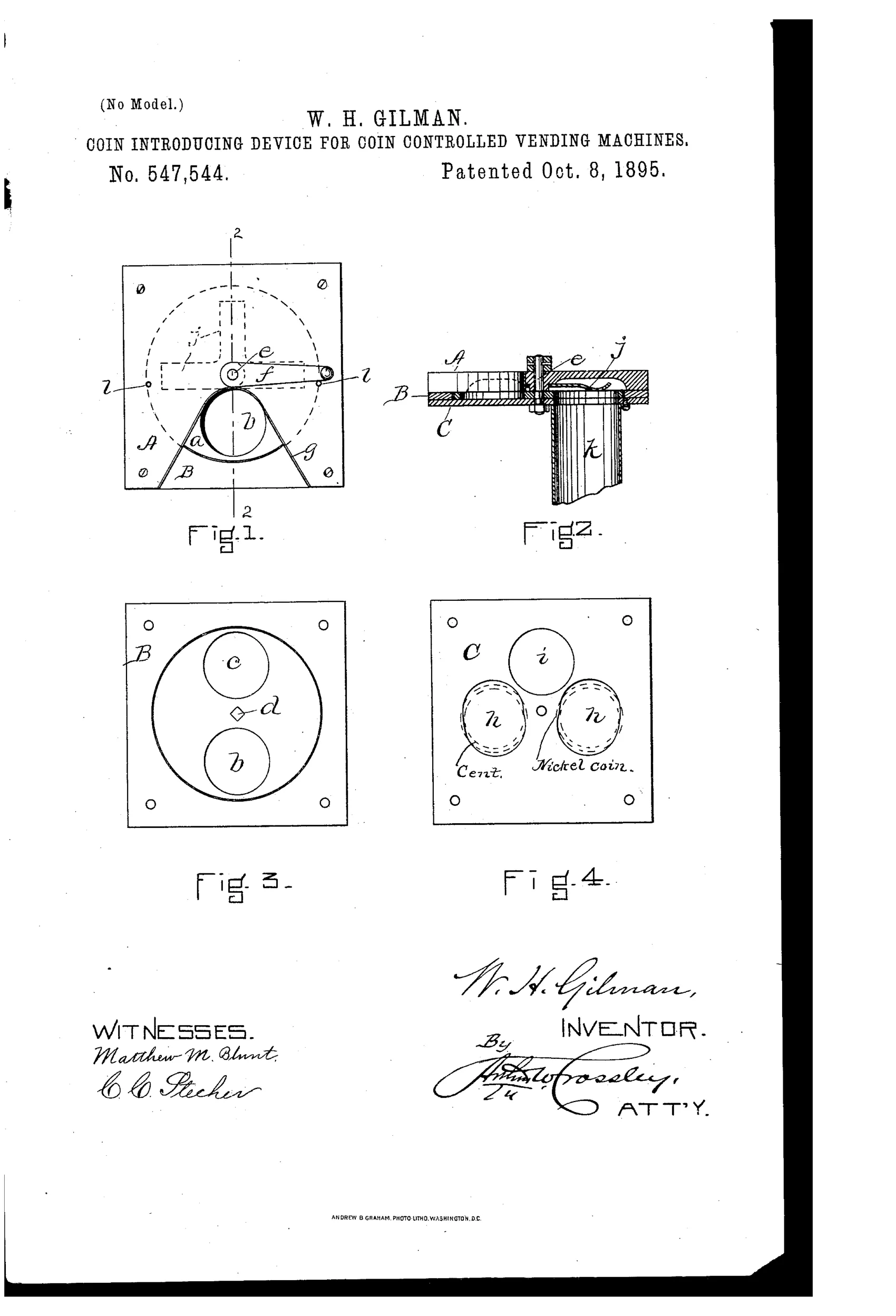
Anti-fraud coin slot mechanism for vending machines.
◉ How it works
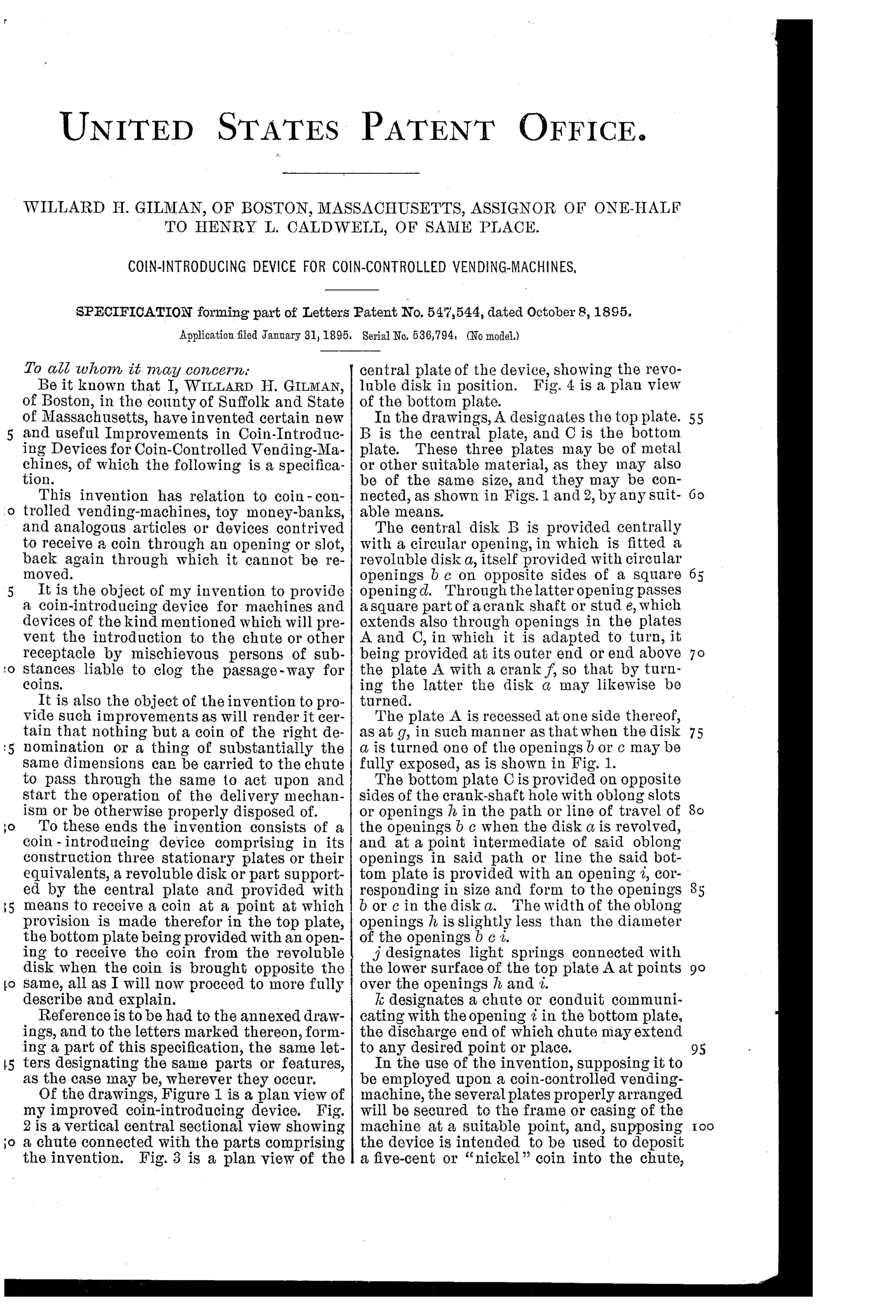
Three stacked plates form the device, with a revoluble disk fitted in a central opening of the middle plate. The disk has coin-receiving apertures sized to a genuine coin, turned by an external crank and stud. When a correctly sized coin is placed in the exposed disk opening and the crank turned, the coin aligns with a discharge opening in the bottom plate and a spring presses it down into a chute. Undersized coins or slugs fall through supplemental oblong slots in the bottom plate before reaching the discharge opening, preventing improper substances from clogging or cheating the machine.
◉ What was claimed
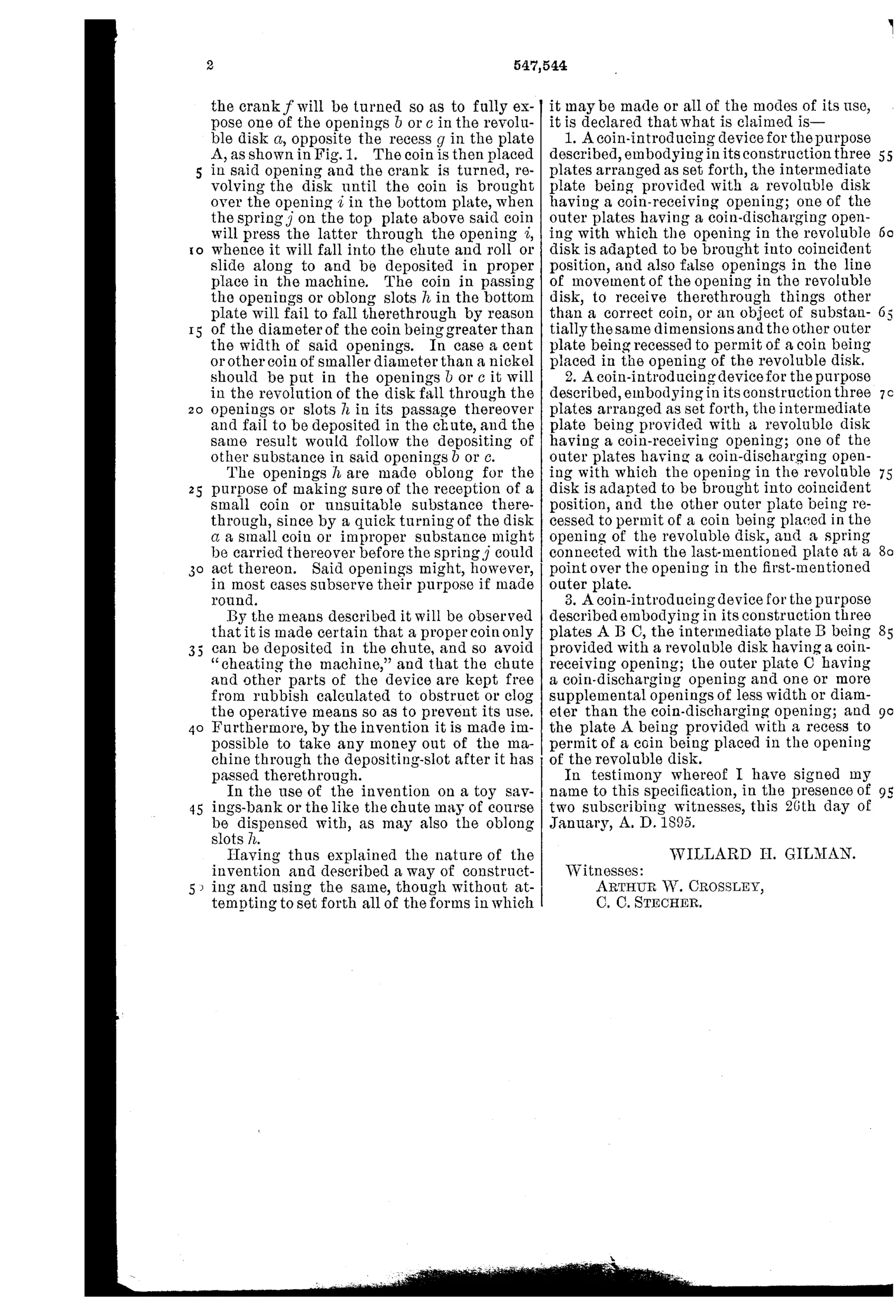
“A coin-introducing device for the purpose described, embodying in its construction three plates arranged as set forth, the intermediate plate being provided with a revoluble disk having a coin-receiving opening; one of the outer plates having a coin-discharging opening with which the opening in the revoluble disk is adapted to be brought into coincident position, and also false openings in the line of movement of the opening in the revoluble disk, to receive therethrough things other than a correct coin, or an object of substantially the same dimensions and the other outer plate being recessed to permit of a coin being placed in the opening of the revoluble disk.”
In plain English: The device uses three plates with a rotating disk that carries a coin to a discharge hole while decoy slots let undersized coins or junk fall away before reaching it.
◉ In the inventor’s words
“By the means described it will be observed that it is made certain that a proper coin only can be deposited in the chute, and so avoid "cheating the machine," and that the chute and other parts of the device are kept free from rubbish calculated to obstruct or clog the operative means so as to prevent its use.”— Willard H. Gilman, from the specification
Fate unknown
No documented machine using Gilman's disk mechanism is known to me; a surviving vending machine or trade catalog matching the design would settle it.
◉ Commentary
Gilman's insight is that the coin slot itself is the vulnerable point of a vending machine — the place where slugs, buttons, and folded paper enter and where mischief clogs the chute. His answer is to abolish the open slot entirely. The coin sits in a recessed pocket in a rotating disk, sandwiched between plates, and only a turn of the crank carries it around to the discharge hole where a spring shoves it into the chute. Nothing falls freely; everything rides the carousel.
The clever bit is in Fig. 4, easy to miss at a glance: the bottom plate has 'false openings' — decoy holes marked 'Cent' and 'Nickel coin' — positioned along the disk's path before the real discharge point. An undersized coin or scrap of rubbish drops through these traps early in the rotation and never reaches the chute. It is a sizing gauge disguised as a delivery mechanism, testing diameter by attrition as the coin travels.
This sits squarely in the 1890s shift from hand-held detectors to automatic in-chute defenses, and it attacks clogging as seriously as cheating — a practical operator's concern the balance-scale era never had to think about. The weakness is obvious too: it only tests dimensions, so a well-cut lead slug sails through. Like most patents in this crowd, it likely vanished anonymously into vending machinery, if it was built at all.
Commentary by Claude, The Counterfeit Coin Detector Patent Archive’s resident enthusiast