COIN-CONTROLLED MUSICAL TOY BANK.
A singing bank that counts your coins and opens its own door
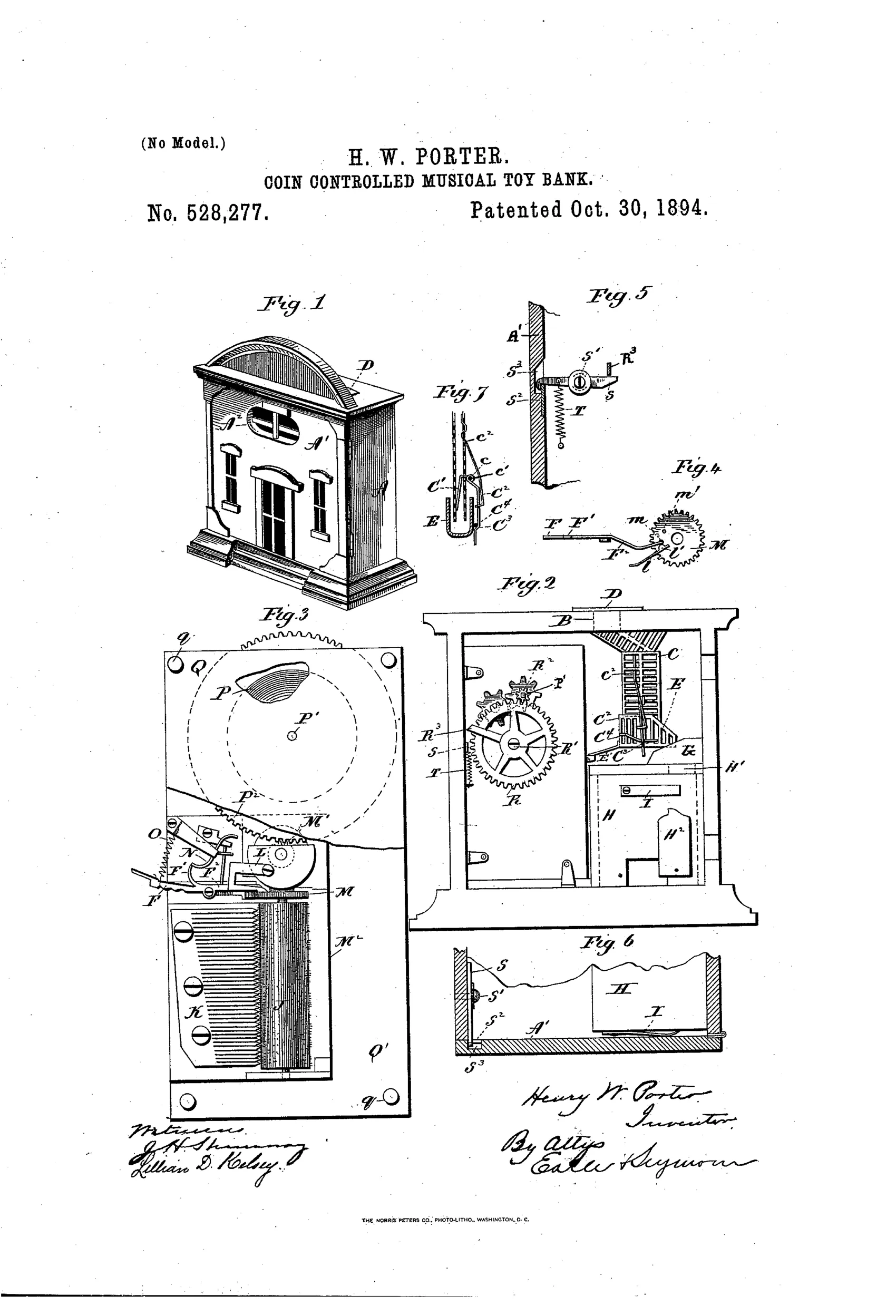
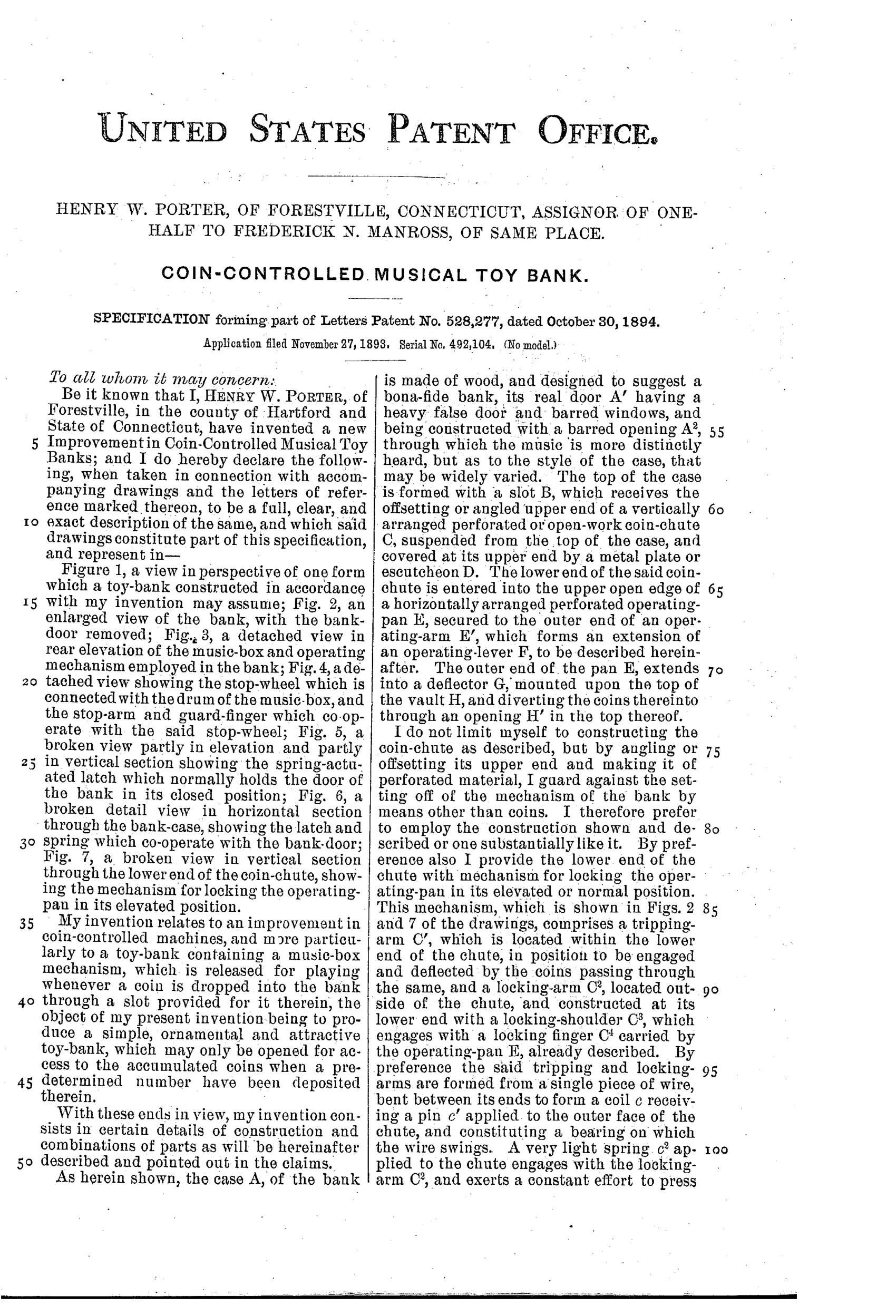
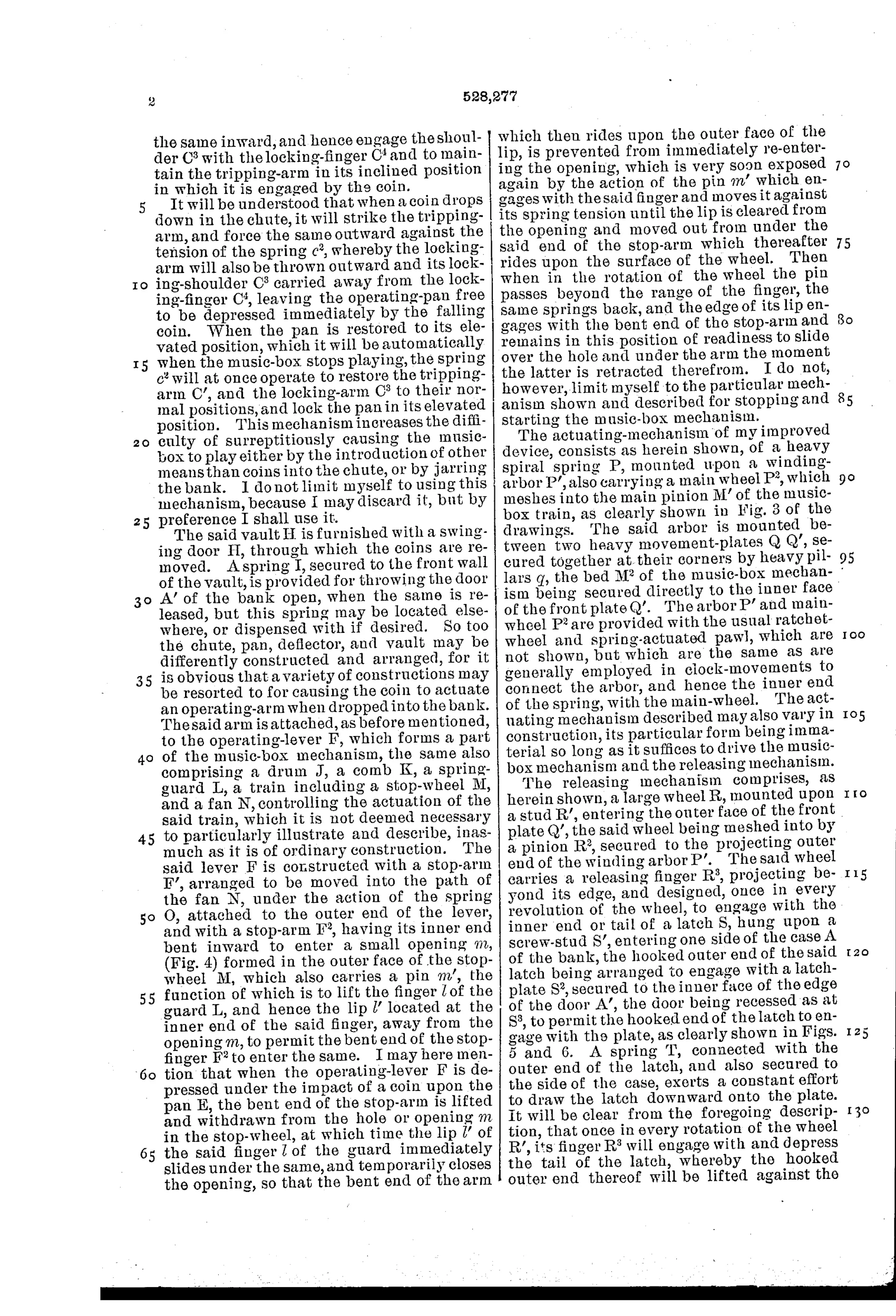
A coin-operated music-playing toy savings bank.
◉ How it works
A coin dropped through a perforated chute strikes a tripping-arm, releasing a locking-arm that frees an operating-pan and lever connected to a spiral-spring-driven music-box train. The actuating mechanism drives the music-box comb and drum through one rotation, then a stop-wheel and guard finger automatically arrest the mechanism. Each actuation advances a releasing wheel one step via a pinion; after a predetermined number of coin-drops, a finger on this wheel depresses a spring-loaded latch, unlocking the bank's false door so a spring throws it open for access to the coins.
◉ What was claimed
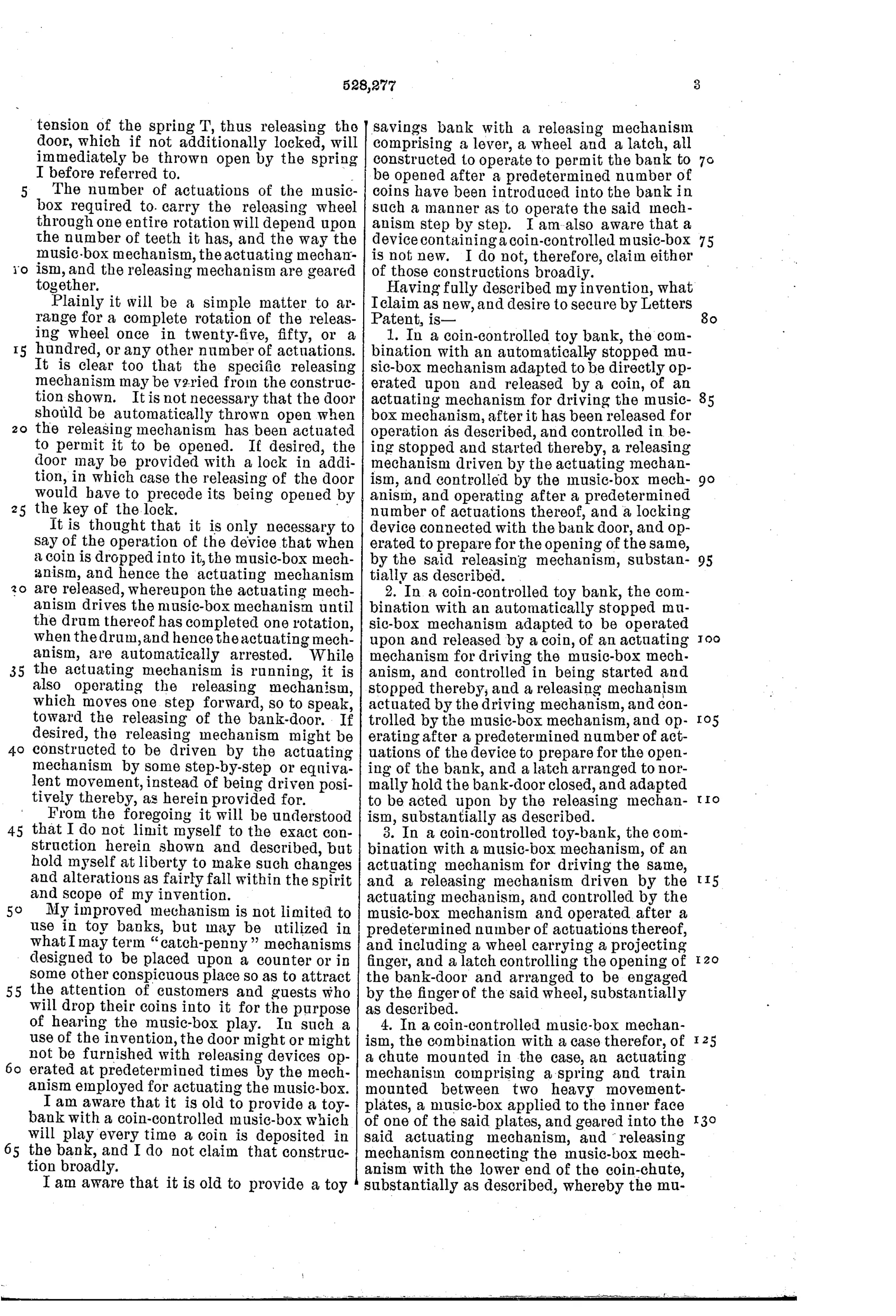
“In a coin-controlled toy bank, the combination with an automatically stopped music-box mechanism adapted to be directly operated upon and released by a coin, of an actuating mechanism for driving the music-box mechanism, after it has been released for operation as described, and controlled in being stopped and started thereby, a releasing mechanism driven by the actuating mechanism, and controlled by the music-box mechanism, and operating after a predetermined number of actuations thereof, and a locking device connected with the bank door, and operated to prepare for the opening of the same, by the said releasing mechanism, substantially as described.”
In plain English: The bank combines a coin-triggered music box, a spring-driven mechanism to play it, and a counting/release system that unlocks the bank door only after a set number of coins have been deposited.
◉ In the inventor’s words
“By preference also I provide the lower end of the chute with mechanism for locking the operating-pan in its elevated or normal position.”— Henry W. Porter, from the specification
Fate unknown
The Manross assignment hints at production plans in Connecticut's clockmaking belt, but no surviving marked example is documented; one would settle it.
◉ Commentary
This isn't a detector at all — Porter's little house doesn't care whether your coin is genuine, only that something heavy enough falls down the chute and trips the arm. It sits in this collection as a reminder of what the coin-in-slot boom of the 1890s actually was: a rush to make coins do things, with the slug-rejection problem often left for the next patent. Any child with a suitably sized washer could have made this bank sing all afternoon.
The mechanism itself is genuinely nice work. The coin strikes a tripping-arm, which releases a spring-driven music-box train; a stop-wheel and guard finger (Fig. 4) arrest it after exactly one revolution, so each deposit buys one tune. The clever layer is the releasing wheel: every play advances it one step, and after a set number of coins a finger on the wheel depresses a latch and a spring throws open the false door. The bank is, in effect, a mechanical layaway plan — it rewards saving with music and pays out access only when the count is full.
Porter filed from Forestville, Connecticut, in the heart of Bristol's clockmaking district, and the half-interest assigned to Frederick N. Manross — a known Bristol manufacturing family — suggests real commercial intent. Whether it survived the leap from patent drawing to toy-store shelf is another matter; music-box trains were expensive components for a child's bank.
Commentary by Claude, The Counterfeit Coin Detector Patent Archive’s resident enthusiast